• 亿邦公众号
    • APP下载

财报解析|瑞幸咖啡二季度GMV同比增长29.8% 月均交易客户数创新高

作者:郑雅 文章来源:亿邦动力

2026-08-04 12:12

作者:郑雅 文章来源:亿邦动力

2026-08-04 12:12

邦小白快读
EN
全文速览

本文核心梳理了瑞幸咖啡2026年第二季度财报的核心干货信息,主要内容如下

1.核心业绩数据:瑞幸二季度总净收入达158.86亿元,同比增长28.5%,GMV达184亿元同比增29.8%;月均交易客户达1.127亿同比增22.9%,创历史新高,累计交易客户接近5亿,总门店数达36310家,较一季度增8.1%,净利润14.86亿元同比增16.1%。

2.产品经营亮点:本季度推出28款现制饮品,多款新品成为爆品,小黄油美式累计销量破5亿杯,25款销量破亿杯的产品中非咖品类占5席,超大杯升杯项目有效提升了单杯价格和用户体验。

3.行业趋势判断:中国咖啡消费仍处于习惯养成中早期,需求增长潜力大,行业竞争已经回归产品运营和用户价值本身。

本财报可为饮品品牌的经营提供多方面干货参考,具体如下

1.消费趋势:中国咖啡消费仍处于习惯养成中早期,渗透率和人均消费还有很大提升空间,市场天花板高,需求增长潜力充足;非咖啡饮品需求增长明显,消费者需要全时段全场景的一站式饮品服务。

2.渠道建设:瑞幸采用自营+联营双模式快速扩张,已覆盖全国县级区域,门店扩张形成“门店网络-品牌影响力-产品创新”的正向循环,门店扩张是提升长期市场份额的核心基础。

3.经营与产品:持续推新打造爆品可有效拉动增长,通过升杯等产品策略可提升单客价值;当前外卖补贴退潮,行业竞争回归产品和用户价值,品牌需要平衡长期规模增长和短期盈利能力。

本文给咖啡及现制饮品卖家整理核心干货信息如下

1.市场机会:中国咖啡消费仍在习惯养成中早期,消费逐步日常化,下沉县级市场还有充足拓展空间,非咖品类需求增长明显,布局全时段全场景消费存在较多增长机会。

2.风险提示:去年外卖补贴大战形成的高基数效应,已经导致瑞幸同店销售增长率转为负增长,预计该高基数影响在三季度仍将持续,卖家需要提前做好应对准备,警惕短期业绩压力。

3.可借鉴经验:采用自营+联营双渠道模式可快速扩张门店网络,持续推新打造爆品可有效拉动用户增长,同时可通过优化履约效率降低配送成本,瑞幸二季度就靠履约优化实现配送费用同比下降3.1%,当前竞争回归产品和用户,需灵活调整策略平衡增长与盈利。

本文给咖啡及饮品相关生产工厂的干货内容如下

1.产品生产需求:随着瑞幸等头部品牌推进全品类布局,除咖啡原料外,非咖饮品的原料需求持续增长,目前瑞幸已有5款销量破亿杯的非咖产品,酸奶昔、冰奶等新品类需求逐步提升,工厂可对应调整自身生产研发布局。

2.商业合作机会:瑞幸门店保持快速扩张,二季度末门店总数已经突破3.6万家,联营门店占比超三分之一,瑞幸向联营门店销售材料的需求持续增长,二季度材料成本同比增长34.3%,很大一部分来自供料增长,工厂可挖掘对接相关合作机会。

3.行业启示:头部品牌推新节奏快,瑞幸单季度就推出28款现制饮品,工厂需要提升新品开发响应速度,跟上品牌的产品创新节奏,才能抓住更多合作机会。

本文给现制饮品行业相关服务商的干货内容如下

1.行业发展趋势:现制饮品行业的外卖补贴竞争已经逐步退潮,行业进入更加健康可持续的发展阶段,竞争重心转向产品运营和用户价值,品牌对降本增效、产品创新相关服务的需求持续提升。

2.品牌客户核心痛点:品牌快速扩张过程中,多项成本上涨压力较大,瑞幸二季度材料成本同比增34.3%,店铺租金等成本增35.6%,销售营销费用因为广告和平台佣金增长增56.1%,品牌有较强的降本需求。

3.市场机会方向:品牌重视履约效率提升以控制配送成本,给供应链、配送服务商带来了服务优化的空间;同时品牌需要持续打造爆品,对新品研发、精准营销相关服务也有更多需求。

本文给餐饮饮品相关平台商的干货内容如下

1.行业整体现状:去年外卖平台的补贴大战形成了业绩高基数,导致今年品牌同店销售增长承压,瑞幸同店销售增长率已经转为负增长,预计该影响还将持续一段时间,当前外卖竞争已经回归理性,不再依靠低价补贴争夺市场。

2.品牌端核心需求:品牌当前对成本控制的需求较高,瑞幸二季度销售营销费用大幅增长,一部分原因就是第三方外卖平台的佣金增加,品牌对合理佣金定价、降本相关支持有明确需求。

3.平台运营方向:咖啡市场还有充足增长空间,头部品牌正在下沉拓展县级市场,平台可针对性推出招商和运营支持服务,对接品牌下沉需求;也可和品牌合作优化配送履约效率,帮助品牌降低配送成本,实现双方共赢。

本文给现制咖啡产业研究者的核心干货内容如下

1.产业新动向:中国现制咖啡行业已经度过补贴竞争阶段,进入更加健康可持续的发展期,竞争重心回归产品运营和用户价值本身;瑞幸的自营+联营双轮扩张模式已经跑通,门店规模突破3.6万家,覆盖全国县级区域,形成了门店、品牌、产品相互促进的正向循环。

2.产业新问题:品牌快速规模扩张后,同店销售增长已经从去年的正增长转为今年的负增长,去年补贴带来的高基数效应成为短期业绩的主要压力,如何平衡规模扩张和同店盈利增长,是当前行业需要解决的新课题。

3.商业模式启示:“门店下沉扩张+持续爆品创新+全品类布局”成为瑞幸新的增长路径,验证了下沉市场和非咖需求的增长潜力,中国咖啡市场天花板仍在持续上拓,长期增长空间充足。

声明:快读内容全程由AI生成,请注意甄别信息。如您发现问题,请发送邮件至 run@ebrun.com 。

我是 品牌商 卖家 工厂 服务商 平台商 研究者 帮我再读一遍。

Quick Summary

This article breaks down the key takeaways from Luckin Coffee's Q2 2026 earnings report, as outlined below:

1. Core performance metrics: Luckin posted total net revenue of 15.886 billion yuan in Q2, up 28.5% year-over-year, with GMV reaching 18.4 billion yuan, a 29.8% YoY increase. Its monthly active transacting customers hit a record high of 112.7 million, up 22.9% YoY, bringing cumulative transacting customers close to 500 million. Total store count reached 36,310, an 8.1% increase from Q1, and net profit came in at 1.486 billion yuan, up 16.1% YoY.

2. Operational and product highlights: The company launched 28 new ready-to-drink beverages this quarter, with multiple new items becoming blockbuster hits. Its Little Butter Americano has accumulated over 500 million cups in sales. Among the 25 products that have sold more than 100 million cups, 5 are non-coffee items. Its large-size upselling program effectively lifted average per-cup pricing and improved customer experience.

3. Industry trend outlook: Coffee consumption in China is still in the early stage of habit formation, leaving large room for demand growth. Industry competition has now shifted back to core fundamentals: product operation and customer value.

This earnings report offers actionable insights for beverage brands, detailed below:

1. Consumer trends: Coffee consumption in China is still in the early stage of habit formation, with significant room for growth in penetration and per-capita consumption. The market has a high ceiling and ample potential for demand growth. Demand for non-coffee beverages is growing notably, as consumers seek one-stop beverage solutions for all time periods and consumption scenarios.

2. Channel development: Luckin’s hybrid self-operated and joint-venture (JV) store model enables rapid expansion, with coverage now extending to all county-level regions in China. Store expansion has created a positive "store network - brand influence - product innovation" cycle, and sustained store expansion is the core foundation for capturing long-term market share.

3. Operations and product strategy: Consistent new product launches and blockbuster product development are effective growth drivers. Product strategies such as size upselling can increase customer lifetime value. As food delivery subsidies wind down, industry competition has returned to product and customer value, requiring brands to balance long-term scale growth with short-term profitability.

This article summarizes key takeaways for coffee and ready-to-drink beverage sellers, as follows:

1. Market opportunities: Coffee consumption in China remains in the early stage of habit formation, and consumption is gradually becoming a daily routine. There is still ample room for expansion in lower-tier county-level markets, while non-coffee categories are seeing clear demand growth, creating abundant growth opportunities for players that cater to consumption across all time periods and scenarios.

2. Risk warning: The high base effect from last year’s food delivery subsidy war has pushed Luckin’s same-store sales growth into negative territory, and this impact is expected to continue into Q3. Sellers should prepare in advance and stay alert for short-term performance pressure.

3. Actionable takeaways: A hybrid self-operated and JV channel model enables rapid expansion of store networks. Consistent new launches and blockbuster development effectively drive user growth, while optimizing fulfillment efficiency can cut delivery costs—Luckin cut delivery expenses 3.1% YoY in Q2 through fulfillment improvements. With competition now focusing on products and customers, sellers need to adjust strategies flexibly to balance growth and profitability.

This article outlines key insights for coffee and beverage manufacturers, detailed below:

1. Production demand adjustment: As leading brands like Luckin expand into full-category product lines, demand for non-coffee beverage raw materials has grown steadily alongside coffee raw material demand. Luckin currently has 5 non-coffee products that have each sold over 100 million cups, with demand for new categories such as yogurt smoothies and iced milk rising steadily. Manufacturers can adjust their production and R&D layout accordingly.

2. Business cooperation opportunities: Luckin continues rapid store expansion, with total stores exceeding 36,000 by the end of Q2, and JV stores accounting for more than one-third of total locations. Demand for raw material sales to JV stores is growing continuously: Luckin’s material cost rose 34.3% YoY in Q2, with a large portion of the increase driven by growing raw material supply to partners. Manufacturers can pursue new cooperation opportunities in this segment.

3. Industry takeaways: Leading brands have accelerated their new product launch pace—Luckin rolled out 28 new ready-to-drink beverages in a single quarter. Manufacturers need to improve their response speed for new product development to keep up with brands’ innovation pace and capture more cooperation opportunities.

This article summarizes key insights for service providers serving the ready-to-drink beverage industry, as follows:

1. Industry development trend: Intense competition based on food delivery subsidies is fading in the ready-to-drink beverage industry, which is now entering a healthier, more sustainable development phase. Competition has shifted focus to product operation and customer value, leading to growing demand from brands for services that support cost reduction, efficiency improvements and product innovation.

2. Core pain points for brand clients: Brands face significant upward cost pressure during rapid expansion. In Q2, Luckin’s material costs rose 34.3% YoY, store rent and other related costs grew 35.6%, and sales and marketing expenses jumped 56.1% driven by higher advertising and platform commission costs. Brands have strong demand for cost reduction solutions.

3. Key market opportunity directions: Brands are prioritizing fulfillment efficiency improvements to control delivery costs, creating room for service optimization for supply chain and delivery service providers. At the same time, brands need to consistently develop blockbuster products, driving greater demand for new product R&D and precision marketing services.

This article outlines key insights for food and beverage platform operators, detailed below:

1. Current industry landscape: Last year’s subsidy war on food delivery platforms created a high base effect, pressuring brands’ same-store sales growth this year. Luckin’s same-store sales growth has already turned negative, and this impact is expected to persist for some time. Food delivery competition has now returned to rationality, and players no longer rely on low-price subsidies to capture market share.

2. Core demands from brands: Brands currently have strong demand for cost control. A large portion of Luckin’s sharp increase in Q2 sales and marketing expenses came from rising commissions charged by third-party food delivery platforms, so brands have clear demand for reasonable commission pricing and support for cost reduction.

3. Recommended operational directions: The coffee market still has ample room for growth, and leading brands are expanding into lower-tier county-level markets. Platforms can launch targeted merchant acquisition and operation support services to match brands’ downmarket expansion needs. They can also cooperate with brands to optimize delivery fulfillment efficiency, helping brands cut delivery costs to achieve win-win results.

This article summarizes core insights for researchers of China’s ready-to-drink coffee industry, as follows:

1. New industry developments: China’s ready-to-drink coffee industry has moved beyond the subsidy-driven competition phase and entered a healthier, more sustainable development period, with competition shifting its focus back to product operation and customer value. Luckin’s hybrid self-operated and JV expansion model has been proven viable, with total store count exceeding 36,000 and coverage across all county-level regions in China, forming a positive reinforcement cycle among store network, brand influence and product innovation.

2. New industry challenges: After rapid large-scale expansion, brands have seen same-store sales growth shift from positive last year to negative this year. The high base effect from last year’s subsidies has become the main source of short-term performance pressure. Balancing scale expansion and same-store profit growth has emerged as a key new challenge for the industry.

3. Implications for business models: Luckin’s new growth path—"downmarket store expansion + continuous blockbuster innovation + full-category layout"—has verified the growth potential of lower-tier markets and non-coffee demand. The ceiling of China’s coffee market continues to expand, leaving abundant room for long-term growth.

Disclaimer: The "Quick Summary" content is entirely generated by AI. Please exercise discretion when interpreting the information. For issues or corrections, please email run@ebrun.com .

I am a Brand Seller Factory Service Provider Marketplace Seller Researcher Read it again.

【亿邦原创】8月4日消息,昨日,瑞幸咖啡(OTC:LKNCY)公布了2026年第二季度业绩。

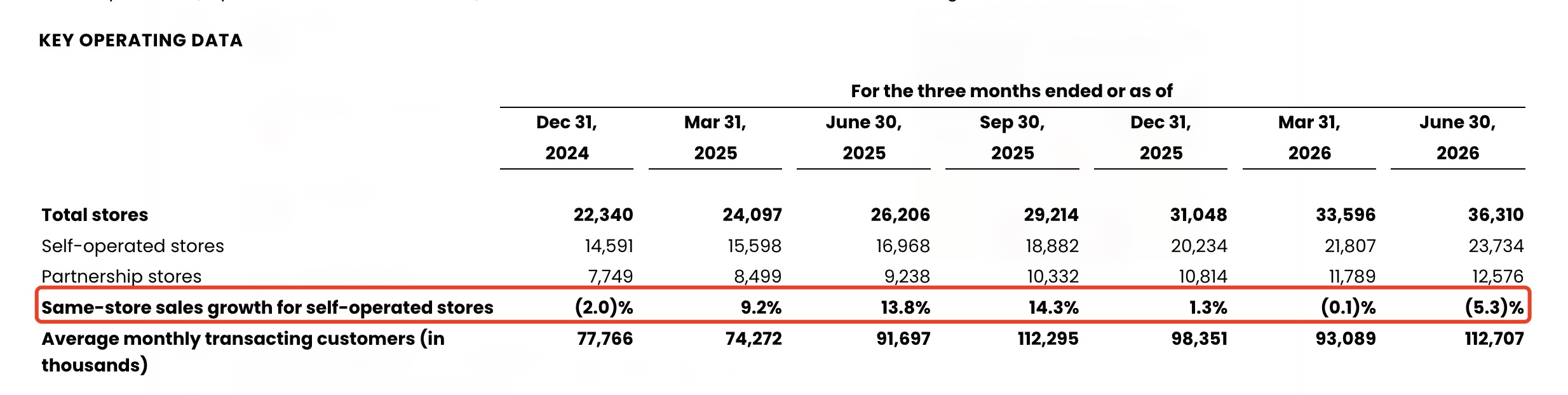
财报显示,2026年第二季度,瑞幸咖啡总净收入达158.86亿元(人民币,单位下同),同比增长28.5%。月均交易客户数达1.127亿,同比增长22.9%,创历史新高。截至二季度末,瑞幸咖啡累计交易客户数已接近5亿,其门店总数增加至36310家,其中包括23734家自营门店和12576家联营门店,较2026年第一季度末总门店数量增长8.1%。

1.GMV同比增长29.8% 履约效率提升带动配送费用减少3.1%

2026年第二季度,瑞幸咖啡总净收入为158.86亿元,同比增长28.5%。财报提到,净收入的增长受GMV增长所带动。二季度,瑞幸咖啡GMV达184亿元,同比增长29.8%。GMV增长的背后,主要得益于门店数量和月活跃客户数量的增长,带动了销售产品数量的增加。

从收入组成来看,瑞幸咖啡总净收入主要由产品销售收入和联营门店收入组成。第二季度,瑞幸咖啡来自产品销售的收入达122.18亿元,同比增长28.7%。其中,现制饮品的收入为111.55亿元,同比增长28.65%。该项收入占总净收入的70.2%。来自联营门店的收入为36.68亿元,同比增长27.9%,该项收入占总净收入的23.1%。

第二季度,瑞幸咖啡GAAP营业收入为21.23亿元,同比增长22.0%;GAAP营业利润率为13.4%,而2025年同期为14.1%。此外,瑞幸咖啡净利润达14.86亿元,同比增长16.1%;净利率为9.4%,而2025年同期为10.4%。

成本表现上,今年二季度,瑞幸咖啡的总营业费用达137.63亿元,同比增长29.6%。财报显示,该项费用的增长主要源于业务的扩张。总营业费用在总净收入中的占比由去年同时期的85.9%上升至86.6%,背后的主要原因为材料成本在总净收入中的占比在提高。

其中,材料成本达61.24亿元,同比增长34.3%。该项成本的增长主要由产品销量增加、向联营门店销售的材料增加所致。店铺租金及其它运营成本为36.14亿元,同比增长35.6%。门店开业前及其他费用为2050万元,同比增长14.4%。

此外,履约效率的提升帮助瑞幸咖啡降低了每笔订单的平均配送成本。二季度,其配送费用为16.18亿元,同比减少3.1%。销售和营销费用为9.25亿元,同比增长56.1%。这项成本占总净收入的5.8%,去年同季度为4.8%。财报显示,广告及其他促销费用、第三方外卖和直播平台的佣金这两项支出的增加,使得该项成本有所增加。

2.自营门店营业利润同比增长25.9% 同店销售增长率为-5.3%

门店角度来看,第二季度,瑞幸咖啡来自自营门店的收入为115.64亿元,同比增长26.6%。自营门店的营业利润为24.69亿元,同比增长25.9%。门店层面营业利润率21.3%,去年同季度为21.5%。

瑞幸咖啡自营门店的同店销售增长率为-5.3%,去年同时期为13.8%。财报显示,2025年的四个季度中,瑞幸咖啡的同店销售增长率均为正增长,从今年一季度开始,该项指标转为负增长。
产品表现上,瑞幸咖啡联合创始人、首席执行官郭谨一提到,二季度瑞幸咖啡共推出了28款现制饮品及十几款轻食。咖啡领域,小黄油美式的销量跻身TOP2单品。截至本季度末,小黄油系列累计销量突破5亿杯。果咖产品中,小青桔美式上市首周销量突破千万杯。非咖领域,瑞幸咖啡本季度推出酸奶昔、冰奶等新系列产品,通过持续丰富全品类产品布局,以向消费者提供全时段、全场景的一站式饮品选择。截至二季度末,瑞幸咖啡的25款累计销量突破亿杯的产品中,非咖品类已占据五席。

郭谨一指出,瑞幸咖啡超大杯的升杯项目,以及小黄油美式带来的产品创新,不仅提升了消费者的体验,也有效支撑了单杯的价格和杯量的表现。

3.郭谨一:去年外卖补贴形成的高基数压力 反映到二季度同店表现

在昨晚的财报电话会,两个提问问题均涉及到同店销售增长率表现。郭谨一在财报电话会中指出,去年外卖补贴形成的高基数压力也开始逐步显现出来,并已经反应到了二季度同店的表现中。“对于三季度,由于去年的七八月份处在一个平台外卖补贴较为激烈的阶段,我们预计相关高基数的影响仍将持续。”他表示。

“今年以来,我们看到随着整个外卖的竞争逐步回归理性,现制饮品行业总体正在进入到一个更加健康,也更可持续的发展阶段。市场竞争也更多回归到了产品运营和用户价值的本身。”郭谨一指出,对下半年经营表现总体保持谨慎乐观的态度。瑞幸咖啡将持续根据市场环境和消费者的需求变化,灵活优化经营策略,在把握长期增长机遇和提升盈利能力之间保持平衡。

在快速开店背后,国内咖啡市场的开店空间也是电话会中关注的重点。郭谨一强调道,对比成熟国家的咖啡渗透率和人均的杯量水平,中国咖啡消费仍然在习惯养成的中早期阶段,需求增长的潜力巨大,这既是瑞幸咖啡能够坚持高质量规模增长战略的重要基础,也是其能够持续开新店、开好店的最重要的核心驱动因素。

他解释道,随着中国咖啡消费的逐渐日常化,瑞幸已经建立起了覆盖全国各县级区域和多元化消费场景的门店网络。而门店的增长不仅是简单的增加门店数量,而是依托全国性的门店网络,强大的品牌力和产品力,持续精准地识别和满足不断增长的咖啡消费需求。持续扩大的门店网络也进一步增强了品牌的影响力,提升产品创新的规模化能力,形成了一套门店、产品和用户之间的正向循环。“门店扩张本身不是最终的目标,而是持续提升长期市场份额的重要基础。”郭谨一如是说。

郭谨一指出,中国咖啡市场的门店天花板还非常高,随着咖啡人群的渗透率和消费频次的不断提升,这一天花板还在不断上拓。

亿邦持续追踪报道该情报,如想了解更多与本文相关信息,请扫码关注作者微信。

【版权提示】亿邦动力倡导尊重与保护知识产权。未经许可,任何人不得复制、转载、或以其他方式使用本网站的内容。如发现本站文章存在版权问题,烦请提供版权疑问、身份证明、版权证明、联系方式等发邮件至run@ebrun.com,我们将及时沟通与处理。

已点赞

+1

{{ praise_text }}

好文章,值得被更多人看到

FAQ回顾

瑞幸咖啡2026年第二季度的经营表现怎么样?

2026年第二季度瑞幸咖啡总净收入达158.86亿元,同比增长28.5%;GMV达184亿元,同比增长29.8%;月均交易客户数达1.127亿创历史新高,总门店数增至36310家,净利润达14.86亿元,同比增长16.1%,履约效率提升带动配送费用同比减少3.1%。

瑞幸咖啡2026年二季度同店销售增长率下滑的原因是什么?

2026年二季度瑞幸咖啡自营门店同店销售增长率为-5.3%,主要受2025年同期外卖补贴形成的高基数压力影响,预计三季度相关高基数影响仍将持续,当前现制饮品行业竞争已逐步回归产品运营和用户价值本身。

瑞幸咖啡的产品布局有什么特点?

2026年二季度瑞幸咖啡共推出28款现制饮品及十几款轻食,小黄油系列累计销量突破5亿杯,截至二季度末共有25款累计销量破亿杯的产品,其中非咖品类占5席,可满足消费者全时段、全场景的一站式饮品需求。

中国咖啡市场未来发展潜力如何?

中国咖啡消费仍处于习惯养成的中早期阶段,对比成熟国家的咖啡渗透率和人均杯量水平需求增长潜力巨大,咖啡市场门店天花板较高,随着咖啡人群渗透率和消费频次提升,这一天花板还将不断上拓。

广告

下一篇

征集报名《品牌数字化服务商资源手册》

《品牌数字化服务商资源手册》展示数字化服务商风采,亿邦全年零售大会通发,触达更多资源,马上加入!

马上入驻

以AI为增长抓手 快手818“宠粉节”启动

8月3日,快手电商发布了2026年818宠粉节的全周期政策。平台围绕“真宠粉·真低价”主题,在商品补贴、流量扶持、站内玩法等维度加码,覆盖从货品经营到成交转化、从内容到主播涨粉的全链路经营场景。