• 亿邦公众号
    • APP下载

星海图新一代具身基础模型G0.7:开箱即用 无需后训练

作者:亿邦动力 文章来源:亿邦动力

2026-11-24 18:14

作者:亿邦动力 文章来源:亿邦动力

2026-11-24 18:14

邦小白快读

EN
全文速览

总:G0.7的核心看点是开箱即用、无需任务后训练,把机器人上岗门槛压到约5小时示教数据。

1.看一遍就会:上下文窗口最长5分钟,人类示范放入上下文即可理解任务规则;按示范分拣、寻杯藏物等任务分布内成功率93.3%,引入上下文学习中期训练后平均达96.7%。

2.实时响应:部署时跳过视频生成直接解码动作,单张RTX 5090上每个动作块仅60ms,约为IDM模式的1/7.6,并支持实时分块,六块轨迹耗时从8.7秒降到6.2秒。

3.快速落地:真机零样本抓放成功率R1 Pro为48%、R1 Lite为54%;折叠快递箱成功率90%、制作柠檬茶100%、工具使用平均进度82%。

总:星海图以整机加智能战略发布G0.7,技术卖点集中在开箱即用、低数据成本和真实节拍响应,可支撑品牌专业形象与多场景产品叙事。

1.产品研发:WAM架构升级长上下文、动作生成效率、模型泛化能力,并通过大规模机器人与人类第一视角视频预训练。

2.品牌传播:5分钟上下文示范即指令、60ms动作生成、约5小时数据后训练上岗,都是可传播的量化卖点。

3.场景与渠道:面向电商零售、工业制造、快递物流、能源电力,案例有折叠快递箱90%、柠檬茶100%、工具使用82%,利于展示跨场景能力。

4.用户价值:非标、小批量、多品种场景可借上下文学习降低重新训练成本。

总:文章对卖家更像机会提示:具身智能开始进入可部署、可上岗阶段,电商零售、制造、物流、能源等场景值得关注。

1.机会:G0.7开箱即用,无需任务后训练已有基础能力;每项长程任务约5小时示教数据后训练即可上岗,降低新场景尝试门槛。

2.需求变化:非标、小批量、多品种任务变化多的场景,可借5分钟长上下文和上下文学习,把人类示范变为指令,减少逐任务重训。

3.效率卖点:60ms动作块生成加实时分块,适合分拣、上下料、组装等高节拍作业,六块轨迹耗时6.2秒。

4.风险提示:长程任务持续数分钟、涉及柔性物体与液体,误差易累积,稳定性要求高;分布外成功率有差异,按示范分拣66.7%、寻杯藏物80.0%,部署前需评估。

总:G0.7对工厂的价值在于把机器人从单动作演示推向真实产线节拍,重点看实时响应、换线成本和长程稳定性。

1.生产需求:分拣、上下料、组装等高节拍作业怕延迟和停顿,G0.7单动作块60ms,Fast加RTC六块轨迹6.2秒,支持连续作业。

2.换线部署:预训练后无需任务后训练已有开箱即用能力,每项长程任务约5小时示教数据后训练即可上岗,利于小批量多品种快速切换。

3.设计启示:长上下文最长5分钟可追踪被遮挡物体状态,上下文学习让示范即指令;人类视频预训练把R1 Lite零样本成功率从12%提升到54%。

4.案例与风险:折叠快递箱成功率90%、进度95%,柠檬茶100%,工具使用20次示范平均进度82%;但长程任务误差累积、柔性物体和液体操作对稳定性要求高。

总:G0.7给出面向具身智能落地的新技术方案,服务商可围绕低数据成本部署、实时执行和分层系统集成寻找服务机会。

1.客户痛点:真实任务要记住历史、理解物体状态变化;新规则多、数据成本高;产线要求及时响应和连续作业。

2.解决方案:5分钟长上下文加上下文学习,人类示范放入上下文即可完成任务;Fast-WAM部署跳过视频生成,60ms生成动作块;RTC让下一段动作边执行边计算。

3.落地服务:预训练后开箱即用,约5小时示教数据后训练可上岗;人类第一视角视频提升泛化,R1 Lite零样本54%,上下文学习分布外73%。

4.集成方向:System 2约1Hz对接GPT等通用多模态模型,System 1为10到50Hz端侧动作模型,System 0为50到100Hz以上反射层,分层协同可做行业方案。

总:文章虽未直接讲平台做法,但G0.7的开箱即用、快速后训练和多场景能力,对平台招商、运营效率和风向规避有参考。

1.平台需求:电商零售、工业制造、快递物流、能源电力等场景需要能快速上岗的机器人;非标小批量多品种要求低数据成本适应。

2.招商与合作:星海图推进整机加智能战略,G0.7可作平台引入具身智能能力的抓手;约5小时数据后训练即可上岗,降低生态伙伴接入门槛。

3.运营管理:分拣、上下料、组装等高节拍作业可用60ms动作生成和实时分块提升连续性;长上下文和上下文学习可减少逐任务定制。

4.风向规避:长程任务误差累积、柔性物体与液体操作稳定性要求高;分布外成功率存在差异,按示范分拣66.7%、寻杯藏物80.0%,平台需按场景评估后再推广。

总:G0.7展示具身基础模型的新动向:从单帧反应转向长上下文与上下文学习,从高延迟视频预测转向Fast-WAM直接解码动作,并用少量后训练落地。

1.技术架构:WAM架构升级长上下文、动作生成效率、泛化能力;上下文窗口最长5分钟,滑动窗口缓存历史观测;Fast-WAM训练用视频预测、部署跳过视频生成;原生支持RTC。

2.系统分层:System 2约1Hz任务理解规划并可对接GPT等通用多模态模型,System 1为10到50Hz端侧动作模型,System 0为50到100Hz以上反射层。

3.数据与泛化:机器人遥操作加人类第一视角视频预训练,三级语言标注;人类视频使R1 Lite零样本成功率由12%升至54%,上下文学习分布外由50%升至73%。

4.任务结果与新问题:分布内93.3%,分布外80.0%和66.7%,引入中期训练后96.7%和93.3%;约5小时示教后训练可上岗;长程任务误差累积与稳定性仍是新问题。

声明:快读内容全程由AI生成,请注意甄别信息。如您发现问题,请发送邮件至 run@ebrun.com 。

我是 品牌商 卖家 工厂 服务商 平台商 研究者 帮我再读一遍。

Quick Summary

Summary: The key highlight of G0.7 is out-of-the-box readiness with no task-specific post-training, lowering the barrier to robot deployment to roughly 5 hours of demonstration data.

1. Learn from a single viewing: The context window extends up to 5 minutes, so human demonstrations can be placed in context to convey task rules; success rates are 93.3% within distribution on tasks such as sorting by demonstration and cup-finding and object-hiding, rising to 96.7% on average after mid-training with in-context learning.

2. Real-time response: At deployment, it skips video generation and directly decodes actions, taking only 60 ms per action chunk on a single RTX 5090—about 1/7.6 of the IDM mode—and supports real-time chunking, reducing the time for six trajectory chunks from 8.7 seconds to 6.2 seconds.

3. Rapid deployment: Zero-shot pick-and-place success rates on real robots are 48% for R1 Pro and 54% for R1 Lite; success rates are 90% for folding express boxes, 100% for making lemon tea, and an average progress rate of 82% for tool use.

Summary: Galaxea has released G0.7 under its robot-plus-intelligence strategy, with technical selling points centered on out-of-the-box readiness, low data cost, and real-world cycle-time responsiveness, supporting a professional brand image and multi-scenario product narrative.

1. Product R&D: The WAM architecture upgrades long-context capabilities, action-generation efficiency, and model generalization, and is pretrained on large-scale robot and human first-person video data.

2. Brand communication: A 5-minute contextual demonstration as instruction, 60 ms action generation, and deployment after roughly 5 hours of post-training data are all quantifiable, communicable selling points.

3. Scenarios and channels: Targeting e-commerce retail, industrial manufacturing, express logistics, and energy and power, with cases including 90% success for folding express boxes, 100% for lemon tea, and 82% for tool use, helping demonstrate cross-scenario capabilities.

4. User value: In non-standard, low-volume, high-mix scenarios, in-context learning can reduce retraining costs.

Summary: For sellers, the article reads more like an opportunity signal: embodied intelligence is beginning to reach a deployable, job-ready stage, and scenarios such as e-commerce retail, manufacturing, logistics, and energy deserve attention.

1. Opportunity: G0.7 is out-of-the-box ready and already has baseline capabilities without task-specific post-training; each long-horizon task can be brought online after about 5 hours of demonstration-data post-training, lowering the threshold for trying new scenarios.

2. Demand shifts: In non-standard, low-volume, high-mix scenarios with frequent task changes, the 5-minute long context and in-context learning can turn human demonstrations into instructions, reducing per-task retraining.

3. Efficiency selling points: 60 ms action-chunk generation plus real-time chunking suits high-tempo operations such as sorting, loading/unloading, and assembly; six trajectory chunks take 6.2 seconds.

4. Risk note: Long-horizon tasks lasting several minutes and involving flexible objects and liquids are prone to error accumulation and require high stability; out-of-distribution success rates vary—66.7% for sorting by demonstration and 80.0% for cup-finding and object-hiding—so scenarios need evaluation before deployment.

Summary: The value of G0.7 for factories lies in moving robots from single-action demonstrations toward real production-line cycle times, with the focus on real-time response, line-change cost, and long-horizon stability.

1. Production requirements: High-tempo operations such as sorting, loading/unloading, and assembly are sensitive to latency and pauses; G0.7 generates one action chunk in 60 ms, and Fast plus RTC takes 6.2 seconds for six trajectory chunks, supporting continuous operation.

2. Line-change deployment: After pretraining, it is out-of-the-box ready without task-specific post-training; each long-horizon task can be deployed after about 5 hours of demonstration-data post-training, facilitating rapid switching across low-volume, high-mix production.

3. Design implications: A context window of up to 5 minutes can track the state of occluded objects, and in-context learning makes demonstrations act as instructions; human-video pretraining raises R1 Lite zero-shot success from 12% to 54%.

4. Cases and risks: Success rates are 90% for folding express boxes, with 95% progress; 100% for lemon tea; and 82% average progress for tool use with 20 demonstrations. However, long-horizon tasks accumulate errors, and flexible-object and liquid manipulation demand high stability.

Summary: G0.7 offers a new technical approach for embodied intelligence deployment, and service providers can identify opportunities around low-data-cost deployment, real-time execution, and layered system integration.

1. Customer pain points: Real-world tasks require memory of history and understanding of object-state changes; many new rules and high data costs; production lines demand timely response and continuous operation.

2. Solution: A 5-minute long context plus in-context learning lets human demonstrations placed in context complete tasks; Fast-WAM deployment skips video generation and generates action chunks in 60 ms; RTC enables the next action segment to be computed while the current one executes.

3. Deployment services: After pretraining, the model is out-of-the-box ready and can be deployed after about 5 hours of demonstration-data post-training; human first-person video improves generalization, with R1 Lite zero-shot at 54% and in-context learning out-of-distribution at 73%.

4. Integration direction: System 2 runs at about 1 Hz and can connect to general multimodal models such as GPT; System 1 is an on-device action model at 10–50 Hz; System 0 is a reflex layer at 50–100 Hz or above; layered collaboration can support industry solutions.

Summary: Although the article does not directly discuss platform practices, G0.7's out-of-the-box readiness, rapid post-training, and multi-scenario capabilities offer references for platform merchant recruitment, operational efficiency, and trend-risk avoidance.

1. Platform needs: Scenarios such as e-commerce retail, industrial manufacturing, express logistics, and energy and power need robots that can quickly take up jobs; non-standard, low-volume, high-mix tasks require low-data-cost adaptation.

2. Merchant recruitment and partnerships: Galaxea is advancing its robot-plus-intelligence strategy, and G0.7 can serve as a lever for platforms to introduce embodied intelligence capabilities; deployment after about 5 hours of data post-training lowers the entry barrier for ecosystem partners.

3. Operational management: High-tempo operations such as sorting, loading/unloading, and assembly can use 60 ms action generation and real-time chunking to improve continuity; long context and in-context learning can reduce per-task customization.

4. Trend-risk avoidance: Long-horizon tasks accumulate errors, and flexible-object and liquid manipulation demand high stability; out-of-distribution success rates vary—66.7% for sorting by demonstration and 80.0% for cup-finding and object-hiding—so platforms should evaluate by scenario before broader rollout.

Summary: G0.7 reveals new directions for embodied foundation models: moving from single-frame reaction to long context and in-context learning, from high-latency video prediction to Fast-WAM direct action decoding, and achieving deployment with limited post-training.

1. Technical architecture: The WAM architecture upgrades long-context capability, action-generation efficiency, and generalization; the context window extends up to 5 minutes, with a sliding-window cache of historical observations; Fast-WAM uses video prediction during training and skips video generation at deployment; it natively supports RTC.

2. System layering: System 2 runs at about 1 Hz for task understanding and planning and can connect to general multimodal models such as GPT; System 1 is an on-device action model at 10–50 Hz; System 0 is a reflex layer at 50–100 Hz or above.

3. Data and generalization: Pretraining uses robot teleoperation plus human first-person video with three-level language annotation; human video raises R1 Lite zero-shot success from 12% to 54%, and in-context learning raises out-of-distribution performance from 50% to 73%.

4. Task results and new questions: In-distribution success is 93.3%, and out-of-distribution is 80.0% and 66.7%; after introducing mid-training, these rise to 96.7% and 93.3%; about 5 hours of demonstration post-training is enough for deployment; error accumulation and stability in long-horizon tasks remain open questions.

Disclaimer: The "Quick Summary" content is entirely generated by AI. Please exercise discretion when interpreting the information. For issues or corrections, please email run@ebrun.com .

I am a Brand Seller Factory Service Provider Marketplace Seller Researcher Read it again.

【亿邦原创】机器人能否真正走进生产现场,不仅取决于能不能完成一个动作,更取决于能否从示范中快速学会任务、在真实节拍下及时响应,并以很低的数据成本适应新场景。

11月24日,星海图正式发布新一代具身基础模型G0.7。基于WAM(World Action Model)架构,G0.7围绕长上下文理解、动作生成效率、模型泛化能力进行升级,并通过大规模机器人与人类第一视角视频预训练,进一步提升机器人在真实环境中的任务执行能力,推动具身智能从单一技能执行,向更复杂、更灵活的真实生产任务迈进。

看一遍就会:5分钟长上下文,示范即指令

真实任务往往不是孤立的单步动作。机器人需要记住此前发生了什么,理解物体状态的变化,并据此决定下一步怎么做。

G0.7将上下文窗口从单帧观测扩展至最长5分钟的历史信息。模型以滑动窗口缓存历史真实观测,即使物体被暂时遮挡,也能结合历史信息持续追踪其状态。长上下文预训练从一开始就内置于模型中,下游任务无需修改架构即可继承这一能力。

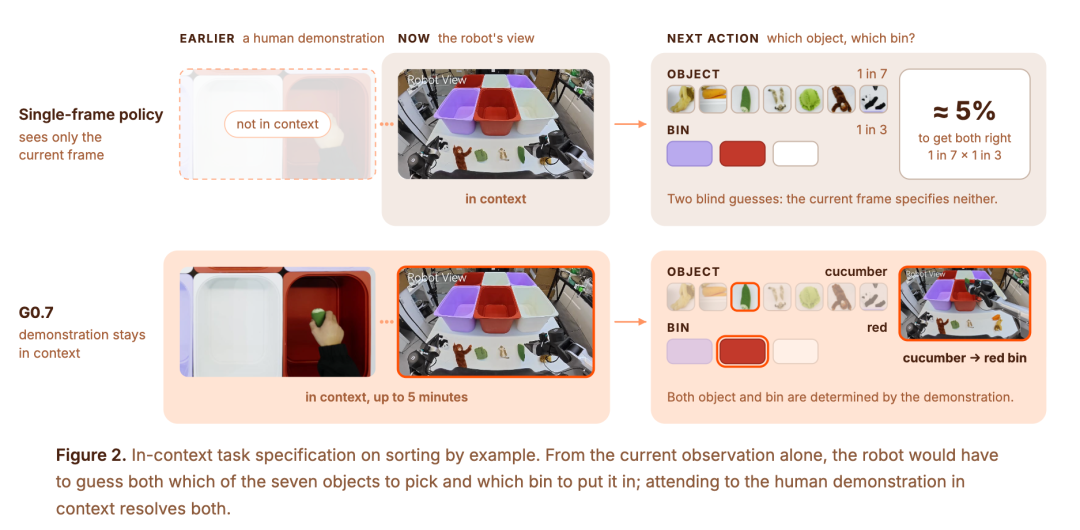
长上下文还带来另一项能力:上下文学习(In-context Learning)。将一段人类操作视频放入上下文,G0.7即可通过观察示范理解任务规则,并自主完成后续操作,无需针对每种新规则重新训练。

以“按示范分拣”为例:桌面上有7个物体和3个箱子,仅凭当前画面,机器人无从判断先取哪一个、放入哪一个箱子,随机猜测的命中率约为5%。当人类示范保留在上下文中,取哪个物体、放入哪个箱子便都有了依据。在寻杯藏物任务中,机器人则需要在杯子被打乱后,持续追踪被遮挡物体的位置。
图片

这意味着,机器人不再只能依据当前画面作出反应,还可以结合一段时间内的观察和人类示范理解任务规则。这对于非标、小批量、多品种等任务变化较多的场景具有重要意义。

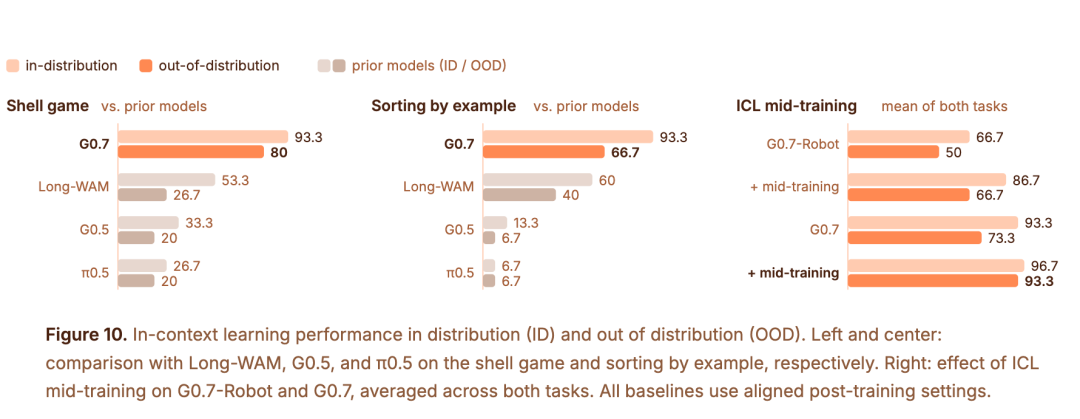
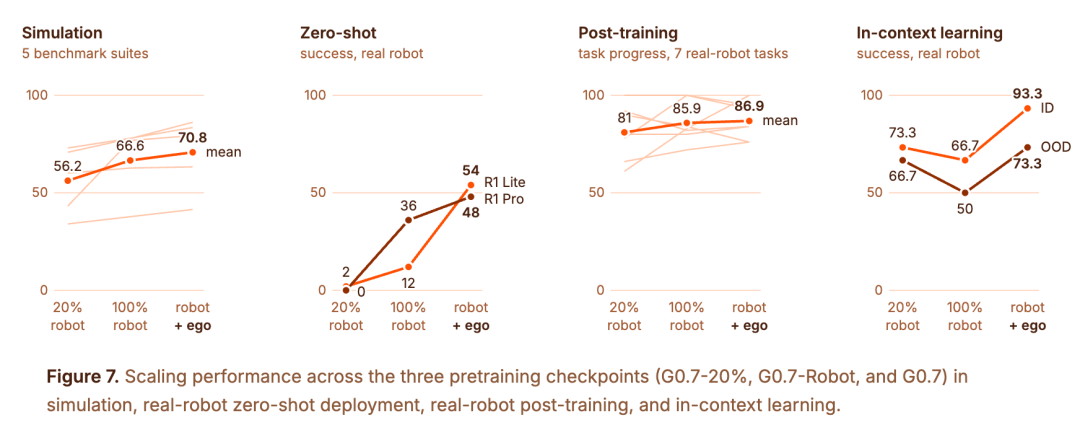
在这两项真机任务上,G0.7的成功率在分布内均达到93.3%,在分布外分别为80.0%(寻杯藏物)和66.7%(按示范分拣);引入上下文学习中期训练后,两项任务的平均成功率进一步达到96.7%(分布内)/93.3%(分布外),明显领先同类模型。
图片

实时响应:60ms生成动作,连续流畅作业

在真实生产场景中,机器人需要对环境变化及时作出响应。动作生成速度不仅影响任务效率,也直接关系到操作过程是否连贯。

传统世界模型通常需要先预测未来视频画面,再根据预测结果生成动作,推理延迟较高。G0.7延续星海图Fast-WAM路线:视频预测主要用于训练阶段,部署时跳过视频生成,直接解码动作。

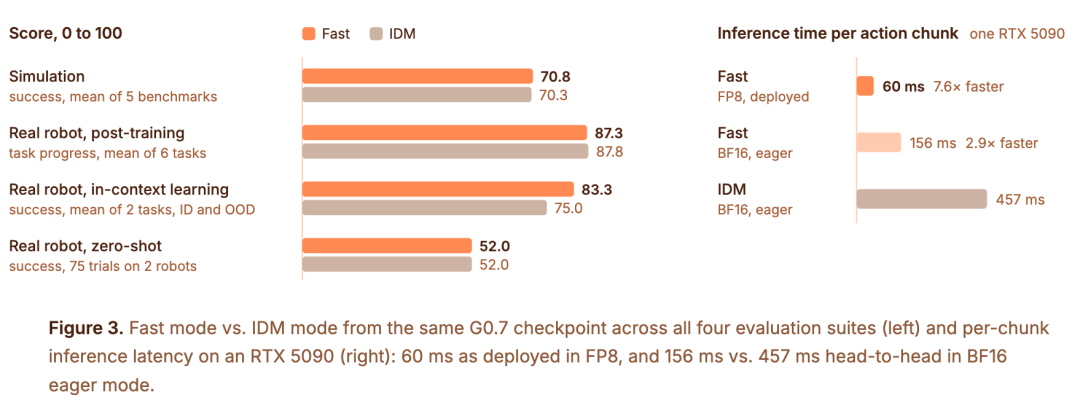
在单张RTX 5090上,部署配置(FP8)下每个动作块仅需60ms,约为先生成未来画面的IDM模式的1/7.6。

同一模型下,Fast模式与IDM模式表现相当:真机后训练任务进度87.3%vs 87.8%,真机零样本成功次数同为39/75。
原生支持实时分块(RTC):机器人执行当前动作块的同时,下一段动作已在计算,块与块之间不再停顿。同一条六块轨迹上,IDM模式耗时8.7秒,Fast模式6.9秒,Fast+RTC 6.2秒。
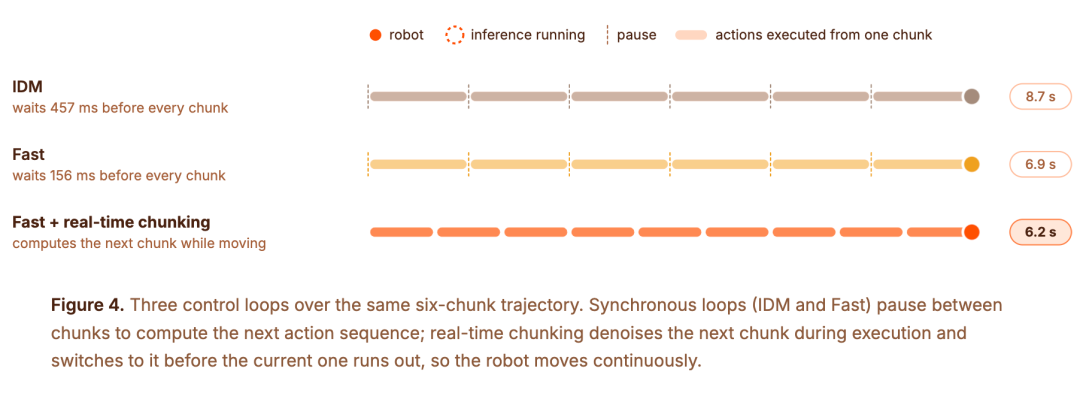
在分拣、上下料、组装等高节拍作业中,响应延迟与动作停顿都会直接拉低节拍。60ms的动作生成加上实时分块,让机器人既能及时响应,又能连续作业,更贴近真实产线的节拍要求。

快速落地:约5小时数据,即可上岗

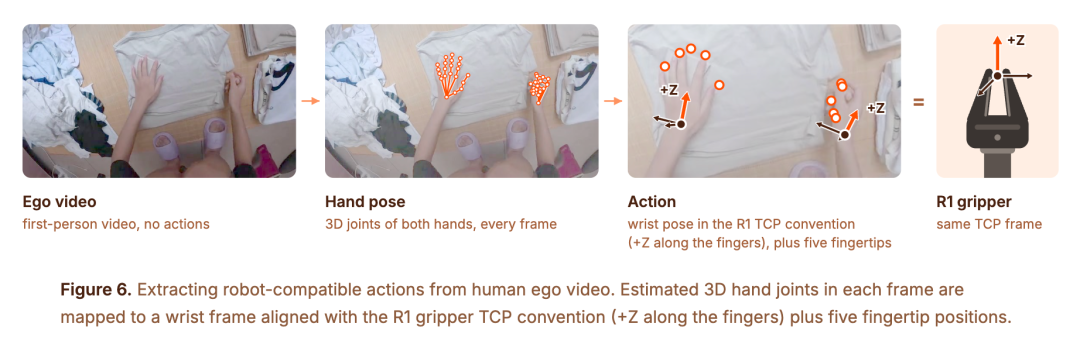
G0.7通过多源数据预训练,结合机器人遥操作数据与人类操作视频,学习不同场景下的操作方式。星海图通过视觉定位与手部姿态估计,将人类视频转化为与机器人兼容的动作表示,并采用三级语言标注,使模型既能理解多阶段的长程目标,也能执行短时动作指令。

预训练之后,G0.7无需任何任务后训练,就已具备开箱即用的基础能力:在真机抓放评测中,G0.7在R1 Pro上完成25次测试,成功率为48%;在R1 Lite上完成50次测试,成功率为54%。人类第一视角数据对泛化的提升尤为明显:相比仅使用机器人数据预训练的版本,R1 Lite上的零样本成功率由12% 提升至54%,上下文学习的分布外成功率由50% 提升至73%。
图片

图片

在此基础上,每项长程生产任务仅需约5小时示教数据进行后训练,即可上岗。这些长程任务持续数分钟,涉及柔性物体与液体,误差容易逐步累积,对稳定性要求很高。

折叠快递箱:将平铺的纸板折成箱体、装入物品并完成封箱,成功率90%,任务进度95%。

制作柠檬茶:开瓶、倒液、搅拌、递交,成功率、任务进度均为100%。

工具使用:每种工具仅20次示范,铲取食物、夹取碗具、扫码、清扫桌面四项任务平均任务进度82%。

从预训练打下的通用基础,到约5小时后训练即可上岗,G0.7降低了机器人适应新任务的门槛,也为不同场景下的快速部署提供了技术基础。

具身基础模型关键在System 1的执行与部署

以GPT为代表的通用多模态模型,正在不断提升机器人对视觉信息、空间关系和复杂任务的理解与推理能力。但理解指令并不等于完成真实世界中的操作,还需要解决动作生成的实时性、执行的精准性,以及与机器人本体的协同。

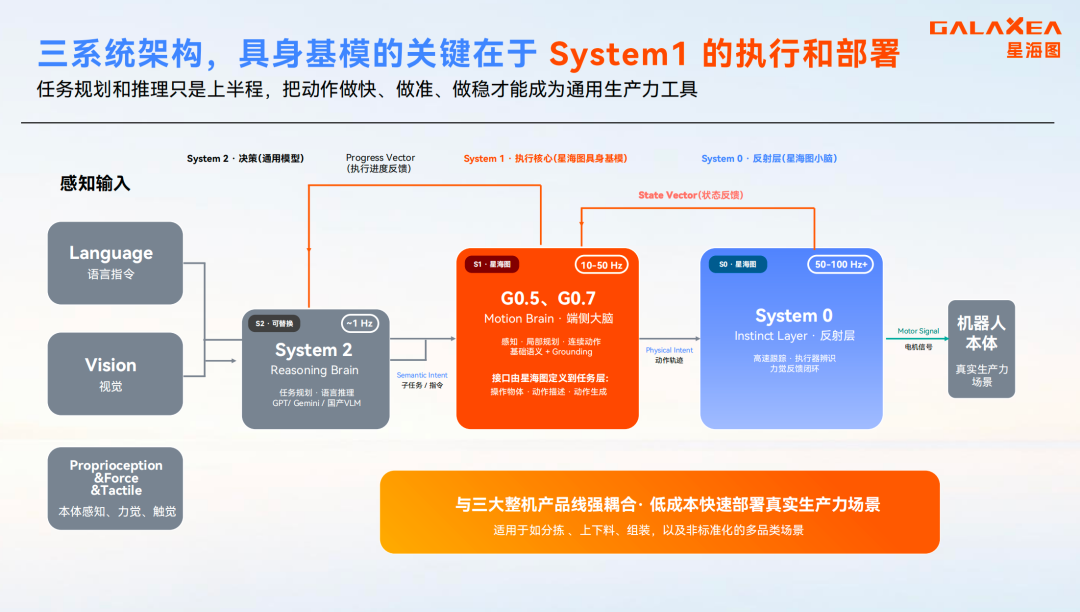
为此,星海图构建了System 2、System 1、System 0三系统架构,不同层级对应不同的时间尺度:

System 2(约1Hz):任务理解、规划与指令衔接,可对接GPT等通用多模态模型,并随其能力提升持续升级。

System 1(10–50Hz):端侧动作模型,G0.7所在层,负责感知、局部规划与连续动作生成,单个动作块生成仅需60ms。

System 0(50–100Hz以上):与机器人本体强相关的反射层,负责高速跟踪与力觉反馈闭环,将动作轨迹转化为电机控制信号。

通过三个系统的分层协同,高层智能与端侧实时执行相结合,让机器人不仅能理解任务,更能以满足真实作业节拍的方式完成任务。
图片

G0.7的发布,是星海图持续推进"整机+智能"战略的重要进展。未来,星海图将持续推动具身基础模型与机器人整机协同发展,面向电商零售、工业制造、快递物流、能源电力等领域,推动具身智能转化为真实生产力,赋能千行万业。

本文首发于 亿邦动力 官方网站

【版权提示】亿邦动力倡导尊重与保护知识产权。未经许可,任何人不得复制、转载、或以其他方式使用本网站的内容。如发现本站文章存在版权问题,烦请提供版权疑问、身份证明、版权证明、联系方式等发邮件至run@ebrun.com,我们将及时沟通与处理。

已点赞

+1

{{ praise_text }}

好文章,值得被更多人看到

FAQ回顾

星海图G0.7具身基础模型是什么?

星海图G0.7是2026年11月24日发布的新一代具身基础模型,基于WAM(World Action Model)架构,面向真实生产任务,具备最长5分钟长上下文理解、单动作块60ms生成和预训练后开箱即用的基础能力。

G0.7如何实现开箱即用并降低新任务部署成本?

G0.7通过大规模机器人与人类第一视角视频预训练,并把人类视频转化为机器人兼容动作表示。预训练后无需任何任务后训练即具备基础能力;真机抓放中R1 Pro成功率48%、R1 Lite为54%。每项长程生产任务约5小时示教数据后训练即可上岗。

G0.7的60ms动作生成对高节拍作业有什么意义?

在单张RTX 5090、FP8部署下,G0.7每个动作块仅需60ms,约为先预测未来画面的IDM模式的1/7.6。它原生支持实时分块(RTC),执行当前动作块时同步计算下一段,减少停顿,更适合分拣、上下料、组装等高节拍作业。

G0.7的Fast-WAM模式与传统IDM模式相比有什么优势?

传统世界模型通常先预测未来视频再生成动作,推理延迟较高。G0.7的Fast-WAM将视频预测主要用于训练,部署时跳过视频生成直接解码动作;单动作块60ms,约为IDM的1/7.6。同一模型下两者表现相当,六块轨迹耗时Fast模式6.9秒、IDM模式8.7秒。

星海图G0.7适合哪些场景和行业?

G0.7面向非标、小批量、多品种等任务变化较多的场景,适合分拣、上下料、组装等高节拍作业,并计划赋能电商零售、工业制造、快递物流、能源电力等领域;折叠快递箱、制作柠檬茶和工具使用等长程任务已验证其部署能力。

广告

下一篇

豆包Personal Agent“小豆”对外公测 可购物可代打电话

字节跳动旗下豆包体系的个人智能体产品“小豆”开启邀请制公测,定位是“懂你,还能主动帮你办事”,采用独立App形态,覆盖信息查询、日程待办、生活服务、购物售后、健康提醒、办公辅助六类场景。