• 亿邦公众号
    • APP下载

网易智企入选全球企业级AI Agent优秀厂商图谱三席 解读AI落地“铁三角”

作者:龚作仁 文章来源:Laborer

2026-11-10 17:17

作者:龚作仁 文章来源:Laborer

2026-11-10 17:17

邦小白快读

EN
全文速览

核心干货是AI落地铁三角:场景选得准、能力接得住、运营扎得深。

1.场景选准:黄山智慧旅游分析约6.5万通历史录音,识别约78%可标准化承接的咨询,优先把高频、规则明确的问题交给AI,复杂事项由人工处理,按项目测算每年有望释放约1500小时人工话务时间。

2.能力接住:企业有文档不等于智能体懂业务知识,需把商品资料、服务规则整理成可检索、可引用的知识;某健康管理品牌让AI做营养解析和信息整理、顾问负责复杂沟通,人效提升40%以上,满意度从58%升至91%。

3.运营扎深:智能体上线像新员工培训,要持续更新知识、做风控评测和复盘;宠物用品企业从夜间售前答疑切入,AI承接约70%售前咨询,未增人力夜间订单明显提升。

品牌商可重点看AI如何嵌入服务营销一体化,改善售前承接、导购匹配和客户体验。

1.用户行为观察:游客问法多样,固定话术难应对;零售顾客会用“颜色浅一点”等口语表达需求,智能体需把自然语言对应到商品颜色、相近款式和实时库存;夜间高频售前答疑也是真实需求。

2.渠道与营销:宠物用品企业同时经营线下门店和线上即时零售,从夜间高频售前切入,AI承接约70%售前咨询,未增加人力夜间订单明显提升,说明AI可作为全渠道服务补充。

3.产品与服务信息治理:云商Mind Studio知识底座承担知识接入、解析和治理,把分散资料转成智能体可检索、可引用的知识;品牌需重视商品资料和服务规则整理。

4.效果衡量:健康管理品牌AI承担标准化工作、顾问负责复杂沟通,人效提升40%以上,满意度从58%提升至91%,品牌可用人效和满意度检验AI价值。

卖家可把企业级AI Agent视为服务营销降本增效和夜间增量的机会,但落地成败不只在模型算力。

1.市场机会:网易智企·云商入选全球企业级AI Agent优秀厂商图谱客服、知识库、零售三席,服务营销一体化有实践;宠物用品企业用AI承接约70%售前咨询,未增人力夜间订单明显提升。

2.可学习点:先选高频、规则明确的场景,黄山智慧旅游从约6.5万通录音中识别约78%可标准化咨询,按项目测算每年释放约1500小时人工话务;复杂事项保留人工兜底。

3.风险提示:企业有文档不等于Agent懂业务,口语化需求要对应商品、库存和服务规则;上线后还要持续更新知识、风控、评测和复盘。

4.合作方式:可关注云商Mind Studio知识底座、Trace追踪和AI体检等交付能力,把知识治理与运营纳入合作。

工厂可从文中看到产品信息标准化、服务数字化和电商零售协同的切入点。

1.产品信息要可调用:零售导购中顾客说“颜色浅一点”,智能体需把口语需求对应到商品颜色、相近款式和实时库存;这意味着产品属性、款式和库存信息需要整理成可检索、可引用的知识。

2.商业机会:宠物用品企业同时经营线下门店和线上即时零售,从夜间高频售前答疑切入,AI承接约70%售前咨询,未增人力夜间订单明显提升;景区热线也把高频规则明确咨询交给AI。

3.数字化启示:企业有文档不等于Agent懂业务,需用Mind Studio知识底座做知识接入、解析和治理;上线后还要用Trace追踪知识引用、工具调用和任务过程,用AI体检检查准确性、稳定性和业务效果。

4.推进节奏:先选高频、规则明确场景,复杂问题由人工兜底,再持续更新知识、做风控评测和复盘。

服务商可关注企业级AI Agent从模型算力竞争转向业务落地,客户痛点集中在场景筛选、知识治理和持续运营。

1.行业趋势:第一新声智库发布2026年Q3全球企业级AI Agent优秀厂商图谱,网易智企·云商入选客服、知识库、零售三席。

2.客户痛点:游客问法多样,固定话术的传统语音机器人难灵活应对;企业有大量文档不等于Agent掌握业务,口语化需求难对应商品、库存和服务规则;商品政策与用户问法还会变化。

3.解决方案:按铁三角推进,场景选得准、能力接得住、运营扎得深;Mind Studio知识底座做知识接入、解析和治理;Trace追踪知识引用、工具调用和任务处理,AI体检检查准确性、稳定性和业务效果,并把风控、评测、运营纳入交付。

4.效果证明:黄山项目识别约78%可标准化咨询,测算每年释放约1500小时;健康管理品牌人效提升40%以上、满意度58%升至91%;宠物用品企业AI承接约70%售前咨询。

平台商可从企业级AI Agent图谱和落地案例中,观察平台需求、运营抓手和风险规避方向。

1.需求判断:企业级AI Agent优秀厂商图谱覆盖客服、知识库、零售等场景,网易智企·云商入选三席,说明服务营销一体化与知识库能力是市场关注点;企业真正卡点在业务落地,不在模型与算力。

2.运营管理:平台可围绕场景筛选、知识接入治理、持续评测复盘设计能力;Mind Studio知识底座负责知识接入、解析和治理,Trace追踪知识引用、工具调用和任务处理,AI体检检查准确性、稳定性与业务效果,风控和运营应纳入交付。

3.风向规避:Agent上线像新员工培训,商品、政策、用户问法变化后要持续更新知识;复杂事项要保留人工兜底,避免只堆文档、只做一次性上线。

4.价值验证:黄山项目以高峰接通率、呼损率等业务结果检验;零售以夜间订单和售前承接检验,平台运营也应回到日常业务结果。

研究者可关注企业级AI Agent的产业新动向、落地瓶颈与可验证的商业化路径。

1.产业新动向:第一新声智库发布2026年Q3全球企业级AI Agent优秀厂商图谱,网易智企·云商入选客服、知识库、零售三席,显示服务营销一体化是企业级Agent的重要实践方向。

2.新问题:模型与算力并非核心瓶颈,卡点在企业业务落地;企业有文档不等于Agent掌握业务知识,口语化需求需映射商品、相近款式和实时库存;上线后知识随商品、政策、用户问法变化,需持续运营。

3.分析框架:云商提出铁三角,场景选得准、能力接得住、运营扎得深;案例数据包括约6.5万通录音、约78%可标准化场景、每年约1500小时、人效提升40%以上、满意度58%至91%、AI承接约70%售前咨询。

4.商业与管理启示:把知识治理、Trace追踪、AI体检、风控评测纳入交付,并以高峰接通率、呼损率、夜间订单等业务结果检验价值。

声明:快读内容全程由AI生成,请注意甄别信息。如您发现问题,请发送邮件至 run@ebrun.com 。

我是 品牌商 卖家 工厂 服务商 平台商 研究者 帮我再读一遍。

Quick Summary

The core takeaway is the three pillars of AI implementation: choosing the right use cases, building the capabilities to handle them, and embedding operations deeply.

1. Right use cases: Huangshan Smart Tourism analyzed about 65,000 historical call recordings and identified around 78% of inquiries that can be handled through standardized responses. It prioritizes high-frequency, rule-based questions for AI while routing complex matters to human agents; project estimates suggest this could free up about 1,500 hours of human call-center time per year.

2. Capabilities: Having documents does not mean an agent understands business knowledge. Companies need to organize product materials and service rules into searchable, citable knowledge. A health-management brand let AI handle nutrition analysis and information organization while advisors handled complex communication, lifting productivity per employee by more than 40% and raising satisfaction from 58% to 91%.

3. Operations: Launching an agent is like training a new employee; knowledge must be continuously updated, with risk control, evaluation, and review. A pet-products company started with nighttime pre-sales Q&A; AI now handles about 70% of pre-sales inquiries, and nighttime orders rose notably without adding staff.

Brands should focus on how AI can be embedded into service-marketing integration to improve pre-sales handling, shopping-guide matching, and customer experience.

1. Observing user behavior: Tourists ask questions in varied ways, making fixed scripts inadequate; retail customers may express needs colloquially, such as “a lighter color,” and the agent must map natural language to product colors, similar styles, and real-time inventory. High-frequency nighttime pre-sales Q&A is also a real demand.

2. Channels and marketing: A pet-products company operates both offline stores and online instant retail. Starting with high-frequency nighttime pre-sales, AI handles about 70% of pre-sales inquiries; nighttime orders rose notably without adding staff, showing AI can supplement omnichannel service.

3. Product and service information governance: Yunshang Mind Studio’s knowledge foundation handles knowledge ingestion, parsing, and governance, turning scattered materials into searchable, citable knowledge for agents. Brands need to prioritize organizing product materials and service rules.

4. Measuring results: A health-management brand uses AI for standardized work and advisors for complex communication, improving productivity by more than 40% and raising satisfaction from 58% to 91%. Brands can use productivity and satisfaction to test AI's value.

Sellers can view enterprise-grade AI agents as an opportunity to reduce service-marketing costs, improve efficiency, and capture nighttime incremental revenue, but success depends on more than models and compute.

1. Market opportunity: NetEase Smart Enterprise · Yunshang was selected in three categories—customer service, knowledge base, and retail—in a global enterprise-grade AI Agent leading-vendor landscape, with practical experience in service-marketing integration. A pet-products company uses AI to handle about 70% of pre-sales inquiries, with nighttime orders rising notably without added staff.

2. Lessons: Start with high-frequency, rule-based use cases. Huangshan Smart Tourism identified about 78% of standardized inquiries from roughly 65,000 recordings, and project estimates suggest freeing up about 1,500 hours of human call-center time per year; complex matters should retain human fallback.

3. Risk warning: Having documents does not mean the agent understands the business. Colloquial needs must map to products, inventory, and service rules. After launch, knowledge must be continuously updated, with risk control, evaluation, and review.

4. Cooperation approach: Consider delivery capabilities such as the Yunshang Mind Studio knowledge foundation, Trace tracking, and AI health checks, and include knowledge governance and operations in partnerships.

Factories can identify entry points in product-information standardization, service digitization, and e-commerce/retail collaboration.

1. Product information must be callable: In retail shopping guidance, when a customer says “a lighter color,” the agent needs to map the colloquial request to product colors, similar styles, and real-time inventory. This means product attributes, styles, and inventory information must be organized into searchable, citable knowledge.

2. Business opportunities: A pet-products company operates both offline stores and online instant retail. Starting with high-frequency nighttime pre-sales Q&A, AI handles about 70% of pre-sales inquiries, and nighttime orders rose notably without adding staff. Scenic-area hotlines are also handing high-frequency, rule-based inquiries to AI.

3. Digitalization implications: Having documents does not mean the agent understands the business. Companies need the Mind Studio knowledge foundation for knowledge ingestion, parsing, and governance. After launch, Trace should track knowledge citations, tool calls, and task processes, while AI health checks verify accuracy, stability, and business results.

4. Rollout pace: Start with high-frequency, rule-based scenarios, keep human fallback for complex issues, and then continuously update knowledge, conduct risk-control evaluations, and review.

Service providers should note that enterprise-grade AI agents are shifting from model-and-compute competition to business implementation, with customer pain points concentrated in use-case selection, knowledge governance, and continuous operations.

1. Industry trend: First New Voice Think Tank released the Q3 2026 global enterprise-grade AI Agent leading-vendor landscape, and NetEase Smart Enterprise · Yunshang was selected in three categories: customer service, knowledge base, and retail.

2. Customer pain points: Tourists ask questions in varied ways, and traditional voice bots with fixed scripts struggle to respond flexibly. Having many documents does not mean an agent has mastered the business; colloquial needs are hard to map to products, inventory, and service rules. Product policies and user questions also keep changing.

3. Solutions: Advance along the three pillars—select use cases precisely, build capabilities that can handle them, and embed operations deeply. The Mind Studio knowledge foundation handles knowledge ingestion, parsing, and governance; Trace tracks knowledge citations, tool calls, and task processing; AI health checks verify accuracy, stability, and business results; and risk control, evaluation, and operations should be included in delivery.

4. Proven results: The Huangshan project identified about 78% of standardized inquiries, with an estimated 1,500 hours freed per year; a health-management brand improved productivity by more than 40% and raised satisfaction from 58% to 91%; a pet-products company uses AI to handle about 70% of pre-sales inquiries.

Platform operators can observe platform demand, operational levers, and risk-avoidance directions from the enterprise-grade AI Agent landscape and implementation cases.

1. Demand assessment: The enterprise-grade AI Agent leading-vendor landscape covers customer service, knowledge base, retail, and other scenarios. NetEase Smart Enterprise · Yunshang was selected in three categories, indicating that service-marketing integration and knowledge-base capabilities are market focal points. The real bottleneck for enterprises is business implementation, not models or compute.

2. Operational management: Platforms can design capabilities around use-case selection, knowledge ingestion and governance, and continuous evaluation and review. The Mind Studio knowledge foundation handles knowledge ingestion, parsing, and governance; Trace tracks knowledge citations, tool calls, and task processing; AI health checks verify accuracy, stability, and business results; risk control and operations should be included in delivery.

3. Risk avoidance: Launching an agent is like training a new employee. Knowledge must be continuously updated as products, policies, and user questions change. Complex matters need human fallback; avoid merely piling up documents or doing a one-time launch.

4. Value validation: The Huangshan project validates results through business metrics such as peak connection rate and call-loss rate; retail validates through nighttime orders and pre-sales handling. Platform operations should also return to everyday business results.

Researchers can focus on new industry developments, implementation bottlenecks, and verifiable commercialization paths for enterprise-grade AI agents.

1. New industry developments: First New Voice Think Tank released the Q3 2026 global enterprise-grade AI Agent leading-vendor landscape. NetEase Smart Enterprise · Yunshang was selected in customer service, knowledge base, and retail, showing that service-marketing integration is an important practice direction for enterprise agents.

2. New questions: Models and compute are not the core bottleneck; the bottleneck is business implementation. Having documents does not mean an agent has mastered business knowledge. Colloquial needs must be mapped to products, similar styles, and real-time inventory. After launch, knowledge changes with products, policies, and user questions, requiring continuous operations.

3. Analytical framework: Yunshang proposes the three pillars—select use cases precisely, build capabilities that can handle them, and embed operations deeply. Case data include about 65,000 recordings, around 78% standardized scenarios, about 1,500 hours per year, productivity improvement of more than 40%, satisfaction rising from 58% to 91%, and AI handling about 70% of pre-sales inquiries.

4. Business and management implications: Include knowledge governance, Trace tracking, AI health checks, and risk-control evaluation in delivery, and validate value through business results such as peak connection rate, call-loss rate, and nighttime orders.

Disclaimer: The "Quick Summary" content is entirely generated by AI. Please exercise discretion when interpreting the information. For issues or corrections, please email run@ebrun.com .

I am a Brand Seller Factory Service Provider Marketplace Seller Researcher Read it again.

近日,第一新声智库发布2026年Q3全球企业级AI Agent优秀厂商图谱,网易智企·云商入选客服、知识库、零售三席,展现了云商在服务营销一体化领域的成功实践和积淀。

网易智企副总经理、云商业务负责人肖钰妍介绍:“模型与算力并非核心瓶颈,卡点更多出在企业业务落地环节。”结合客户实践,云商将企业级AI落地归纳为一个“铁三角”——场景要选得准,能力要接得住,运营要扎得深。
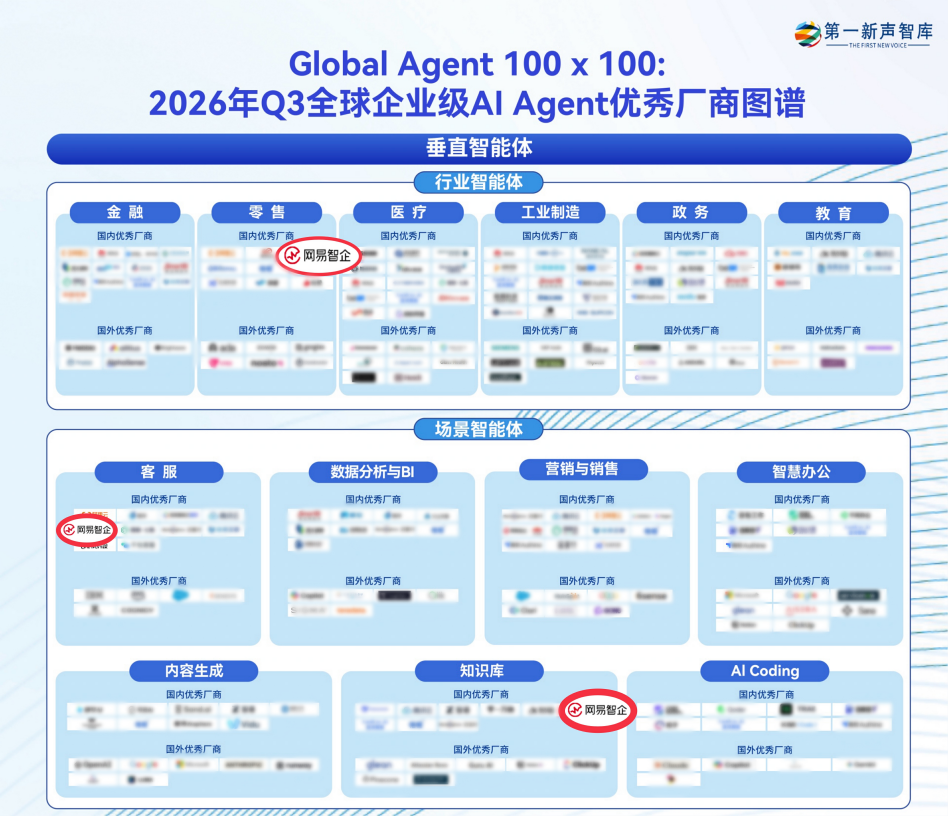
Global Agent 100 x 100:2026年Q3全球企业级AI Agent优秀厂商图谱

场景选得准|从高频需求切入,让AI先解决具体问题

同一条热线既要回答索道运营、门票退改等高频问题,也要处理突发情况和需要协调的游客求助。游客的问法多样,依赖固定话术的传统语音机器人较难灵活应对。

在与黄山智慧旅游的合作中,黄山从历史来电中区分哪些咨询可以按规则处理,哪些事项需要人工判断。该项目分析了约6.5万通历史录音,识别出约78%有望标准化承接的场景,据此优先把高频、规则明确的咨询交给AI,突发和复杂事项由人工处理。

按项目测算,这一分工每年有望释放约1500小时人工话务时间。对景区而言,还可以跟踪高峰接通率和呼损率,看看常见咨询分流后,有多少原本可能漏接的来电得到了回应。对准备出行的游客,及时问清购票和游览安排,有助于确定行程。对已在景区、遇到复杂问题的游客,人工坐席则有更多时间了解情况并协调处理,最终让服务承接与人工分工落到具体场景中。

能力接得住|打通知识与流程,让AI懂业务、有人兜底

企业拥有大量文档,并不意味着Agent已经掌握业务知识。以零售导购为例,理解顾客的自然语言需求之后,还需要把它与具体商品和业务信息对应起来。

顾客想找“颜色浅一点”的衣服,导购凭经验就能挑出几款。智能体则需要将这一类口语化需求与商品颜色、相近款式和实时库存对应起来。企业已有的文档、商品资料和服务规则,经过整理,才能在具体任务中被可靠调用。云商的Mind Studio知识底座承担知识接入、解析和治理,帮助企业把分散资料转化为智能体可检索、可引用的知识。

在某健康管理品牌的实践中,云商让AI承担营养解析、信息整理等标准化工作,由顾问负责复杂沟通和持续关怀。数据表明,该项目人效提升40%以上,客户满意度从58%提升至91%。

运营扎得深|让知识随业务更新,让效果在复盘中改进

云商把智能体上线比作新员工接受上岗培训。随着商品、服务政策和用户问法变化,培训也需要持续进行。为此,云商将风控、评测和运营纳入Agent交付。Trace追踪知识引用、工具调用和任务处理过程,帮助定位问题;AI体检检查准确性、稳定性与业务效果,推动知识、流程持续更新。

零售经营也有类似的运营要求。在与云商的合作中,一家同时经营线下门店和线上即时零售的宠物用品企业从夜间高频售前答疑切入,补充人手有限时的服务。上线后,AI承接约70%的售前咨询,企业在未增加人力的情况下,夜间订单量明显提升。

“AI落地最终一定会回归到企业经营的本质。”肖钰妍说。从景区热线到零售售前,检验AI应用价值的依据就在日常业务中:高峰时段的咨询能否及时得到回应,复杂问题能否顺利交到人工手中,服务能否跟上业务变化。把这些结果持续看清楚,企业就能据此决定下一步把AI用到哪里。

注:文/龚作仁,文章来源:Laborer,本文为作者独立观点,不代表亿邦动力立场。

【版权提示】亿邦动力倡导尊重与保护知识产权。未经许可,任何人不得复制、转载、或以其他方式使用本网站的内容。如发现本站文章存在版权问题,烦请提供版权疑问、身份证明、版权证明、联系方式等发邮件至run@ebrun.com,我们将及时沟通与处理。

已点赞

+1

{{ praise_text }}

好文章,值得被更多人看到

FAQ回顾

企业级AI Agent落地的主要难点是什么?

网易智企副总经理、云商业务负责人肖钰妍认为,模型与算力并非核心瓶颈,企业级AI Agent的卡点更多在业务落地环节。云商据此把AI落地归纳为“铁三角”:场景要选得准、能力要接得住、运营要扎得深,分别对应高频需求切入、知识与流程打通、持续评测和运营。

企业如何选择AI Agent优先落地的业务场景?

可从高频、规则明确的需求切入,把突发和复杂事项留给人工。黄山智慧旅游与云商合作时分析约6.5万通历史录音,识别出约78%有望标准化承接的场景,优先让AI处理高频咨询;按项目测算,这一分工每年有望释放约1500小时人工话务时间,并可跟踪高峰接通率和呼损率。

AI Agent如何把企业文档转化为可用的业务知识?

企业文档多并不等于Agent已掌握业务知识,需要把文档、商品资料和服务规则经过接入、解析、治理,转成可检索、可引用的知识,并与商品和业务流程对应。云商的Mind Studio知识底座承担这一工作;在某健康管理品牌实践中,AI承担营养解析、信息整理,顾问负责复杂沟通和持续关怀,项目人效提升40%以上,客户满意度从58%提升至91%。

企业级AI Agent上线后为什么需要持续运营?

因为商品、服务政策和用户问法会变化,智能体上线后仍需像新员工一样持续培训。云商将风控、评测和运营纳入Agent交付:Trace追踪知识引用、工具调用和任务处理过程,帮助定位问题;AI体检检查准确性、稳定性与业务效果,推动知识和流程持续更新。

零售企业如何用AI Agent缓解夜间售前咨询压力?

在零售场景中,一家同时经营线下门店和线上即时零售的宠物用品企业从夜间高频售前答疑切入,补充人手有限时的服务。上线后,AI承接约70%的售前咨询,企业在未增加人力的情况下,夜间订单量明显提升。这说明AI可用于夜间售前答疑等高频场景,并与人工服务形成分工。

广告

下一篇

跨境电商资源对接

《全球跨境电商服务商资源手册》第二期手册现已发布,触达更多资源,了解跨境服务商信息,欢迎点击链接下载。

了解详情

千峰访谈百型智能韩美:企业级AI Agent要从单点工具提效到企业级业务结果交付

近日,在2026千峰奖访谈期间,亿邦动力、亿邦智库与百型智能创始人、CEO韩美,围绕“AI与出海带来的模态进化”深度交流。