• 亿邦公众号
    • APP下载

PureblueAI清蓝联创王立新:31亿用户涌向AI,品牌如何从“被检索”走向“被信任”?

作者:亿邦动力 文章来源:亿邦动力

2026-11-20 17:11

作者:亿邦动力 文章来源:亿邦动力

2026-11-20 17:11

邦小白快读

EN
全文速览

总:最值得关注的是AI正在改变信息获取方式,品牌营销从GEO曝光转向GCO认知优化。

1. AI应用用户规模达31亿,直逼传统搜索引擎,用户获取信息习惯发生根本性逆转。

2. GEO虽解决品牌在AI中的曝光,却有四大局限:AI单次回答通常只展示3至4个品牌,内容收录时效滞后,展示资源分配不均,且仅停留在浅层品牌提及。

3. GCO要求优化品牌在大模型隐空间中的认知印记,拆解AI搜索的意图理解、多路召回、排序、生成与校验全链路,以概率思维提升可发现性、引用概率和内容吸收保真度。

4. 品牌营销不再是单一关键词优化,而是融合营销科学、计算科学与大模型认知科学的全链路体系。

总:品牌商应把握品牌营销从被检索到被信任的转向,把GCO作为AI认知建设的新框架。

1. 31亿AI用户直逼传统搜索引擎,用户获取信息习惯逆转,品牌必须适应AI回答中的品牌呈现与信任建立。

2. 仅做GEO存在零和博弈,AI单次回答通常只展示3至4个品牌,另有收录时效滞后、展示资源分配不均、仅浅层品牌提及等局限,难以形成长期认知。

3. GCO强调在大模型隐空间建立长期深度认知关联,拆解意图理解、多路召回、排序、生成与校验,通过提升可发现性、引用概率与内容吸收保真度,提高品牌被AI引用的综合概率。

4. 品牌营销将升级为融合营销科学、计算科学与大模型认知科学的全链路科学体系。

总:卖家要关注AI流量迁移带来的需求变化与机会,同时警惕GEO内卷风险,学习从GEO转向GCO的新打法。

1. 机会信号是AI应用用户达31亿、直逼传统搜索引擎,用户获取信息习惯根本逆转,品牌在AI回答中的被引用能力变得重要。

2. 风险提示是GEO存在四大无解局限:零和博弈下AI单次回答通常仅展示3至4个品牌,内容收录时效滞后,展示资源分配不均,且仅停留在浅层品牌提及。

3. 可学习点是GCO通过优化品牌在大模型隐空间中的认知印记,拆解AI搜索的意图理解、多路召回、排序、生成与校验全链路,提升可发现性、引用概率和内容吸收保真度。

4. 最新商业模式方向是融合营销科学、计算科学与大模型认知科学的全链路科学体系。

总:文章虽未直接展开产品生产与设计需求,但工厂可从AI认知优化中理解产品信息如何更易被AI发现和吸收。

1. AI应用用户规模达31亿、直逼传统搜索引擎,品牌在AI回答中被引用成为商业机会的一部分,工厂的产品信息与卖点表达需要适配这一变化。

2. GEO仅停留在浅层品牌提及,且存在单次回答仅展示3至4个品牌、收录时效滞后、展示资源分配不均等局限,说明只靠曝光难以形成稳定认知。

3. GCO强调品牌在大模型隐空间中的长期深度认知关联,并拆解AI搜索全链路,提升可发现性、引用概率与内容吸收保真度,这提示工厂要重视产品内容被大模型理解和吸收。

4. 推进数字化和电商时,需理解品牌营销已从单一关键词优化走向融合营销科学、计算科学与大模型认知科学的全链路体系。

总:服务商应抓住品牌营销从GEO升级为GCO的服务机会,围绕客户在AI曝光内卷和认知浅层化上的痛点提供解决方案。

1. 客户痛点是GEO存在四大无解局限:极度零和博弈,AI单次回答通常仅展示3至4个品牌;内容收录时效滞后;展示资源分配不均;仅停留在浅层品牌提及。

2. 解决方案是GCO:优化品牌在大模型隐空间中的认知印记,拆解AI搜索的意图理解、多路召回、排序、生成与校验全链路,将其视为概率分布函数问题,提升可发现性、引用概率与内容吸收保真度。

3. 行业趋势是AI应用用户达31亿、直逼传统搜索引擎,用户信息习惯逆转,品牌营销走向融合营销科学、计算科学与大模型认知科学的全链路科学体系。

4. 服务商需具备跨营销、计算与大模型认知的综合能力,帮助品牌从被检索走向被信任。

总:平台商应关注AI成为信息入口后品牌对平台的新需求,以及AI回答分发中的运营与风向问题。

1. 需求变化是AI应用用户达31亿、直逼传统搜索引擎,用户获取信息习惯根本逆转,品牌需要在AI回答中被发现、被引用并获得信任。

2. 平台运营需注意GEO的四大局限:AI单次回答通常仅展示3至4个品牌造成零和博弈,内容收录时效滞后,展示资源分配不均,且仅停留在浅层品牌提及。

3. GCO提供新思路:拆解AI搜索的意图理解、多路召回、排序、生成与校验全链路,以概率分布函数思维提升可发现性、引用概率和内容吸收保真度,可作为平台招商、运营管理和风向规避的参考。

4. 平台还要看到品牌营销正升级为融合营销科学、计算科学与大模型认知科学的全链路体系。

总:研究者可关注AI搜索入口化带来的产业新动向,以及从GEO到GCO所揭示的认知优化新问题。

1. 新动向是AI应用用户规模达31亿、直逼传统搜索引擎,用户获取信息习惯发生根本性逆转,品牌营销逻辑随之从GEO向GCO跨越。

2. 新问题是GEO存在零和博弈、内容收录时效滞后、展示资源分配不均、仅浅层品牌提及四大无解局限,单次回答通常仅展示3至4个品牌。

3. GCO将AI搜索全链路拆解为意图理解、多路召回、排序、生成与校验,并把品牌在大模型隐空间中的认知印记作为优化对象,视为概率分布函数问题,强调可发现性、引用概率与内容吸收保真度。

4. 研究启示是品牌营销成为融合营销科学、计算科学与大模型认知科学的全链路科学体系。

声明:快读内容全程由AI生成,请注意甄别信息。如您发现问题,请发送邮件至 run@ebrun.com 。

我是 品牌商 卖家 工厂 服务商 平台商 研究者 帮我再读一遍。

Quick Summary

Summary: The most notable point is that AI is changing how information is accessed, and brand marketing is shifting from GEO exposure to GCO cognitive optimization.

1. AI applications have reached 3.1 billion users, approaching traditional search engines, and users' information-seeking habits have fundamentally reversed.

2. Although GEO solves brand exposure in AI, it has four major limitations: a single AI answer usually shows only 3 to 4 brands; content indexing is time-lagged; display resources are unevenly allocated; and it remains at the level of shallow brand mentions.

3. GCO requires optimizing the brand's cognitive imprint in the LLM latent space, deconstructing the full chain of AI search—intent understanding, multi-path retrieval, ranking, generation, and verification—and using probabilistic thinking to improve discoverability, citation probability, and content absorption fidelity.

4. Brand marketing is no longer single-keyword optimization but a full-chain system integrating marketing science, computational science, and LLM cognitive science.

Summary: Brands should grasp the shift in brand marketing from being retrieved to being trusted and treat GCO as a new framework for AI cognition building.

1. With 3.1 billion AI users approaching traditional search engines and users' information habits reversing, brands must adapt to brand presentation and trust-building within AI answers.

2. GEO alone is a zero-sum game: a single AI answer usually shows only 3 to 4 brands, and there are other limitations such as time-lagged content indexing, uneven allocation of display resources, and shallow brand mentions, making it hard to build long-term cognition.

3. GCO emphasizes building long-term, deep cognitive associations in the LLM latent space, deconstructing intent understanding, multi-path retrieval, ranking, generation, and verification, and improving the overall probability of brands being cited by AI by enhancing discoverability, citation probability, and content absorption fidelity.

4. Brand marketing will upgrade into a full-chain scientific system integrating marketing science, computational science, and LLM cognitive science.

Summary: Sellers should pay attention to demand changes and opportunities brought by AI traffic migration, while guarding against the risk of GEO involution and learning the new playbook of shifting from GEO to GCO.

1. The opportunity signal is that AI applications have 3.1 billion users, approaching traditional search engines, and users' information habits have fundamentally reversed; a brand's ability to be cited in AI answers has become important.

2. The risk warning is that GEO has four unsolvable limitations: under a zero-sum game, a single AI answer usually shows only 3 to 4 brands; content indexing is time-lagged; display resources are unevenly allocated; and it remains at the level of shallow brand mentions.

3. The learning point is that GCO optimizes the brand's cognitive imprint in the LLM latent space and deconstructs the full chain of AI search—intent understanding, multi-path retrieval, ranking, generation, and verification—to improve discoverability, citation probability, and content absorption fidelity.

4. The latest business model direction is a full-chain scientific system integrating marketing science, computational science, and LLM cognitive science.

Summary: Although the article does not directly elaborate on product manufacturing and design requirements, factories can understand from AI cognition optimization how product information can be more easily discovered and absorbed by AI.

1. AI applications have reached 3.1 billion users, approaching traditional search engines; brands being cited in AI answers has become part of commercial opportunity, and factories' product information and selling-point expression need to adapt to this change.

2. GEO remains at the level of shallow brand mentions and has limitations such as a single answer showing only 3 to 4 brands, time-lagged content indexing, and uneven allocation of display resources, indicating that exposure alone cannot build stable cognition.

3. GCO emphasizes long-term, deep cognitive associations of brands in the LLM latent space and deconstructs the full AI search chain to improve discoverability, citation probability, and content absorption fidelity, suggesting that factories should value product content being understood and absorbed by LLMs.

4. When advancing digitalization and e-commerce, factories need to understand that brand marketing has moved from single-keyword optimization to a full-chain system integrating marketing science, computational science, and LLM cognitive science.

Summary: Service providers should seize the service opportunity of brand marketing upgrading from GEO to GCO and offer solutions around clients' pain points of AI exposure involution and shallow cognition.

1. The client pain point is that GEO has four unsolvable limitations: extreme zero-sum competition, with a single AI answer usually showing only 3 to 4 brands; time-lagged content indexing; uneven allocation of display resources; and remaining at the level of shallow brand mentions.

2. The solution is GCO: optimize the brand's cognitive imprint in the LLM latent space, deconstruct the full chain of AI search—intent understanding, multi-path retrieval, ranking, generation, and verification—treat it as a probability distribution function problem, and improve discoverability, citation probability, and content absorption fidelity.

3. The industry trend is that AI applications have 3.1 billion users, approaching traditional search engines, users' information habits have reversed, and brand marketing is moving toward a full-chain scientific system integrating marketing science, computational science, and LLM cognitive science.

4. Service providers need comprehensive capabilities spanning marketing, computation, and LLM cognition to help brands move from being retrieved to being trusted.

Summary: Marketplace operators should pay attention to brands' new demands on platforms after AI becomes an information entry point, as well as operational and trend-related issues in AI answer distribution.

1. The demand change is that AI applications have 3.1 billion users, approaching traditional search engines, and users' information habits have fundamentally reversed; brands need to be discovered, cited, and trusted in AI answers.

2. Platform operations should note GEO's four major limitations: a single AI answer usually shows only 3 to 4 brands, creating a zero-sum game; time-lagged content indexing; uneven allocation of display resources; and remaining at the level of shallow brand mentions.

3. GCO offers a new approach: deconstruct the full chain of AI search—intent understanding, multi-path retrieval, ranking, generation, and verification—and use probability distribution function thinking to improve discoverability, citation probability, and content absorption fidelity, which can serve as a reference for platform merchant recruitment, operational management, and trend-risk avoidance.

4. Platforms should also recognize that brand marketing is upgrading into a full-chain system integrating marketing science, computational science, and LLM cognitive science.

Summary: Researchers can focus on new industry dynamics brought by AI search becoming an entry point, and the new cognition-optimization questions revealed by the shift from GEO to GCO.

1. The new dynamic is that AI applications have reached 3.1 billion users, approaching traditional search engines, and users' information habits have fundamentally reversed, with brand marketing logic shifting from GEO to GCO.

2. The new question is that GEO has four unsolvable limitations: zero-sum competition, time-lagged content indexing, uneven allocation of display resources, and only shallow brand mentions; a single answer usually shows only 3 to 4 brands.

3. GCO deconstructs the full AI search chain into intent understanding, multi-path retrieval, ranking, generation, and verification, and takes the brand's cognitive imprint in the LLM latent space as the optimization object, treating it as a probability distribution function problem and emphasizing discoverability, citation probability, and content absorption fidelity.

4. The research implication is that brand marketing has become a full-chain scientific system integrating marketing science, computational science, and LLM cognitive science.

Disclaimer: The "Quick Summary" content is entirely generated by AI. Please exercise discretion when interpreting the information. For issues or corrections, please email run@ebrun.com .

I am a Brand Seller Factory Service Provider Marketplace Seller Researcher Read it again.

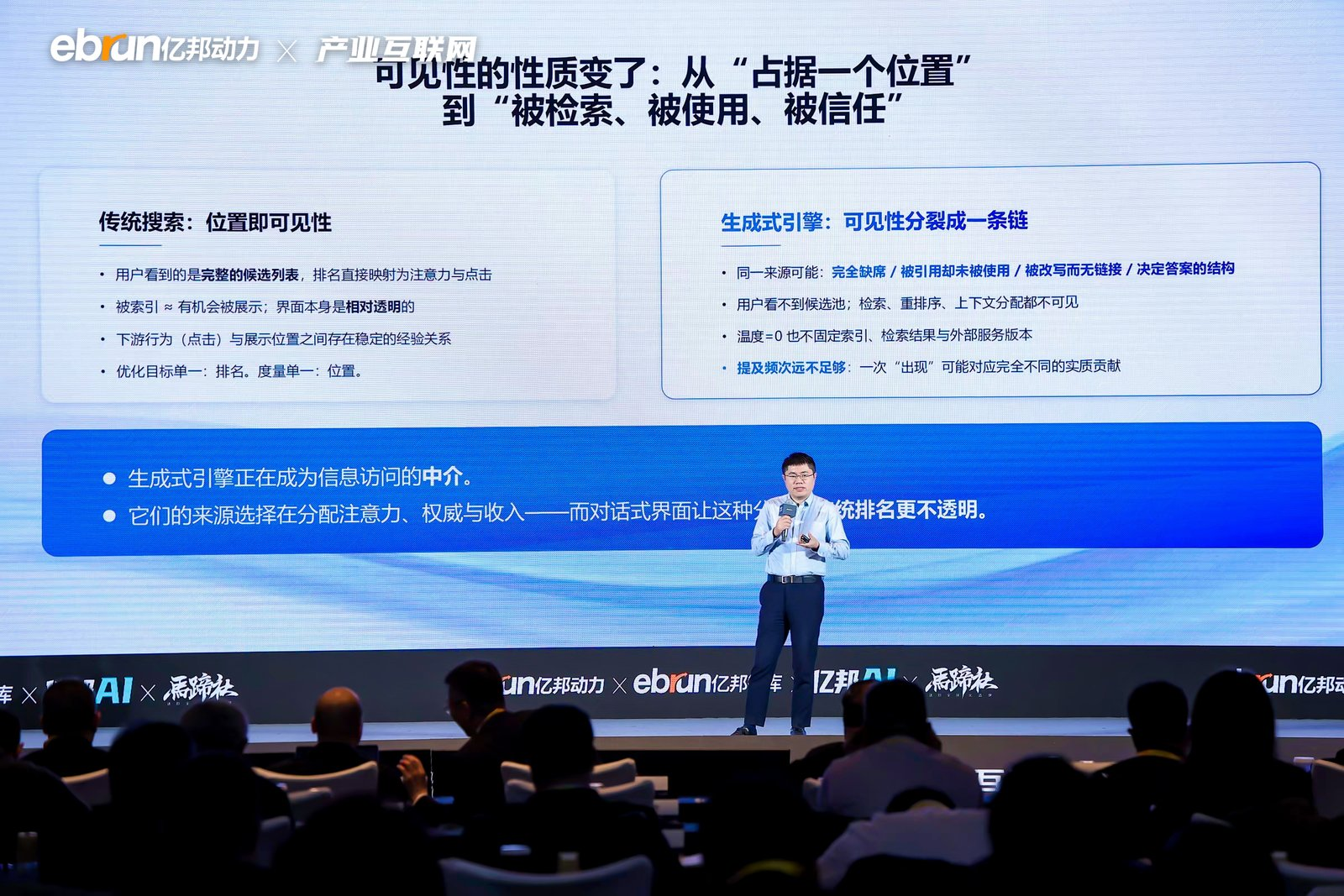
【亿邦原创】11月20日消息,在2026第八届亿邦产业互联网年会暨首届产业智能体大会上,PureblueAI清蓝联合创始人&CTO王立新发表了题为《GCO,构建AI认知的新体系》的主题演讲。

他认为,在AI应用用户规模达31亿、直逼传统搜索引擎的当下,用户获取信息的习惯已发生根本性逆转。面对AI,品牌的营销逻辑正经历一场从“GEO(生成式引擎优化)”向“GCO(生成式认知优化)”的跨越。

过去两年,GEO虽然解决了品牌在AI中的曝光问题,但存在四大无解局限:极度的零和博弈(AI单次回答通常仅展示3-4个品牌)、内容收录时效滞后、展示资源分配不均,以及仅停留在浅层的“品牌提及”。

要打破这一内卷,品牌必须优化在大模型“隐空间”中的认知印记。王立新指出,大模型的隐空间如同人类的大脑皮层,品牌需要在此建立长期、深度的认知关联。GCO的底层逻辑是拆解AI搜索的全链路(意图理解、多路召回、排序、生成与校验),将其视为一个概率分布函数的数学问题。通过提升可发现性、引用概率与内容吸收保真度,系统性提高品牌被AI引用的综合概率。

从GEO到GCO,不仅是战术的升级,更是底层的重构。AI时代的品牌营销不再是单一的关键词优化,而是融合了营销科学、计算科学与大模型认知科学的全链路科学体系。

本文首发于 亿邦动力 官方网站

【版权提示】亿邦动力倡导尊重与保护知识产权。未经许可,任何人不得复制、转载、或以其他方式使用本网站的内容。如发现本站文章存在版权问题,烦请提供版权疑问、身份证明、版权证明、联系方式等发邮件至run@ebrun.com,我们将及时沟通与处理。

已点赞

+1

{{ praise_text }}

好文章,值得被更多人看到

FAQ回顾

GCO是什么?和GEO有什么区别?

GCO即生成式认知优化,是面向AI搜索的品牌营销新体系。GEO主要解决品牌在AI中的曝光,但存在零和博弈、收录滞后、资源分配不均和仅浅层提及等局限。GCO则优化品牌在大模型隐空间中的认知印记,拆解AI搜索全链路,提升可发现性、引用概率与内容吸收保真度,系统性提高品牌被AI引用的综合概率。

AI搜索用户规模增长对品牌营销有什么影响?

AI应用用户规模达31亿,直逼传统搜索引擎,用户获取信息习惯发生根本性逆转。品牌营销逻辑正从GEO向GCO跨越。AI单次回答通常仅展示3-4个品牌,曝光呈零和博弈,品牌必须优化在大模型隐空间中的认知印记,建立长期、深度认知关联,而非只追求浅层品牌提及。

品牌如何提高被AI搜索引用的概率?

品牌可通过GCO提升被AI引用概率。GCO拆解AI搜索全链路,包括意图理解、多路召回、排序、生成与校验,并将其视为概率分布函数问题;通过提升可发现性、引用概率与内容吸收保真度,系统性提高综合概率。AI时代品牌营销不再依赖单一关键词优化,而是融合营销科学、计算科学与大模型认知科学。

GEO在AI搜索营销中存在哪些局限?

GEO过去两年解决了品牌在AI中的曝光问题,但存在四大局限:极度零和博弈,AI单次回答通常仅展示3-4个品牌;内容收录时效滞后;展示资源分配不均;仅停留在浅层品牌提及。要打破内卷,品牌需从GEO转向GCO,优化在大模型隐空间中的认知印记。

广告

下一篇

征集报名《品牌数字化服务商资源手册》

《品牌数字化服务商资源手册》展示数字化服务商风采,亿邦全年零售大会通发,触达更多资源,马上加入!

马上入驻

腾讯云行业生态总经理张林:Agent是组织能力放大器,企业应把最痛流程交给它

11月20日消息,在2026第八届亿邦产业互联网年会暨首届产业智能体大会上,腾讯云行业生态总经理张林发表了题为《Agent走进业务场景,从回答问题到完成任务》的演讲。

WorkBuddy 产业互联网 腾讯云 B2B

2026-11-20 15:47:59