• 亿邦公众号
    • APP下载

千峰访谈普渡机器人张涛:让智能能力从单一产品向更多应用场景延伸

作者:亿邦动力 文章来源:亿邦动力

2026-11-17 15:05

作者:亿邦动力 文章来源:亿邦动力

2026-11-17 15:05

邦小白快读

EN
全文速览

总1:普渡的规模化落地靠技术复用、场景选择和数据闭环,而非单点产品。

1.产品落地看两个案例:商用清洁PUDU MT1用AI视觉识别垃圾,巡检中发现清洁需求并针对性作业;工业物流PUDU MP2000用库位占用检测、托盘识别和自适应对位,应对托盘位置与角度变化,减少人工介入。

2.场景选择有方法:优先任务边界清晰、现场需求高频的场景,先跑通再向更多场景延伸。

3.数据使用有边界:每年超5000万小时运行数据,但运行数据不等于训练数据;要围绕具体问题筛选,明确授权和使用边界,识别长尾问题并验证经验迁移。

总2:出海与商业复制是另一条主线。

1.本地化贯穿需求评估、产品选型、部署、培训和售后;欧洲总部集办公、展示、培训、仓储、售后及维修于一体。

2.PISTF从产品、行业、场景、任务四维找匹配,SSPCP按细分、筛选、试点、案例、复制五步闭环。

3.实操上可从需求明确、价值易验证的任务切入,试点后再复制扩展。

总1:普渡的品牌与渠道打法是全球商用服务机器人领导者定位,加本地化伙伴生态。

1.品牌信任来自稳定产品体验和伙伴长期业务:客户能持续获得稳定产品体验,伙伴能围绕产品建立长期业务;全球化深度看客户长期使用、伙伴持续交付、验证应用能否复制。

2.渠道建设以全球合作伙伴及本地化服务网络为支撑,区域团队、仓储、维修等基础设施补位;欧洲总部在德国诺伊斯集办公、产品展示、培训、仓储、售后及维修功能,与欧洲办公室、伙伴及德国和荷兰仓储互补。

总2:产品研发与竞争判断围绕复用、成本和持续服务。

1.研发以AI原生和一脑多形为支点,PuduFM和PuduAgent OS支撑模型、软件模块、任务技能跨平台复用,硬件本体与运动控制按任务差异化设计,减少重复研发、缩短周期、降低成本。

2.价格竞争不只看模型进步,未来更看完整商业化能力:可靠性、部署成本和服务网络决定机会能否形成规模;评价技术进步要看任务表现和合理使用成本。

3.用户行为上,客户可从需求明确、价值易验证任务引入,再按效果扩展;持续服务能力会成为选择供应商的重要因素。

总1:对卖家而言,普渡给出的是出海增长市场、场景机会和可复制合作模式。

1.增长市场数据:累计出货超13万台,覆盖85个以上国家和地区,服务超5万家客户;欧洲、北美以及日本、韩国等亚洲市场是全球业务重要组成。

2.机会在服务配送、商用清洁、工业配送及通用具身智能协同;清洁和工业物流任务边界相对清晰、现场需求高频,适合先用AI跑通再延伸。

3.合作方式:普渡提供持续迭代产品、技术支持和培训,本地伙伴发挥行业理解、客户关系和服务能力,参与需求评估、部署交付与后续服务;区域团队及仓储、维修基础设施支持协作。

总2:可学习点是试点到复制的商业闭环,同时有风险提示。

1.PISTF从产品、行业、场景、任务四维找匹配,SSPCP按市场细分、客户筛选、试点验证、案例打造、规模化复制五步走,复制结果反哺细分。

2.单客户成功要沉淀为同类客户方案;标准化产品和可复用技术支持可减少重复开发与交付摸索。

3.风险在于各市场空间环境、工作流程、采购方式和服务要求差异明显,本地化要贯穿全过程;运行数据不等于训练数据,长尾识别和经验迁移是挑战,持续服务能力越来越重要。

总1:工厂可从普渡的产品设计复用、本体差异化和场景需求中获得生产启示。

1.设计需求上,一脑多形以PuduFM和PuduAgent OS为共享技术基础,模型、软件模块和任务技能跨机器人平台复用;硬件本体与运动控制系统按应用任务针对性设计与优化。

2.生产价值是减少不同平台重复研发,提升核心技术复用效率,缩短产品研发与项目部署周期,降低技术研发及实际应用成本。

3.产品形态分工:专用机器人解决高频且边界清晰需求,类人形与人形逐步探索更复杂作业;商用清洁PUDU MT1用AI视觉识别垃圾并动态组织清洁,工业物流PUDU MP2000用库位占用检测、托盘识别和自适应对位减少人工介入。

总2:商业机会与数字化推进方向清晰。

1.机会来自服务配送、商用清洁、工业配送和通用具身智能协同发展,围绕客户实际工作流程推进。

2.数字化不是单点功能,而是模型、软件平台及机器人本体协同发展;现场问题进入技术改进,再回到现场检验,形成数据飞轮。

3.规模化应用带来场景反馈和真实运行数据,每年超5000万小时运行数据可支撑迭代,但需筛选、授权和验证。

总1:服务商应关注商用服务机器人从技术探索走向规模化商业应用,以及本地化服务能力的机会。

1.行业趋势是AI与全球化共同推动:AI提升环境理解、适应和任务执行,全球化让能力进入不同国家和真实场景接受检验,并反馈迭代。

2.新技术核心是一脑多形,以PuduFM和PuduAgent OS支撑共享智能架构,减少重复研发、缩短部署周期、降低成本,让智能能力从单一产品向更多场景延伸。

3.客户痛点包括不同市场空间环境、工作流程、采购方式和服务要求差异明显;单客户成功应用难以直接复制;运行数据不等于训练数据,长尾识别和经验迁移有难度。

总2:解决方案是本地化全流程加伙伴协作加闭环复制。

1.本地化贯穿需求评估、产品选型、部署、培训和售后;欧洲总部集办公、展示、培训、仓储、售后及维修,与办公室、伙伴和仓储设施互补。

2.合作模式是普渡提供产品、技术支持和培训,本地伙伴负责贴近客户的需求评估、部署交付与后续服务;区域团队和仓储维修基础设施支撑。

3.用PISTF看市场、SSPCP做业务,通过试点确认适用条件、作业表现和服务要求,再案例化、规模化复制,标准化产品与可复用技术支持可减少重复开发。

总1:平台商可关注普渡如何用本地化运营体系和伙伴生态,把单点项目变成可复制业务。

1.商业对平台的需求:机器人项目要把一个客户现场的成功应用转化为更多同类客户可用的方案,需要区域支持、仓储维修、培训和持续服务等基础设施。

2.平台最新做法:以全球合作伙伴及本地化服务网络为客户提供从部署到持续使用的支持;欧洲总部在德国诺伊斯集办公、产品展示、培训、仓储、售后及维修功能,与现有欧洲办公室、区域合作伙伴及德国和荷兰仓储形成互补。

3.运营管理上,PISTF从产品、行业、场景、任务四维做市场分析,SSPCP按市场细分、客户筛选、试点验证、案例打造、规模化复制五步闭环,复制结果反哺市场细分。

总2:招商合作与风向规避也有启示。

1.合作方式:普渡提供持续迭代产品、技术支持和培训,本地伙伴发挥行业理解、客户关系和服务能力,参与需求评估、部署交付与后续服务。

2.可复制关键在试点确认适用条件、作业表现和服务要求,沉淀为后续项目参考;标准化产品和可复用技术支持减少重复开发。

3.风向规避要重视市场差异和本地化全过程,运行数据使用要有明确授权和使用边界,并推进数据质量、场景覆盖与验证能力。大会信息显示2026年11月20日北京将开产业互联网年会暨首届产业智能体大会,主题聚焦AI与出海模态进化。

总1:普渡案例呈现产业新动向:商用服务机器人从技术探索转向规模化商业应用,AI与全球化共同驱动模态进化。

1.技术动向是一脑多形,以PuduFM和PuduAgent OS构建共享技术基础,模型、软件模块和任务技能跨平台复用,硬件本体与运动控制差异化设计;专用机器人处理高频边界清晰任务,类人形与人形探索复杂作业。

2.商业动向是PISTF加SSPCP:前者从产品、行业、场景、任务四维做双向适配,后者按细分、筛选、试点、案例、复制五步闭环,反哺细分,从卖产品转向可复制商业闭环系统。

总2:新问题与政策启示集中在数据治理和全球化能力。

1.数据问题:运行数据不能直接等同训练数据,需筛选、包含待解决问题并支持评估改进;核心挑战是识别长尾问题、判断经验迁移程度;导航经验可共性复用,复杂操作需匹配任务、本体和控制方式的数据验证。

2.政策法规启示:围绕具体问题组织数据使用,在明确授权和使用边界前提下推进数据质量、场景覆盖与验证能力建设。

3.竞争判断:未来更重视完整商业化能力,模型进步打开任务空间,可靠性、部署成本和服务网络决定规模化;本地化深度看客户长期使用、伙伴持续交付和验证应用复制。代表数据为出货超13万台、覆盖85国以上、服务超5万家客户、每年超5000万小时运行数据。

声明:快读内容全程由AI生成,请注意甄别信息。如您发现问题,请发送邮件至 run@ebrun.com 。

我是 品牌商 卖家 工厂 服务商 平台商 研究者 帮我再读一遍。

Quick Summary

Overall 1: Pudu's path to scaled deployment rests on technology reuse, scenario selection, and data closed loops, rather than standalone products.

1. Product deployment is illustrated by two cases: the commercial cleaning PUDU MT1 uses AI vision to identify waste, detects cleaning needs during inspection, and performs targeted cleaning; the industrial logistics PUDU MP2000 uses slot occupancy detection, pallet recognition, and adaptive alignment to handle changes in pallet position and angle and reduce manual intervention.

2. Scenario selection follows a method: prioritize scenarios with clear task boundaries and high-frequency on-site demand, prove them out first, and then extend to more scenarios.

3. Data use has boundaries: the company generates more than 50 million operating hours of data annually, but operating data is not equivalent to training data; it must be filtered around specific problems, with clear authorization and usage boundaries, to identify long-tail issues and validate experience transfer.

Overall 2: Going global and commercial replication form another main line.

1. Localization runs through demand assessment, product selection, deployment, training, and after-sales service; the European headquarters integrates office, showroom, training, warehousing, after-sales, and repair functions.

2. PISTF matches opportunities across four dimensions—product, industry, scenario, and task—while SSPCP forms a five-step closed loop of segmentation, screening, pilot, case creation, and replication.

3. In practice, start with tasks with clear demand and easily verifiable value, then replicate and expand after piloting.

Overall 1: Pudu's brand and channel strategy combines a positioning as the global leader in commercial service robots with a localized partner ecosystem.

1. Brand trust comes from consistent product experience and partners' long-term business: customers can consistently obtain a stable product experience, while partners can build long-term businesses around the products; depth of globalization is measured by long-term customer use, continuous partner delivery, and whether validated applications can be replicated.

2. Channel building is supported by global partners and a localized service network, with regional teams, warehousing, repair, and other infrastructure filling gaps; the European headquarters in Neuss, Germany, integrates office, product showroom, training, warehousing, after-sales, and repair functions, complementing European offices, partners, and warehousing in Germany and the Netherlands.

Overall 2: Product R&D and competitive assessment center on reuse, cost, and continuous service.

1. R&D is anchored in AI-native development and the one-brain-multiple-forms approach; PuduFM and PuduAgent OS support cross-platform reuse of models, software modules, and task skills, while hardware bodies and motion control are designed differentiated by task, reducing duplicate R&D, shortening cycles, and lowering costs.

2. Price competition depends not only on model progress but increasingly on full commercialization capability: reliability, deployment cost, and service networks determine whether opportunities can reach scale; evaluating technological progress should focus on task performance and reasonable usage cost.

3. In terms of user behavior, customers can start with tasks that have clear demand and easily verifiable value, then expand based on results; continuous service capability will become an important factor in choosing suppliers.

Overall 1: For sellers, Pudu offers growing overseas markets, scenario opportunities, and a replicable partnership model.

1. Growth-market data: cumulative shipments exceed 130,000 units, covering more than 85 countries and regions and serving more than 50,000 customers; Europe, North America, and Asian markets such as Japan and South Korea are important components of the global business.

2. Opportunities lie in service delivery, commercial cleaning, industrial delivery, and general embodied intelligence collaboration; cleaning and industrial logistics tasks have relatively clear boundaries and high-frequency on-site demand, making them suitable for AI-led validation first and extension afterward.

3. Partnership approach: Pudu provides continuously iterated products, technical support, and training, while local partners contribute industry understanding, customer relationships, and service capabilities and participate in demand assessment, deployment delivery, and follow-up service; regional teams and warehousing and repair infrastructure support collaboration.

Overall 2: The key takeaway is the commercial closed loop from pilot to replication, along with risk caveats.

1. PISTF identifies matches across the four dimensions of product, industry, scenario, and task; SSPCP follows five steps—market segmentation, customer screening, pilot validation, case creation, and scaled replication—with replication results feeding back into segmentation.

2. Single-customer success must be distilled into solutions for similar customers; standardized products and reusable technical support can reduce duplicate development and delivery exploration.

3. Risks include pronounced differences across markets in spatial environments, workflows, procurement methods, and service requirements, so localization must run through the entire process; operating data is not training data, long-tail identification and experience transfer are challenges, and continuous service capability is increasingly important.

Overall 1: Factories can draw production insights from Pudu's product design reuse, hardware differentiation, and scenario requirements.

1. On design requirements, the one-brain-multiple-forms approach uses PuduFM and PuduAgent OS as a shared technology foundation, with models, software modules, and task skills reused across robot platforms; hardware bodies and motion control systems are designed and optimized specifically for application tasks.

2. The production value lies in reducing duplicate R&D across different platforms, improving the reuse efficiency of core technologies, shortening product R&D and project deployment cycles, and lowering technology R&D and practical application costs.

3. Product forms are divided by role: specialized robots address high-frequency needs with clear boundaries, while humanoids and quasi-humanoids gradually explore more complex operations; the commercial cleaning PUDU MT1 uses AI vision to identify waste and dynamically organize cleaning, while the industrial logistics PUDU MP2000 uses slot occupancy detection, pallet recognition, and adaptive alignment to reduce manual intervention.

Overall 2: The commercial opportunities and digitalization direction are clear.

1. Opportunities come from the coordinated development of service delivery, commercial cleaning, industrial delivery, and general embodied intelligence, advanced around customers' actual workflows.

2. Digitalization is not a single-point feature but the coordinated development of models, software platforms, and robot bodies; on-site problems feed into technical improvements and are then tested back on site, forming a data flywheel.

3. Scaled applications generate scenario feedback and real operating data; more than 50 million operating hours per year can support iteration, but the data must be filtered, authorized, and validated.

Overall 1: Service providers should focus on commercial service robots moving from technology exploration to scaled commercial application, as well as opportunities in localized service capabilities.

1. The industry trend is driven jointly by AI and globalization: AI improves environmental understanding, adaptation, and task execution, while globalization lets capabilities enter different countries and real scenarios for validation and feedback-driven iteration.

2. The core of the new technology is one-brain-multiple-forms, with PuduFM and PuduAgent OS supporting a shared intelligence architecture, reducing duplicate R&D, shortening deployment cycles, lowering costs, and extending intelligence from single products to more scenarios.

3. Customer pain points include pronounced differences across markets in spatial environments, workflows, procurement methods, and service requirements; successful applications for a single customer are difficult to replicate directly; operating data is not training data, and long-tail identification and experience transfer are difficult.

Overall 2: The solution is end-to-end localization plus partner collaboration plus closed-loop replication.

1. Localization runs through demand assessment, product selection, deployment, training, and after-sales service; the European headquarters integrates office, showroom, training, warehousing, after-sales, and repair functions and complements offices, partners, and warehousing facilities.

2. The partnership model has Pudu providing products, technical support, and training, while local partners handle customer-adjacent demand assessment, deployment delivery, and follow-up service; regional teams and warehousing and repair infrastructure provide support.

3. Use PISTF to assess the market and SSPCP to conduct business; through pilots, confirm applicable conditions, operational performance, and service requirements, then create cases and scale replication; standardized products and reusable technical support can reduce duplicate development.

Overall 1: Marketplace sellers can look at how Pudu uses a localized operating system and partner ecosystem to turn point projects into replicable businesses.

1. Platform requirements from the business side: robot projects must convert a successful application at one customer site into solutions usable by more similar customers, requiring infrastructure such as regional support, warehousing and repair, training, and continuous service.

2. The platform's latest approach: provide customers with support from deployment to ongoing use through global partners and a localized service network; the European headquarters in Neuss, Germany, integrates office, product showroom, training, warehousing, after-sales, and repair functions, complementing existing European offices, regional partners, and warehousing in Germany and the Netherlands.

3. In operations management, PISTF conducts market analysis across the four dimensions of product, industry, scenario, and task, while SSPCP forms a five-step closed loop of market segmentation, customer screening, pilot validation, case creation, and scaled replication, with replication results feeding back into market segmentation.

Overall 2: There are also lessons for partner recruitment and risk avoidance.

1. Partnership approach: Pudu provides continuously iterated products, technical support, and training, while local partners contribute industry understanding, customer relationships, and service capabilities and participate in demand assessment, deployment delivery, and follow-up service.

2. Replicability depends on pilots confirming applicable conditions, operational performance, and service requirements, and distilling them into references for later projects; standardized products and reusable technical support reduce duplicate development.

3. Risk avoidance should emphasize market differences and end-to-end localization; the use of operating data must have clear authorization and usage boundaries, while data quality, scenario coverage, and validation capabilities should be advanced. Conference information indicates that the Industrial Internet Annual Conference and the first Industrial Agent Conference will be held in Beijing on November 20, 2026, with the theme focusing on AI and the evolution of overseas expansion modalities.

Overall 1: The Pudu case reveals new industry dynamics: commercial service robots are shifting from technology exploration to scaled commercial application, with AI and globalization jointly driving modality evolution.

1. The technological trend is one-brain-multiple-forms: PuduFM and PuduAgent OS build a shared technology foundation, with models, software modules, and task skills reused across platforms and hardware bodies and motion control designed differently; specialized robots handle high-frequency tasks with clear boundaries, while quasi-humanoids and humanoids explore complex operations.

2. The commercial trend is PISTF plus SSPCP: the former performs two-way adaptation across the four dimensions of product, industry, scenario, and task, while the latter forms a five-step closed loop of segmentation, screening, pilot, case, and replication that feeds back into segmentation, shifting from selling products to a replicable commercial closed-loop system.

Overall 2: New questions and policy implications center on data governance and globalization capabilities.

1. Data issues: operating data cannot be directly equated with training data; it must be filtered, include the problems to be solved, and support evaluation and improvement; core challenges are identifying long-tail issues and judging the degree of experience transfer; navigation experience can be reused in common, while complex operations require data validation matching tasks, bodies, and control methods.

2. Policy and regulatory implications: organize data use around specific problems and advance data quality, scenario coverage, and validation capability under clear authorization and usage boundaries.

3. Competitive assessment: the future will place greater emphasis on full commercialization capability; model progress opens up task space, while reliability, deployment cost, and service networks determine scale; depth of localization is measured by long-term customer use, continuous partner delivery, and validated application replication. Representative data includes shipments exceeding 130,000 units, coverage in more than 85 countries, service to more than 50,000 customers, and more than 50 million operating hours per year.

Disclaimer: The "Quick Summary" content is entirely generated by AI. Please exercise discretion when interpreting the information. For issues or corrections, please email run@ebrun.com .

I am a Brand Seller Factory Service Provider Marketplace Seller Researcher Read it again.

【亿邦原创】张涛,深圳市普渡科技股份有限公司(PUDU普渡机器人)创始人兼CEO。普渡机器人定位为全球商用服务机器人领导者,业务覆盖服务配送、商用清洁、工业配送及通用具身智能,以“AI原生”为战略支点,通过“一脑多形”技术理念构建支撑不同机器人形态的共享技术基础,累计出货超过13万台,业务覆盖85个以上国家和地区,服务超过5万家客户。本届千峰奖访谈中,张涛围绕AI与出海带来的模态进化,分享了普渡机器人在商用服务机器人方向的实践与判断。
亿邦:本届千峰奖以“AI与出海带来的模态进化”为核心主题,聚焦产业能力的深层重构。结合具身智能与商用服务机器人行业,您如何理解这一轮由AI和全球化共同驱动的产业模态进化?普渡机器人在AI能力建设与全球化出海上有哪些核心战略布局?能否具体介绍一下公司的定位及业务模式?

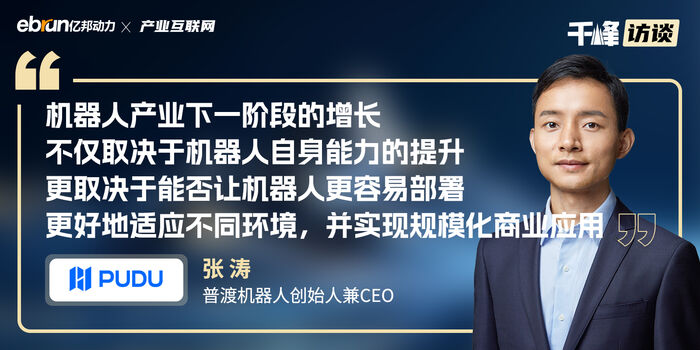
张涛:随着人工智能技术持续演进,机器人产业正迎来从技术探索向规模化商业应用发展的重要阶段。我们认为,机器人产业下一阶段的增长,不仅取决于机器人自身能力的提升,更取决于能否让机器人更容易部署、更好地适应不同环境,并实现规模化商业应用。AI与全球化正在共同推动这一进程。AI提升机器人对环境的理解、适应和任务执行能力,全球化则让这些能力进入不同国家、行业和真实场景,接受多样化需求的检验,也为产品与技术迭代提供持续反馈。

普渡的定位是全球商用服务机器人领导者,业务覆盖服务配送、商用清洁、工业配送及通用具身智能。我们的业务模式,是将机器人技术转化为面向具体任务的产品与解决方案,通过全球合作伙伴及本地化服务网络,为客户提供从部署到持续使用的支持。

技术方面,我们以“AI原生”为战略支点,通过“一脑多形”技术理念,构建能够支撑不同机器人形态的共享技术基础。从专用服务机器人到类人形、人形机器人,通过可复用的AI能力与针对不同任务设计的机器人本体,加快技术创新、提升研发效率,并推动机器人进入更多真实应用场景。全球化方面,我们持续完善本地化运营与服务体系,深化合作伙伴生态。核心目标,是推动技术创新转化为不同市场、不同客户能够实际获得的生产力。

亿邦:您提到“一脑多形”技术理念,核心是具身智能基座模型PuduFM和PuduAgent OS。这两者分别承担什么角色?为什么共享技术基础对多形态机器人重要?

张涛:“一脑多形”以自主研发的具身智能基座模型PuduFM和PuduAgent OS为核心技术支撑,通过统一的智能技术架构,推动模型能力、软件模块及任务技能在不同机器人平台之间复用,同时根据不同应用任务的需求,对机器人硬件本体与运动控制系统进行针对性设计与优化。这一架构的价值,在于减少不同机器人平台之间的重复研发,提升核心技术复用效率,缩短产品研发与项目部署周期,并降低技术研发及实际应用成本。通过共享智能能力与差异化本体设计相结合,我们希望让智能能力从单一产品向更多应用场景延伸。

亿邦:目前贵公司在哪些核心业务环节落地了AI/大模型技术?形成了怎样独具特色的AI或数智化竞争力体系?

张涛:技术创新的价值,最终需要通过真实场景中的应用来体现。普渡围绕服务配送、商用清洁、工业配送及通用具身智能,持续推动AI技术与产品、任务和工作流程深度融合。

例如,在商用清洁领域,PUDU MT1通过AI视觉识别垃圾,在巡检过程中发现清洁需求并开展针对性作业,使清洁任务能够根据现场情况动态组织。在工业物流领域,PUDU MP2000通过库位占用检测、托盘识别和自适应对位等能力,应对托盘位置与摆放角度的变化,减少搬运过程中的人工介入。支撑产品持续演进的,是普渡以模型、软件平台及机器人本体协同发展的技术体系。

亿邦:您提到PUDU MT1和PUDU MP2000分别在商用清洁和工业物流中落地。这两个场景对AI能力的要求有什么不同?为什么选择这两个场景先落地?

张涛:商用清洁场景中,PUDU MT1通过AI视觉识别垃圾,在巡检过程中发现清洁需求并开展针对性作业,使清洁任务能够根据现场情况动态组织;工业物流场景中,PUDU MP2000通过库位占用检测、托盘识别和自适应对位等能力,应对托盘位置与摆放角度的变化,减少搬运过程中的人工介入。两个场景的共同点是任务边界相对清晰、现场需求高频,适合用AI能力先跑通,再向更多场景延伸。

亿邦:在推进AI规模化落地过程中,数据要素扮演了怎样的支撑角色?普渡更侧重自有产业数据深耕,还是推进跨主体、跨行业的数据协同?核心挑战是什么、如何应对?

张涛:对机器人而言,数据连接着真实场景与模型能力。客户现场的通道、地面、载具、障碍物和工作流程不断变化,这些差异能够帮助我们发现实验室中难以充分覆盖的问题,为产品和模型改进提供方向。

普渡累计出货超过13万台,业务覆盖85个以上国家和地区,服务超过5万家客户。规模化应用带来的价值,既包括广泛的场景反馈,也包括持续产生的真实运行数据。依托每年超5000万小时真实运行数据,我们持续推进场景应用、数据积累与能力提升之间的迭代。

我们更侧重深耕自身产品在真实业务中的场景积累,同时重视不同数据来源对能力建设的补充。但运行数据不能直接等同于训练数据,数据是否有价值,还要看它能否被有效筛选、是否包含需要解决的问题,以及能否支持能力评估和改进。

这里有两个核心挑战:一是从大量运行记录中识别有价值的长尾问题;二是判断一种任务或本体积累的经验,能够在多大程度上用于其他产品。导航经验可以为不同机器人提供共性基础,而复杂操作仍需要与具体任务、本体和控制方式相匹配的数据与验证。因此,我们强调围绕具体问题组织数据使用,在明确授权和使用边界的前提下,推进数据质量、场景覆盖与验证能力建设。数据飞轮的关键,是让现场问题能够进入技术改进,再让改进后的能力回到现场接受检验。

亿邦:您特别强调“运行数据不能直接等同于训练数据”。这个判断对普渡的数据治理意味着什么?怎么从每年超5000万小时运行数据里识别有价值的长尾问题?

张涛:运行数据不能直接等同于训练数据,数据是否有价值,还要看它能否被有效筛选、是否包含需要解决的问题,以及能否支持能力评估和改进。我们强调围绕具体问题组织数据使用,在明确授权和使用边界的前提下,推进数据质量、场景覆盖与验证能力建设。从大量运行记录中识别有价值的长尾问题,是核心挑战之一;另一个挑战是判断一种任务或本体积累的经验,能够在多大程度上用于其他产品。导航经验可以为不同机器人提供共性基础,而复杂操作仍需要与具体任务、本体和控制方式相匹配的数据与验证。

亿邦:海外布局方面,普渡目前布局了哪些核心市场?做了哪些关键本地化调整?

张涛:普渡已经进入全球85个以上国家和地区,欧洲、北美以及日本、韩国等亚洲市场,都是全球业务的重要组成部分。各市场对清洁质量、物流效率和稳定服务有共同需求,但在空间环境、工作流程、采购方式与服务要求上又存在明显差异。

因此,本地化要贯穿需求评估、产品选型、部署、培训和售后全过程。例如,同样是清洁任务,零售门店、酒店和交通枢纽对作业时间、人机共处和清洁流程的要求就不同,需要结合现场条件确定方案。

我们也在持续完善区域基础设施。2026年10月30日,普渡欧洲总部在德国诺伊斯正式启用,集办公、产品展示、培训、仓储、售后及维修等功能于一体,并与现有欧洲办公室、区域合作伙伴及德国和荷兰的仓储设施形成互补,为当地交付和持续服务提供支持。在我们看来,全球化的深度,体现在产品进入市场之后,客户能否长期使用、伙伴能否持续交付,以及经过验证的应用能否向更多客户复制。本地化能力建设,正是为了支撑这一过程。

亿邦:您提到普渡欧洲总部在德国诺伊斯正式启用,集办公、产品展示、培训、仓储、售后及维修等功能于一体。为什么欧洲总部要同时承担这么多功能?这对当地交付和持续服务意味着什么?

张涛:欧洲总部集办公、产品展示、培训、仓储、售后及维修等功能于一体,并与现有欧洲办公室、区域合作伙伴及德国和荷兰的仓储设施形成互补,为当地交付和持续服务提供支持。全球化的深度,体现在产品进入市场之后,客户能否长期使用、伙伴能否持续交付,以及经过验证的应用能否向更多客户复制。本地化能力建设,正是为了支撑这一过程。

亿邦:在海外市场的深度价值链建设上,普渡形成了怎样的模式?为海外合作伙伴和当地产业创造什么价值?

张涛:我们的基本思路,是把普渡的研发和产品能力,与本地合作伙伴的行业理解、客户关系和服务能力结合起来。普渡提供持续迭代的机器人产品、技术支持和培训,合作伙伴发挥贴近客户、熟悉当地业务环境的优势,参与需求评估、部署交付与后续服务。区域团队及仓储、维修等基础设施,则为双方协作提供支持。

这一模式要解决的核心问题,是如何把一个客户现场的成功应用,转化为更多同类客户能够使用的方案。机器人项目可以从具体任务切入,通过试点确认适用条件、作业表现和服务要求,再沉淀为可供后续项目参考的经验。

对合作伙伴而言,标准化产品和可复用的技术支持,有助于减少重复开发与交付摸索,使其更专注于行业需求和客户服务。对客户而言,可以从需求明确、价值容易验证的任务开始引入机器人,再根据实际效果逐步扩展应用。我们理解的海外价值链建设,是让产品、交付与持续服务能够相互衔接,使机器人真正进入客户的日常经营。品牌信任也由此产生:客户能够持续获得稳定的产品体验,合作伙伴能够围绕这些产品建立长期业务。

亿邦:您提到普渡沉淀了一套基于PISTF框架的SSPCP闭环。这套方法论具体怎么运转?为什么说它让普渡从“卖产品”升级为“可复制的商业闭环系统”?

张涛:PISTF是底层的市场分析框架,从Product(产品组合)、Industry(行业)、Scenario(场景)、Task(任务)四个维度,通过Fit(双向适配)找到产品与市场的最佳匹配;SSPCP则是落地执行的五步闭环——从Segmentation(市场细分)、Sorting(客户筛选)、Pilot(试点验证)、Case-Study(案例打造),到Propagation(规模化复制),再将复制结果反哺市场细分,形成持续迭代的增长飞轮。简单说,PISTF解决“怎么看市场”,SSPCP解决“怎么做业务”,两者结合让普渡从“卖产品”升级为“可复制的商业闭环系统”,这也是13万台规模化落地背后的核心方法论支撑。

亿邦:面向2026年及未来两年,普渡在AI能力迭代与全球化布局上有哪些重点投入规划?您预判这会给行业竞争格局带来哪些关键变化?

张涛:面向2026年及未来两年,我们关注的重点,是让智能能力、产品能力与全球交付能力同步提升。从普渡已有布局出发,AI能力迭代的核心方向,是继续深化“一脑多形”,提高机器人对复杂环境的理解、任务执行的可靠性,以及共性能力在不同产品中的复用效率。

产品层面,要围绕客户的实际工作流程,继续推进服务配送、商用清洁、工业配送和通用具身智能的协同发展。不同形态各有适合承担的任务:专用机器人解决高频且边界清晰的需求,类人形与人形机器人逐步探索更加复杂的作业。评价技术进步,需要看它能否带来更好的任务表现和更合理的使用成本。

全球化层面,重点在于提高已有市场的经营深度,强化区域支持与合作伙伴能力,让产品更容易交付、服务更贴近客户、同类应用更容易复制。随着机器人参与客户日常运营的程度加深,持续服务能力会成为客户选择供应商时越来越重要的因素。

我们判断,未来两年的竞争将更重视完整的商业化能力。模型进步会打开更多任务空间,可靠性、部署成本和服务网络则决定这些机会能否形成规模。能够把技术研发、产品迭代、客户反馈和全球交付连接起来的企业,更有机会建立持续优势。普渡希望沿着这条路径,让机器人在更多真实场景中创造长期价值。

作为TO B领域年度风向标,“2026第八届亿邦产业互联网年会暨首届产业智能体大会”将于2026年11月20日在北京召开。主题定为“AI与出海带来的模态进化”,聚焦产业智能体落地、AI供应链价值重构、数据要素与TOKEN经济、产业出海新生态等前沿议题深度思辨。大会将集结学界权威、央国企标杆、产业龙头、投资机构、服务生态伙伴,汇聚产业核心力量、拆解产业数智化转型路径、分享前沿实战经验。同期还将发布年度产业互联网报告及标杆案例,举办决策人闭门会、“千峰奖”颁奖盛典。

本文首发于 亿邦动力 官方网站

【版权提示】亿邦动力倡导尊重与保护知识产权。未经许可,任何人不得复制、转载、或以其他方式使用本网站的内容。如发现本站文章存在版权问题,烦请提供版权疑问、身份证明、版权证明、联系方式等发邮件至run@ebrun.com,我们将及时沟通与处理。

已点赞

+1

{{ praise_text }}

好文章,值得被更多人看到

FAQ回顾

普渡机器人是做什么的?属于什么行业?

普渡机器人(PUDU)定位为全球商用服务机器人领导者,业务覆盖服务配送、商用清洁、工业配送及通用具身智能,以“AI原生”为战略支点、“一脑多形”为技术理念,累计出货超过13万台,业务覆盖85个以上国家和地区,服务超过5万家客户。

普渡机器人的“一脑多形”技术是什么?

“一脑多形”以自研具身智能基座模型PuduFM和PuduAgent OS为核心,通过统一智能技术架构推动模型能力、软件模块及任务技能在不同机器人平台复用,同时针对不同任务优化硬件本体与运动控制。其价值在于减少重复研发、缩短产品研发与部署周期,并降低研发及应用成本。

商用服务机器人如何在清洁和工业物流场景落地AI?

在商用清洁场景,PUDU MT1通过AI视觉识别垃圾,在巡检中发现清洁需求并开展针对性作业,使清洁任务根据现场情况动态组织;在工业物流场景,PUDU MP2000通过库位占用检测、托盘识别和自适应对位,应对托盘位置与摆放角度变化。两类场景任务边界相对清晰、需求高频,适合先用AI跑通再向更多场景延伸。

普渡机器人出海做了哪些本地化布局?

普渡已进入85个以上国家和地区,欧洲、北美及日本、韩国等亚洲市场是重要组成部分;本地化贯穿需求评估、产品选型、部署、培训和售后。2026年10月30日,普渡欧洲总部在德国诺伊斯启用,集办公、产品展示、培训、仓储、售后及维修于一体,并与现有欧洲办公室、区域伙伴及德国和荷兰仓储设施形成互补。

机器人企业为什么说运行数据不能直接等同于训练数据?

机器人客户现场的通道、地面、载具、障碍物和工作流程不断变化,差异能帮助发现实验室难以覆盖的问题。普渡每年有超5000万小时真实运行数据,但运行数据需被有效筛选、包含待解决问题并支持能力评估改进。核心挑战是识别有价值的长尾问题,以及判断一项经验能在多大程度上复用于其他产品。

广告

下一篇

征集报名《品牌数字化服务商资源手册》

《品牌数字化服务商资源手册》展示数字化服务商风采,亿邦全年零售大会通发,触达更多资源,马上加入!

马上入驻

百亿采购如何实现业数智协同:中铁工业杨皓岚将出席2026第八届亿邦产业互联网年会

北京中铁工业有限公司总经理杨皓岚将出席2026第八届亿邦产业互联网年会,并将深度拆解制度创新与科技变革下,“业数智”协同如何引发百亿平台化采购。