• 亿邦公众号
    • APP下载

财报解析|瑞幸咖啡Q3净利润同比增长45.4% 配送费用省了11亿元

作者:郑雅 文章来源:亿邦动力

2026-11-05 11:32

作者:郑雅 文章来源:亿邦动力

2026-11-05 11:32

邦小白快读

EN
全文速览

总1:财报核心数据

1.瑞幸2026年第三季度总净收入179亿元,同比增长17.0%;月均交易客户1.23亿,同比增长9.6%,创历史新高;累计交易客户5.27亿,全球门店38909家,环比增长7.2%。

2.净利润18.59亿元,同比增长45.4%;GAAP营业利润27.56亿元,同比增长55.1%,营业利润率15.4%,净利率10.4%。

总2:成本与经营变化

1.配送费用17.89亿元,同比减少38.1%,主要因订单结构从配送转向自取;总营业费用占比降至84.6%。

2.自营门店收入129.40亿元,同比增长16.8%,门店层面营业利润30.19亿元,同比增长55.5%,门店层面营业利润率23.3%。

3.第三季度净增门店2599家,推出41款现制饮品和20多款轻食;同店销售增长率-11.1%,管理层称受外卖大战高基数影响,门店利润率已基本恢复到外卖大战前水平。

总1:品牌与产品营销

1.瑞幸通过埃塞瑰夏冷萃及多款冷萃新品强化专业心智与品牌调性;将Lab店反馈积极的两款特调推广至全国限时供应。

2.第三季度推出41款现制饮品和20多款轻食;8月泰奶系列首周销量超1300万杯,刷新今年新品销售记录,显示新品具备爆款拉动能力。

总2:消费趋势与渠道价格

1.月均交易客户1.23亿,同比增长9.6%,累计交易客户5.27亿,人均杯量再创新高;订单结构从配送转向自取,客户回归自提,杯量结构更健康。

2.渠道上全球门店38909家,自营25402家、联营13507家,Q3净增2599家;国际市场279家。

3.价格竞争方面,去年7至8月外卖大战高补贴拉高外送杯量和单杯价格,形成高基数;今年补贴收缩、配送成本下降,自营门店利润率基本恢复至外卖大战前水平。销售和市场费用9.76亿元,同比增长30.0%,广告及促销投入增加。

总1:增长市场与需求机会

1.瑞幸Q3总净收入179亿元,同比增长17.0%;GMV207.34亿元,同比增长19.7%,增长来自门店数量和月交易客户增加带动销量。

2.月均交易客户1.23亿,同比增长9.6%,累计交易客户5.27亿;全球门店38909家,Q3净增2599家,其中联营门店净增931家,联营门店收入42.43亿元,同比增长11.7%。

总2:风险提示与可学习点

1.自营门店同店销售增长率为-11.1%,管理层解释去年7至8月外卖大战高补贴形成高基数,补贴收缩亦影响同店表现,提示短期同店波动风险。

2.机会在于订单从配送转向自取,配送费用同比减少38.1%,杯量结构更健康,有利于发挥线下门店网络和运营效率;配送费用节省约11亿元。

3.可学习点是看增长不能只看短期同店,要结合用户指标、业务规模和盈利表现综合分析;瑞幸采用自营加联营和持续扩店模式,Q3门店层面利润率已基本恢复至外卖大战前水平。

总1:产品生产与设计需求

1.瑞幸Q3推出41款现制饮品和20多款轻食,咖啡端推出埃塞瑰夏冷萃并延展多款冷萃新品,非咖啡端泰奶系列首周销量超1300万杯,显示上新节奏快、品类延展强。

2.产品结构覆盖现制饮品、轻食、特调限时供应,工厂可关注冷萃、特调、泰奶等细分品类的原料、配方和配套生产需求。

总2:商业机会与运营启示

1.门店网络扩大带来产能和供应机会:全球门店38909家,Q3净增2599家,自营净增1668家、联营净增931家,国际市场279家。

2.成本端材料成本68.54亿元,同比增长23.7%;店铺租金及其他运营成本39.25亿元,同比增长26.7%,反映门店扩张和原料需求增长。

3.运营启示是订单结构从配送转向自取,配送费用同比减少38.1%,杯量结构更健康;工厂可关注门店效率、产品上新与供应链协同,但文章未展开数字化和电商具体做法。

总1:行业趋势与客户痛点

1.中国咖啡消费行业仍处起步和快速扩张阶段,瑞幸门店规模接近翻倍,Q3全球门店38909家,净增2599家,行业扩张与外卖补贴大战交织。

2.客户痛点包括同店销售增长率-11.1%,受去年7至8月外卖大战高补贴高基数及补贴收缩影响;配送成本曾较高,外卖占比仍明显高于2024年同期。

总2:解决方案与经营启示

1.瑞幸的应对是订单结构从配送转向自取,配送费用17.89亿元,同比减少38.1%,节省约11亿元,杯量结构更健康。

2.通过门店网络和运营效率提升,自营门店层面营业利润30.19亿元,同比增长55.5%,门店层面营业利润率23.3%,已基本恢复至外卖大战前水平。

3.服务商可关注企业不能孤立看同店指标,应结合月均交易客户1.23亿、人均杯量创新高、业务规模和盈利表现,提供长期经营分析方案。

总1:平台需求与商家订单变化

1.瑞幸订单结构出现从配送转向自取的显著变化,配送费用17.89亿元,同比减少38.1%,节省约11亿元,说明商家对降低配送成本、提升自提比例有明确需求。

2.去年7至8月外卖大战高补贴拉动外送杯量和单杯价格,形成高基数;今年补贴收缩后,自营门店利润率恢复,平台需关注补贴退潮对订单结构和商家盈利的影响。

总2:合作机会与风向规避

1.瑞幸全球门店38909家,Q3净增2599家,自营25402家、联营13507家,国际市场279家;持续扩店和联营门店增长带来平台合作与招商机会。

2.平台运营管理可关注月均交易客户1.23亿、累计交易客户5.27亿、人均杯量创新高,以及自取订单对线下门店网络和运营效率的要求。

3.风向规避上,同店销售增长率-11.1%提示高基数和补贴收缩会带来短期波动,不能仅凭短期同店判断增长质量,应结合用户指标、业务规模和盈利表现综合分析。

总1:产业新动向与新问题

1.瑞幸Q3总净收入179亿元,同比增长17.0%,GMV207.34亿元,同比增长19.7%,全球门店38909家,净增2599家,门店规模接近翻倍,显示中国咖啡消费行业仍处快速扩张阶段。

2.新问题是自营门店同店销售增长率-11.1%,受去年7至8月外卖大战高补贴形成高基数及补贴收缩影响;同店指标在成熟企业与快速扩张企业中的意义不同。

总2:商业模式与启示

1.瑞幸采用自营加联营和持续扩店模式,Q3自营门店收入129.40亿元,同比增长16.8%,联营门店收入42.43亿元,同比增长11.7%;门店层面营业利润率23.3%,已基本恢复至外卖大战前水平。

2.订单从配送转向自取,配送费用同比减少38.1%,杯量结构更健康,有利于发挥线下门店网络和运营效率。

3.研究启示是不能孤立、静态看同店指标,要着眼长期,结合用户指标、业务规模、盈利表现和商业模式底层运行逻辑综合判断增长节奏和质量。

声明:快读内容全程由AI生成,请注意甄别信息。如您发现问题,请发送邮件至 run@ebrun.com 。

我是 品牌商 卖家 工厂 服务商 平台商 研究者 帮我再读一遍。

Quick Summary

Summary 1: Core financial data

1. Luckin's total net revenue in Q3 2026 was RMB 17.9 billion, up 17.0% year on year; average monthly transacting customers reached 123 million, up 9.6% year on year and a record high; cumulative transacting customers reached 527 million; global stores totaled 38,909, up 7.2% quarter on quarter.

2. Net profit was RMB 1.859 billion, up 45.4% year on year; GAAP operating profit was RMB 2.756 billion, up 55.1% year on year, with an operating margin of 15.4% and a net margin of 10.4%.

Summary 2: Costs and operating changes

1. Delivery expenses were RMB 1.789 billion, down 38.1% year on year, mainly because the order mix shifted from delivery to pickup; total operating expenses fell to 84.6% of revenue.

2. Self-operated store revenue was RMB 12.940 billion, up 16.8% year on year; store-level operating profit was RMB 3.019 billion, up 55.5% year on year, with a store-level operating margin of 23.3%.

3. Net store additions in Q3 were 2,599; the company launched 41 freshly made beverages and more than 20 light-food items; same-store sales growth was -11.1%, which management attributed to a high base from the delivery subsidy war, and store margins have basically returned to pre-war levels.

Summary 1: Brand and product marketing

1. Luckin reinforced its professional image and brand positioning through Ethiopian Gesha cold brew and multiple cold-brew innovations; it rolled out two specialty drinks that received positive feedback at its Lab stores to nationwide limited-time availability.

2. In Q3, it launched 41 freshly made beverages and more than 20 light-food items; the Thai milk tea series sold more than 13 million cups in its first week in August, setting a new record for new-product sales this year and showing that new products can drive blockbuster demand.

Summary 2: Consumer trends and channel pricing

1. Average monthly transacting customers were 123 million, up 9.6% year on year; cumulative transacting customers reached 527 million, and cups per customer hit a new high; the order mix shifted from delivery to pickup, with customers returning to self-pickup and a healthier cup-volume mix.

2. In terms of network, global stores totaled 38,909, including 25,402 self-operated and 13,507 partner-operated; Q3 net additions were 2,599; international stores totaled 279.

3. On price competition, high subsidies in the delivery war in July-August last year boosted delivery cup volume and per-cup prices, creating a high base; this year subsidies contracted and delivery costs fell, and self-operated store margins have basically recovered to pre-delivery-war levels. Sales and marketing expenses were RMB 976 million, up 30.0% year on year, with increased advertising and promotion investment.

Summary 1: Growth markets and demand opportunities

1. Luckin's Q3 total net revenue was RMB 17.9 billion, up 17.0% year on year; GMV was RMB 20.734 billion, up 19.7% year on year, with growth driven by higher sales from more stores and more monthly transacting customers.

2. Average monthly transacting customers were 123 million, up 9.6% year on year; cumulative transacting customers reached 527 million; global stores totaled 38,909, with Q3 net additions of 2,599, including 931 net additions of partner-operated stores; revenue from partner-operated stores was RMB 4.243 billion, up 11.7% year on year.

Summary 2: Risk alerts and lessons

1. Same-store sales growth for self-operated stores was -11.1%; management explained that high subsidies in the July-August delivery war last year created a high base, and subsidy contraction also weighed on same-store performance, pointing to short-term same-store volatility risk.

2. The opportunity lies in the shift from delivery to pickup; delivery expenses fell 38.1% year on year, the cup-volume mix is healthier, and this helps leverage the offline store network and operating efficiency; delivery expense savings were about RMB 1.1 billion.

3. The lesson is that growth should not be judged by short-term same-store sales alone, but by combining user metrics, business scale, and profitability; Luckin uses a self-operated plus partner-operated model and continuous store expansion, and Q3 store-level margins have basically recovered to pre-delivery-war levels.

Summary 1: Product production and design needs

1. Luckin launched 41 freshly made beverages and more than 20 light-food items in Q3; on the coffee side, it introduced Ethiopian Gesha cold brew and extended multiple cold-brew innovations, while on the non-coffee side, the Thai milk tea series sold more than 13 million cups in its first week, indicating a fast launch cadence and strong category extension.

2. The product mix covers freshly made beverages, light food, and limited-time specialty drinks; factories can focus on raw materials, formulations, and related production demand in subcategories such as cold brew, specialty drinks, and Thai milk tea.

Summary 2: Business opportunities and operational implications

1. Store network expansion brings capacity and supply opportunities: global stores totaled 38,909, with Q3 net additions of 2,599, including 1,668 net self-operated additions and 931 net partner-operated additions; international stores totaled 279.

2. On the cost side, material costs were RMB 6.854 billion, up 23.7% year on year; store rent and other operating costs were RMB 3.925 billion, up 26.7% year on year, reflecting store expansion and growing raw-material demand.

3. The operational implication is that the order mix shifted from delivery to pickup, delivery expenses fell 38.1% year on year, and the cup-volume mix is healthier; factories can focus on store efficiency, product launches, and supply-chain coordination, though the article does not detail specific digital and e-commerce practices.

Summary 1: Industry trends and customer pain points

1. China's coffee consumption industry is still in an early-stage and rapid-expansion phase; Luckin's store count has nearly doubled, with 38,909 global stores in Q3 and net additions of 2,599, as industry expansion intersects with the delivery subsidy war.

2. Customer pain points include same-store sales growth of -11.1%, affected by the high base from high subsidies in the July-August delivery war last year and by subsidy contraction; delivery costs were once high, and the delivery share remains significantly above the same period in 2024.

Summary 2: Solutions and operational implications

1. Luckin's response was to shift the order mix from delivery to pickup; delivery expenses were RMB 1.789 billion, down 38.1% year on year, saving about RMB 1.1 billion, and the cup-volume mix is healthier.

2. Through store network and operating efficiency improvements, self-operated store-level operating profit was RMB 3.019 billion, up 55.5% year on year, with a store-level operating margin of 23.3%, basically recovered to pre-delivery-war levels.

3. Service providers should note that companies cannot view same-store metrics in isolation; they should combine average monthly transacting customers of 123 million, record cups per customer, business scale, and profitability to provide long-term operating analysis solutions.

Summary 1: Platform demand and merchant order changes

1. Luckin's order mix has shifted markedly from delivery to pickup; delivery expenses were RMB 1.789 billion, down 38.1% year on year, saving about RMB 1.1 billion, indicating clear merchant demand for lowering delivery costs and raising pickup share.

2. High subsidies in the July-August delivery war last year boosted delivery cup volume and per-cup prices, creating a high base; after subsidy contraction this year, self-operated store margins recovered, and platforms need to watch the impact of subsidy retreat on order mix and merchant profitability.

Summary 2: Partnership opportunities and risk avoidance

1. Luckin has 38,909 global stores, with Q3 net additions of 2,599, including 25,402 self-operated and 13,507 partner-operated; international stores total 279; continued store expansion and partner-operated store growth create platform partnership and merchant recruitment opportunities.

2. Platform operation management can focus on average monthly transacting customers of 123 million, cumulative transacting customers of 527 million, record cups per customer, and the requirements that pickup orders place on the offline store network and operating efficiency.

3. On risk avoidance, same-store sales growth of -11.1% signals that a high base and subsidy contraction can cause short-term volatility; growth quality should not be judged by short-term same-store sales alone, but by combining user metrics, business scale, and profitability.

Summary 1: New industry developments and issues

1. Luckin's Q3 total net revenue was RMB 17.9 billion, up 17.0% year on year; GMV was RMB 20.734 billion, up 19.7% year on year; global stores totaled 38,909, with net additions of 2,599, and the store count has nearly doubled, showing that China's coffee consumption industry remains in a rapid-expansion phase.

2. A new issue is that same-store sales growth for self-operated stores was -11.1%, affected by the high base from high subsidies in the July-August delivery war last year and by subsidy contraction; the same-store metric has different meanings for mature companies and rapidly expanding companies.

Summary 2: Business model and implications

1. Luckin uses a self-operated plus partner-operated model and continuous store expansion; Q3 self-operated store revenue was RMB 12.940 billion, up 16.8% year on year, and partner-operated store revenue was RMB 4.243 billion, up 11.7% year on year; store-level operating margin was 23.3%, basically recovered to pre-delivery-war levels.

2. Orders shifted from delivery to pickup, delivery expenses fell 38.1% year on year, and the cup-volume mix is healthier, helping leverage the offline store network and operating efficiency.

3. The research implication is that same-store metrics cannot be viewed in isolation or statically; a long-term view should combine user metrics, business scale, profitability, and the underlying operating logic of the business model to assess growth pace and quality.

Disclaimer: The "Quick Summary" content is entirely generated by AI. Please exercise discretion when interpreting the information. For issues or corrections, please email run@ebrun.com .

I am a Brand Seller Factory Service Provider Marketplace Seller Researcher Read it again.

【亿邦原创】11月5日消息,日前,瑞幸咖啡(OTC:LKNCY)公布了2026年第三季度业绩。

财报显示,第三季度,瑞幸咖啡总净收入达179亿元(人民币,单位下同),同比增长17.0%。月均交易客户数为1.23亿,同比增长9.6%,创历史新高。截至三季度末,瑞幸咖啡累计交易客户数达5.27亿,全球门店总数为38909家,环比增长7.2%。

1.营业利润同比增长55.1% 配送费用同比减少38.1%

今年第三季度,瑞幸咖啡总净收入为179亿元,同比增长17.0%。财报中指出,总净收入的增长主要得益于GMV的增长。报告期内,瑞幸咖啡GMV达207.34亿元,同比增长19.7%。而GMV的增长,主要是因为运营门店数量和每月交易客户数量的增加,带动了销售产品数量的增加。

从收入构成来看,瑞幸咖啡总净收入主要由产品销售收入和联营门店收入组成。第三季度,瑞幸咖啡的产品销售达136.49亿元,同比增长18.8%。其中,来自现制饮品的收入为124.38亿元,同比增长16.98%,该项收入在总净收入中占比69.5%,与2025年同期基本持平。来自联营门店的收入为42.43亿元,同比增长11.7%,这项收入占总净收入的23.7%,2025年同期为24.9%。

第三季度,瑞幸咖啡GAAP营业利润为27.56亿元,同比增长55.1%;GAAP营业利润率为15.4%,较2025年同期的11.6%上升3.8个百分点。净利润为18.59亿元,同比增长45.4%。净利率为10.4%,去年同时期为8.4%。

成本端,报告期内,瑞幸咖啡总营业费用达151.36亿元,同比增长12.0%。总营业费用在总净收入中占比84.6%,去年同时期为88.4%,占比下降的原因是配送费用占总净收入的比例有所下降。

具体来看,第三季度,材料成本达68.54亿,同比增长23.7%;店铺租金及其他运营成本为39.25亿元,同比增长26.7%。

同时,配送费用达17.89亿元,同比减少38.1%。该项支出的减少,主要是因为订单结构出现从配送转向自取的显著变化。销售和市场费用为9.76亿元,同比增长30.0%。该项成本的增长源自广告及其他促销费用的增加。销售和营销费用占总净收入的比例为5.5%,2025年同时期为4.9%。一般及行政费用为10.75亿元,同比增长35.5%。该项成本的增加,主要是由于管理层及员工的股权激励费用、一般及行政人员的薪资成本、研发费用这三项成本的增加所致。一般及行政费用在总净收入中占比6.0%,去年同时期为5.2%。

2.自营门店营业利润同比增长55.5%

第三季度,瑞幸咖啡自营门店收入达129.40亿元,同比增长16.8%。自营门店层面营业利润为30.19亿元,同比增长55.5%;门店层面营业利润率同比提升5.8个百分点至23.3%。

报告期内,瑞幸咖啡的自营门店同店销售增长率为-11.1%。瑞幸咖啡联合创始人、首席执行官郭谨一在财报电话会中提到:“去年的7月到8月是外卖大战的一个高峰期,受外卖大战高补贴拉动,外送杯量和整体单杯价格均有抬升,因此形成了较高基数。这个高基数对于今年三季度同比的影响更加明显。”
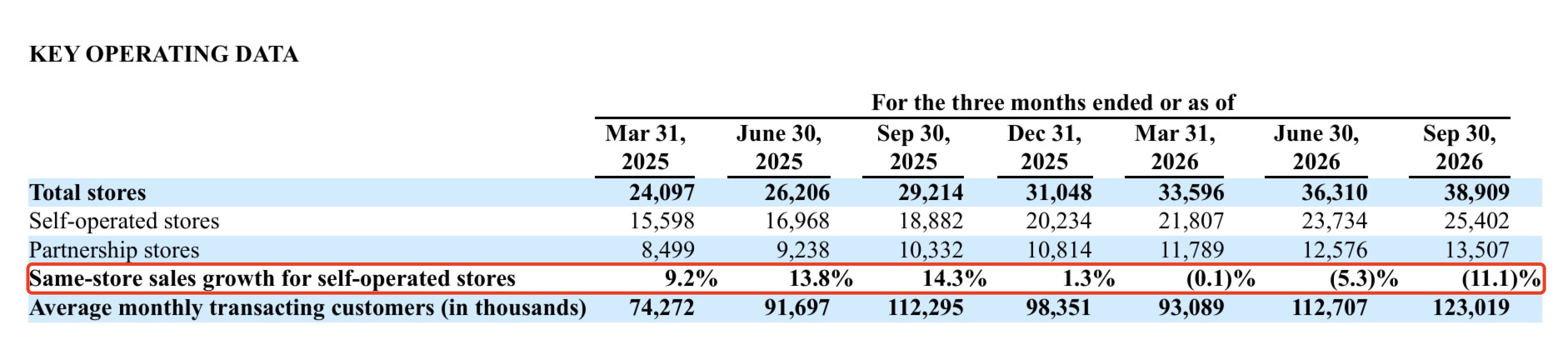
产品表现上,第三季度,瑞幸咖啡共推出41款现制饮品和20多款轻食。在咖啡领域,为强化瑞幸咖啡的专业心智与品牌调性,其推出埃塞瑰夏冷萃,并在此基础上延展出多款冷萃新品。瑞幸咖啡还将此前在Lab店获得积极反馈的两款特调产品推广至全国限时供应。非咖啡领域,瑞幸咖啡在8月新推出的泰奶系列,首周销量超1300万杯,刷新了今年新品的销售记录。

门店方面,截至三季度末,瑞幸咖啡全球门店总数为38909家,其中自营门店有25402家、联营门店有13507家。全球门店中,国际市场门店总数279家,其中新加坡103家、马来西亚154家、美国22家。第三季度,瑞幸咖啡净增门店2599家,其中自营门店1668家、联营门店931家。

3.郭谨一:门店层面利润率已基本恢复到外卖大战前的水平

在财报电话会中,瑞幸咖啡第三季度的自营门店同店销售增长率指标,是大家关注的重点。

据悉,7月以来,瑞幸咖啡自营门店同店销售增长率的跌幅逐月收窄。郭谨一指出,随着外卖补贴及配送成本的大幅下降,自营门店盈利能力持续改善,门店层面利润率不仅显著高于去年同期,也已基本恢复到了外卖大战前的水平。“与2024年三季度相比,当前外卖占比仍明显更高,同时门店规模接近翻倍,而本季度自营门店层级的营业利润率已和当时基本一致。这些经营成果进一步验证了瑞幸的规模增长模式,也增强了我们对长期发展前景的信心。”他如是说。

杯量结构的健康是瑞幸咖啡关注的重点之一。“我们觉得更重要的是,随着客户逐渐回归自提,瑞幸的整体杯量结构也更加健康,更加有利于发挥瑞幸在线下门店网络和运营效率方面的优势。”郭谨一表示。

郭谨一也在财报电话会中分享了对同店销售增长率指标的看法。他指出,同店增长指标一直是餐饮行业重点关注的一项经营指标,但在不同发展阶段,它所代表的意义也有所不同。对于已经相对成熟的餐饮企业和行业,同店增长是收入和利润增长的重要来源。而对于刚起步发展的中国咖啡消费行业,对于仍处于快速扩张阶段的瑞幸咖啡来说,业绩增长不仅来自于现有门店,也来自于持续扩大的门店网络和整体运营效率的提升。“我们不会孤立的、静态的看待同店指标,而是更加着眼长期,关注整体业务的增长节奏和质量。”

郭谨一进一步指出,第三季度,虽然同店销售增长率指标因为高基数和补贴收缩的影响有所波动,但整体消费需求依然保持良好的势头。瑞幸咖啡的月均交易客户数和人均杯量都再创新高、同店增长也在持续改善之中、门店层面的盈利能力也在稳步恢复。“这也说明不能仅仅凭着短期的同店波动来判断公司的增长质量,而是要从中国咖啡行业的长远发展视角和瑞幸商业模式的底层运行逻辑出发,结合用户指标、业务规模和盈利表现进行一个综合的分析判断。”他总结道。

亿邦持续追踪报道该情报,如想了解更多与本文相关信息,请扫码关注作者微信。

本文首发于 亿邦动力 官方网站

【版权提示】亿邦动力倡导尊重与保护知识产权。未经许可,任何人不得复制、转载、或以其他方式使用本网站的内容。如发现本站文章存在版权问题,烦请提供版权疑问、身份证明、版权证明、联系方式等发邮件至run@ebrun.com,我们将及时沟通与处理。

已点赞

+1

{{ praise_text }}

好文章,值得被更多人看到

FAQ回顾

瑞幸咖啡2026年第三季度财报核心业绩如何?

2026年第三季度,瑞幸咖啡总净收入179亿元,同比增长17.0%;GAAP营业利润27.56亿元,同比增长55.1%;净利润18.59亿元,同比增长45.4%,净利率10.4%。月均交易客户1.23亿,全球门店38909家。

瑞幸咖啡第三季度配送费用为什么大幅下降?

第三季度配送费用为17.89亿元,同比减少38.1%。主要原因是订单结构从配送转向自取,配送费用占总净收入比例下降,也带动总营业费用占比由2025年同期的88.4%降至84.6%。

瑞幸咖啡目前全球门店规模是多少?

截至2026年三季度末,瑞幸咖啡全球门店总数38909家,其中自营门店25402家、联营门店13507家;国际市场门店279家,包括新加坡103家、马来西亚154家、美国22家。本季度净增门店2599家。

瑞幸咖啡自营门店同店销售下降的原因是什么?

第三季度瑞幸自营门店同店销售增长率为-11.1%。郭谨一称,2025年7月至8月外卖大战高补贴形成较高基数,对2026年三季度同比影响更明显;随着补贴和配送成本下降,门店层面利润率已基本恢复至外卖大战前水平。

广告

下一篇

征集报名《品牌数字化服务商资源手册》

《品牌数字化服务商资源手册》展示数字化服务商风采,亿邦全年零售大会通发,触达更多资源,马上加入!

马上入驻

Pattern:黑五争取的不只是订单 还有大促后的自然流量 | 黑五微访谈

黑五广告成本上涨,如何让投入在大促结束后继续带来销量?Pattern栢藤将提升商品自然排名、积累自然流量,作为今年大促的重要目标。