• 亿邦公众号
    • APP下载

得物发布《2026户外年轻人消费解读》:户外用户数复合增长65%,品牌营收复合年增长82%

作者:龚作仁 文章来源:Laborer

2026-09-18 13:17

作者:龚作仁 文章来源:Laborer

2026-09-18 13:17

邦小白快读

EN
全文速览

这份得物联合欧睿国际发布的《2026户外年轻人消费解读》,梳理了当下年轻人户外消费的最新特征,能为普通消费者参与户外活动、选购户外装备提供实用参考。

1. 户外参与门槛正在降低,不用特意凑长假、等大促节点再准备装备,61%的消费者是临时起意购买户外用品,超六成用户会利用工作日晚间、周末的碎片化时间参与户外活动,搜索装备时可以直接输入具体场景关键词,比如“武功山徒步穿搭”“玉龙雪山OOTD”,比泛搜商品名的参考性更强。

2. 装备选购可以优先参考真实用户体验,60%的消费者更信任有实际使用经历的博主或买手分享,超半数人对AI生成的营销内容持保留态度,多看普通用户、资深玩家的真实体验帖,能有效降低踩坑概率。

3. 户外装备选择越来越多元,不用盲目追捧高价尖货,除了顶级专业款,还有颜值功能兼顾款、高性价比日常款等不同定位的产品,可以根据自身实际需求挑选。

这份报告披露了户外赛道的最新消费趋势、用户特征与渠道增长数据,能为品牌制定经营策略、挖掘增长机会提供明确参考。

1. 渠道增长价值突出,得物平台户外用户数复合增长率达65%,平台内品牌营收复合年增长率达82%,触达的用户比其他渠道年轻5-10岁,是品牌连接年轻消费群体的重要阵地,当前平台消费从季节性大促爆发转向日常长销,品牌可以调整运营节奏布局全年经营。

2. 用户行为出现结构性变化,59%的户外搜索由场景关键词驱动,60%的用户更信任真实体验分享,品牌营销可以围绕具体户外场景产出内容,联动日常博主、圈层OG、种草博主搭建多元内容矩阵,用有“活人感”的沟通方式触达用户,缩短从种草到转化的链路。

3. 产品布局方向清晰,除了打造极致专业的尖货建立信任,还可以布局颜值功能结合款、细分价格带高质价比款、限定礼赠款,同时通过品类延伸寻找第二曲线,重点挖掘占比48%、增速超男性24%的女性消费者,以及占比35%的高校学生群体。

这份报告透传了户外消费赛道的最新增长信号与可落地的运营方法,能为卖家找准机会、优化经营提供直接参考。

1. 赛道增长基本面扎实,得物平台户外用户复合增长率达65%,品牌营收复合年增长率达82%,户外消费正从传统的季节性、节点性集中消费,转向全年随时发生的日常消费,日常长销的盈利空间大于单次大促爆发。

2. 需求变化催生大量新机会,59%的搜索由场景关键词驱动,61%的消费是临时起意决策,83%的用户同时参与两项以上户外运动,细分装备增长迅猛,其中越野跑鞋同比增长108%、登山鞋增长76%、登山杖增长85%、抓绒服增长62%,美利奴羊毛面料产品、攀岩等细分垂直赛道也存在明显增量。

3. 可复制的运营逻辑清晰,要重视真实内容的种草价值,联动不同类型创作者覆盖用户全决策链路;货品端不要只盯着尖货,可以布局专业性能、颜值功能双优、高性价比、限定礼赠四类货盘,重点挖掘女性、校园两大增量人群,借助“社区+电商”的模式实现种草即买,提升转化效率。

这份报告披露的户外消费市场需求变化,能为工厂的产品设计、产能布局、渠道对接提供明确的方向指引。

1. 产品设计与生产的方向清晰,除了传统的极致专业性能款户外装备,三类产品的市场需求旺盛:一是兼顾美学设计与实用功能的款式,比如可隆“粉芭蕾”露营鞋实现了1600元的溢价;二是瞄准细分价格带的高质价比产品,比如定位1000-1200元价格带的喜马拉雅玉龙羽绒服月销售额突破2000万元;三是适配女性、校园人群的专属款式,比如女性专属配色、符合学生消费能力的高性价比户外单品。

2. 潜力品类的增长信号明确,越野跑鞋、登山鞋、登山杖、抓绒服等细分装备增速均超60%,美利奴羊毛面料相关户外产品、攀岩等细分垂直赛道的装备需求持续上涨,头部品牌也在主动拓展品类边界,比如萨洛蒙从鞋类拓展至服装品类后相关营收同比增长2900%,工厂可以提前布局对应产能。

3. 供货模式需要调整,可以对接得物这类“社区+电商”平台的品牌客户,适配平台日常长销的供货节奏,替代传统只服务大促节点的集中供货模式。

这份报告梳理了户外赛道的发展趋势与品牌经营的核心链路,能为服务商找准服务方向、打磨服务产品提供务实参考。

1. 赛道整体服务需求持续上涨,当前户外品类保持高成长性,得物平台户外用户复合增长65%,品牌营收复合年增长82%,消费模式从节点性大促转向日常长销,品牌对覆盖日常经营、内容种草、交易转化全链路的服务需求会持续提升。

2. 品牌经营的核心痛点明确:一是场景化内容生产的需求,59%的户外搜索由场景关键词驱动,品牌需要能结合具体户外场景产出内容的相关服务;二是用户信任构建的需求,60%的用户更信任真实体验内容,58%的用户对AI生成内容持保留态度,纯AI营销内容的转化效果有限,服务商需要打磨能联动多元创作者、产出真实体验内容的服务,覆盖用户从产生兴趣到选购装备的全决策阶段。

3. 货盘规划服务存在缺口,当前市场进入“后尖货时代”,品牌需要专业的货品定位服务,帮助其布局多元货盘,挖掘女性、校园人群的增量机会。

这份报告展示了得物在户外赛道的运营成果与成熟经验,能为各类内容电商平台布局户外品类、优化运营体系提供参考。

1. 户外品类的平台价值突出,当前户外赛道用户规模、品牌营收均保持高速增长,消费习惯从季节性节点消费转向日常碎片化、即时性消费,平台需要打通内容社区与电商交易的通道,适配“种草即买”的消费链路,帮助合作品牌实现从依赖大促爆发到日常长销的经营转型。

2. 内容生态的运营方向明确,要搭建覆盖日常博主、圈层OG、种草博主、品牌官方的多元创作者矩阵,鼓励真实体验内容产出,减少低质AI内容对用户决策的干扰,得物的实践显示,平台内80%的动态带有商品链接,20%的GMV由社区行为直接贡献,充分验证了真实内容的转化价值。

3. 招商与运营管理要多元布局,不要只聚焦头部尖货商品,要引入覆盖专业性能、颜值功能双优、高性价比、限定礼赠等多元定位的品牌与商品,同时重点挖掘女性、校园等新增量人群的需求,围绕“好货、好价、好内容、好服务”优化平台供给体系。

这份基于得物全量用户消费数据、2528份户外运动消费者定量调研、50个合作户外品牌经营实践形成的行业报告,呈现了国内户外消费产业的最新动向,具备较高的产业研究价值。

1. 产业增长逻辑出现新变化,当前户外赛道保持高成长性,得物平台户外用户数复合增长率达65%,品牌营收复合年增长率达82%,户外消费正从传统的特定运动场景、季节性节点消费,全面融入年轻人的日常多元生活,用户利用碎片化时间参与户外、同时参与多项户外运动成为常态,消费节奏转向全年即时发生。

2. 消费行为呈现新特征,消费入口从“搜索商品”转向“搜索场景”,59%的户外搜索由场景关键词驱动;消费决策从关注商品参数转向关注真实使用体验,60%的用户更信任真实用户分享,超半数用户对AI生成营销内容持保留态度。

3. 产业经营出现新模式,“社区+电商”的内容交易闭环有效缩短了从种草到转化的链路,市场进入“后尖货时代”,品牌增长逻辑从单爆品打造转向多元货盘布局、品类延伸、细分赛道拓展,女性、校园人群成为核心增量,用户结构从男性主导转向性别均衡、全面覆盖年轻群体。

声明:快读内容全程由AI生成,请注意甄别信息。如您发现问题,请发送邮件至 run@ebrun.com 。

我是 品牌商 卖家 工厂 服务商 平台商 研究者 帮我再读一遍。

Quick Summary

The *2026 Insights on Young Consumers’ Outdoor Spending*, released jointly by Dewu (Poizon) and Euromonitor International, maps the latest patterns in young people’s outdoor consumption, offering practical guidance for general consumers to participate in outdoor activities and select gear.

1. Barriers to outdoor participation are falling. There is no need to wait for long holidays or major shopping promotions to prepare equipment: 61% of consumers make outdoor gear purchases on impulse, and over 60% take part in outdoor activities during fragmented time slots such as weekday evenings and weekends. When searching for gear, using scenario-specific keywords such as "Wugong Mountain hiking outfits" or "Yulong Snow Mountain OOTD" delivers more relevant references than generic product name searches.

2. Prioritize real user experiences when selecting gear. 60% of consumers place greater trust in reviews from bloggers or buyers who have actually used the products, and over half are skeptical of AI-generated marketing content. Reading first-hand experience posts from ordinary users and veteran outdoor enthusiasts can effectively reduce the risk of unsatisfactory purchases.

3. Outdoor gear options are increasingly diversified, so there is no need to blindly chase premium, high-priced flagship products. Beyond top-tier professional options, the market offers products balancing aesthetic design and functionality, as well as cost-effective daily-use models, allowing consumers to choose based on their actual needs.

This report discloses the latest consumption trends, user characteristics and channel growth data in the outdoor sector, providing clear references for brands to formulate business strategies and identify growth opportunities.

1. Channel growth value is prominent: Dewu’s outdoor user base has recorded a compound annual growth rate (CAGR) of 65%, while brand revenue on the platform has grown at a CAGR of 82%. The platform’s user base is 5 to 10 years younger than that of other channels, making it a key position for brands to connect with young consumers. As consumption on the platform shifts from seasonal promotion-driven spikes to consistent year-round sales, brands can adjust their operational rhythm to plan for full-year operations.

2. User behavior is undergoing structural changes: 59% of outdoor searches are driven by scenario-specific keywords, and 60% of users trust real experience sharing more. For marketing, brands can produce content centered on specific outdoor scenarios, build a diversified content matrix covering lifestyle bloggers, niche community key opinion leaders (OGs) and seeding-focused creators, engage users with authentic, relatable communication, and shorten the path from product discovery to conversion.

3. Product positioning directions are clear: Beyond building credibility through top-tier professional flagship products, brands can develop lines that balance aesthetics and functionality, high cost-performance options across segmented price tiers, and limited-edition gift sets. They can also explore second growth curves through category expansion, with a focus on tapping the female consumer segment (which accounts for 48% of users and is growing 24% faster than the male segment) and the college student group (35% of users).

This report delivers the latest growth signals and actionable operational approaches for the outdoor consumption sector, providing direct references for sellers to identify opportunities and optimize business performance.

1. The sector has solid growth fundamentals: Dewu’s outdoor user base has grown at a CAGR of 65%, and brand revenue on the platform at a CAGR of 82%. Outdoor consumption is shifting from traditional seasonal, promotion-focused concentrated spending to year-round, everyday purchases, with steady daily sales offering greater profit potential than one-off promotion surges.

2. Demand shifts are creating abundant new opportunities: 59% of searches are driven by scenario keywords, 61% of purchases are impulsive decisions, and 83% of users participate in two or more types of outdoor sports. Segmented gear categories are seeing rapid growth, with trail running shoes up 108% year-over-year (YoY), hiking boots up 76%, trekking poles up 85%, and fleece apparel up 62%. Clear growth potential also exists in niche verticals such as merino wool products and rock climbing equipment.

3. Replicable operational logic is well defined: Sellers should prioritize the seeding value of authentic content, collaborating with different types of creators to cover the full user decision journey. On the inventory side, instead of focusing solely on flagship premium products, they can build a product portfolio covering professional performance gear, items that balance aesthetics and functionality, cost-effective options, and limited-edition gift sets. They should also focus on the high-growth female and campus user segments, and leverage the "community + e-commerce" model to enable instant purchases at the point of product discovery, improving conversion efficiency.

The shifts in outdoor consumer market demand disclosed in this report provide clear guidance for factories on product design, capacity planning and channel partnership.

1. Product design and production directions are clear: Beyond traditional high-performance professional outdoor gear, three product categories show strong market demand: First, items that balance aesthetic design and practical functions, such as Kolon's "Pink Ballet" camping shoes which command a price premium of 1,600 yuan. Second, high cost-performance products targeting segmented price bands, such as the Himalaya Yulong down jacket positioned at the 1,000–1,200 yuan price point, which has achieved monthly sales exceeding 20 million yuan. Third, exclusive styles tailored to female and campus consumer groups, such as women-specific colorways and cost-effective outdoor items priced to suit student spending power.

2. Growth signals for high-potential categories are clear: Segmented gear including trail running shoes, hiking boots, trekking poles and fleece apparel are all growing at over 60% YoY. Demand for merino wool outdoor products and equipment for niche verticals such as rock climbing continues to rise. Leading brands are also actively expanding category boundaries: for example, Salomon saw 2900% YoY revenue growth in its apparel line after expanding from footwear into clothing. Factories can plan corresponding production capacity in advance.

3. Supply models require adjustment: Factories can partner with brand clients on "community + e-commerce" platforms such as Dewu, adapting to the consistent year-round supply rhythm of the platforms, rather than relying solely on the traditional concentrated supply model serving major promotion nodes.

This report outlines the development trends of the outdoor sector and the core operational links for brand management, offering practical references for service providers to identify service directions and refine service offerings.

1. Overall service demand across the sector continues to rise: The outdoor category maintains high growth momentum, with Dewu’s outdoor user base growing at a CAGR of 65% and brand revenue on the platform growing at a CAGR of 82%. As consumption patterns shift from promotion-driven spikes to steady daily sales, brands will see growing demand for services covering the full operational chain: daily operation, content seeding, and transaction conversion.

2. Core pain points in brand operations are clear: First, there is strong demand for scenario-based content production, as 59% of outdoor searches are driven by scenario keywords, creating a need for services that help brands produce content tied to specific outdoor scenarios. Second, brands need support in building user trust: 60% of users place greater trust in real experience content, and 58% are skeptical of AI-generated content, meaning pure AI marketing content delivers limited conversion results. Service providers need to develop offerings that bring together diverse creators to produce authentic experience content, covering the full user decision journey from initial interest to gear purchase.

3. There is an unmet need for product portfolio planning services: As the market enters the "post-flagship era", brands require professional product positioning support to help them build diversified product assortments and tap growth opportunities among female and campus consumer groups.

This report showcases Dewu’s operational achievements and proven experience in the outdoor sector, providing references for all types of content e-commerce platforms looking to build out their outdoor categories and optimize their operational systems.

1. The outdoor category delivers significant platform value: The outdoor sector currently maintains rapid growth in both user scale and brand revenue. As consumption habits shift from seasonal, occasion-based purchases to fragmented, on-demand daily spending, platforms need to connect content communities with e-commerce transactions to support the "see now, buy now" consumption path, helping partner brands transition from relying on promotion-driven spikes to steady year-round sales.

2. Content ecosystem operation directions are clear: Platforms should build a diversified creator matrix covering lifestyle bloggers, niche community OGs, seeding-focused creators and official brand accounts, encourage the production of authentic experience content, and reduce the interference of low-quality AI content with user decision-making. Dewu’s practice shows that 80% of posts on the platform include product links, and 20% of GMV is directly driven by community interactions, fully validating the conversion value of authentic content.

3. Merchant recruitment and operation management should adopt a diversified layout: Instead of focusing exclusively on top-tier flagship products, platforms should onboard brands and products spanning professional performance gear, items balancing aesthetics and functionality, cost-effective options, and limited-edition gift sets. They should also prioritize addressing the demand of high-growth user segments such as female consumers and college students, and optimize the platform’s supply system around the pillars of "quality products, fair prices, good content, and reliable service."

This industry report, based on Dewu’s full-platform user consumption data, a quantitative survey of 2,528 outdoor sports consumers, and the operational practices of 50 partner outdoor brands, presents the latest trends in China’s domestic outdoor consumption industry and holds high value for industrial research.

1. The industry’s growth logic is undergoing new changes: The outdoor sector maintains strong growth momentum, with Dewu’s outdoor user base growing at a CAGR of 65% and brand revenue on the platform at a CAGR of 82%. Outdoor consumption is shifting from its traditional association with specific sports scenarios and seasonal, occasion-based spending to becoming fully integrated into young people’s diverse daily lives. It has become the norm for users to participate in outdoor activities during fragmented time slots and take part in multiple outdoor sports, with consumption occurring on a year-round, on-demand basis.

2. Consumer behavior exhibits new characteristics: The entry point for consumption is shifting from "product searches" to "scenario searches", with 59% of outdoor searches driven by scenario-specific keywords. Purchase decisions are shifting from a focus on product specifications to a focus on real-world use experiences: 60% of users place greater trust in shares from real users, and over half are skeptical of AI-generated marketing content.

3. New operational models are emerging in the industry: The "community + e-commerce" closed loop of content and transactions effectively shortens the path from product discovery to conversion. The market has entered the "post-flagship era", where brand growth logic is shifting from building single hit products to diversified product portfolio layout, category extension, and expansion into segmented verticals. Female consumers and campus groups have become core growth drivers, with the user structure shifting from male-dominated to gender-balanced, fully covering young demographic groups.

Disclaimer: The "Quick Summary" content is entirely generated by AI. Please exercise discretion when interpreting the information. For issues or corrections, please email run@ebrun.com .

I am a Brand Seller Factory Service Provider Marketplace Seller Researcher Read it again.

近日,得物App与欧睿国际基于得物用户消费数据洞察,以及覆盖2528名户外运动消费者的定量调研,联合50个运动户外品牌官方发布《2026得物户外年轻人消费解读》(以下简称《报告》)。《报告》从消费场景、内容生态、商品经营及人群结构等维度,洞察年轻人户外消费的新趋势,呈现户外消费市场正在发生的变化,为品牌探索新的增长机会提供参考。

据悉,这是得物连续第二年发布户外行业报告。去年,得物首次发布户外白皮书,围绕商品供给与品牌经营沉淀尖货、标杆品等运营方法。今年,伴随户外消费人群和场景进一步扩展,得物户外用户数复合增长率达65%,品牌营收复合年增长率达82%。从用户规模与品牌经营表现来看,户外消费正逐步突破传统运动场景,融入年轻人更加日常、多元的生活方式。
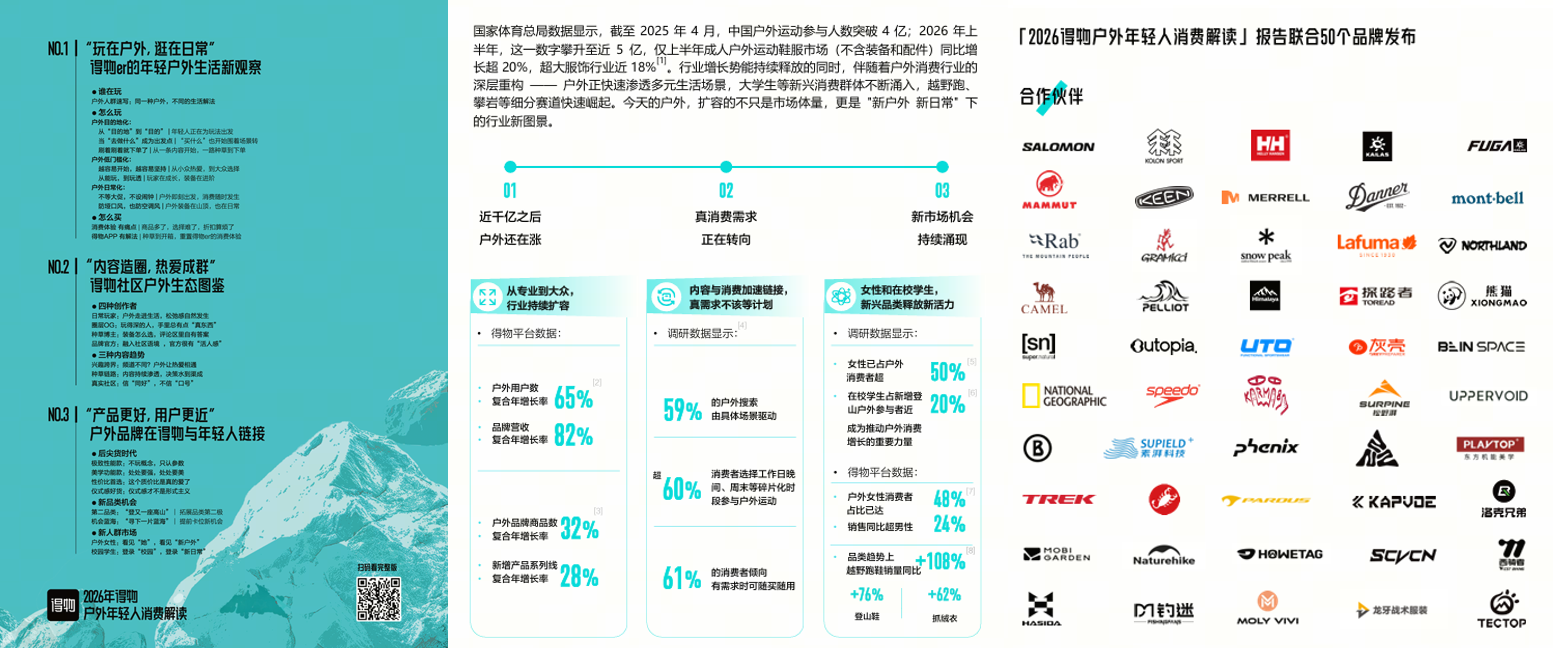
年轻人户外消费转向“即时发生”,59%运动户外搜索由场景驱动

《报告》显示,年轻人的户外消费正在发生结构性变化,消费入口从“商品”转向“场景”。

数据显示,44%的消费者因运动本身的吸引力而参与户外活动,33%的消费者则是因为刷到社交媒体上的户外真实体验内容而产生兴趣。在得物社区,59%的运动户外搜索由场景关键词驱动。相比直接搜索“冲锋衣”,消费者更倾向于搜索“武功山徒步穿搭”“玉龙雪山OOTD”等与具体户外场景相关的内容。

消费场景的变化,也带来了消费节奏的变化。61%的户外消费者属于临时起意购买,83%的用户同时参与两项以上户外运动,超过60%的消费者选择工作日晚间、周末等碎片化时间参与户外活动。

这意味着,户外消费正从相对集中的季节性、节点性消费,逐渐融入年轻人的日常生活。消费全年随时发生,得物“社区+电商”的模式,帮助消费者种草即买,助力品牌经营从大促爆发转向日常长销。与此同时,细分户外装备也迎来增长:越野跑鞋同比增长108%,登山鞋同比增长76%,登山杖同比增长85%,抓绒服同比增长62%。
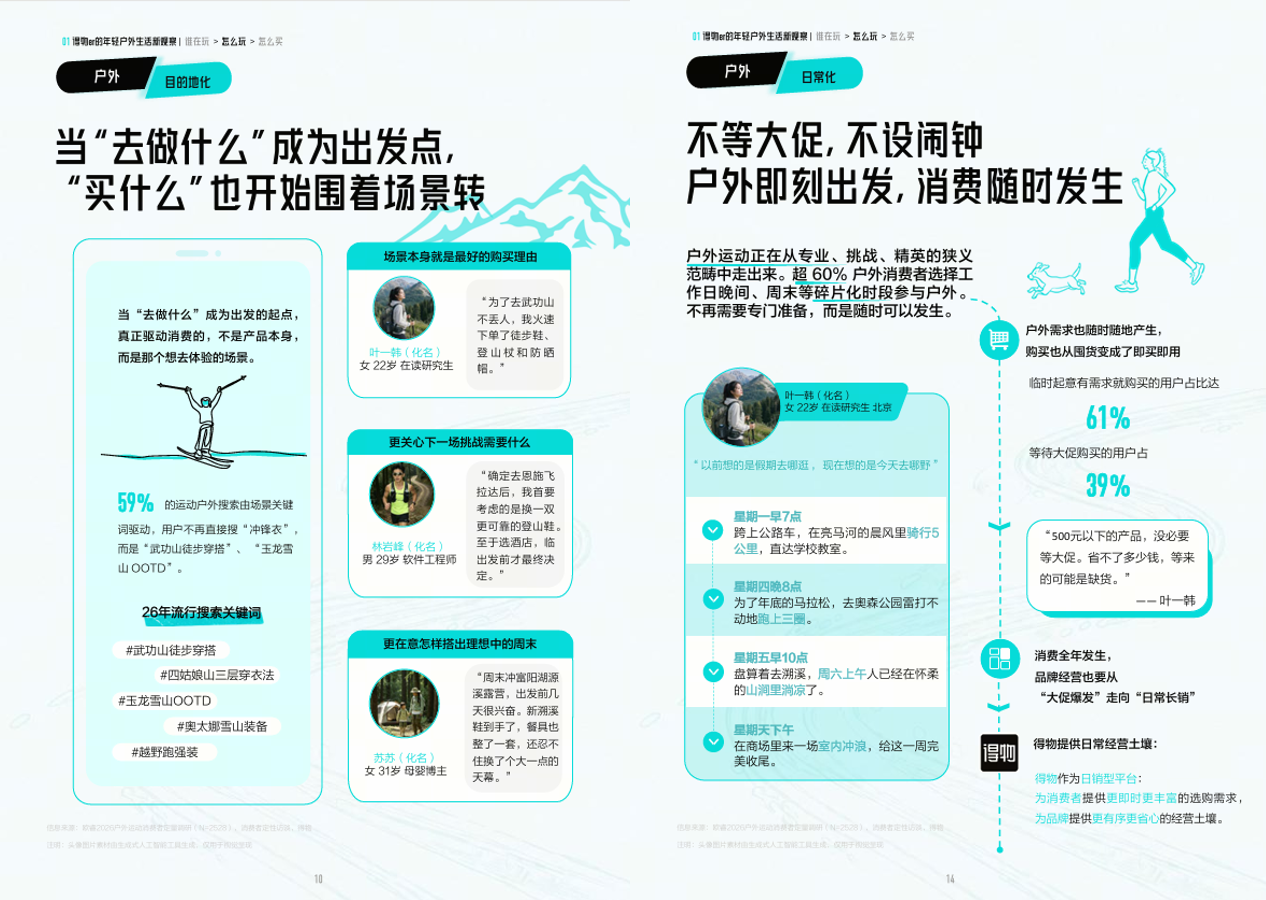
年轻人从“看商品”转向“看体验”,60%用户更信任真实分享

当消费入口从商品转向场景,真实体验内容也进一步进入年轻人的消费决策。《报告》显示,60%的消费者更信任具有真实使用体验的种草博主或买手,58%的消费者对AI生成内容持保留态度。在这一趋势下,内容的价值正在从单纯提供商品信息,转向提供真实的使用经验与消费参考。

在得物社区,多元的创作者生态覆盖了户外消费决策的不同阶段。日常博主分享真实户外体验,户外博主类日常话题在得物社区总贴占比63%;圈层OG输出专业判断,“重装徒步”话题次数同比增长4.8倍;种草博主提供装备参考,“2026户外装备榜”话题次数同比增长70%;品牌官方融入得物社区语境,用“活人感”与消费者直接对话,如伯希和品牌2026话题次数同比增长11倍。

从产生兴趣到研究装备,四类创作者覆盖了户外消费决策的不同阶段,也进一步缩短了内容与交易之间的距离。真实分享也驱动了真实消费,据得物数据显示,70%的用户会浏览社区,80%的动态直接带商品链接,20%的GMV由社区行为直接贡献。得物持续完善从内容种草、商品比较到交易转化的消费链路,并围绕“好货、好价、好内容、好服务”持续优化平台供给与服务,为年轻消费者提供更加完整的户外消费体验。
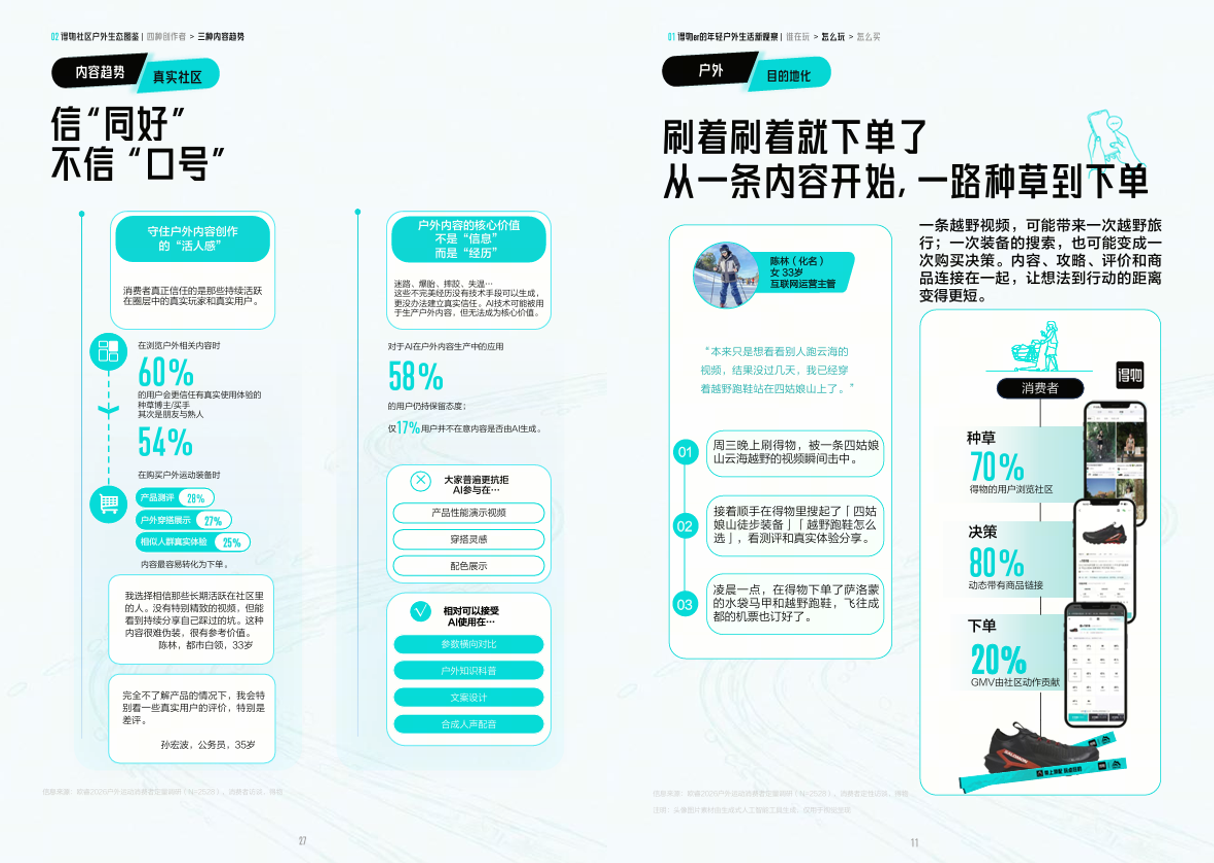
户外市场进入“后尖货时代”,女性、校园人群成为户外消费新增量

随着户外消费人群和场景持续扩展,得物的户外消费也正在从单纯围绕“尖货”展开,进一步进入“后尖货时代”。

在得物,品牌正在形成多元的好货方向。一类是通过极致性能建立专业信任,例如凯乐石MONT-X冲锋衣成为国内高阶户外冲锋衣TOP1;一类是以美学功能承接消费者对颜值与功能的双重需求,例如可隆“粉芭蕾”露营鞋实现溢价1600元;还有品牌通过高质价比切入细分价格带,例如喜马拉雅玉龙羽绒服月销售额突破2000万元,位居1000至1200元价格带TOP1;此外,限定礼赠也成为品牌制造话题的方式,萨洛蒙茶马古道限定礼盒1秒售罄,溢价超过30%,曝光超过4700万。

与此同时,品牌也在通过品类延伸寻找第二增长曲线。萨洛蒙从鞋类进一步拓展至服装,服装品类同比增长2900%;得物也在持续关注美利奴羊毛等潜力品类,使其从传统面料逐渐成为户外消费的新选择。针对更加细分的户外运动,Karma8a专注攀岩赛道,入驻得物30天兴趣人群新增20万。从单一爆品到品类扩张,再到新兴细分赛道,户外品牌的增长机会正在从“打造一款尖货”延伸至更完整的商品经营。
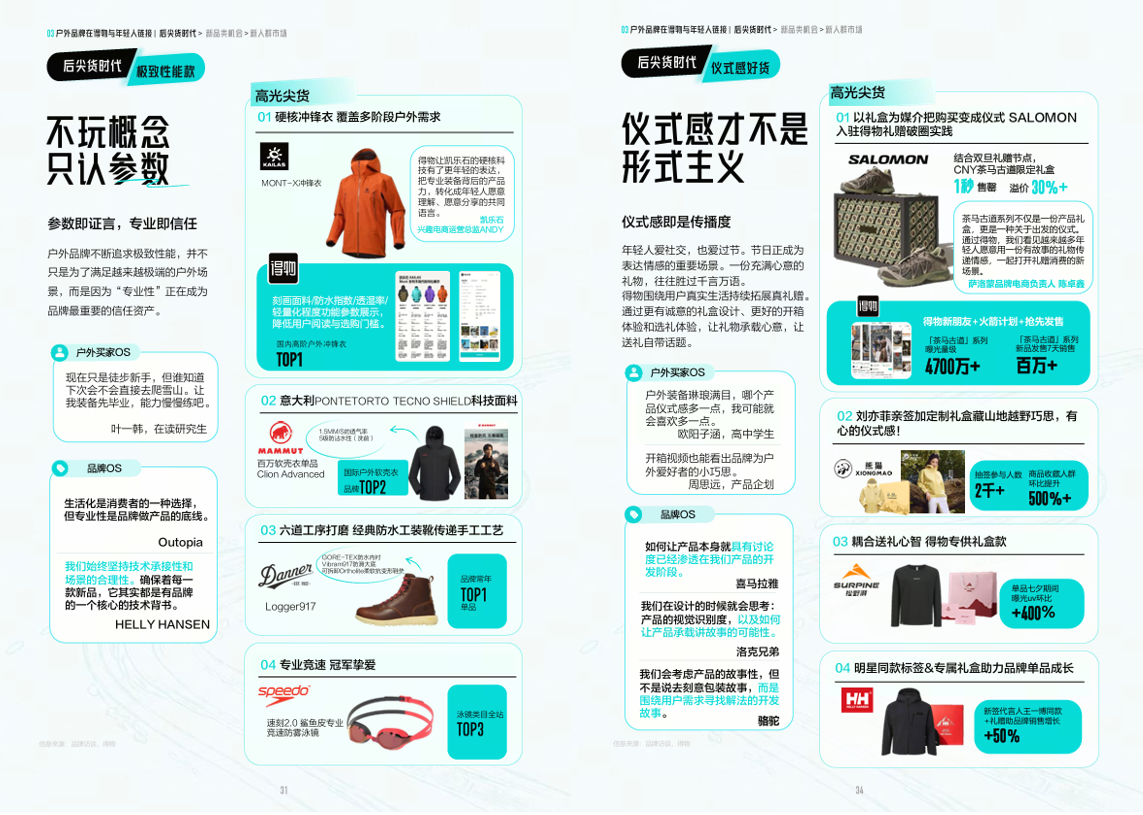
人群结构的变化同样值得关注。《报告》显示,得物户外女性消费者占比已经达到48%,男女消费者比例接近各半;2026年以来,女性消费者销售增速高于男性24%。品牌也在通过产品与内容进一步触达女性消费者。凯乐石通过女性专属配色与明星同款,将女性用户占比从27%提升至44%;伯希和风盾软壳衣则成为得物女性消费者首选户外外套,为品牌带来超过1万名女性用户。

校园被视为年轻人接触户外运动的重要起点。《报告》显示,得物户外消费者中高校学生占比达到35%。骆驼通过“造浪计划”切入校园市场,月销售额突破千万元,得物校园人群占比达到33%。相关品牌方表示,品牌在得物触达到的用户人群,比其他渠道年轻5至10岁。得物的人群结构,为品牌获取年轻用户提供了基础。从男性主导的传统户外消费人群,到校园人群、女性等新消费群体持续进入,户外市场的人群边界正在进一步扩大。

当户外逐渐从一种特定的运动方式融入年轻人的日常生活,“新日常”也成为户外消费持续发展的重要背景。围绕年轻人的消费场景、内容需求与商品需求,得物将继续深耕运动户外领域,持续完善从趋势发现、内容种草到商品交易的消费链路,帮助品牌与年轻消费者建立更长期的连接。

注:文/龚作仁,文章来源:Laborer,本文为作者独立观点,不代表亿邦动力立场。

【版权提示】亿邦动力倡导尊重与保护知识产权。未经许可,任何人不得复制、转载、或以其他方式使用本网站的内容。如发现本站文章存在版权问题,烦请提供版权疑问、身份证明、版权证明、联系方式等发邮件至run@ebrun.com,我们将及时沟通与处理。

已点赞

+1

{{ praise_text }}

好文章,值得被更多人看到

FAQ回顾

当前年轻人户外消费呈现哪些新趋势?

当前年轻人户外消费呈现三大新趋势:一是消费入口从商品转向场景,59%运动户外搜索由场景关键词驱动,消费从季节性节点性转向日常化;二是消费决策更信任真实体验内容,60%消费者认可真实使用分享;三是人群持续扩容,女性、校园群体成为消费新增量。

得物平台户外品类的经营增长数据如何?

得物户外品类增长表现突出,平台户外用户数复合增长率达65%,合作户外品牌营收复合年增长率达82%;细分装备增长迅猛,越野跑鞋同比增108%、登山鞋增76%、登山杖增85%,平台社区内容直接贡献20%的户外品类GMV。

户外品牌在得物有哪些可落地的增长路径?

户外品牌在得物可通过多路径实现增长:打造极致性能专业产品建立用户信任,推出兼顾颜值与功能的产品,布局高质价款切入细分价格带,推出限定款制造话题,也可通过拓展品类、触达女性及校园人群挖掘新的增长空间。

哪些因素会影响年轻人的户外消费决策?

真实体验内容是影响年轻人户外消费决策的核心因素,60%的消费者更信任有真实使用体验的博主或买手分享,58%的消费者对AI生成内容持保留态度,覆盖决策全链路的多元创作者内容可有效缩短内容到交易的转化路径。

广告

下一篇

跨境电商资源对接

《全球跨境电商服务商资源手册》第二期手册现已发布,触达更多资源,了解跨境服务商信息,欢迎点击链接下载。

了解详情

圆桌对话:全球化进程加速 品牌如何从有界跨越到无界?

Accelerate 2026 China跨境生态加速大会在深圳召开。在上午的“品牌从有界跨越到无界的实践与思考”圆桌对话环节,亿邦动力联合创始人、马蹄社CEO刘宸担任主持,并对“无界”做出解读。