• 亿邦公众号
    • APP下载

亿邦智库发布《2026全球化新品牌AI竞争力报告》

作者:亿邦动力 文章来源:亿邦动力

2026-07-27 11:13

作者:亿邦动力 文章来源:亿邦动力

2026-07-27 11:13

邦小白快读

EN
全文速览

本文核心是亿邦智库发布的《2026全球化新品牌AI竞争力报告》的核心干货内容,当前全球化新品牌进入物种爆发期,AI已成为驱动行业发展的核心引擎,核心信息整理如下

1. 行业整体发展逻辑:全球化新品牌由五大力量交汇驱动,分别是内卷竞争从国内延展到跨境、中国全球供应链规模扩张、工程师红利质变、AI平权抹平算力鸿沟、品牌内核审美觉醒,整体进入快速增长阶段。

2. 行业核心发展方向:明确产品AI化、品类场景化、品牌生态化三大核心方向,产品AI化分为增强、幻化、创物三层递进,品类围绕细分场景做规模化创新,品牌依托AI延伸生态建立竞争壁垒。

3. 未来发展趋势:指出产品走向拟专业技能人设、品牌呈现反流量特征、组织进化为创造型全球化组织三个趋势,同时点明行业当前面临的认知转型挑战。

这份报告为出海全球化新品牌提供了AI转型的完整方向和实践参考,围绕品牌商关注的各类核心问题整理干货如下

1. 消费趋势与产品研发:当前生活方式细分带来大规模场景化产品需求,AI可驱动既有产品持续升级,也能催生全新产品形态;研发逻辑可转变为将智能服务作为规划起点,以日常穿戴为切口反向推导产品设计,更容易落地。

2. 品牌建设与竞争:品牌可依托AI挖掘海外细分需求,围绕核心爆款的科技或美学基因延伸生态产品线,拉高复购和客单价;也可走反流量路线,靠成熟用户认知获得免费自然流量,逐步转型非价格竞争的研发型品牌。

3. 营销发展方向:当前AI正在接管营销全流程,品牌竞争焦点已经转向AI驱动的全链路效率,素材产能、投放精度和用户资产沉淀能力决定品牌增长身位。

这份报告为跨境出海卖家梳理了AI转型的方向、可落地的机会以及需要警惕的风险,核心干货整理如下

1. 市场机会判断:当前全球化新品牌处于物种爆发期,AI带来了产品升级、场景创新、生态扩张的多重增长机会,不同体量、不同品类的卖家都可以获得对应AI工具支持,比如SHOPLINE就推出了覆盖全链路的场景化AI工具链,降低转型门槛。

2. 可借鉴的实践经验:营销端可参考飞书深诺的多AI协同全链路营销模式,提升决策效率和精准度;物流端可根据自身品类选择履约模式,中大件选海外仓、轻小件选直邮、高复购品类用爆款入仓加长尾直发的混合模式。

3. 风险与挑战提示:卖家需要注意AI转型的核心挑战,创始人需要转向AI训练师角色,数据飞轮需要冷启动投入,要认清AI的能力边界,必须掌握当地市场规则,竞争逻辑要从大牌平替转向非价格竞争,估值逻辑也要从GMV崇拜转向留存信仰。

这份报告为出海制造工厂指明了产品升级方向、数字化转型路径以及新的商业机会,核心干货整理如下

1. 产品生产与设计需求变化:当前市场要求产品走AI化升级路线,产品要支持OTA持续迭代,硬件作为入口,核心盈利点转向软件订阅和增值服务;产品设计逻辑要转变为以智能服务能力为起点,反向推导整机外观、人机交互和长效服务体系,同时还要围绕细分场景做产品组合创新。

2. 新商业机会:随着大模型、多模态交互等技术成熟,很多过去无法实现的产品构想已经具备商业化条件,催生了大量新物种产品,工厂可依托中国全球供应链优势和工程师红利,切入这些新赛道获得增长。

3. 数字化与电商转型启示:工厂可转型研发型品牌,依托AI挖掘海外细分需求,围绕核心产品延伸生态产品线,建立差异化竞争壁垒,还可以借助AI升级供应链和物流体系,提升整体运营效率,获得更高利润空间。

这份报告梳理了跨境服务商AI转型的新范式,点明了行业发展趋势、客户核心痛点和可借鉴的解决方案,核心干货整理如下

1. 行业发展趋势:当前跨境服务已经进入智能体重构的新阶段,正确的增长新范式是构建Agent智能体应用、LLM大语言模型深度整合、Skill技能库持续更新三位一体的服务体系,这一变革覆盖营销、金融支付、物流履约、用户服务四大核心环节。

2. 客户核心痛点:出海品牌商家普遍需要全链路AI赋能来提升运营效率,跨境物流行业长期存在客户画像模糊、销售过程黑盒化、团队能力难以复制的痛点,传统售后响应慢、处理周期长,会影响商家的转化和复购。

3. 可借鉴的解决方案:营销端可打造多Agent协同的全链路营销系统,提升决策准确率和执行效率;物流端可将AI嵌入运价计算、路径规划、风险处置等核心环节,打造端到端的数智履约平台;售后端可推出AI驱动的嵌入式保障服务,提升响应和赔款效率,帮助商家提升转化复购。

这份报告梳理了出海商家对平台服务的核心需求,指明了平台运营发展的方向和需要规避的风险,核心干货整理如下

1. 商家对平台的核心需求:当前不同体量、不同品类的出海商家都有AI转型的需求,需要平台提供覆盖建站、运营、营销到开发者生态的全链路场景化AI工具支持,帮助降低AI转型的门槛,获得增长动能。

2. 可参考的平台最新运营做法:平台可将AI定位为全场景赋能抓手,面向商家推出AI Copilot实现跨平台Agent管理,提升运营效率;面向开发者推出AI代码工具降低定制门槛,打通交易链路,释放AI的长尾普惠价值;面向消费者提升AI搜索入口的可见性,优化体验同时给商家带来更多流量。

3. 需要规避的行业风险:平台要关注行业认知过渡期的挑战,引导商家正确认识AI的能力边界,提醒商家重视本地市场规则,帮助商家适配从GMV崇拜转向留存信仰的行业逻辑转变,推动生态内商家转型研发型品牌,保障平台生态长期稳定增长。

这份报告是亿邦智库聚焦全球化新品牌赛道推出的重磅年度研究成果,梳理了产业最新动向、新问题和新框架,对研究有很高参考价值,核心内容整理如下

1. 产业发展最新动向:当前全球化新品牌由五大力量交汇驱动,已经进入物种爆发期,AI完成了从效率工具到驱动产品、品牌、服务价值创造核心引擎的转变,行业形成了产品AI化、品类场景化、品牌生态化、智能体重构跨境服务的发展格局。

2. 新商业模式变化:产品端AI让OTA持续迭代成为常态,催生了硬件做入口、软件订阅和增值服务盈利的持续增长商业模式;服务端跨境服务商形成了三位一体的智能体服务新范式,催生了全链路AI营销、AI数智物流、AI嵌入式售后等多种新服务模式。

3. 新问题与研究框架:当前行业处于认知过渡期,面临创始人角色转型、数据飞轮冷启动、AI能力边界、估值逻辑转变、竞争逻辑转变等新问题,报告提出了品牌&产品三维支点模型,还拆解了15家全球化新品牌的AI实践案例,为后续研究和行业实践提供了清晰的战略指引。

声明:快读内容全程由AI生成,请注意甄别信息。如您发现问题,请发送邮件至 run@ebrun.com 。

我是 品牌商 卖家 工厂 服务商 平台商 研究者 帮我再读一遍。

Quick Summary

This article summarizes key insights from ebrun Think Tank’s *2026 AI Competitiveness Report for Global New Brands*. It finds that the global new brand sector is currently experiencing a period of explosive growth, with AI emerging as the core engine driving industry development. Key takeaways are as follows:

1. Industry growth drivers: The sector’s rapid expansion is fueled by the convergence of five major forces: intensifying competition spreading from China’s domestic market to cross-border business, the expansion of China’s global supply chain, the qualitative transformation of China’s engineer dividend, AI-enabled equalization of computing power access, and the awakening of aesthetic-centric brand identity.

2. Core development directions: The industry is moving toward three key priorities: AI-enabled product iteration, scenario-based category innovation, and ecosystem-based brand building. AI-enabled product development follows a three-layer progression: enhancement, customization, and entirely new product creation. Categories are being scaled around specialized user scenarios, while brands leverage AI to extend their ecosystems and build competitive moats.

3. Future trends: The report projects three key trends: products will increasingly feature quasi-professional persona attributes, brands will shift away from a reliance on paid traffic, and organizations will evolve into creative global entities. It also notes that the industry currently faces a key challenge of cognitive transformation.

This report provides a complete direction and practical reference for AI transformation for global new brands going overseas. Below is a summary of key insights aligned with core questions that brand owners focus on:

1. Consumer trends and product R&D: The segmentation of modern lifestyles has generated large-scale demand for scenario-specific products. AI can drive continuous upgrades of existing products and enable entirely new product forms. Brands can shift their R&D logic to start planning from intelligent service capabilities, and reverse-engineer product design starting from everyday wearable scenarios, a approach that significantly improves implementation odds.

2. Brand building and competition: Brands can leverage AI to uncover niche overseas demand, and extend their ecosystem product lines around the technological or aesthetic DNA of core bestsellers to boost repeat purchases and average order value. Brands can also adopt an anti-traffic strategy: relying on established user recognition to generate free organic traffic, and gradually transition to a R&D-focused brand that competes on value rather than price.

3. Marketing development direction: AI is now taking over the entire end-to-end marketing workflow. Brand competition has shifted to AI-driven full-funnel efficiency, where creative output capacity, ad targeting accuracy, and user asset retention capabilities determine a brand’s growth position.

This report outlines AI transformation directions, actionable opportunities and key risks for cross-border sellers going overseas. Key takeaways are as follows:

1. Market opportunity assessment: The global new brand sector is currently in a period of explosive growth, and AI opens up multiple growth opportunities across product upgrading, scenario innovation and ecosystem expansion. Sellers of all sizes and categories can access AI tools tailored to their needs: for example, SHOPLINE has launched a full-stack scenario-based AI tool chain that lowers the barrier to AI transformation.

2. Actionable best practices: For marketing, sellers can adopt Feishu Shennuo’s multi-AI collaborative full-funnel marketing model to improve decision-making efficiency and accuracy. For logistics, sellers can select fulfillment models based on their product category: overseas warehouses for large and medium-sized items, direct mail for small and light items, and a hybrid model of core bestseller warehousing plus long-tail direct shipping for high-repeat-purchase categories.

3. Risk and challenge warnings: Sellers need to address core challenges in AI transformation: founders must transition into the role of AI trainer, data flywheels require cold-start investment, and teams must clarify AI’s capability boundaries. Sellers also need to master local market rules, shift their competitive logic from being "cheap alternatives to big brands" to non-price competition, and adjust their valuation logic from GMV-centricity to retention-first growth.

This report clarifies product upgrading directions, digital transformation paths and new business opportunities for Chinese manufacturing factories going overseas. Key takeaways are as follows:

1. Shifts in product design and production demand: The market now requires AI-enabled product upgrades, with products supporting continuous OTA iteration. Hardware acts as an entry point, while core profits have shifted to software subscriptions and value-added services. Product design logic should shift to starting from intelligent service capabilities, and reverse-engineering product appearance, human-computer interaction, and long-term service systems, while developing innovative product combinations for niche scenarios.

2. New business opportunities: With the maturation of large models and multimodal interaction technologies, many product concepts that were previously unfeasible are now commercially viable, giving rise to a large number of entirely new product categories. Factories can leverage China’s global supply chain advantages and engineer dividend to enter these new tracks and drive growth.

3. Insights for digital and e-commerce transformation: Factories can transform into R&D-focused brands, leverage AI to uncover niche overseas demand, extend ecosystem product lines around core offerings to build differentiated competitive moats. They can also use AI to upgrade their supply chain and logistics systems, improve overall operational efficiency, and capture higher profit margins.

This report outlines a new paradigm for AI transformation for cross-border service providers, clarifying industry trends, core client pain points and referenceable solutions. Key takeaways are as follows:

1. Industry development trends: Cross-border services have entered a new phase of intelligent agent restructuring. The correct new growth paradigm is to build a three-in-one service system combining Agent applications, deep integration with large language models (LLMs), and continuous updating of skill libraries. This transformation covers four core sectors: marketing, financial payment, logistics fulfillment, and customer service.

2. Core client pain points: Overseas brands generally need full-funnel AI empowerment to improve operational efficiency. The cross-border logistics industry has long suffered from vague customer profiling, opaque sales processes, and difficulties replicating team capabilities. Traditional after-sales service has slow response times and long processing cycles, which hurt merchants’ conversion rates and repeat purchases.

3. Referenceable solutions: For marketing, providers can build a multi-Agent collaborative full-funnel marketing system to improve decision-making accuracy and execution efficiency. For logistics, AI can be embedded into core links including freight calculation, route planning, and risk management to build an end-to-end digital intelligence fulfillment platform. For after-sales, providers can launch AI-powered embedded protection services to improve response and claim payout efficiency, helping merchants boost conversion and repeat purchases.

This report summarizes the core needs of overseas sellers for platform services, and clarifies directions for platform operation development and risks to avoid. Key takeaways are as follows:

1. Core merchant needs for platforms: Overseas sellers of all sizes and categories now have demand for AI transformation. They need platforms to provide full-funnel scenario-based AI tool coverage spanning site building, operations, marketing and developer ecosystems, to lower the barrier to AI transformation and unlock growth momentum.

2. Referenceable latest platform operation practices: Platforms can position AI as a full-scenario empowerment enabler, launch AI Copilot for merchants to enable cross-platform Agent management and improve operational efficiency. For developers, platforms can launch AI coding tools to lower the barrier for custom development, integrate transaction pathways, and unlock the long-tail inclusive value of AI. For consumers, platforms can increase the visibility of AI search entries to improve user experience while driving more traffic to merchants.

3. Industry risks to avoid: Platforms need to address challenges during the industry’s cognitive transition period, guide merchants to correctly understand AI’s capability boundaries, remind merchants to prioritize compliance with local market rules, help merchants adapt to the industry’s shift from GMV-centricity to retention-first logic, and support ecosystem merchants to transform into R&D-focused brands to ensure long-term stable growth of the platform ecosystem.

This report is a landmark annual research成果 from ebrun Think Tank focused on the global new brand track. It maps the latest industry developments, emerging issues and new analytical frameworks, offering high reference value for research. Key content is summarized below:

1. Latest industry developments: The global new brand sector is driven by the convergence of five major forces and has entered a period of explosive growth. AI has transitioned from a pure efficiency tool to a core engine driving value creation across products, brands and services. The industry has formed a development landscape defined by AI-enabled products, scenario-based categories, ecosystem-focused brands, and AI agent restructured cross-border services.

2. New business model shifts: On the product side, AI has made continuous OTA iteration the norm, giving rise to a sustainable growth business model where hardware acts as the entry point, and profits come from software subscriptions and value-added services. On the service side, cross-border service providers have formed a new three-in-one intelligent service paradigm, spawning a variety of new service models including full-funnel AI marketing, AI-powered digital logistics, and AI-embedded after-sales service.

3. Emerging issues and research frameworks: The industry is currently in a cognitive transition period, facing new challenges including founder role transformation, data flywheel cold start, clarifying AI’s capability boundaries, and shifts in valuation and competitive logic. The report proposes a three-pillar model for brands and products, and analyzes AI practice cases from 15 global new brands, providing clear strategic guidance for future research and industry practice.

Disclaimer: The "Quick Summary" content is entirely generated by AI. Please exercise discretion when interpreting the information. For issues or corrections, please email run@ebrun.com .

I am a Brand Seller Factory Service Provider Marketplace Seller Researcher Read it again.

文丨亿邦智库

【亿邦原创】2026年7月23日,亿邦智库正式发布《2026全球化新品牌AI竞争力报告》。亿邦动力董事长、亿邦智库院长郑敏在2026全球化新品牌AI竞争力大会现场对报告展开深度解读,这份报告是亿邦智库聚焦全球化新品牌赛道推出的重磅年度研究成果。

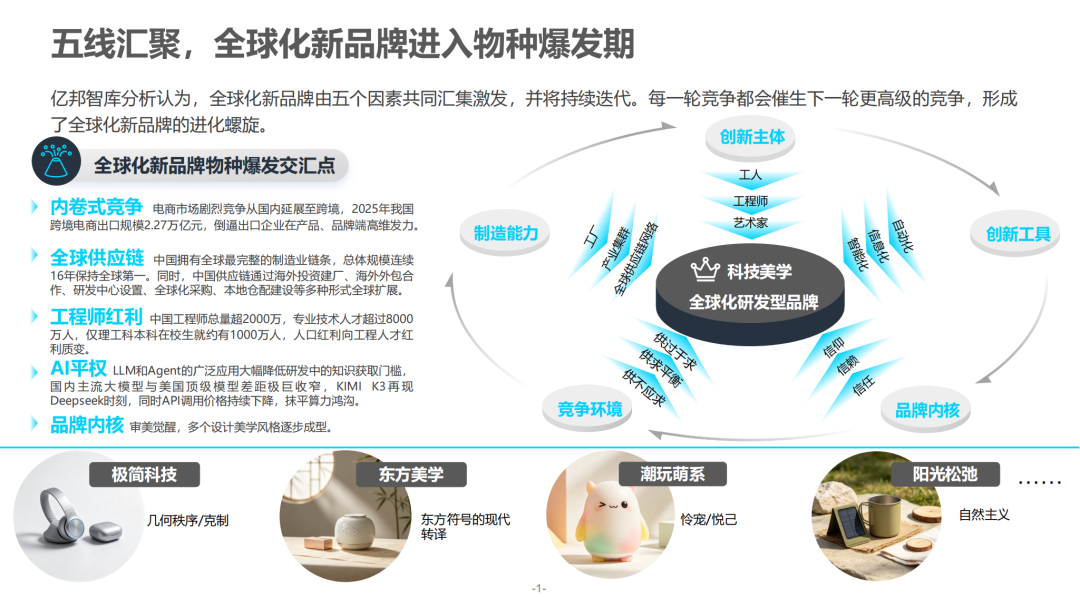
报告认为,全球化新品牌正由五股力量交汇激发——内卷式竞争从国内延展至跨境、中国全球供应链规模持续扩张、工程师红利质变、AI平权抹平算力鸿沟、品牌内核审美觉醒。五线汇聚之下,全球化新品牌进入物种爆发期,AI已从效率工具升级为驱动产品、品牌与服务价值创造的核心引擎。

图片

产品AI化:从增强、幻化到创物

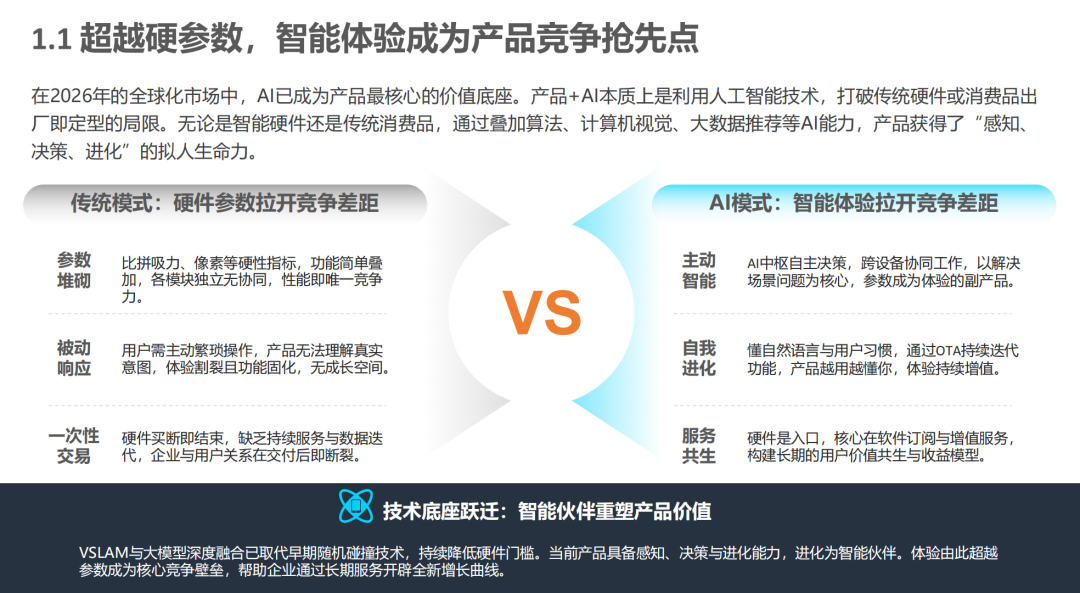
报告提出产品AI化呈现增强、幻化、创物三层递进关系。

AI模式下,产品通过OTA持续迭代,越用越懂用户;硬件成为入口,核心在软件订阅与增值服务;AI中枢自主决策,跨设备协同工作,参数成为体验的副产品。
图片

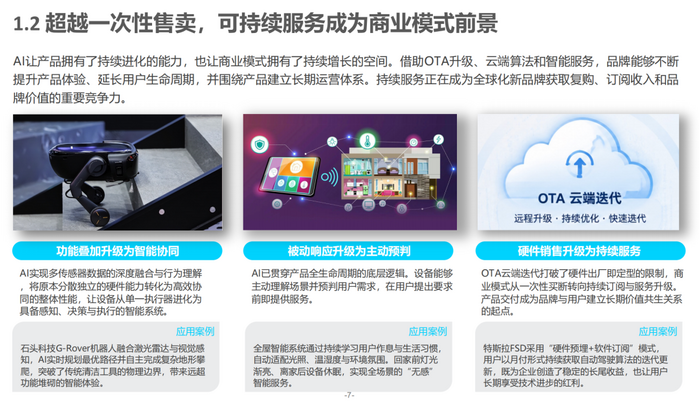
报告特别指出,AI让产品拥有了持续进化的能力,也让商业模式拥有了持续增长的空间。借助OTA升级、云端算法和智能服务,品牌能够不断提升产品体验、延长用户生命周期,并围绕产品建立长期运营体系。
图片

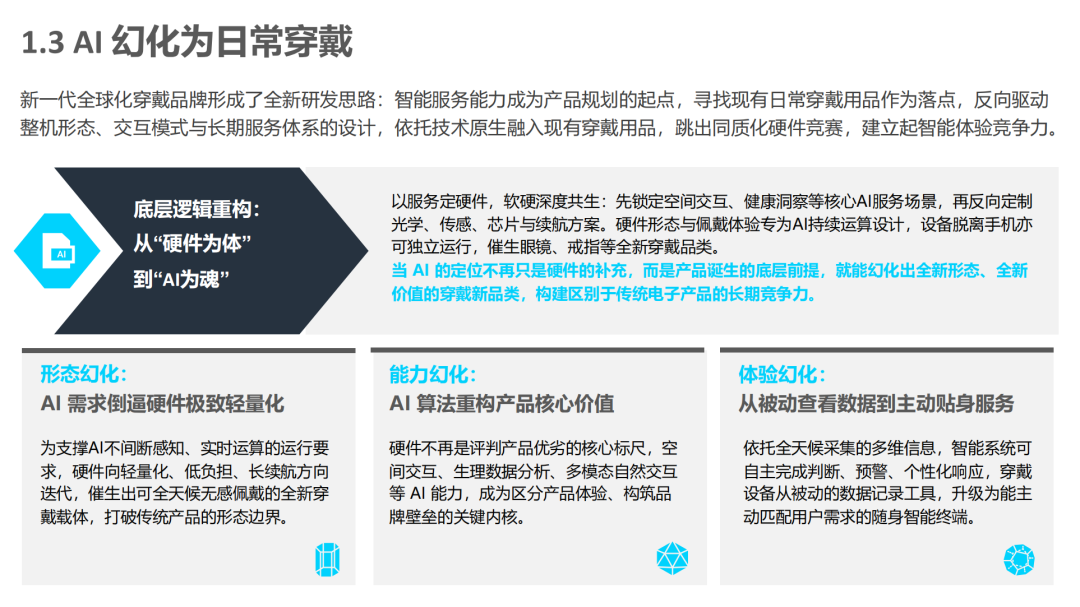
报告揭示了一个全新研发逻辑:将智能服务能力作为产品规划起点,以成熟日常穿戴载体为落地切口,反向推导整机外观形态、人机交互方案与长效服务体系设计。
图片

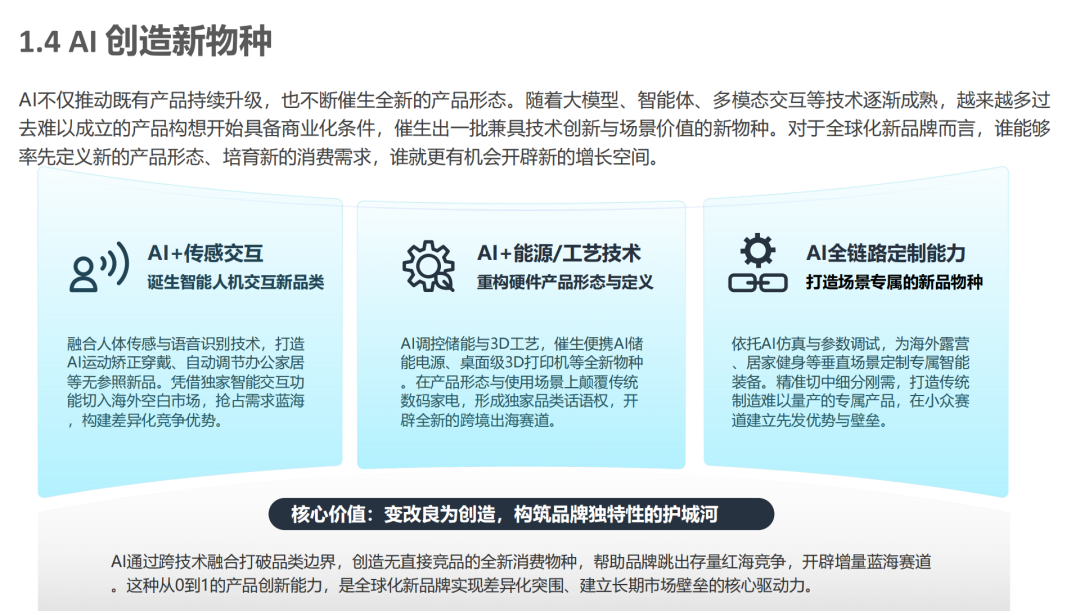
AI不仅推动既有产品持续升级,也不断催生全新的产品形态。随着大模型、智能体、多模态交互等技术逐渐成熟,越来越多过去难以成立的产品构想开始具备商业化条件,催生出一批兼具技术创新与场景价值的新物种。

图片

品类场景化:场景体验释放出"细分的规模化"

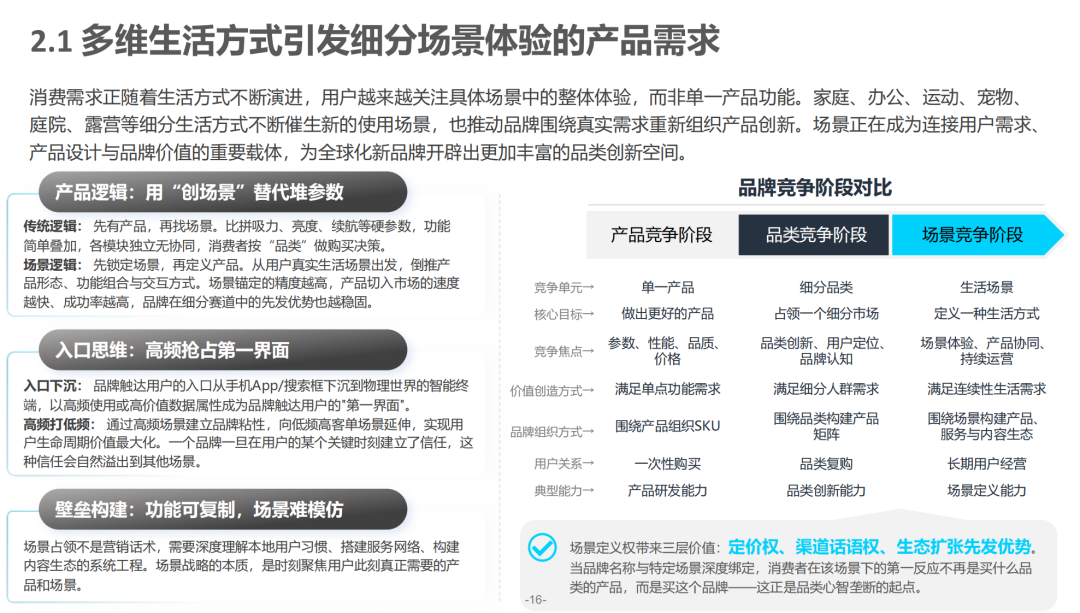
报告提出,生活方式不断细分丰富,配套生活场景的产品需求大规模释放。一方面,品牌围绕家庭、办公、运动、庭院等具体场景组织品类创新,重新定义产品科技美学;另一方面,通过产品组合、软硬件协同和生态连接,满足用户更加完美的体验需求。围绕场景定义产品、围绕体验构建品类,正在成为全球化新品牌创造差异化,寻找小产品大规模的竞争优势。

图片

品牌生态化:科技/美学的基因复制

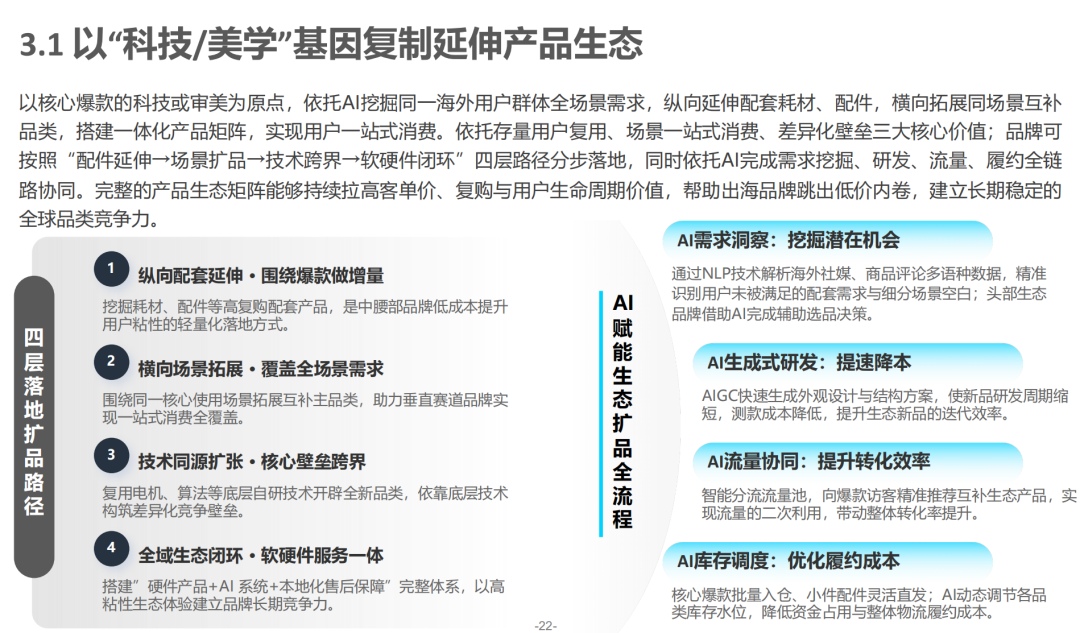
报告指出,依托AI挖掘海外细分场景需求,品牌围绕核心爆款展现的科技或美学基因优势,延伸配套生态产品线,实现多品类协同扩张,拉高用户复购与客单价,建立差异化竞争壁垒。
图片

在生态服务侧,SHOPLINE将AI定位为“全场景赋能抓手”,面向不同体量不同品类的商家,推出覆盖建站、运营、营销到开发者生态的全链路、场景化AI工具链;面向消费者,AI友好型基建提升AI搜索入口可见性;面向商家,AI Copilot实现跨平台Agent管理;面向开发者,AI代码工具降低定制门槛,通过UCP/ACP直连完成交易,释放AI对跨境电商的长尾普惠价值。

智能体重构跨境服务

报告认为,跨境服务商聚焦Agent智能体应用、LLM大语言模型深度整合与Skill技能库持续更新,构建三位一体的服务商增长新范式,正在驱动全球化品牌加速构建AI竞争力。这一变革贯穿营销、金融支付、物流履约与用户服务四大环节。

▎AI趋向接管营销全流程

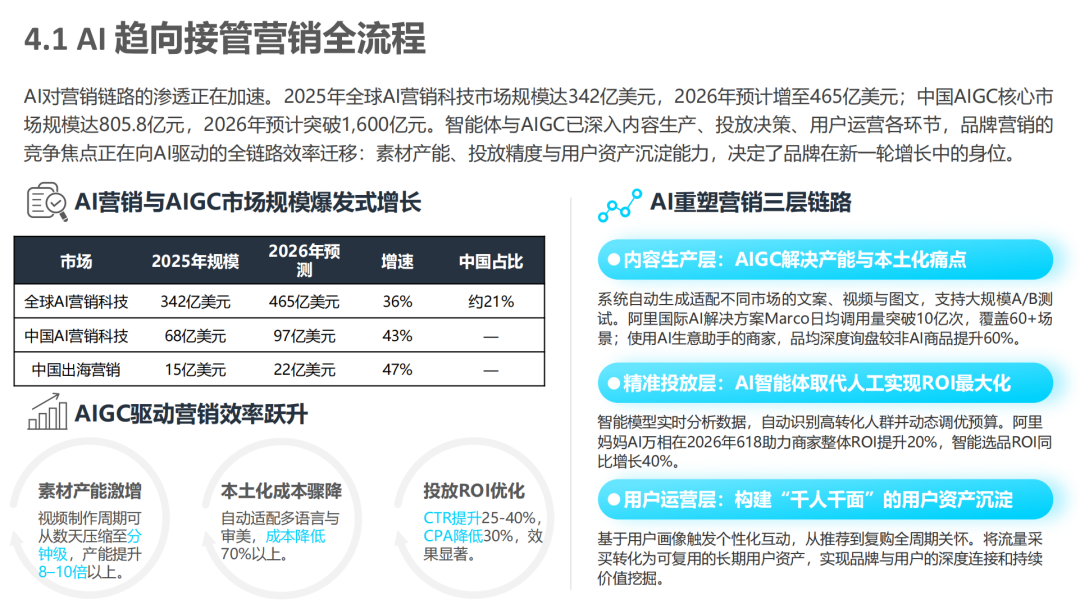
2025年全球AI营销科技市场达342亿美元,2026年预计465亿美元;中国AIGC核心市场规模达805.8亿元,2026年预计突破1,600亿元。智能体与AIGC已深入内容生产、投放决策、用户运营各环节,品牌营销的竞争焦点正在向AI驱动的全链路效率迁移:素材产能、投放精度与用户资产沉淀能力,决定了品牌在新一轮增长中的身位。
图片

飞书深诺推出新一代企业级出海营销AI系统Marvy Agent OS,基于市场洞察、媒介策略、智能创意、智能投放、数据分析五大核心Agent协同作业,构建起全链路广告业务闭环,可将广告决策准确率提升至95%,执行效率提高1.7倍,策略可复制性增长3倍。通过将个人隐性经验转化为可迭代的企业数字资产,让团队回归战略与创造。

跨企查(KQC)以“AI+数据智能”破解跨境物流行业长期面临的客户画像模糊、销售过程黑盒化、团队能力复制难等痛点,将ACEM方法论嵌入销售全链路,实现客户画像清晰、销售过程全程可溯、团队能力可标准化复制。其Atlas问数跨境B2B营销Agent、橙子拓客智能获客平台等产品矩阵,帮助企业实现从“凭经验销售”到“靠数据打仗”。

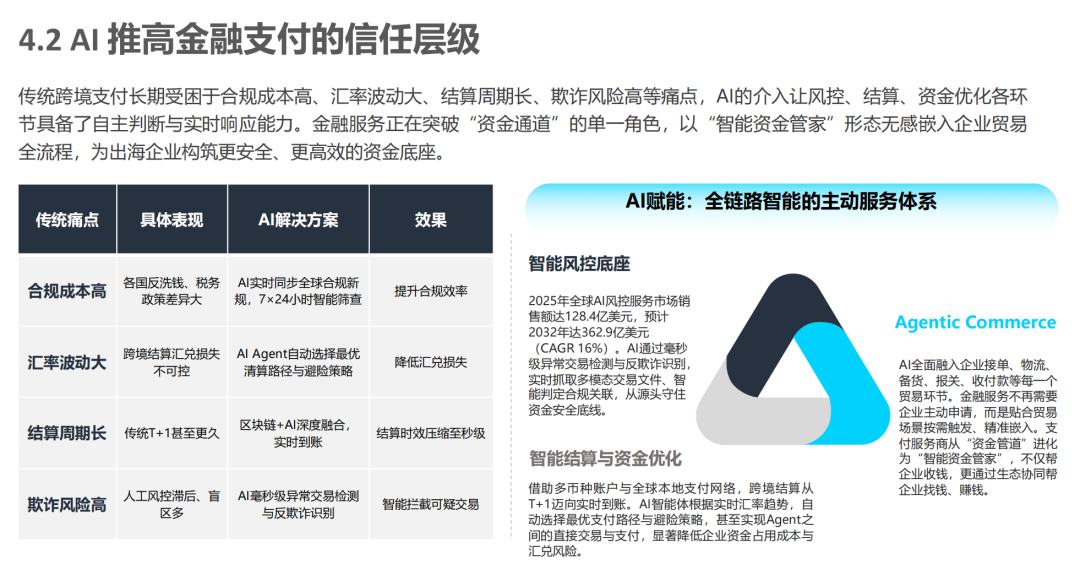
▎AI推高金融支付信任层级

2025年全球AI风控服务市场达128.4亿美元,预计2032年达362.9亿美元(CAGR 16%)。AI让风控、结算各环节具备自主判断能力,跨境结算从T+1迈向实时到账,Agentic Commerce趋势下金融服务按需触发、精准嵌入。
图片

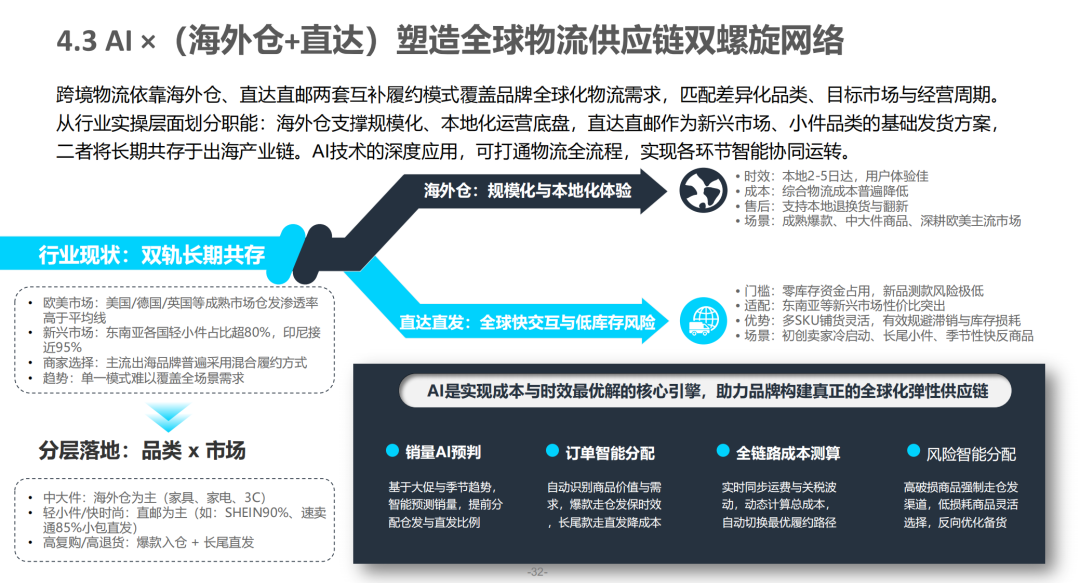
▎AI×(海外仓+直达)塑造全球供应链双螺旋网络

报告认为,跨境物流依靠海外仓、直达直邮两套互补履约模式覆盖品牌全球化物流需求,二者将长期共存。从品类属性看,中大件(家具、家电)以海外仓为主,轻小件/快时尚以直邮为主(如SHEIN 90%、速卖通85%小包直发),高复购/高退货品类采用爆款入仓+长尾直发的混合策略。
图片

拓威天海自研“跨境门到门物流垂类模型”,融合通用大模型、全链路实时数据、多海关/多语言/多运输方式规则与Agent,将AI深度嵌入运价、路径规划、风险处置、末端派送及全流程自动化等核心环节,将分散的物流能力整合为专为中大件而生的端到端数智履约平台。报价准确率99.5%,服务企业50,000家,海外仓100万m²,海外仓日订单处理量10万+。

燕文物流作为领先的第三方B2C跨境电商物流服务商,构建了“全球专线跨境运输+美国本土最后一公里派送”的双业务协同模式。专线包裹服务覆盖头程揽收到尾程派送全链路,服务境内外超3万家B端客户,服务覆盖全球200多个国家和地区,2025年包裹量1.20亿件;美国本土最后一公里派送业务已覆盖41个州,覆盖约70%美国人口,派送包裹量2523万件(同比+381%)。依托海内外履约网络及完善的基础设施建设,燕文构筑了稳定、高效的跨境电商履约服务实力。

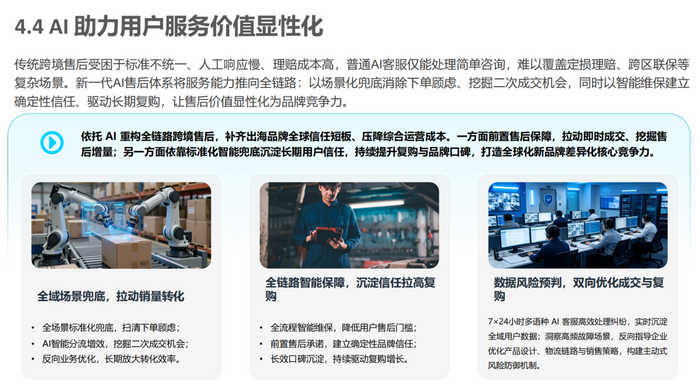
▎AI助力用户服务价值显性化

报告提出,新一代AI售后体系将服务能力推向全链路:以场景化兜底消除下单顾虑、挖掘二次成交机会,同时以智能维保建立确定性信任、驱动长期复购。
图片

全球智能售后与消费者保障平台Seel首创“嵌入式零成本保障”新模式,品牌无需前期投入与技术改造,即可在独立站商详页/购物车/结账页嵌入保障服务,AI Workforce基于数千万售后订单训练,7×24小时秒级响应,5分钟闪电赔款,处理周期中位数仅3.2小时。“无忧购”累计服务Anker、Nike等9000+品牌,GravaStar接入后购买率达66%,复购率提升2.86个百分点。

趋势及挑战:认知过渡期的辩证法

1产品趋向:拟专业技能人设。

AI硬件从被动工具进化为专业角色。例如电动自行车(E-bike)化身运动健康教练、智能门锁升级为家庭管家,核心价值是向用户交付完整场景解决方案。

2品牌趋向:反流量特征。

品牌正从“地理辨识依赖”到“认知辨识依赖”。 例如大鱼智行线下渠道营收占比超70%、XbotGo不投入大额流量投放、麒盛科技长期坚持不打折促销;成熟的用户品牌认知,本身就是无需付费流量的自然获客入口。

3企业组织趋向:创造型全球化组织。

总部升级为超级创造中枢,创始人转向“首席创造官”,组织进化为“人类核心团队+AI Agent集群+生态合作伙伴”的协同共生形态。

4挑战:认知过渡期的辩证法。

创始人需转向AI训练师;数据飞轮需要冷启动投入期;AI有能力边界,最终拍板人必须懂当地市场规则;估值模型从“GMV崇拜”转向“留存信仰”;大牌平替终结,需构建非价格竞争的全球化能力。嘉御资本卫哲指出,候鸟时代已彻底结束,唯一解药是转向"研发型品牌"。

最后,报告围绕“产品AI化、品类场景化、品牌生态化、智能体重构跨境服务、趋势及挑战”五大维度,系统梳理了全球化新品牌的AI竞争力图谱,并提出“品牌&产品三维支点模型”,为出海品牌从大牌平替迈向研发型品牌提供战略指引。

值得关注的是,报告拆解了Ninebot、Oclean、CAYE、Urtopia、Rokid、RingConn、Zeroth、Keyi Tech、Sylvox、Cololight、XbotGo、DYU、Lockin、探路生态、ROCKBROS等15家全球化新品牌AI实践成果。

报告全文及更多精彩内容,点击【阅读原文】查看下载。

【版权提示】亿邦动力倡导尊重与保护知识产权。未经许可,任何人不得复制、转载、或以其他方式使用本网站的内容。如发现本站文章存在版权问题,烦请提供版权疑问、身份证明、版权证明、联系方式等发邮件至run@ebrun.com,我们将及时沟通与处理。

已点赞

+1

{{ praise_text }}

好文章,值得被更多人看到

FAQ回顾

全球化新品牌的AI竞争力主要包含哪些核心维度?

主要包含五大核心维度,分别是产品AI化、品类场景化、品牌生态化、智能体重构跨境服务、趋势及挑战,报告还提出“品牌&产品三维支点模型”,为出海品牌从大牌平替向研发型品牌转型提供系统战略指引。

AI在跨境营销领域的应用能带来哪些效率提升?

AI已深入跨境营销的内容生产、投放决策、用户运营各环节,可提升素材产能、投放精度与用户资产沉淀能力。例如飞书深诺的Marvy Agent OS可将广告决策准确率提升至95%,执行效率提高1.7倍,策略可复制性增长3倍。

跨境物流领域落地AI应用有哪些实际价值?

AI可深度嵌入运价核算、路径规划、风险处置、末端派送等核心物流环节,整合分散履约能力构建数智化服务体系。例如拓威天海自研的垂类模型可实现报价准确率99.5%,已服务超5万家企业,海外仓日订单处理量超10万单。

当前出海品牌构建AI能力有哪些可参考的发展趋势?

主要有三大趋势:一是产品趋向拟专业技能人设,交付完整场景解决方案;二是品牌趋向反流量特征,靠用户认知实现自然获客;三是组织进化为人类核心团队、AI Agent集群与生态伙伴协同的创造型全球化组织。

广告

下一篇

对话未来智能viaim创始人兼CEO马啸:Agent 的“三级火箭”,难在用户“点火”那一步

这场“耳朵战争”最终的胜负手,也许并不在参数、算力或供应链上,它在马啸那句最简单的话里:“必须想办法让用户先迈出第一步,先往发动机里加第一滴油,并把它点燃。”