• 亿邦公众号
    • APP下载

任务之外也在观察!智元发布终身具身智能框架LIFE 解锁机器人持续在线能力

作者:龚作仁 文章来源:Laborer

2026-11-11 16:03

作者:龚作仁 文章来源:Laborer

2026-11-11 16:03

邦小白快读

EN
全文速览

总:智元发布的终身具身智能框架 LIFE,让机器人不再“干完就忘”,在任务执行期间和任务间隔期都能持续观察环境、把看到的东西记下来,以后接着用。

1. 三个部件各管一件事:RoboBeats 有 0.8B、2B、4B 三种小模型,只判断某个条件成立不成立,不逐帧生成大段文字;可塑性记忆同时保存原始画面和 JSON 结构化记录,原图保留现场信息,记录存时间、位置、人物与物品;EDM 负责把摸索出的方法变成可随时调用的工具。

2. 效果有具体数字:单张 RTX 5090 上处理一帧新画面约 75 毫秒,同时检测 16 个条件约 77 毫秒;主动感知准确率从 21.2% 升到 64.0%;动作边界检测 F1 从 26.4 升到 45.8;24 小时真机 6 道题答对 29.5/30,平均 80.6 秒,对照组 28.5/30 却要 554.7 秒。

3. 可直接上手:论文、项目主页、代码(GitHub 上 AgibotTech/LIFE)、三个模型权重和 SSS-Bench 评测资源全部开放,开发者当天就能复现。

总:对品牌商而言,这篇文章的价值在于技术叙事与开源口碑——智元用一套可验证的指标把“终身具身智能”讲成了明确的产品方向,并用全开源动作做行业影响力。

1. 产品研发方向:框架把机器人能力从单任务执行扩展到跨任务积累,持续感知、可塑性记忆、能力复用三块构成了下一代产品的能力拼图,可作为研发路线参考。

2. 品牌营销打法:论文、项目主页、GitHub 代码、三档模型权重与评测基准同步放出,强调开发者当天可复现,属于以开源换生态与声量的典型做法。

3. 传播素材:75 毫秒端侧延迟、64.0% 主动感知准确率、29.5/30 真机问答、token 减少约 45% 等数据,都是可直接对外使用的竞争力背书。

4. 用户行为观察:文章强调环境在任务之间仍在变化,用户在无指令时也希望机器保持在线观察,提示产品卖点要从“听话执行”转向“长期值守与经验积累”。

总:对卖家来说,这是一条关于机器人新供给与新场景的信号——开源模型和开源代码降低了接入门槛,持续在线感知则打开了“长时间盯环境”类需求的空间。

1. 市场机会:巡检、安防、仓储、看护这类需要全天候留意的场景可被激活;可塑性记忆能把一天的录像构建成可检索记录,回答“东西最后放在哪”之类的历史问题。

2. 成本与门槛:三档轻量模型在单张 RTX 5090 上即可运行,约 75 毫秒出一帧结论,同时检测 16 个条件约 77 毫秒,中小卖家也有部署可能。

3. 可学习点:EDM 把一次解决问题的方法固化成工具挂载进工具库,同一批未参与构建的查询成功率从 37.5% 升到 65.8%,意味着交付后的能力还能持续增值。

4. 风险提示:文章明确称这是技术探索,后续仍需多日在线部署和动态仿真来验证记忆更新、决策与运行可靠性,不宜过早向客户承诺成熟商用。

总:工厂可从端侧部署、现场值守与经验沉淀三方面看这篇文章,它给出的是一条低成本把视觉观察变成可复用经验的路径。

1. 生产与设计需求:感知端只需判断条件是否成立,例如抓取动作是否完成、电梯门是否打开;条件从 1 个增加到 16 个,延迟仅从 75 毫秒变为 77 毫秒,适合多工位并行监测。

2. 商业机会:24 小时第一视角录像可离线构建记忆并做历史问答,对应产线回溯、物品归属判断、责任追溯等实际需求,文中就有杯子归属和外套位置的案例。

3. 数字化启示:记忆分两层,原图保真加 JSON 结构化字段便于接入既有信息系统;EDM 让现场摸索出的检索与去重方法挂载为工具,减少重复编程,是经验数字化的具体做法。

4. 落地前提:单卡即可运行,但长期可靠性仍需多日在线部署和动态仿真验证,建议先做小场景试点。

总:服务商应关注客户痛点与解决方案是否对得上——LIFE 针对的是机器人“任务结束即重置、经验无法累积”这一长期痛点,并给出了可量化的解法。

1. 行业趋势:具身智能的调度单位从单个任务转向任务之间,持续感知、长期记忆、能力复用正在成为框架标配。

2. 客户痛点:采集时难以预判哪些细节将来有用,旧记录往往字段不全;LIFE 用原图加 JSON 双存,日后可回看原图重新提取门牌、房间号等信息并补充索引,解决了“当时没记、后来要用”的问题。

3. 解决方案:RoboBeats 心跳式监测负责发现事件,可塑性记忆负责检索,EDM 负责把方法变成工具;SSS-Bench 上问答准确率从 40.9% 升到 60.5%,OVO-Bench 写入端 token 减少约 45%,成本可控。

4. 集成便利:论文、代码、三档模型权重与评测集全部开放,便于快速做概念验证并按需选型。

总:平台商可把这篇文章视为“以开源加基准牵引生态”的样板——智元用项目主页、代码仓库、模型权重和评测基准 SSS-Bench 搭起了一个开发者入口。

1. 平台做法:论文、项目主页、GitHub 代码、RoboBeats-0.8B/2B/4B 三个权重与 SSS-Bench 资源同步开放,强调开发者当天可复现,明显是在降低上手门槛、扩大接入面。

2. 招商与运营:三档模型规模给了不同算力预算的客户选择空间;六组基准测试(端侧性能、主动感知、动作边界、记忆有效性、回溯问答、能力复用)形成了统一比较口径,便于生态内横向对标和榜单化运营。

3. 商业需求与问题:文章点明后续要结合长期目标与自主行动,并通过多日在线部署和动态仿真评估,说明平台侧需要提供长周期测试环境和真机录像类数据服务。

4. 风向规避:文章自称是一项技术探索,尚未给出规模化商用结论,平台在推广时应避免过度承诺,先把复现和评测能力做实。

总:研究者可关注三层新动向:范式从单任务转向跨任务、记忆与能力复用的工程实现、以及尚待解决的问题与开放评测资源。

1. 新范式:LIFE 把调度单位从任务本身改到任务之间,提出无指令状态下心跳式持续感知;StreamingBench 主动输出任务准确率从 21.2% 升到 64.0%,SPOT-Bench 动作边界 F1 从 26.4 升到 45.8。

2. 新机制:可塑性记忆采用原图加 JSON 双存储,支持事后重解析并补字段、补索引;EDM 不更新基础模型参数,只在程序、工具接口与技能层扩展,FindingDory 中 597 个未参与能力构建的查询成功率从 37.5% 升到 65.8%,提升 28.3 个百分点、相对约 75%。

3. 新问题与启示:论文提出后续需结合长期目标与自主行动,并通过多日在线部署和动态仿真评估记忆更新、决策与运行可靠性;SSS-Bench(171 段视频、618 个问题)、OVO-Bench 回溯子集等基准开放,便于复现与对比。

4. 关键数据:24 小时真机实验 6 题各测 3 次,在相同问答模型下 LIFE 得 29.5/30、平均 80.6 秒,Codex 对照组 28.5/30、平均 554.7 秒,效率差异显著。

声明:快读内容全程由AI生成,请注意甄别信息。如您发现问题,请发送邮件至 run@ebrun.com 。

我是 品牌商 卖家 工厂 服务商 平台商 研究者 帮我再读一遍。

Quick Summary

Summary: AgiBot's LIFE, a lifelong embodied intelligence framework, lets robots stop forgetting after a task and continuously observe the environment during and between tasks, record what they see, and reuse it later.

1. Three components split responsibilities: RoboBeats comes in 0.8B, 2B, and 4B lightweight models and only judges whether a condition holds rather than generating long frame-by-frame text; plastic memory stores both raw images and structured JSON records, with images preserving scene details and records capturing time, location, people, and objects; EDM turns explored methods into tools that can be called on demand.

2. Results are concrete: on a single RTX 5090, processing a new frame takes about 75 ms, and detecting 16 conditions simultaneously takes about 77 ms; proactive perception accuracy rises from 21.2% to 64.0%; action-boundary detection F1 rises from 26.4 to 45.8; in a 24-hour real-robot test, LIFE answers 29.5/30 across six questions in 80.6 seconds on average, while the control group scores 28.5/30 but takes 554.7 seconds.

3. It is immediately usable: the paper, project page, code (AgibotTech/LIFE on GitHub), three model weights, and SSS-Bench evaluation resources are all open, so developers can reproduce it the same day.

Summary: For brands, the value lies in the technical narrative and open-source reputation: AgiBot frames lifelong embodied intelligence as a clear product direction with verifiable metrics and uses full open source to build industry influence.

1. Product R&D direction: the framework extends robot capability from single-task execution to cross-task accumulation; continuous perception, plastic memory, and capability reuse form the capability map for next-generation products and can serve as an R&D roadmap reference.

2. Brand marketing playbook: the paper, project page, GitHub code, three model weights, and evaluation benchmark are released together, with emphasis on same-day developer reproduction, a typical open-source-first approach to ecosystem and mindshare.

3. Communication assets: 75 ms on-device latency, 64.0% proactive perception accuracy, 29.5/30 real-robot Q&A, and roughly 45% token reduction are all directly usable competitive proofs.

4. User behavior observation: the article stresses that the environment keeps changing between tasks and that users want the machine to stay online and observe even without commands, suggesting product selling points should shift from obedient execution to long-term monitoring and experience accumulation.

Summary: For sellers, this signals new robot supply and new scenarios: open models and code lower the barrier to entry, while always-on perception opens demand for long-duration environmental monitoring.

1. Market opportunity: inspection, security, warehousing, and care scenarios that require all-day attention can be activated; plastic memory can turn a day's footage into searchable records and answer historical questions such as where an item was last placed.

2. Cost and barrier: the three lightweight models run on a single RTX 5090, producing a frame-level conclusion in about 75 ms and detecting 16 conditions simultaneously in about 77 ms, making deployment possible even for small and midsize sellers.

3. What to learn: EDM codifies a one-off solution into a tool mounted in a tool library; on the same set of queries not used to build the capability, success rate rises from 37.5% to 65.8%, meaning delivered capability can continue to appreciate.

4. Risk note: the article explicitly calls this a technical exploration and says multi-day online deployment and dynamic simulation are still needed to validate memory updates, decision-making, and operational reliability, so sellers should not promise mature commercial readiness to customers too early.

Summary: Factories can read this article through three lenses: edge deployment, on-site monitoring, and experience capture. It outlines a low-cost path to turn visual observation into reusable experience.

1. Production and design needs: the perception side only needs to judge whether conditions hold, such as whether a grasp is complete or an elevator door is open; increasing conditions from 1 to 16 raises latency only from 75 ms to 77 ms, making it suitable for parallel monitoring across workstations.

2. Business opportunity: 24-hour first-person video can be used offline to build memory and support historical Q&A, matching real needs such as production-line traceback, item ownership, and responsibility tracking; the article includes cases involving cup ownership and coat location.

3. Digitalization insight: memory has two layers, with raw images preserving fidelity and JSON structured fields making it easy to connect to existing information systems; EDM mounts retrieval and deduplication methods learned on site as tools, reducing repeated programming and offering a concrete approach to digitizing experience.

4. Deployment prerequisites: it runs on a single card, but long-term reliability still needs multi-day online deployment and dynamic simulation validation; small-scenario pilots are advisable first.

Summary: Service providers should check whether customer pain points and solutions align. LIFE targets the long-standing problem that robots reset after each task and cannot accumulate experience, and offers a quantifiable approach.

1. Industry trend: the scheduling unit in embodied intelligence is shifting from individual tasks to the intervals between tasks, with continuous perception, long-term memory, and capability reuse becoming standard framework features.

2. Customer pain point: during data collection it is hard to predict which details will matter later, and old records often lack fields. LIFE stores both raw images and JSON, so later users can revisit images to re-extract information such as door numbers and room numbers and add indexes, solving the problem of not recording something when needed and needing it later.

3. Solution: RoboBeats performs heartbeat-style monitoring to detect events, plastic memory handles retrieval, and EDM turns methods into tools; on SSS-Bench, Q&A accuracy rises from 40.9% to 60.5%, and on OVO-Bench the write-side token count drops by about 45%, keeping costs manageable.

4. Integration convenience: the paper, code, three model weights, and evaluation set are all open, making rapid proof-of-concept work and needs-based model selection easier.

Summary: Marketplace sellers can view this article as a model of using open source plus benchmarks to drive an ecosystem: AgiBot has built a developer entry point with a project page, code repository, model weights, and the SSS-Bench evaluation benchmark.

1. Platform playbook: the paper, project page, GitHub code, three RoboBeats-0.8B/2B/4B weights, and SSS-Bench resources are released together, with emphasis on same-day developer reproduction, clearly aiming to lower the onboarding barrier and broaden access.

2. Partner recruitment and operations: the three model sizes give customers with different compute budgets room to choose; six benchmark groups (on-device performance, proactive perception, action boundaries, memory effectiveness, retrospective Q&A, and capability reuse) create a common comparison standard for cross-ecosystem benchmarking and leaderboard-style operations.

3. Commercial needs and issues: the article notes that future work must combine long-term goals with autonomous action and be evaluated through multi-day online deployment and dynamic simulation, implying that platforms need to provide long-cycle test environments and real-robot video data services.

4. Hype avoidance: the article describes itself as a technical exploration and does not yet offer conclusions on large-scale commercialization; platforms should avoid overpromising in promotion and first make reproduction and evaluation capabilities solid.

Summary: Researchers can focus on three new directions: the paradigm shift from single tasks to cross-task operation, the engineering implementation of memory and capability reuse, and the open problems and evaluation resources that remain.

1. New paradigm: LIFE moves the scheduling unit from the task itself to the intervals between tasks and proposes heartbeat-style continuous perception without commands; on StreamingBench, proactive-output task accuracy rises from 21.2% to 64.0%, and on SPOT-Bench action-boundary F1 rises from 26.4 to 45.8.

2. New mechanisms: plastic memory uses dual storage of raw images plus JSON, enabling post hoc re-parsing and field and index supplementation; EDM does not update base model parameters and expands only at the program, tool-interface, and skill layers. In FindingDory, success rate on 597 queries not used to build the capability rises from 37.5% to 65.8%, an increase of 28.3 percentage points, or about 75% relative.

3. New questions and implications: the paper argues that future work needs to combine long-term goals with autonomous action and evaluate memory updates, decision-making, and operational reliability through multi-day online deployment and dynamic simulation; benchmarks such as SSS-Bench (171 videos, 618 questions) and the OVO-Bench retrospective subset are open for reproduction and comparison.

4. Key data: in a 24-hour real-robot experiment, each of six questions was tested three times; with the same Q&A model, LIFE scores 29.5/30 at an average of 80.6 seconds, while the Codex control group scores 28.5/30 at an average of 554.7 seconds, a striking efficiency difference.

Disclaimer: The "Quick Summary" content is entirely generated by AI. Please exercise discretion when interpreting the information. For issues or corrections, please email run@ebrun.com .

I am a Brand Seller Factory Service Provider Marketplace Seller Researcher Read it again.

近日,智元AGIBOT发布终身具身智能框架LIFE(Learning to Live:A Step Toward Lifelong Embodied Intelligence),该框架将持续感知、长期记忆与能力复用结合,用于支持机器人在任务执行期间及任务间隔期获取环境信息,并将历史观察用于后续决策。相关论文、项目主页、RoboBeats系列模型(0.8B/ 2B/ 4B)推理代码与权重,以及SSS-Bench评测资源已开放。

所谓“终身”,与传统具身智能框架的差别在调度单位:传统具身智能系统以单个任务为中心,接收指令、感知、规划、执行,任务结束即重置状态。但在任务执行期间及任务之间,物理环境仍在持续变化。LIFE通过持续监测环境、选择性保存观察并复用任务解决方法,探索机器人如何积累和利用跨任务的方法。

在“理解指令—调用工具—等待结果”的流程中,工具执行期间的环境变化可能影响后续行动。LIFE在此基础上增加了持续运行的感知与记忆链路,使系统能够在工具运行时跟踪相关条件,并将值得记录的变化保存为可检索的历史信息。

框架由三部分协同构成:轻量决策模型“RoboBeats”负责条件跟踪与事件发现,判断何时需要触发响应或记忆写入;可塑性记忆模块“Plastic Memory”保存选中的原始画面及结构化记录;能力复用机制“EDM”(Explore–Distill–Mount,探索—提炼—挂载)将问题求解过程中形成的方法转化为经过验证的工具与技能。三个模块与多模态大模型驱动的智能体协同运行。

据智元远征Research Team介绍,LIFE旨在使机器人在未接收到指令时保持环境感知,积累历史记录,并在新的问题出现时调用已有经验。
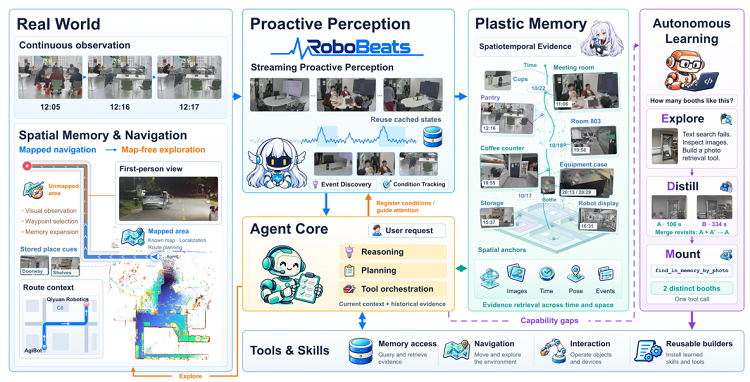
图1|LIFE整体架构:持续观察、主动感知、可塑性记忆与自主学习四部分围绕智能体协同工作。来源:论文。

01/ 三项能力协同,让机器人持续在线

单次任务完成度反映机器人在特定指令下的执行表现。LLIFE则进一步研究跨任务的信息积累与调用,关注系统在未接收到新指令时的环境监测,以及相关观察在后续问答和行动中的应用。

这一转向的工程前提在端侧。RoboBeats通过轻量判断筛选需要进一步处理的画面,减少大模型逐帧完整分析的需求;同时复用历史计算缓存,降低连续观察中的重复计算开销。单张RTX 5090上,RoboBeats-2B处理一帧新画面的延迟约为75毫秒;同时检测16个条件时,延迟约为77毫秒。在该测试设置下,增加检测条件数量未显著增加延迟,为系统持续运行提供了性能支持。

心跳:RoboBeats,未接收指令时持续感知

RoboBeats是一个轻量决策模型(Decision Model),支持0.8B、2B和 4B三种参数规模。模型不逐帧生成文本回答,而是读取true/ false标签的得分,判断自然语言描述的条件是否成立。多个条件共享视觉输入和历史计算缓存,各自维护预测状态。

执行任务时,智能体可设置持续监测的条件,例如“电梯门是否打开”“抓取动作是否完成”。在没有新任务指令时,系统仍可检测新事件,筛选值得记录的观察,再由写入模型生成描述并保存相应画面。团队将这种持续感知机制称为“心跳”。

在StreamingBench的主动输出任务(PO)上,以参考时刻前后2 秒内首次触发的准确率为指标,RoboBeats-4B从 21.2% 提升至64.0%;在SPOT-Bench上,动作边界检测的F1分数(百分制)从26.4提升至45.8。
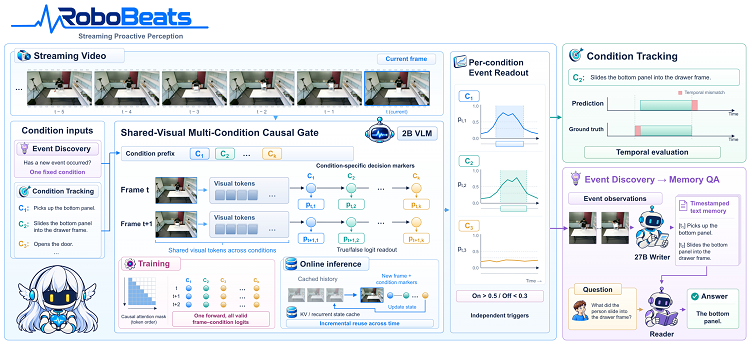
图2|RoboBeats复用同一条视频流,同时对多个条件输出成立概率。来源:论文图4。
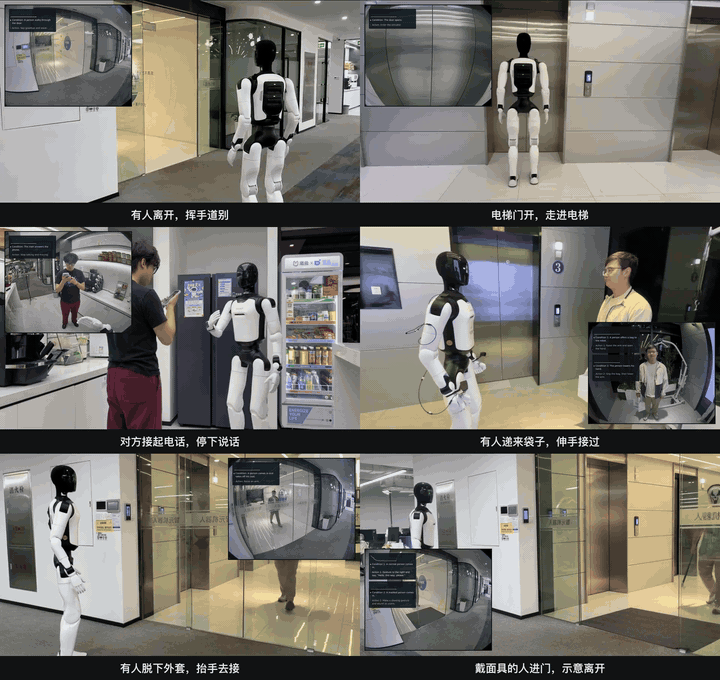
图3|条件成立即行动:大图为第三人称视角,小窗为机器人第一视角。来源:智元远征Research Team实拍。

记忆:可塑性记忆,将观察过程保存为可检索记录

由于采集时难以预判哪些细节将用于后续任务,可塑性记忆分别保存原始画面和当前解析结果:原图保留现场信息,结构化记录(JSON)保存时间、位置、人物与物品等线索。执行智能体通过工具快速检索已有记录;具备文件读取和编程能力的编程智能体,则可回看原图、提取新信息,并补充字段与索引。

这一机制使记忆既支持历史信息检索,也可根据后续需求更新。例如,系统最初保存的门口画面未记录房间号,后续需要按房间号检索时,可重新分析原图,提取门牌文字并补充索引。

在基于24小时真机录像的案例研究中,远征A3 Ultra连续采集一天的第一视角视频,团队随后通过离线回放构建记忆,并开展历史信息问答。以12时 30分为提问时点,在被问及外套最后出现的位置时,系统检索到12时 18分外套位于茶水间椅背上的记录,并展示对应历史画面及拍摄位置。在判断会议室两只杯子的归属时,系统结合人物到场和杯子使用记录,找到绿色杯子的归属依据;由于黑色杯子在参会者到场前已出现,系统未将其归属于某位参会者。

团队围绕当天记录设置了6 个问题,每题测试3 次。在使用相同的GPT-6.1-sol问答模型的条件下,LIFE得分为29.5/30分,平均回答用时80.6秒;同样获得已构建记忆的Codex B对照组得分为28.5/30分,平均回答用时554.7秒。
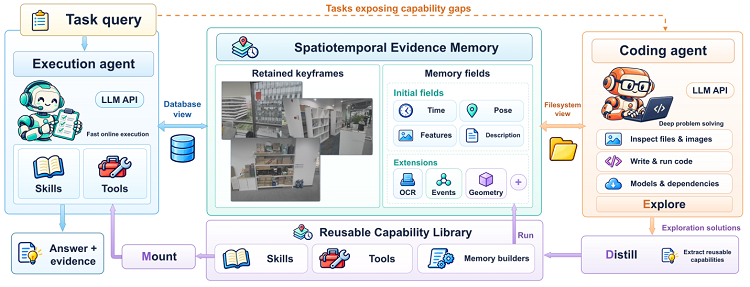
图4|可塑性记忆:保留画面、时间与位置,日后可回看并提取新线索。来源:论文。
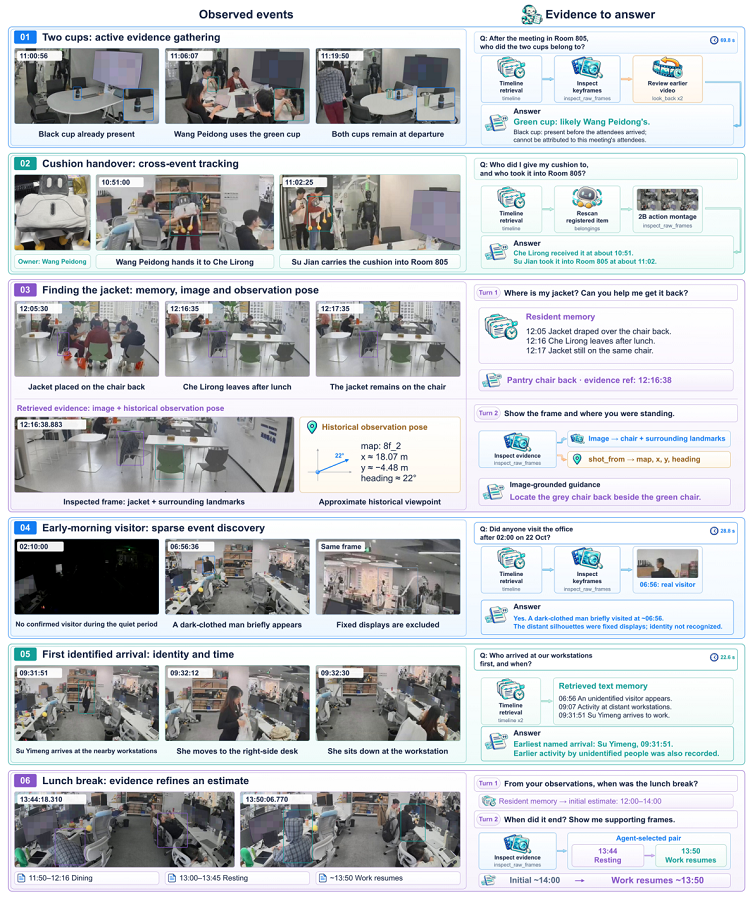
图5|一天的录像构建为记忆后,回答人物、物品与活动相关问题。来源:论文。

自进化:探索形成的方法,转化为可复用工具

EDM(探索—提炼—挂载)沿用前作ReSight的机制。当现有工具无法解决问题时,编程智能体查看历史记录、编写程序,探索检索与去重方法;验证有效后,将相关方法提炼并挂载至系统工具库,供后续任务直接调用。这一能力扩展发生在程序、工具接口与技能层面,不要求基础模型在每次任务后更新参数。

在FindingDory实验中,挂载EDM构建的能力后,系统在597个未参与能力构建的查询上,成功率从37.5% 提升至65.8%,提升28.3个百分点、相对提升约75%。其中,37.5% 为未挂载EDM时在同一批查询上的结果。
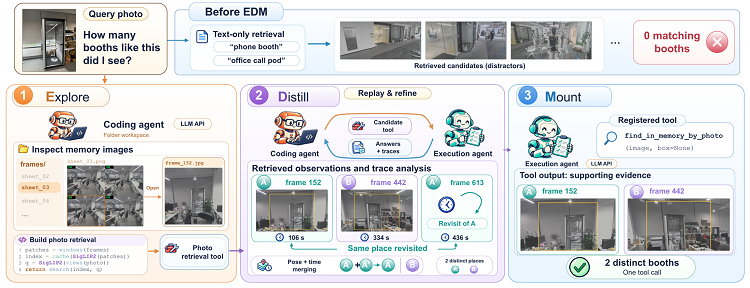
图6|EDM:探索—提炼—挂载,把摸索出的办法沉淀成可复用的能力。来源:论文图12。

02/ 六组基准测试与全天实验,验证持续在线

论文分别评估了条件跟踪、历史记忆问答和能力复用。不同测试采用各自的指标与比较设置,主要结果如下:

● 端侧运行性能:RoboBeats-2B在单张RTX 5090上处理一帧新画面的延迟约为75毫秒,同时检测16个条件时约为77毫秒。

● 主动感知:在StreamingBench主动输出任务(PO)中,以参考时刻前后2 秒内首次触发的准确率为指标,RoboBeats-4B的结果从21.2% 提升至64.0%。

● 动作边界检测:在SPOT-Bench中,动作边界检测的F1分数(百分制)从26.4% 提升至45.8%。

● 记忆有效性:在SSS-Bench(171段视频 /618个问题)中,仅凭文本记忆作答,且写入画面数量、写入模型和问答模型相同的条件下(论文表15),采用RoboBeats-2B的方案问答准确率从40.9% 提升至60.5%,提高19.6个百分点。

● 回溯问答:在OVO-Bench回溯问答子集中,仅使用文本记忆时,情景记忆和动作序列识别相关指标分别提升6.2和 6.1个百分点;写入端输入token数量减少约45%。

● 长时记忆与能力复用:在FindingDory的 597个未参与能力构建的查询上,成功率从37.5% 提升至65.8%。

●24小时真机实验:设置6 个问题,每题测试3 次。在使用相同的GPT-6.1-sol问答模型的条件下,LIFE得分为29.5/30分,平均用时80.6秒;对照组Codex得分为28.5/30分,平均用时554.7秒。

注:SSS-Bench的 60.5% 为仅凭文本记忆作答、写入画面数量相同、使用相同写入与问答模型条件下的问答准确率,不等同于“记忆准确率”。
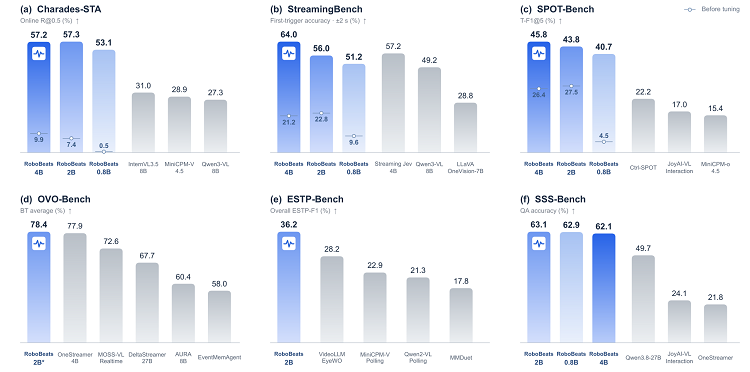
图7|从持续感知到记忆问答的六组基准结果。来源:论文图1。
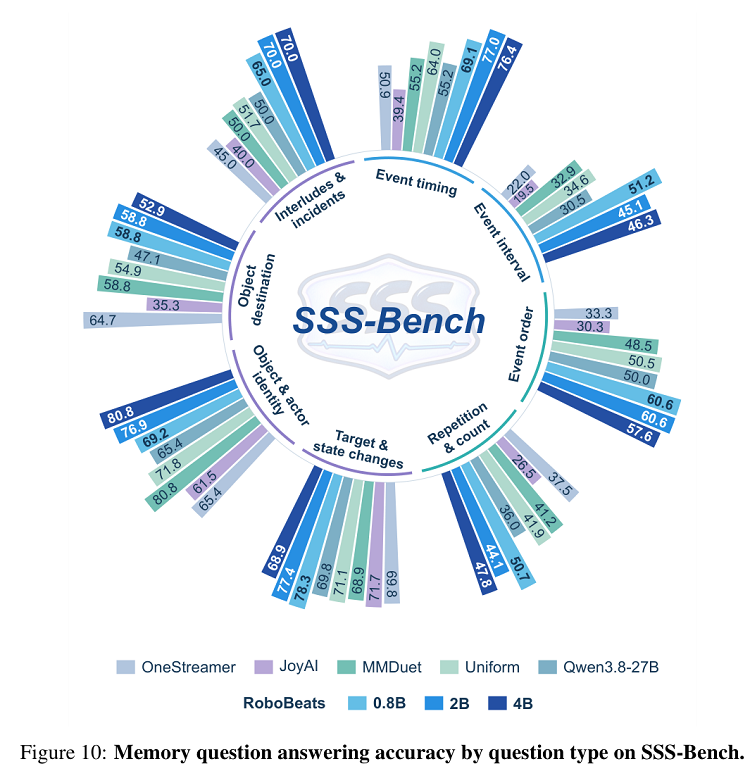
图8|SSS-Bench各类问题的问答准确率。来源:论文图10。

03/ 论文、代码与模型同步开源,开发者当天可复现

LIFE论文、项目主页、代码与RoboBeats三种参数规模的模型已同步开放,供开发者开展研究与复现。

● 论文:Learning to Live:A Step Toward Lifelong Embodied Intelligence

● 项目主页:agibotgeneral.github.io/life-site

● 代码:GitHub· AgibotTech/LIFE

● 模型:RoboBeats-0.8B、RoboBeats-2B、RoboBeats-4B

此次发布是智元面向机器人持续运行与经验利用的一项技术探索。LIFE将持续感知、历史记忆与工具复用纳入同一框架,将研究范围从单次任务执行延伸至跨任务的信息积累与调用。论文提出,后续研究需进一步结合长期目标与自主行动,并通过多日在线部署和动态仿真,评估系统在持续变化环境中的记忆更新、决策与运行可靠性。

注:文/龚作仁,文章来源:Laborer,本文为作者独立观点,不代表亿邦动力立场。

【版权提示】亿邦动力倡导尊重与保护知识产权。未经许可,任何人不得复制、转载、或以其他方式使用本网站的内容。如发现本站文章存在版权问题,烦请提供版权疑问、身份证明、版权证明、联系方式等发邮件至run@ebrun.com,我们将及时沟通与处理。

已点赞

+1

{{ praise_text }}

好文章,值得被更多人看到

FAQ回顾

智元LIFE终身具身智能框架是什么?

智元AGIBOT发布的终身具身智能框架,将持续感知、长期记忆与能力复用结合,支持机器人在任务执行期间及任务间隔期获取环境信息,并把历史观察用于后续决策;框架由RoboBeats、Plastic Memory和EDM三部分协同构成。

LIFE框架与传统具身智能系统的主要区别是什么?

传统具身智能系统以单个任务为中心,任务结束即重置状态;LIFE把调度单位扩展到跨任务,在任务执行期间及任务之间持续监测环境、选择性保存观察并复用任务解决方法,从而积累和利用跨任务经验。

机器人如何在未接收到新指令时持续感知环境?

LIFE通过轻量决策模型RoboBeats实现“心跳”式持续感知,模型读取true/false标签得分判断自然语言条件是否成立,多个条件共享视觉输入和历史缓存;没有新指令时仍检测新事件,筛选值得记录的观察并保存画面。

智元LIFE的可塑性记忆如何支持历史信息检索?

可塑性记忆分别保存原始画面和JSON结构化记录,记录时间、位置、人物与物品等线索;执行智能体可通过工具快速检索,编程智能体可回看原图、提取新信息并补充字段与索引,使记忆能按后续需求更新。

智元LIFE的实际测试效果如何?

在基于24小时真机录像的实验中,6个问题每题测3次,相同GPT-6.1-sol问答模型下LIFE得29.5/30分,平均用时80.6秒;在FindingDory的597个未参与能力构建查询上,挂载EDM后成功率从37.5%提升至65.8%。

广告

下一篇

跨境电商资源对接

《全球跨境电商服务商资源手册》第二期手册现已发布,触达更多资源,了解跨境服务商信息,欢迎点击链接下载。

了解详情

千峰访谈正和网络宇文立朋:把非标品做成可验证、可定价、可履约的标准件

近日,在2026千峰奖访谈期间,亿邦动力、亿邦智库与石家庄正和网络有限公司创始人宇文立朋,围绕”AI与出海带来的模态进化“深度交流。