• 亿邦公众号
    • APP下载

白宫宣布对华关税增至104% T86小额包裹关税再度飙升

作者:王昱 文章来源:亿邦动力

2025-04-09 10:30

作者:王昱 文章来源:亿邦动力

2025-04-09 10:30

邦小白快读

EN
全文速览

美国关税政策重大调整,对中国商品加征104%关税,并提升小额包裹关税标准,进口成本将显著增加。

1. 从4月9日美东时间00:01起实施新关税,基于特朗普2月7日声明,白宫新闻秘书卡罗琳·莱维特证实此政策。

2. 小额包裹从价关税税率从30%提高到90%,大幅增加低价值商品进口负担。

3. 定额关税分阶段提升:2025年5月2日后每件邮递物品关税从25美元增至75美元;2025年6月1日后从50美元增至150美元。

4. 运输承运人必须对所有货物采用相同关税收集方法,允许每月更改一次,但需提前24小时通知美国海关和边境保护局(CBP),以简化操作。

关税提升对品牌商成本结构和定价策略构成直接冲击,需关注消费趋势变化。

1. 104%关税增加进口商品成本,迫使品牌商调整产品定价和价格竞争策略,以维持市场竞争力。

2. 小额包裹关税飙升(从价90%和定额阶段增加)特别影响低价值产品,可能改变用户购买行为和消费趋势,促使品牌研发转向高价值或本地化产品。

3. 品牌渠道建设需优化供应链,应对更高进口门槛,考虑数字化电商以减少依赖。

4. 运输规则变更(统一收集方法可月更)启示品牌商整合物流,以降低成本风险。

美国关税新政解读带来风险与机会,卖家需及时应对消费需求变化。

1. 政策细节:税率104%从4月9日生效,小额包裹关税提升(从价90%、定额2025年分阶段加倍),增加进口成本,带来负面影响。

2. 风险提示:成本上升可能导致价格上涨、销量下滑,需评估正面机会如优化电商模式或寻找增长市场。

3. 应对措施:利用承运人规则(统一方法可月更)调整物流策略;合作方式上,可探索平台扶持政策或供应链本地化。

4. 机会提示:小额包裹变化凸显低价值商品需求调整,卖家可学习数字化管理以规避风险,提升商业模式韧性。

关税增加对工厂生产设计和商业机会提出新需求,推进数字化电商成关键启示。

1. 产品生产需求:104%关税导致成本上升,工厂需优化设计以控制支出,例如考虑简化流程或高价值转型。

2. 商业机会:小额包裹规则变化(从价90%和定额提升)可能推动工厂寻求本土化市场或替代供应链,减少进口依赖。

3. 启示:从关税政策中学习,加速数字化和电商化,例如利用承运人统一收集方法简化操作,提升效率。

4. 风险应对:定额关税阶段增加启示工厂规划生产周期,提前应对2025年成本波动,把握潜在机会。

行业发展趋势凸显客户痛点和解决方案需求,关税增加催化服务创新。

1. 发展趋势:美国关税政策升级(104%整体税率和小额包裹飙升)反映贸易摩擦加剧,行业面临更高不确定性。

2. 客户痛点:进口商成本负担加重,合规挑战如运输承运人统一方法要求增加操作复杂性,需专业支持。

3. 解决方案:服务商可提供关税管理工具,帮助优化物流策略;利用新技术如自动化系统处理CBP通知要求,简化客户流程。

4. 机会点:小额包裹变化(从价90%和定额规则)启示开发定制服务,例如低价值商品合规方案,以应对市场需求。

商业对平台需求和问题因关税变化凸显,平台需调整运营以规避风险。

1. 商业需求:卖家面临104%关税成本压力和小额包裹规则提升,需求平台提供招商支持、教育资源和合作方案。

2. 平台最新做法:需优化运营管理,如整合承运人统一收集方法,简化卖家流程;加强招商策略,吸引合规卖家。

3. 风险规避:监控政策变化(如2025年定额关税阶段提升),教育卖家提前应对;利用CBP通知机制,确保平台合规。

4. 风向管理:小额包裹关税飙升(从价90%和定额增加)启示平台开发工具帮助卖家计算成本,规避运营风险。

产业新动向和政策启示明显,关税升级带来新问题与商业模式反思。

1. 新动向:美国对中国商品加征104%关税,小额包裹规则变化(从价90%升至定额阶段提升),反映贸易政策收紧趋势。

2. 新问题:政策不确定性如运输承运人统一方法要求,可能引发供应链中断,需研究其对全球产业影响。

3. 政策法规启示:此决策(基于特朗普声明)启示加强多边贸易对话,建议法规优化以平衡竞争。

4. 商业模式:关税变化促使反思电商模式,例如本土化生产或数字化适应;小额包裹规则提供案例研究政策执行效率。

声明:快读内容全程由AI生成,请注意甄别信息。如您发现问题,请发送邮件至 run@ebrun.com 。

我是 品牌商 卖家 工厂 服务商 平台商 研究者 帮我再读一遍。

Quick Summary

The U.S. has significantly adjusted its tariff policy, imposing a 104% tariff on Chinese goods and raising the de minimis threshold, which will substantially increase import costs.

1. The new tariffs take effect at 00:01 EST on April 9, based on former President Trump's February 7 declaration, as confirmed by White House Press Secretary Karoline Leavitt.

2. The de minimis tariff rate has surged from 30% to 90%, significantly raising the import burden on low-value goods.

3. Flat-rate tariffs will be phased in: after May 2, 2025, the tariff per mail item will increase from $25 to $75; after June 1, 2025, it will rise from $50 to $150.

4. Carriers must apply the same tariff collection method to all shipments, with the option to change it monthly, provided they notify U.S. Customs and Border Protection (CBP) 24 hours in advance to streamline operations.

Tariff hikes directly impact brand owners' cost structures and pricing strategies, necessitating close attention to shifting consumer trends.

1. The 104% tariff increases import costs, forcing brands to adjust product pricing and competitive strategies to maintain market position.

2. The sharp rise in de minimis tariffs (90% ad valorem and phased flat-rate increases) particularly affects low-value products, potentially altering consumer behavior and driving a shift toward higher-value or localized offerings.

3. Brands must optimize supply chains and channel strategies to navigate higher import barriers, reducing reliance through digital commerce.

4. Changes in shipping rules (unified collection methods, monthly adjustments) highlight the need for integrated logistics to mitigate cost risks.

The new U.S. tariff policy presents both risks and opportunities, requiring sellers to adapt swiftly to changing demand.

1. Policy details: The 104% tariff takes effect April 9, with de minimis thresholds rising (90% ad valorem, flat rates doubling by 2025), increasing import costs.

2. Risks: Higher costs may lead to price hikes and sales declines; sellers should assess opportunities like e-commerce optimization or new market expansion.

3. Mitigation: Leverage carrier rules (unified methods, monthly changes) to adjust logistics; explore platform support or localized supply chains.

4. Opportunities: De minimis changes highlight demand shifts for low-value goods; adopt digital tools to enhance business resilience.

Tariff increases demand new production designs and business strategies, with digital commerce becoming critical.

1. Production needs: The 104% tariff raises costs, requiring factories to optimize designs (e.g., simplified processes, high-value shifts) to control expenses.

2. Opportunities: De minimis rule changes (90% ad valorem, higher flat rates) may drive localization or alternative supply chains to reduce import reliance.

3. Insight: Accelerate digitalization and e-commerce adoption, using unified carrier methods to streamline operations.

4. Risk management: Plan production cycles for 2025 flat-rate hikes to mitigate cost volatility and seize potential opportunities.

Industry trends highlight client pain points and solution demand, with tariffs catalyzing service innovation.

1. Trends: The 104% tariff and de minimis surge reflect escalating trade friction, increasing industry uncertainty.

2. Pain points: Importers face higher costs and compliance complexity (e.g., unified carrier methods), requiring professional support.

3. Solutions: Offer tariff management tools and logistics optimization; deploy automation for CBP notifications to simplify client processes.

4. Opportunities: Develop customized services for low-value goods compliance in response to de minimis changes.

Platform demands and challenges intensify due to tariffs, requiring operational adjustments to mitigate risks.

1. Demands: Sellers seek platform support (e.g., recruitment, education) amid 104% tariffs and de minimis hikes.

2. Platform actions: Optimize operations by integrating unified carrier methods; enhance seller recruitment for compliance.

3. Risk management: Monitor policy shifts (e.g., 2025 flat-rate phases); educate sellers on proactive measures using CBP notification systems.

4. Trend guidance: Develop cost-calculation tools for sellers to navigate de minimis spikes (90% ad valorem, flat-rate increases).

Industry shifts and policy implications emerge from tariff escalation, prompting new questions and business model reviews.

1. Trends: The 104% tariff on Chinese goods and de minimis changes (90% ad valorem, phased flat rates) signal tightening trade policies.

2. Issues: Policy uncertainty (e.g., unified carrier methods) may disrupt supply chains, warranting study of global industry impacts.

3. Implications: The decision (based on Trump's declaration) underscores the need for multilateral trade dialogue and regulatory balance.

4. Business models: Tariffs prompt reevaluation of e-commerce, such as localization or digital adaptation; de minimis rules offer case studies on policy efficiency.

Disclaimer: The "Quick Summary" content is entirely generated by AI. Please exercise discretion when interpreting the information. For issues or corrections, please email run@ebrun.com .

I am a Brand Seller Factory Service Provider Marketplace Seller Researcher Read it again.

【亿邦原创】4月9日消息,日前,白宫新闻秘书卡罗琳·莱维特在简报会上证实,从美东夏令时间4月9日00:01起,美国将落实特朗普在2月7日的有关声明,对中国出口到美国的商品进一步加征关税,其关税税率将达到104%。
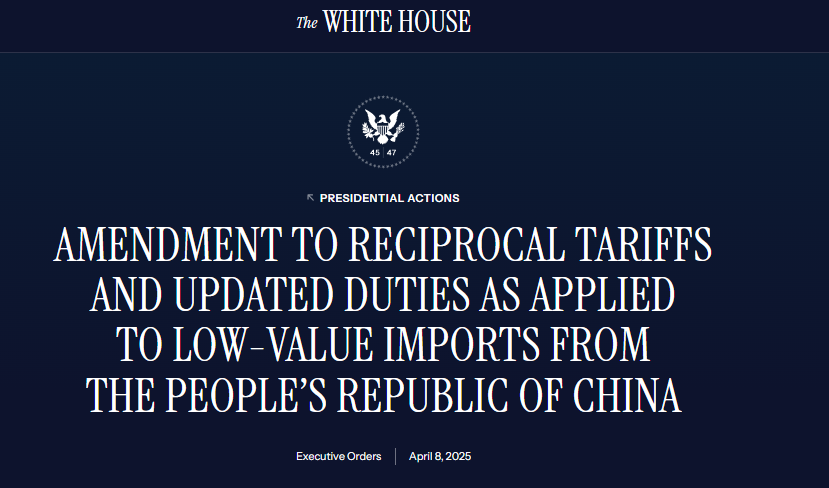
此外,美方还进一步宣布降低来自中国的低价值进口产品的关税优待,即再次提升800美金以下的“小额包裹”的关税标准。

据悉,白宫相关公告显示:

1、(从价法)小额包裹的从价关税税率将从30%提高到90%;

2、(定额法)2025年5月2日东部夏令时间或之后但在2025年6月1日东部夏尔令时间或之前的每件邮递物品,关税由25美元增至75美元;2025年6月1日,每一件邮递品的关税,由50美元增至150美元。

运输承运人必须对所有货物采用相同的关税收集方法;但是,运输承运人可以每月更改一次收集方法,或在CBP认为适当的其他定期时间范围内更改其收集方法,但需要提前24小时通知CBP。
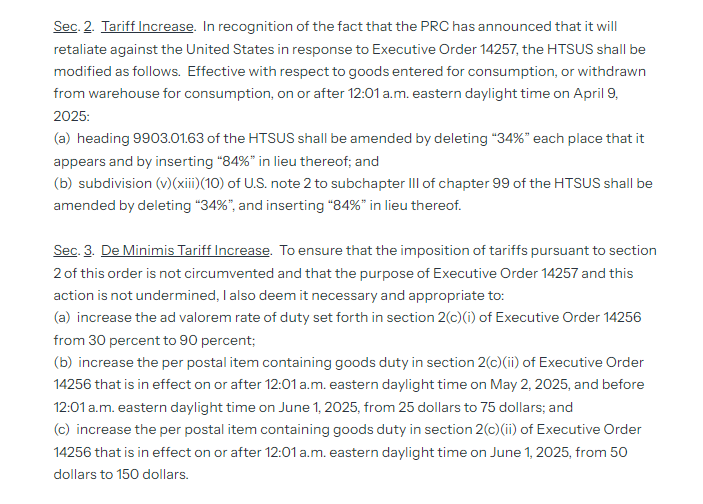
(图片来自白宫官网)

亿邦持续追踪报道该情报,如想了解更多与本文相关信息,请扫码关注作者微信。

【版权提示】亿邦动力倡导尊重与保护知识产权。未经许可,任何人不得复制、转载、或以其他方式使用本网站的内容。如发现本站文章存在版权问题,烦请提供版权疑问、身份证明、版权证明、联系方式等发邮件至run@ebrun.com,我们将及时沟通与处理。

已点赞

+1

{{ praise_text }}

好文章,值得被更多人看到

FAQ回顾

美国对华关税最新税率是多少?

自2024年4月9日起,美国白宫宣布对中国出口商品加征关税,总体税率达到104%。

T86小额包裹关税有哪些具体变化?

800美元以下小额包裹的从价关税税率从30%提高到90%;定额关税将于2025年分阶段从25/50美元增至75/150美元。

新关税政策何时开始执行?

104%的总体关税于2024年4月9日美东时间00:01生效;小额包裹定额关税新标准将于2025年5月2日和6月1日分阶段实施。

广告

下一篇

跨境电商资源对接

《全球跨境电商服务商资源手册》第二期手册现已发布,触达更多资源,了解跨境服务商信息,欢迎点击链接下载。

了解详情

奶茶新排位赛:谁是最大黑马

随着霸王茶姬递交招股书,蜜雪冰城、茶百道、奈雪的茶等各家上市公司发布最新财报,新茶饮行业格局逐渐明朗。