• 亿邦公众号
    • APP下载

3年投资过亿:东方甄选入局新会陈皮,用时间兑现用户信任

作者:龚作仁 文章来源:Laborer

2026-11-11 16:10

作者:龚作仁 文章来源:Laborer

2026-11-11 16:10

邦小白快读

EN
全文速览

总1:先看行业机会与风险

1.新会柑种植面积从2011年1.3万亩增至2024年15万亩,2025年新会陈皮全产业链约283亿元,较十年前增长9.4倍,带动超8万人就业,机构预判2030年有望冲击500亿元。

2.行业存在产地冒充、年份虚标、工艺速成三大失真,消费者即便愿意花钱也难买到确定品质。

总2:再看实操辨别与购买保障

1.可关注“五真陈皮标准”的五个维度:产地、品种、仓储、工艺、安全;核心产区、正宗茶枝柑、恒温干仓、日光生晒、拒绝熏硫和高温速成是关键信号。

2.东方甄选三年累计投资过亿元,设一园一档、一果一剪、铅封流转、编号入库、每月飞检、多批次第三方检测,今年符合其要求的果子仅51.4%。

3.首批新会柑皮约定三年后启封,兑现“三年陈化”承诺;其五常大米做种源基因检测、龙井茶全程驻场、有机蔬菜做500余项农残检测,可作为判断品控认真程度的案例。

总1:品牌信任营销与产品研发

1.新会陈皮2025年全产业链约283亿元,较十年前增长9.4倍,2030年有望达500亿元,但产地冒充、年份虚标、工艺速成造成信任缺口,信任已成为消费决策关键。

2.东方甄选以《五真陈皮标准》把产地、品种、仓储、工艺、安全转化为可核验证据,三年投资过亿,形成品牌壁垒。

3.产品研发上锚定核心产区,前置检测空气、土壤、种苗,建立一园一档,锁定茶枝柑种源;采用恒温干仓、每月飞检、对称三刀法开皮、优先日光生晒,拒绝熏硫和高温速成。

总2:定价、渠道与消费趋势

1.年份是陈皮定价核心锚点,行业年份虚标会扰乱价格体系;东方甄选以真实年份和三年后启封承诺支撑价格信任。

2.渠道上扩展自营农产品矩阵,借发布会公开标准,用溯源信息回应用户品质关注。

3.跨品类案例可借鉴:五常大米从买种开始做种源基因检测,龙井茶坚持无跟产不生产,有机蔬菜采收期做500余项农残检测,说明品牌品控要前置到种源和产地。

总1:增长市场、风险与机会

1.新会陈皮2025年全产业链约283亿元,较十年前增长9.4倍,带动超8万人就业,2030年有望冲击500亿元,市场仍处增长通道。

2.风险在于产地冒充、年份虚标、工艺速成,外围产区与核心产区原料价差可达数倍;今年产区天气不利又逢柑果小年,符合东方甄选要求的果子仅51.4%,供给偏紧。

3.机会在于信任缺口:东方甄选以当年新皮价采购并提前锁定需求量与果园资源,供应商负责鲜果初制和仓库日常管理,提供果园信息与溯源资料,平台派品控团队驻场。

总2:合作方式与可学习点

1.合作模式从凭信任进货转向全链路自控,种植、采收、初制、仓储、陈化每个节点都有可留存、可抽查、可追责的记录。

2.可学习点是长期品控投入:三年累计投资过亿,2027财年品控成本将突破1亿元,主要用于源头驻场、第三方检测、每月飞检与全流程溯源。

3.事件影响上,五真标准发布利好规范经营者,对冒充、虚标、速成形成挤压;首批柑皮三年后启封,可作为合作承诺样本。

总1:产品生产和设计需求

1.产地与品种:锚定新会核心产区,对合作果园空气、土壤、种苗前置检测,建立一园一档,指标不达标不合作;使用正宗新会茶枝柑,从源头锁定道地种源。

2.采收与仓储:执行一果一剪、车辆铅封流转、核对编号入库;设专属恒温干仓,门禁、温湿度与视频全程监控,每月飞检,规避闷仓和非正常催陈。

3.工艺与安全:采用对称三刀法开皮,优先日光生晒,拒绝熏硫和高温速成;对土壤、鲜果、柑皮做多批次第三方检测。

总2:商业机会与数字化启示

1.工厂可作为供应商负责鲜果初制与仓库日常管理,提供果园信息与溯源资料,平台以当年新皮价采购并提前锁定需求量与果园资源。

2.推进数字化和电商的启示是,全流程溯源、视频监控和可抽查记录是接入自营渠道的基础。

3.今年天气不利又逢小年,果径、外观缺陷、成熟度、农残等标准逐项卡死,符合要求果子仅51.4%,提示工厂需稳定原料和精细分级。

总1:行业趋势与客户痛点

1.新会柑种植面积从2011年1.3万亩扩至2024年15万亩,2025年全产业链约283亿元,较十年前增长9.4倍,带动超8万人就业,2030年有望冲击500亿元。

2.客户痛点是行业缺可核验、可追溯的品质证据,消费者面临产地冒充、年份虚标、工艺速成,外围产区与核心产区原料价差可达数倍。

总2:解决方案与新技术

1.东方甄选发布《五真陈皮标准》,从产地、品种、仓储、工艺、安全五维约定;建一园一档、前置检测、一果一剪、铅封流转、编号入库、恒温干仓、每月飞检、多批次第三方检测。

2.技术手段包括种源基因检测用于五常大米、龙井茶春茶季全程驻场、有机蔬菜500余项农残检测;陈皮则用门禁、温湿度与视频监控和全流程溯源。

3.客户价值上,三年累计投资过亿,2027财年品控成本将破亿元,把品控成本转化为信任资产;首批柑皮三年后启封,形成可验证承诺。

总1:平台需求、问题与最新做法

1.新会陈皮2025年全产业链约283亿元,2030年有望达500亿元,但产地冒充、年份虚标、工艺速成导致信任机制缺失,平台自营需要可核验的品质证据。

2.东方甄选以自营入局,发布《五真陈皮标准》,三年累计投资过亿;锚定核心产区,建一园一档,指标不达标不合作,达不到品控标准坚决不上线。

3.招商与合作上,以当年新皮价采购,提前锁定需求量与果园资源;供应商负责鲜果初制和仓库日常管理并提供溯源资料,平台派品控团队源头驻场全天候管控。

总2:运营管理与风向规避

1.运营管理包括恒温干仓门禁、温湿度与视频监控、每月飞检、多批次第三方检测,记录可留存、可抽查、可追责。

2.风向规避上,今年产区天气不利又逢小年,符合要求果子仅51.4%,提示平台要防范供给紧张和品控失守。

3.可复制样本是把规范化、科学化管理沉淀为可核验、可复制的行业样本,首批柑皮三年后启封作为公开见证。

总1:产业新动向

1.新会柑种植面积从2011年1.3万亩增至2024年15万亩,2025年全产业链约283亿元,较十年前增长9.4倍,带动超8万人就业,机构预判2030年有望冲击500亿元。

2.东方甄选三年累计投资过亿入局,发布《五真陈皮标准》,从产地、品种、仓储、工艺、安全五维建立品质约定,并布局全链路、全周期管控。

总2:新问题、政策启示与商业模式

1.新问题是规模扩张伴随信任机制缺位,产地冒充、年份虚标、工艺速成三重失真,年份成为定价核心锚点,行业缺少可核验、可追溯品质证据。

2.政策启示是新会区农业农村局局长强调政府、企业及广大经营主体共同维护金字招牌;标准要求每个节点记录可留存、可抽查、可追责,为监管和行业自律提供样本。

3.商业模式是自营加供应商合作:当年新皮价采购锁定果园,供应商负责初制与仓储,平台驻场品控;首批柑皮三年后启封兑现陈化承诺;五常大米种源基因检测、龙井茶驻场、有机蔬菜500余项检测可作跨品类研究案例。

声明:快读内容全程由AI生成,请注意甄别信息。如您发现问题,请发送邮件至 run@ebrun.com 。

我是 品牌商 卖家 工厂 服务商 平台商 研究者 帮我再读一遍。

Quick Summary

Summary 1: Industry opportunity and risk

1. Xinhui mandarin planting area grew from 13,000 mu in 2011 to 150,000 mu in 2024. The Xinhui chenpi (aged tangerine peel) industry chain was worth about RMB 28.3 billion in 2025, 9.4 times higher than a decade ago, and supports over 80,000 jobs; institutions expect it could approach RMB 50 billion by 2030.

2. The industry suffers from three distortions: origin mislabeling, false vintage claims, and accelerated processing. As a result, even consumers willing to pay struggle to buy quality they can be sure of.

Summary 2: Practical identification and purchase assurance

1. Look at the five dimensions of the Five-True Chenpi Standard: origin, variety, storage, craft, and safety. Core production areas, authentic Chazhi mandarin, temperature-controlled dry warehouses, sun-drying, and a refusal of sulfur fumigation and high-temperature acceleration are the key signals.

2. East Buy has invested more than RMB 100 million cumulatively over three years. It keeps one file per orchard, one cut per fruit, lead-sealed transit, and numbered warehousing; conducts monthly unannounced audits and multi-batch third-party testing; and this year only 51.4% of fruit met its requirements.

3. The first batch of Xinhui peel is scheduled to be opened three years later, honoring the three-year aging commitment. Its Wuchang rice seed-source genetic testing, on-site presence throughout the Longjing tea season, and 500-plus pesticide residue tests on organic vegetables are useful cases for judging how seriously a brand takes quality control.

Summary 1: Brand trust marketing and product development

1. The Xinhui chenpi industry chain was worth about RMB 28.3 billion in 2025, 9.4 times more than a decade ago, and could reach RMB 50 billion by 2030. But origin mislabeling, false vintage claims, and accelerated processing have created a trust gap, and trust has become the decisive factor in consumer decisions.

2. East Buy's Five-True Chenpi Standard turns origin, variety, storage, craft, and safety into verifiable evidence. With more than RMB 100 million invested over three years, it has built a brand moat.

3. On product development, it anchors to core production areas, tests air, soil, and seedlings in advance, keeps one file per orchard, and locks in Chazhi mandarin seed sources. It uses temperature-controlled dry storage, monthly unannounced audits, the symmetrical three-cut peeling method, and prioritizes sun-drying, rejecting sulfur fumigation and high-temperature acceleration.

Summary 2: Pricing, channels, and consumer trends

1. Vintage is the core pricing anchor for chenpi, and false vintage claims disrupt the price system. East Buy underpins price trust with real vintages and a commitment to open the batch three years later.

2. On channels, it is expanding its self-operated agricultural product lineup, publishing standards at launch events, and using traceability information to address users' quality concerns.

3. Cross-category cases offer lessons: Wuchang rice undergoes seed-source genetic testing starting from seed procurement; Longjing tea follows a rule of no on-site oversight, no production; organic vegetables undergo 500-plus pesticide residue tests at harvest. All show that brand quality control must start at seed source and origin.

Summary 1: A growing market, risks, and opportunities

1. The Xinhui chenpi industry chain was worth about RMB 28.3 billion in 2025, 9.4 times higher than a decade ago, and supports over 80,000 jobs. It could reach RMB 50 billion by 2030, and the market is still on a growth track.

2. Risks lie in origin mislabeling, false vintage claims, and accelerated processing. Raw material price gaps between peripheral and core production areas can reach several times. Unfavorable weather in the production area this year, combined with an off-year for mandarin fruit, meant only 51.4% of fruit met East Buy's requirements, leaving supply tight.

3. The opportunity lies in the trust gap. East Buy purchases at the current-year fresh peel price and locks in demand volume and orchard resources in advance. Suppliers handle primary processing of fresh fruit and day-to-day warehouse management and provide orchard information and traceability materials, while the platform sends its quality control team on site.

Summary 2: Partnership model and lessons

1. The partnership model has shifted from buying on trust to full-chain self-control, with every node, from planting, harvesting, and primary processing to storage and aging, backed by records that can be retained, spot-checked, and traced to accountability.

2. The lesson is long-term investment in quality control: more than RMB 100 million cumulatively over three years, with quality control costs set to exceed RMB 100 million in fiscal 2027, mainly for on-site supervision at source, third-party testing, monthly unannounced audits, and full-process traceability.

3. In terms of impact, the release of the Five-True Standard benefits compliant operators and squeezes out mislabeling, false vintage claims, and accelerated processing. The first batch of peel to be opened three years later serves as a model of partnership commitment.

Summary 1: Production and design requirements

1. Origin and variety: anchor to Xinhui's core production areas, pre-test air, soil, and seedlings at partner orchards, and keep one file per orchard, with no cooperation if indicators fall short. Use authentic Xinhui Chazhi mandarin to lock in terroir-true seed sources from the start.

2. Harvest and storage: one cut per fruit, lead-sealed vehicle transit, and numbered warehousing with verification. Dedicated temperature-controlled dry warehouses with access control and full temperature, humidity, and video monitoring, plus monthly unannounced audits, prevent stagnant storage and abnormal accelerated aging.

3. Craft and safety: use the symmetrical three-cut peeling method, prioritize sun-drying, and reject sulfur fumigation and high-temperature acceleration. Run multi-batch third-party testing on soil, fresh fruit, and peel.

Summary 2: Business opportunity and digitalization takeaways

1. Factories can serve as suppliers handling primary processing of fresh fruit and day-to-day warehouse management while providing orchard information and traceability materials, with the platform buying at the current-year fresh peel price and locking in demand volume and orchard resources in advance.

2. The digitalization and e-commerce takeaway is that full-process traceability, video monitoring, and spot-checkable records are the baseline for joining self-operated channels.

3. Unfavorable weather and an off-year this year meant standards on fruit diameter, appearance defects, ripeness, and pesticide residues were enforced item by item, with only 51.4% of fruit qualifying. This signals that factories need stable raw material supply and fine-grained grading.

Summary 1: Industry trends and client pain points

1. Xinhui mandarin planting area expanded from 13,000 mu in 2011 to 150,000 mu in 2024. The full industry chain was worth about RMB 28.3 billion in 2025, 9.4 times higher than a decade ago, and supports over 80,000 jobs; it could reach RMB 50 billion by 2030.

2. The client pain point is the industry's lack of verifiable, traceable quality evidence. Consumers face origin mislabeling, false vintage claims, and accelerated processing, and raw material price gaps between peripheral and core production areas can reach several times.

Summary 2: Solutions and new technologies

1. East Buy released the Five-True Chenpi Standard, setting terms across origin, variety, storage, craft, and safety. It has built one file per orchard, pre-testing, one cut per fruit, lead-sealed transit, numbered warehousing, temperature-controlled dry storage, monthly unannounced audits, and multi-batch third-party testing.

2. Technical tools include seed-source genetic testing for Wuchang rice, full on-site presence during the Longjing spring tea season, and 500-plus pesticide residue tests for organic vegetables. For chenpi, it uses access control, temperature and humidity monitoring, video surveillance, and full-process traceability.

3. On client value: more than RMB 100 million invested over three years, with quality control costs set to exceed RMB 100 million in fiscal 2027, turning quality control costs into trust assets. The first batch of peel to be opened three years later creates a verifiable commitment.

Summary 1: Platform needs, problems, and current approach

1. The Xinhui chenpi industry chain was worth about RMB 28.3 billion in 2025 and could reach RMB 50 billion by 2030, but origin mislabeling, false vintage claims, and accelerated processing have left trust mechanisms absent. Platform self-operation requires verifiable quality evidence.

2. East Buy entered with a self-operated model, released the Five-True Chenpi Standard, and has invested more than RMB 100 million cumulatively over three years. It anchors to core production areas, keeps one file per orchard, declines cooperation when indicators fall short, and refuses to list products that fail its quality standards.

3. On merchant recruitment and partnership, it buys at the current-year fresh peel price and locks in demand volume and orchard resources in advance. Suppliers handle primary processing and day-to-day warehouse management and provide traceability materials, while the platform sends quality control teams to be on site at source around the clock.

Summary 2: Operational management and risk avoidance

1. Operational management includes access control at temperature-controlled dry warehouses, temperature, humidity, and video monitoring, monthly unannounced audits, and multi-batch third-party testing, with records that can be retained, spot-checked, and traced to accountability.

2. On risk avoidance: unfavorable weather in the production area this year plus an off-year meant only 51.4% of fruit qualified, a reminder that platforms must guard against supply tightness and quality control failures.

3. The replicable model is to turn standardized, scientific management into a verifiable, replicable industry benchmark, with the first batch of peel opened three years later as public testimony.

Summary 1: New industry developments

1. Xinhui mandarin planting area grew from 13,000 mu in 2011 to 150,000 mu in 2024. The full industry chain was worth about RMB 28.3 billion in 2025, 9.4 times higher than a decade ago, and supports over 80,000 jobs; institutions expect it could approach RMB 50 billion by 2030.

2. East Buy entered with more than RMB 100 million invested over three years, released the Five-True Chenpi Standard establishing quality terms across origin, variety, storage, craft, and safety, and is building full-chain, full-cycle control.

Summary 2: New issues, policy implications, and business model

1. The new issue is that scale expansion has come with an absence of trust mechanisms. Origin mislabeling, false vintage claims, and accelerated processing form a triple distortion. Vintage is the core pricing anchor, and the industry lacks verifiable, traceable quality evidence.

2. The policy implication is that the director of the Xinhui District Agriculture and Rural Affairs Bureau stresses that government, enterprises, and the broad range of market operators must jointly protect the region's gold-lettered brand. The standard requires records at every node to be retainable, spot-checkable, and traceable to accountability, offering a model for regulation and industry self-discipline.

3. The business model is self-operation plus supplier partnership: purchasing at the current-year fresh peel price to lock in orchards, with suppliers handling primary processing and storage and the platform stationing quality control staff on site. The first batch of peel opened three years later honors the aging commitment, while Wuchang rice seed-source genetic testing, Longjing tea on-site supervision, and 500-plus tests on organic vegetables serve as cross-category research cases.

Disclaimer: The "Quick Summary" content is entirely generated by AI. Please exercise discretion when interpreting the information. For issues or corrections, please email run@ebrun.com .

I am a Brand Seller Factory Service Provider Marketplace Seller Researcher Read it again.

2026年11月6日,东方甄选举办“五真陈皮·三年之约”发布会,正式发布自营新会陈皮,并同步发布《东方甄选五真陈皮标准》。发布会现场,新会区农业农村局局长吴春明、东方甄选执行总裁孙进出席并致辞,东方甄选供应链伙伴共同见证。
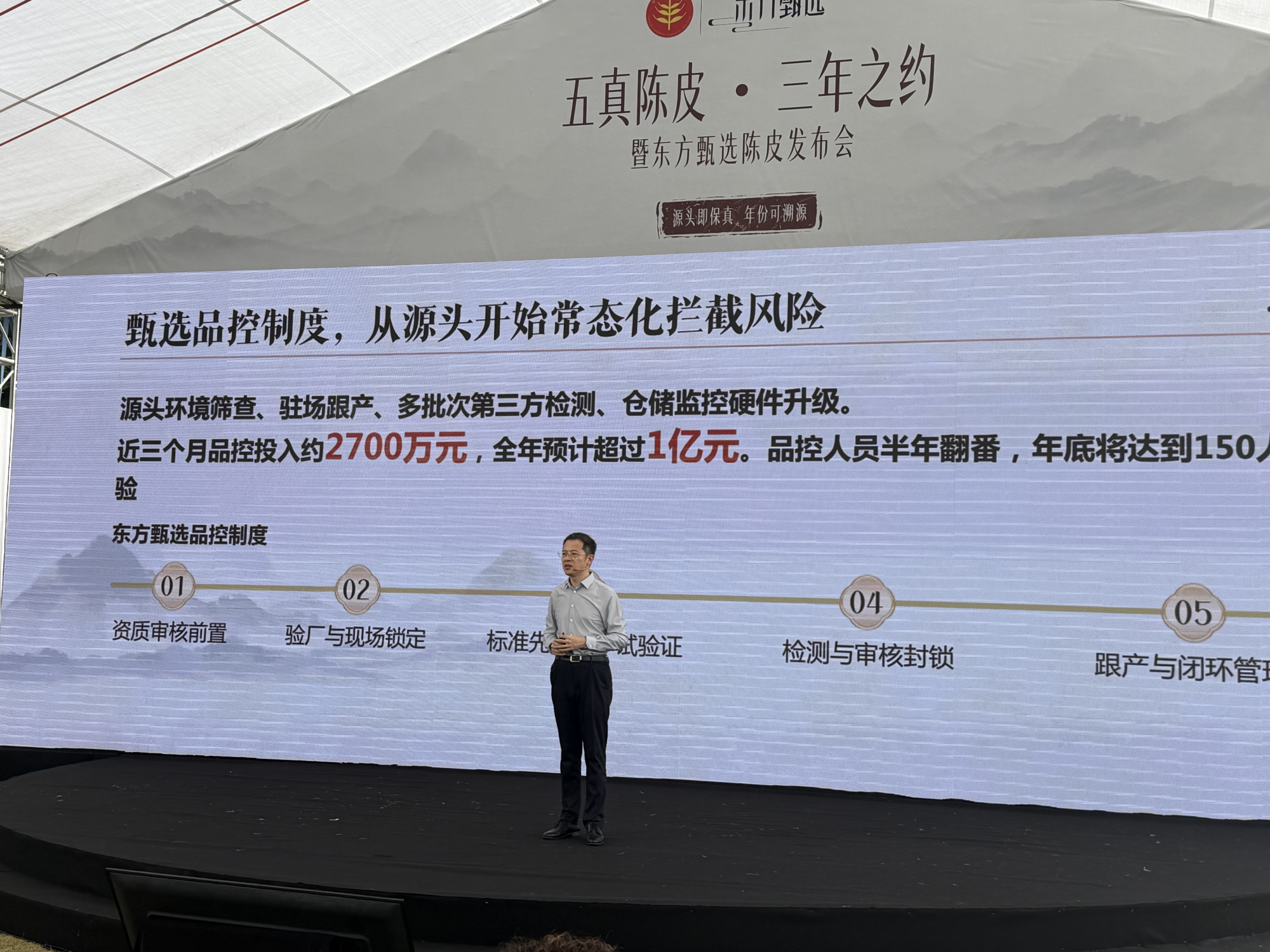
图:东方甄选执行总裁孙进致辞

行业突飞猛进,信任机制缺失

新会陈皮是近年增长最快的道地农产品品类之一。数据显示,新会柑的种植面积从2011年1.3万亩扩至2024年的15万亩,2025年新会陈皮全产业链规模约283亿元,较十年前增长9.4倍,带动超8万人增收就业。有机构预判,到2030年全产业链规模有望冲击500亿元。

但在规模扩张的另一面,是长期缺位的信任机制。东方甄选在发布会上点出了消费者面临的三大失真:产地冒充——外地皮贴上“新会”标签,消费者仅凭外观难以分辨,外围产区与一线核心产区的原料价差可达数倍;年份虚标——通过做旧手段在短时间内把新皮催出“多年陈”的外观,而年份正是陈皮定价的核心锚点;工艺速成——以高温高湿、染色熏硫等手段炮制“工艺皮”。产地、年份、工艺三重问题叠加,让消费者即便愿意花钱也难以买到确定的品质。显而易见,行业真正的缺口不在产能,而在于缺少一套可核验、可追溯的品质证据。

新会陈皮的品牌价值,根植于真实产地、优良品种、规范生产和稳定品质。新会区农业农村局局长吴春明强调:“维护新会陈皮金字照牌,需要政府、企业及广大经营主体共同努力”。这也是东方甄选入局陈皮产业的初心。

五真陈皮标准发布,为行业信任加码

从果园到仓库,每一道关口都对应一个行业风险,也对应一组可留存、可抽查、可追责的记录。为促进行业健康发展、提振消费者对陈皮产品的信任,东方甄选自营陈皮产品团队现场发布《东方甄选五真陈皮标准》,从陈皮的产地、品种、仓储、工艺、安全五个维度作出严格且详细的约定。
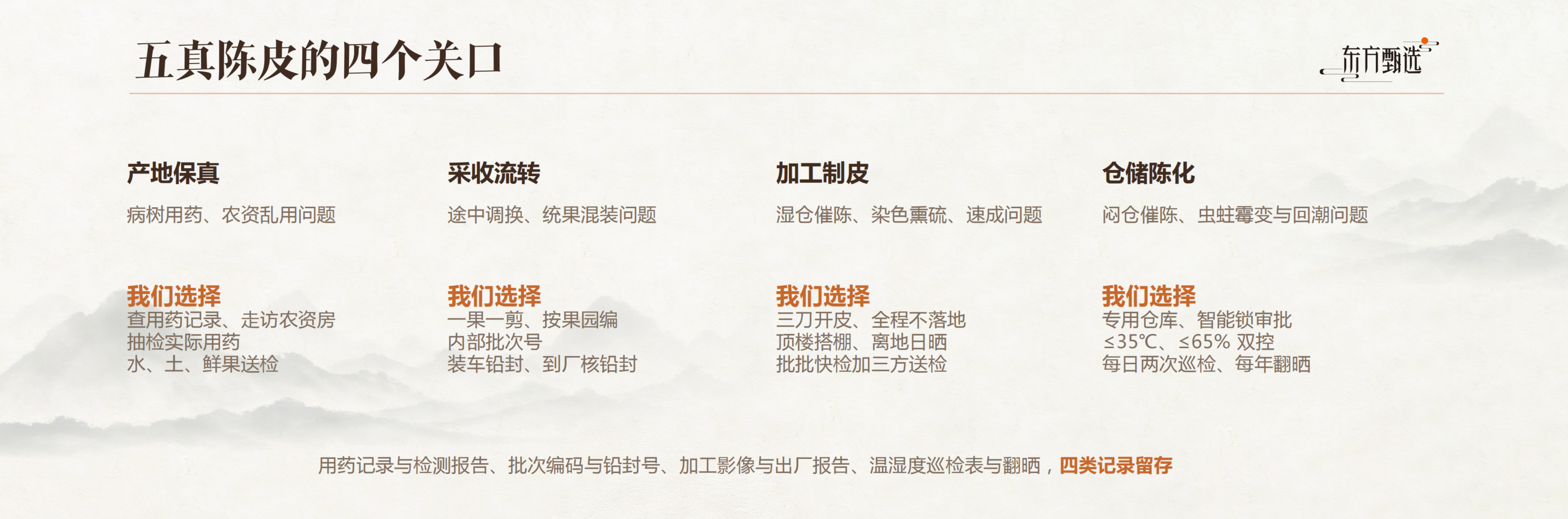
图:《东方甄选五真陈皮标准》

东方甄选锚定新会核心产区,对合作果园的空气、土壤、种苗进行前置检测,建立“一园一档”,指标不达标的果园不予合作,并正宗新会茶枝柑,从源头锁定道地种源。在采收过程中,执行一果一剪,车辆铅封流转,核对编号入库,杜绝原料调换的风险。东方甄选还设置专属恒温干仓,门禁、温湿度与视频全程监控,并实行每月飞检,规避闷仓与非正常催陈。在加工工艺上,采用对称三刀法开皮,优先日光生晒,拒绝熏硫和高温速成,让时间成为产品的一部分。此外,东方甄选还对土壤、鲜果、柑皮进行多批次第三方检测,确保产品品质安全。

发布会现场,东方甄选执行总裁孙进表示:“布局陈皮项目三年累计投资过亿元。不是所有新会陈皮,都能成为东方甄选的新会陈皮。光是‘真的’新会陈皮还不够,还得是‘好的’新会陈皮。达不到我们品控标准的,坚决不上线。”。由于今年产区天气不利,又逢柑果“小年”,果径、外观缺陷、成熟度、农残等标准被逐项卡死,真正符合东方甄选要求的果子只有51.4%”。

全链路全周期管控,创行业科学管理样本

标准之外,更关键的是执行。在合作模式上,东方甄选从“凭信任进货、凭运气卖货”转向全链路自控:以当年新皮价采购,提前锁定需求量与果园资源;供应商负责鲜果初制与仓库日常管理,并提供果园信息与溯源资料;东方甄选则派出品控团队常态化源头驻场全天候管控。从果园前置检测到恒温干仓陈化、每月飞检与多批次第三方检测等,种植、采收、初制、仓储、陈化的每个节点都对应可留存、可抽查、可追责的记录,为产品品质设置重重保障。
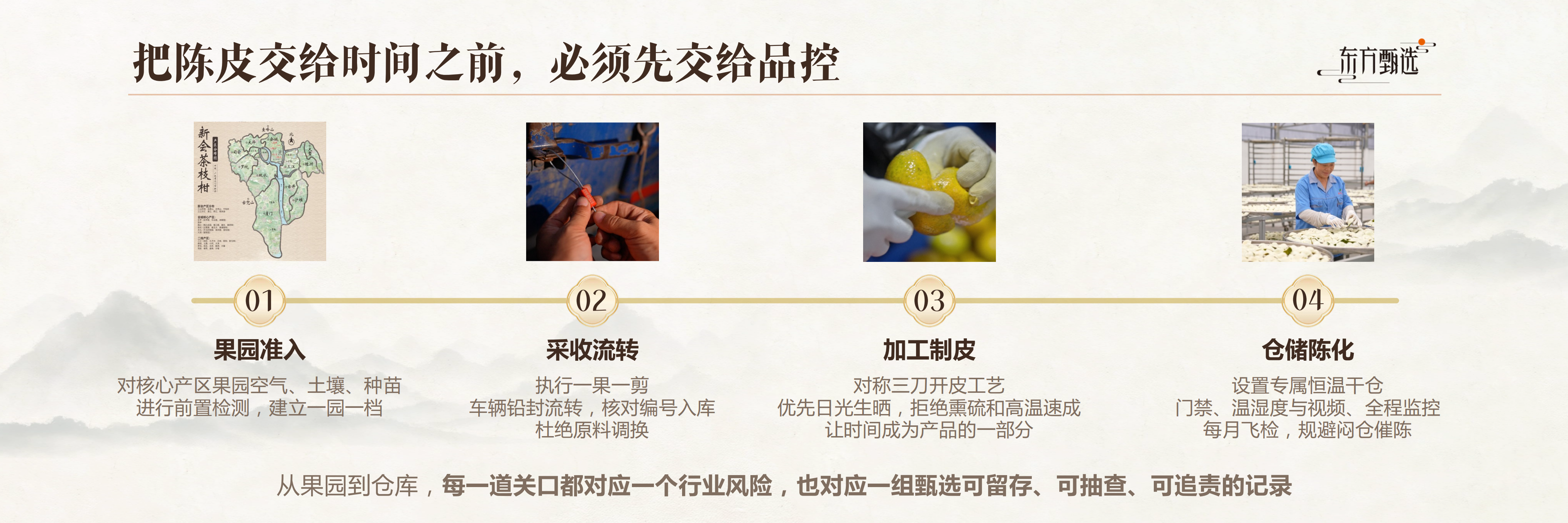
图:东方甄选自营陈皮全周期全流程管控

东方甄选对陈皮产品全链路、全周期管控的底气来源于其在诸多种植类产品上积累的丰富经验。真·特等五常大米买种开始做种源基因检测;龙井茶锁定产区、春茶季全程驻场,坚持“无跟产不生产”;有机蔬菜种植前做水土第三方外检,采收期对每一茬做500余项农残检测,确保土地、过程和产出每个环节真实可控。

支撑全周期管控的,是持续加码的品控投入。东方甄选不断抬高自营品的品控成本,2027财年品控成本将突破1亿元,主要用于源头驻场、第三方检测、每月飞检与全流程溯源。

陈皮的价值需要时间沉淀,企业的投入同样需要时间兑现。据悉,发布会现场封印的首

批新会柑皮约定将于三年后启封,作为兑现“三年陈化”承诺的公开见证,按照《东方甄选五真陈皮标准》留存溯源信息,相关品控投入也将随陈化周期持续接受检验。随着自营农产品矩阵的拓展,东方甄选正在把规范化、科学化的管理标准沉淀为一套可核验、可复制的行业样本,既回应用户对品质的关注,也助力农产品行业良性发展。

注:文/龚作仁,文章来源:Laborer,本文为作者独立观点,不代表亿邦动力立场。

【版权提示】亿邦动力倡导尊重与保护知识产权。未经许可,任何人不得复制、转载、或以其他方式使用本网站的内容。如发现本站文章存在版权问题,烦请提供版权疑问、身份证明、版权证明、联系方式等发邮件至run@ebrun.com,我们将及时沟通与处理。

已点赞

+1

{{ praise_text }}

好文章,值得被更多人看到

FAQ回顾

新会陈皮市场主要存在哪些品质乱象?

新会陈皮市场长期存在产地冒充、年份虚标和工艺速成三大问题。产地冒充是外地皮贴“新会”标签,核心产区与外围产区原料价差可达数倍;年份虚标通过做旧手段把新皮催出“多年陈”外观;工艺速成则以高温高湿、染色熏硫等方式制作“工艺皮”。

《东方甄选五真陈皮标准》包含哪些维度?

《东方甄选五真陈皮标准》从产地、品种、仓储、工艺、安全五个维度作出约定。产地锚定新会核心产区,合作果园需前置检测并建立“一园一档”;品种采用正宗新会茶枝柑;仓储设置专属恒温干仓并每月飞检;工艺采用对称三刀法开皮、优先日光生晒,拒绝熏硫和高温速成;安全则进行多批次第三方检测。

东方甄选如何对新会陈皮进行全链路品质管控?

东方甄选对陈皮实施全链路、全周期管控:果园端检测空气、土壤和种苗并建立“一园一档”;采收端执行一果一剪、车辆铅封流转和编号入库;仓储端设置恒温干仓,门禁、温湿度与视频全程监控并每月飞检;加工端采用对称三刀法开皮、优先日光生晒,拒绝熏硫和高温速成;同时进行多批次第三方检测并派品控团队源头驻场。

企业做高端农产品如何建立可追溯的信任机制?

东方甄选在新会陈皮上的做法是全链路自控:以当年新皮价采购,提前锁定需求量与果园资源;供应商负责鲜果初制与仓库日常管理,并提供果园信息和溯源资料;企业派品控团队常态化源头驻场;种植、采收、初制、仓储、陈化各节点都留存可抽查、可追责记录,并通过每月飞检和多批次第三方检测验证品质。

新会陈皮产业规模和发展趋势如何?

新会柑种植面积已从2011年的1.3万亩扩大到2024年的15万亩;2025年新会陈皮全产业链规模约283亿元,较十年前增长9.4倍,带动超8万人增收就业。有机构预判,到2030年全产业链规模有望冲击500亿元。规模扩张的同时,行业更需要可核验、可追溯的品质证据。

广告

下一篇

跨境电商资源对接

《全球跨境电商服务商资源手册》第二期手册现已发布,触达更多资源,了解跨境服务商信息,欢迎点击链接下载。

了解详情

AI时代品牌如何“制胜”?天猫激云说了些大实话

“未来的胜利者不是看谁做得最大,而是看谁活得最久,谁能熬到最后的那一天。时间会帮你杀死竞争对手。”