• 亿邦公众号
    • APP下载

中国平安携手阿里巴巴:日均消耗超3000亿Token 产业 AI加速创造业务价值

作者:龚作仁 文章来源:Laborer

2026-09-22 15:25

作者:龚作仁 文章来源:Laborer

2026-09-22 15:25

邦小白快读

EN
全文速览

这篇文章核心披露了2026云栖大会上,中国平安联合阿里巴巴落地产业AI的最新进展,包含不少和大众日常服务相关的实用信息。

1. AI落地的效率成果:不到一年时间,在阿里云全栈技术支持下,平安日均AI处理的Token规模从约300亿增长至超3000亿,算力仅增长不到2倍,单位Token成本下降76%,意味着大众能接触到的AI服务已经跨过早期高成本阶段。

2. 日常可触及的AI服务:平安面向超2.5亿个人客户上线的AI快捷服务,上线不到半年累计服务量突破1亿;医疗场景中25%的到院服务、70%的到家服务由AI首接分发,医疗大模型问诊场景幻觉率低于0.3%,服务可靠性已经达到较高水平。

3. 企业落地AI的务实思路:不盲目堆砌算力,重点提升Token转化效率,把通用AI能力转化为专业场景能力,后续大众接触到的各类AI服务实用性会持续提升。

平安与阿里巴巴合作落地产业AI的实践,为品牌商推进AI应用、优化经营效率、升级用户服务提供了可直接参考的标杆路径。

1. AI投入的成本参考:品牌落地AI无需盲目堆砌算力投入,通过模型、推理、算力调度的全栈优化,就能实现极高的投入产出比,参考平安的实践,单位算力Token产出可提升368%,单位Token成本下降76%,可控成本下即可实现AI服务规模化覆盖。

2. 用户服务的升级方向:平安面向2.5亿客户上线的AI快捷服务,上线半年服务量突破1亿,大幅提升服务响应效率、降低服务人力成本,是品牌优化用户触达渠道、提升服务体验的可行方向。

3. 产品能力的打造思路:将通用大模型结合自身积累的专业数据、专家知识、真实业务反馈,打磨垂直领域的专业AI能力,比如平安打磨的金融、医疗大模型均拿下行业评测第一,这种模式能帮助品牌打造差异化的产品竞争力,贴合用户对专业服务的核心需求。

平安联合阿里云落地产业AI的实践,为各类经营主体挖掘AI场景价值、找到降本增效路径提供了可借鉴的实操方法与机会提示。

1. 可复制的AI落地路径:经营主体落地AI无需承担高额的算力投入成本,通过模型优化、推理优化、合理的算力调度,就能用有限的投入支撑10倍规模的业务处理量,大幅降低AI工具的使用门槛。

2. 服务端的效率升级机会:AI首接分发的服务模式已经在客户服务、本地生活服务场景得到验证,平安的落地数据显示70%的到家服务由AI完成首接分发,卖家可以借鉴这种模式降低服务端人力成本,提升用户咨询的响应速度。

3. 生产力层面的升级方向:在研发生产环节,平安已经实现80%的新代码由AI生成、67%的测试工作由AI完成,卖家可以借助成熟的通用大模型能力,结合自身业务数据打磨适配经营需求的AI工具,在营销、客服、品控等环节找到新的效率增长空间。

平安与阿里云合作推进AI规模化落地的实践,为工厂推进数字化转型、挖掘AI生产价值、对接新产业需求提供了清晰的参考方向。

1. 数字化转型的务实思路:工厂落地AI无需一开始就投入高额成本堆砌硬件算力,可以优先从效率优化切入,通过模型适配、流程调度优化提升单位算力的实际产出,参考平安单位算力产出提升368%、单位Token成本下降76%的经验,用可控投入就能实现数字化能力的阶梯式升级。

2. 生产端的效率升级方向:AI可以深度介入研发、质控类核心环节,参考平安研发领域80%新代码由AI生成、67%测试由AI完成的模式,工厂可以将AI嵌入产品设计、生产质控、流程调度等环节,降低重复性人力投入,提升生产精度与效率。

3. 潜在商业机会提示:随着全行业AI规模化落地加速,产业场景适配、算力配套、专业模型落地的相关硬件与服务需求会持续增长,工厂可以结合自身生产场景优势,对接相关供应链需求开辟新的业务增长点。

平安与阿里的AI落地实践,清晰展现了当前产业AI的发展趋势、大型企业客户的核心痛点,以及经过市场验证的可行解决方案方向。

1. 行业发展趋势判断:产业AI已经从早期的试点探索阶段进入规模化创造业务价值的阶段,平安日均Token消耗量不到一年增长10倍突破3000亿,说明企业端的AI需求正在快速释放,相关服务市场已经进入高速增长期。

2. 企业客户的核心痛点:大型企业落地AI并不愿意单纯靠追加算力投入换取规模增长,更核心的需求是提升Token转化效率、降低单位AI使用成本,把通用大模型能力转化为适配自身业务的专业能力,解决专业场景的可靠性问题,比如医疗场景下的模型幻觉控制。

3. 可落地的解决方案方向:服务商可以从模型优化、推理优化、算力调度的全栈技术服务切入,帮助客户提升算力产出、降低使用成本,同时结合客户的专业数据、专家知识、真实业务反馈做垂直模型微调,满足金融、医疗等强专业场景的高可靠服务要求。

2026云栖大会上披露的平安与阿里云的AI合作成果,展现了当前企业用户对平台型技术服务的核心需求,也为平台优化服务体系、拓展客户合作提供了参考方向。

1. 企业用户对平台的核心需求:企业选择AI技术合作方,并不只看重平台的算力规模,更需要平台提供模型、推理、算力调度的全栈优化能力,帮助客户降低单位AI使用成本、提升Token产出效率,同时提供成熟的通用基础大模型,支持企业结合自身数据打磨垂直领域的专业能力。

2. 经过验证的平台合作路径:阿里云通过提供全栈AI技术支持、开放千问系列基础模型,支撑平安实现10倍的Token规模增长,助力平安金融大模型登顶CNFinBench榜单、医疗大模型拿下HealthBench Hard最高分,这种技术底座+联合打磨的模式,能帮助平台沉淀高价值的行业标杆案例。

3. 平台运营与风险规避方向:平台可以围绕企业AI规模化落地的全流程需求,搭建从算力调度、模型微调到大模型应用落地的全链路服务体系,吸引更多大型企业客户合作,同时要重点关注专业场景的AI可靠性问题,比如通过技术优化降低模型幻觉率,规避服务风险。

2026云栖大会上披露的平安与阿里的AI合作实践,为观察国内产业AI落地进程、总结规模化应用规律、研究新型产业协作商业模式提供了最新的实证案例。

1. 产业AI发展的最新动向:国内产业AI已经进入规模化落地的价值兑现期,平安日均Token用量不到一年从300亿增长至超3000亿,以不到2倍的算力增长支撑10倍的业务规模,单位Token成本下降76%,说明全栈技术优化带来的效率提升,已经取代单纯的算力堆砌成为AI规模化发展的核心驱动力。

2. 产业AI落地的现实问题与解法:当前AI进入金融、医疗等专业场景后,核心要解决的是通用能力向专业能力转化的问题,以及专业场景下的服务可靠性问题,比如平安金融大模型登顶CNFinBench公开榜单、医疗大模型刷新HealthBench Hard基准纪录,将问诊幻觉率控制在0.3%以下,证明基础模型提供方+行业场景方协作,结合专业数据、专家知识、业务反馈打磨垂直模型是可行路径。

3. 新型产业协作模式:科技平台提供全栈AI技术与基础大模型,实体产业方开放业务场景与专业数据,双方联合推进模型优化与效率提升的协作模式,正在成为产业AI落地的主流商业协作模式。

声明:快读内容全程由AI生成,请注意甄别信息。如您发现问题,请发送邮件至 run@ebrun.com 。

我是 品牌商 卖家 工厂 服务商 平台商 研究者 帮我再读一遍。

Quick Summary

This article covers key updates on Ping An’s industrial AI deployment in partnership with Alibaba, unveiled at the 2026 Apsara Conference, including practical updates relevant to everyday consumer services.

1. Efficiency gains from AI rollout: In under a year, with full-stack technical support from Alibaba Cloud, Ping An’s average daily AI token processing volume grew from roughly 30 billion to over 300 billion, while computing power investment increased by less than 2x. Per-token costs fell by 76%, marking that consumer-facing AI services have moved past the early high-cost phase.

2. Accessible everyday AI services: Ping An has launched AI-powered quick services for its over 250 million individual customers, with cumulative usage exceeding 100 million within six months of launch. In healthcare, 25% of in-hospital services and 70% of at-home services are initially triaged and routed by AI; the medical large language model (LLM) has a hallucination rate below 0.3% in consultation scenarios, reflecting strong service reliability.

3. Pragmatic approach to enterprise AI adoption: Rather than blindly scaling up computing power, the focus is on improving token conversion efficiency and adapting general AI capabilities to specialized use cases. This will continue to improve the practical utility of AI services available to the general public going forward.

Ping An’s industrial AI deployment in collaboration with Alibaba offers a benchmark reference for brands looking to advance AI adoption, improve operational efficiency, and upgrade customer service.

1. Cost benchmark for AI investment: Brands do not need to overinvest in computing power to scale AI. Full-stack optimization across models, inference, and computing scheduling can deliver very high return on investment. Drawing on Ping An’s practice, per-unit computing power can deliver a 368% increase in token output, with per-token costs falling 76%, enabling scaled AI service coverage at controllable costs.

2. Direction for customer service upgrades: Ping An’s AI quick services for 250 million customers surpassed 100 million uses within six months of launch, sharply improving response efficiency and reducing labor costs. This model offers a viable path for brands to optimize customer touchpoints and elevate service experience.

3. Approach to building product capabilities: Combining general-purpose LLMs with in-house professional data, expert knowledge, and real-world business feedback to build vertical-domain AI capabilities has proven effective. For example, Ping An’s financial and medical LLMs both ranked first in industry evaluations; this model helps brands build differentiated product competitiveness aligned with users’ core demand for professional services.

Ping An’s industrial AI deployment with Alibaba Cloud provides actionable methods and opportunity signals for businesses of all sizes to unlock value from AI use cases and identify paths to reduce costs and raise efficiency.

1. Replicable AI deployment path: Businesses do not need to bear high computing costs to adopt AI. Through model optimization, inference optimization, and smart computing scheduling, limited investment can support a 10x increase in business processing volume, significantly lowering the barrier to using AI tools.

2. Efficiency upgrade opportunities in service operations: The model of AI-led initial intake and routing has been validated in customer service and local lifestyle services. Ping An’s data shows 70% of at-home services are initially routed by AI; sellers can adopt this model to reduce service labor costs and speed up response to customer inquiries.

3. Direction for productivity upgrades: In R&D and production, Ping An now generates 80% of new code with AI and completes 67% of testing via AI. Sellers can leverage mature general-purpose LLM capabilities, combined with their own business data, to build AI tools tailored to their operations, unlocking new efficiency gains in marketing, customer service, quality control, and other areas.

Ping An’s scaled AI deployment with Alibaba Cloud offers clear reference points for factories pursuing digital transformation, unlocking AI value in production, and aligning with new industry demand.

1. Pragmatic approach to digital transformation: Factories do not need to make large upfront investments in hardware computing power to adopt AI. A better starting point is efficiency optimization—improving actual output per unit of computing power through model adaptation and process scheduling optimization. Drawing on Ping An’s experience, where per-unit computing output rose 368% and per-token costs fell 76%, controllable investment can deliver step-by-step upgrades to digital capabilities.

2. Efficiency upgrade direction for production: AI can be deeply integrated into core R&D and quality control processes. Mirroring Ping An’s model—where 80% of new code and 67% of testing in R&D are AI-powered—factories can embed AI into product design, production quality control, and process scheduling to reduce repetitive labor and improve production precision and efficiency.

3. Potential commercial opportunities: As scaled AI adoption accelerates across industries, demand will grow for hardware and services related to industrial scenario adaptation, computing infrastructure, and specialized model deployment. Factories can leverage their production scenario strengths to tap into related supply chain demand and open new growth avenues.

Ping An and Alibaba’s AI deployment clearly illustrates current industrial AI trends, the core pain points of large enterprise customers, and validated, viable solution directions.

1. Industry trend assessment: Industrial AI has moved beyond early pilot stages into a phase of creating tangible business value at scale. Ping An’s average daily token consumption grew 10x to over 300 billion in less than a year, indicating fast-growing enterprise AI demand and a rapidly expanding service market.

2. Core pain points for enterprise customers: Large enterprises do not want to scale AI purely by adding computing power. Their priority needs are improving token conversion efficiency, reducing per-unit AI usage costs, translating general LLM capabilities into business-specific professional capabilities, and solving reliability issues in specialized scenarios—for example, controlling model hallucinations in healthcare settings.

3. Actionable solution directions: Service providers can offer full-stack technical services spanning model optimization, inference optimization, and computing scheduling to help clients boost computing output and lower costs. They can also support vertical model fine-tuning using clients’ professional data, expert knowledge, and real business feedback to meet the high-reliability requirements of highly regulated sectors such as finance and healthcare.

The outcomes of Ping An’s AI partnership with Alibaba Cloud, unveiled at the 2026 Apsara Conference, highlight enterprise customers’ core needs for platform-based technology services and offer direction for platforms to optimize their service systems and expand client partnerships.

1. Core enterprise demand for platforms: When selecting AI technology partners, enterprises prioritize more than just a platform’s computing scale. They also need full-stack optimization capabilities across models, inference, and computing scheduling to help lower per-unit AI costs and improve token output efficiency, as well as mature general-purpose foundation models that support enterprises in building vertical-domain capabilities using their own data.

2. Validated platform collaboration model: By providing full-stack AI technical support and opening its Tongyi series of foundation models, Alibaba Cloud supported Ping An in achieving 10x token volume growth, and helped Ping An’s financial LLM top the CNFinBench ranking and its medical LLM score highest on HealthBench Hard. This “technology foundation + joint refinement” model helps platforms build high-value industry benchmark cases.

3. Platform operations and risk mitigation direction: Platforms can build an end-to-end service system covering computing scheduling, model fine-tuning, and LLM application deployment to meet the full lifecycle needs of scaled enterprise AI rollouts, attracting more large enterprise clients. At the same time, they should prioritize AI reliability in professional scenarios, such as reducing model hallucination rates through technical optimization, to mitigate service risks.

Ping An and Alibaba’s AI collaboration, unveiled at the 2026 Apsara Conference, provides a latest empirical case for observing China’s industrial AI deployment progress, summarizing patterns in scaled application, and studying new industry collaboration business models.

1. Latest trends in industrial AI development: China’s industrial AI has entered a value realization phase of scaled deployment. Ping An’s average daily token usage grew from 30 billion to over 300 billion in under a year, supporting 10x business scale with less than 2x growth in computing power, while per-token costs fell 76%. This indicates that efficiency gains from full-stack technical optimization, rather than brute-force computing expansion, have become the core driver of scaled AI development.

2. Real-world challenges and solutions in industrial AI deployment: As AI enters professional sectors such as finance and healthcare, the core challenges are translating general capabilities into domain-specific expertise and ensuring service reliability in professional scenarios. For example, Ping An’s financial LLM topped the public CNFinBench ranking, its medical LLM set a new record on the HealthBench Hard benchmark, and consultation hallucination rates were kept below 0.3%—proving that collaboration between foundation model providers and industry players, combining professional data, expert knowledge, and business feedback to refine vertical models, is a viable path.

3. New industry collaboration model: The model in which technology platforms provide full-stack AI technology and foundation models, while industry players open up business scenarios and professional data for joint model optimization and efficiency improvements, is emerging as the mainstream commercial collaboration model for industrial AI deployment.

Disclaimer: The "Quick Summary" content is entirely generated by AI. Please exercise discretion when interpreting the information. For issues or corrections, please email run@ebrun.com .

I am a Brand Seller Factory Service Provider Marketplace Seller Researcher Read it again.

9月22日,2026云栖大会在杭州举行。中国平安集团首席技术官王晓航在主论坛发表《从Token到价值:平安之解》主题演讲,介绍平安在金融、医疗等领域的AI实践,以及与阿里巴巴的AI合作。
过去不到一年,在阿里云AI全栈技术优化支持下,平安日均Token用量从约300亿增至超过3000亿,同期算力从800PF提升至1500PF,以不到2 倍的算力增长支撑了10倍的Token增长。通过模型、推理和算力调度等全栈优化,平安单位算力Token产出提升368%,单位Token成本下降76%。

王晓航表示,对大型企业而言,AI规模化不能简单依靠增加算力,更重要的是提升Token效率,把通用智能转化为专业智能,并真正进入业务。
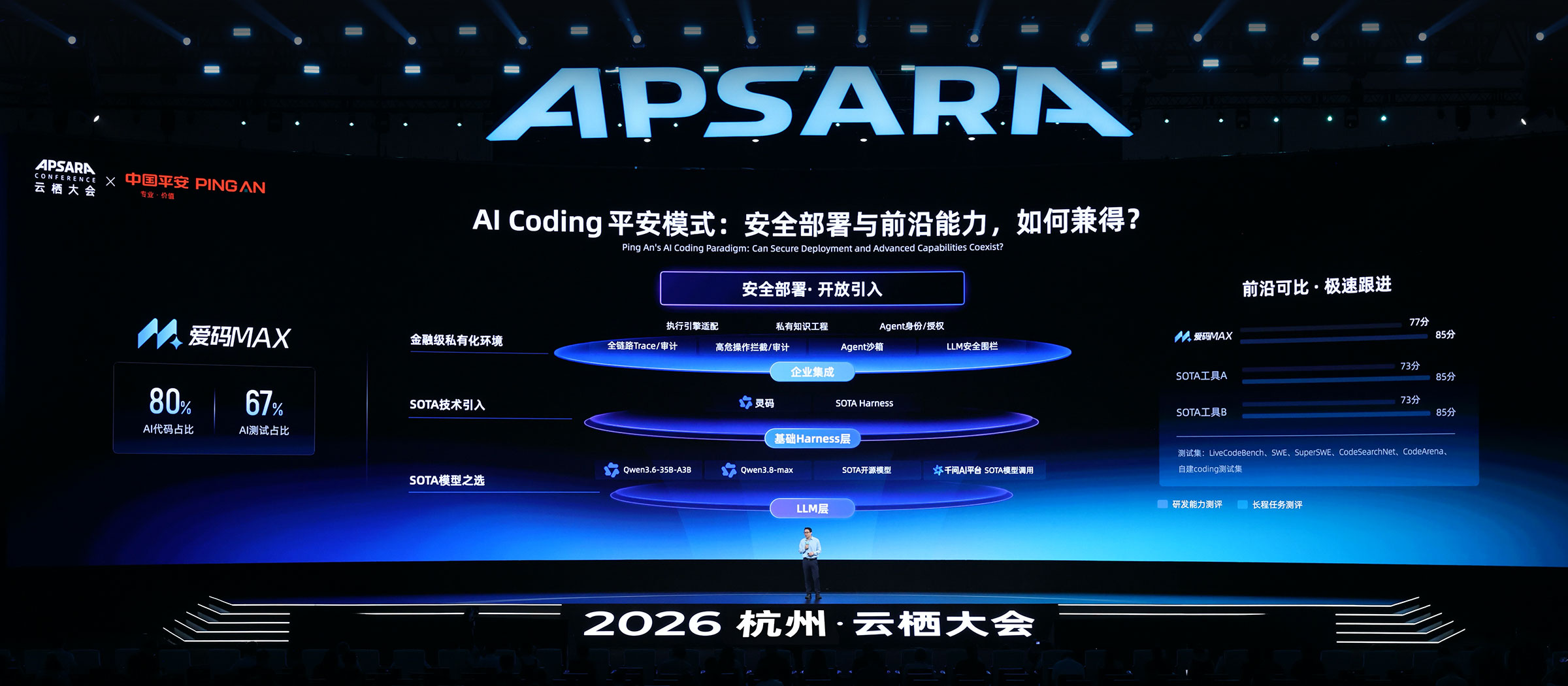
目前,平安AI应用已覆盖客户服务、医疗和研发等场景。面向超过2.5亿客户,AI快捷服务上线不到半年,累计服务量突破1 亿;AI医生连接线上线下医疗服务,目前25% 的到院服务、70% 的到家服务由AI首接和分发;软件研发领域,约80%新代码由AI生成,AI测试占比达到67%。

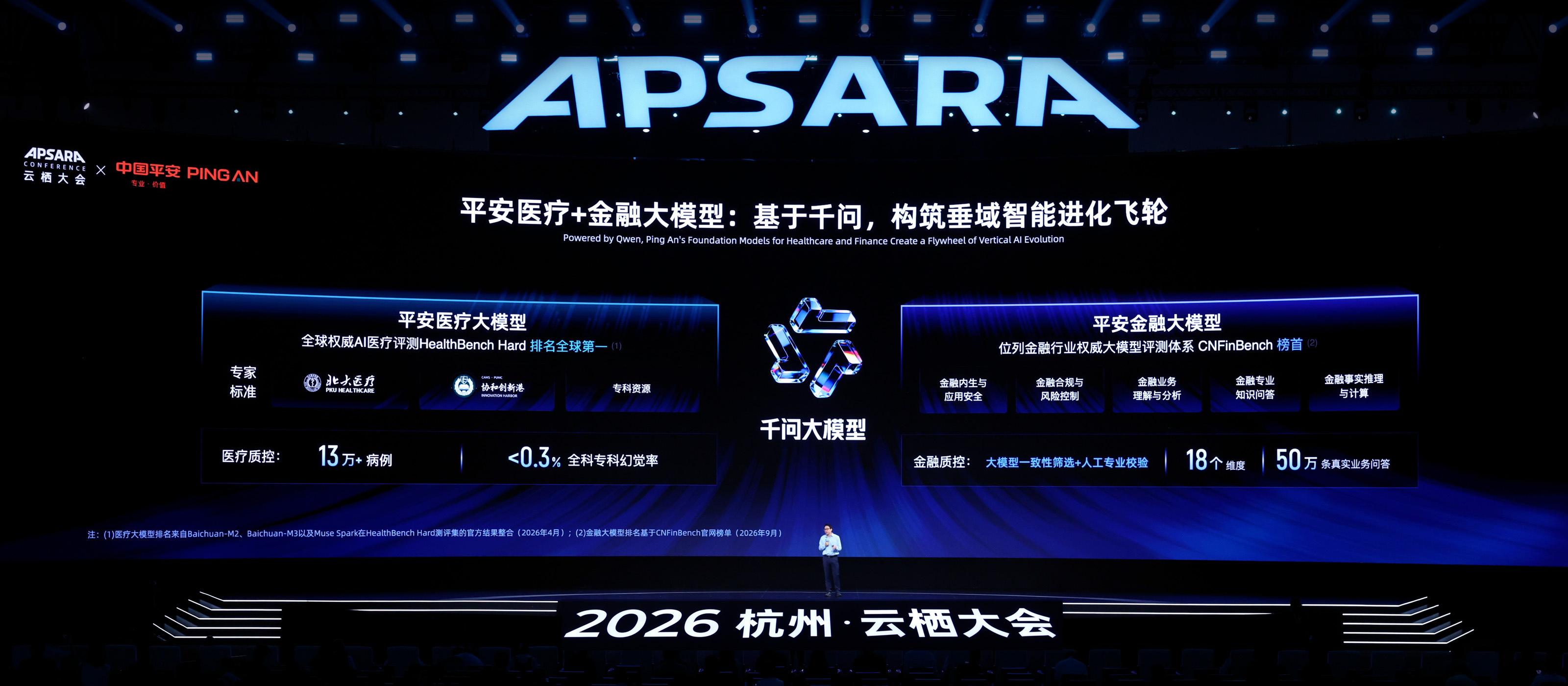
随着AI进入更复杂的专业场景,对模型能力的要求也在提高。平安与阿里云围绕千问系列模型开展合作,平安结合专业数据、专家知识和真实业务反馈,将千问的通用模型能力进一步转化为金融、医疗专业能力。平安金融大模型登顶CNFinBench大语言模型公开榜单;平安医疗大模型在HealthBench Hard取得最高分,刷新基准纪录,医疗质控显示问诊场景幻觉率低于0.3%。

从AI全栈技术优化到千问系列模型,平安与阿里巴巴的合作正在进入更多AI生产和应用环节。随着Token规模持续增长,双方也将继续围绕模型、推理和算力效率等方向推进合作。

注:文/龚作仁,文章来源:Laborer,本文为作者独立观点,不代表亿邦动力立场。

【版权提示】亿邦动力倡导尊重与保护知识产权。未经许可,任何人不得复制、转载、或以其他方式使用本网站的内容。如发现本站文章存在版权问题,烦请提供版权疑问、身份证明、版权证明、联系方式等发邮件至run@ebrun.com,我们将及时沟通与处理。

已点赞

+1

{{ praise_text }}

好文章,值得被更多人看到

FAQ回顾

中国平安与阿里云在AI领域有哪些合作?

双方围绕千问系列模型和AI全栈技术展开合作,覆盖模型、推理和算力调度等环节。平安结合专业数据、专家知识和真实业务反馈,将千问通用模型能力转化为金融、医疗专业能力,未来会在Token规模增长下继续推进合作。

中国平安如何实现AI Token用量的大幅增长?

在阿里云AI全栈技术优化支持下,平安日均Token用量从约300亿增至超过3000亿,算力仅从800PF提升至1500PF,以不到2倍算力增长支撑10倍Token增长。通过模型、推理和算力调度等优化,单位算力Token产出提升368%,单位Token成本下降76%。

中国平安的AI应用落地了哪些业务场景?

AI应用已覆盖客户服务、医疗和研发等场景。AI快捷服务面向超2.5亿客户,上线不到半年累计服务量突破1亿;AI医生连接线上线下医疗服务,25%到院服务和70%到家服务由AI首接和分发;约80%新代码由AI生成,AI测试占比67%。

平安金融大模型和医疗大模型有哪些技术成果?

平安金融大模型登顶CNFinBench大语言模型公开榜单;平安医疗大模型在HealthBench Hard取得最高分,刷新基准纪录,医疗质控显示问诊场景幻觉率低于0.3%。

广告

下一篇

跨境电商资源对接

《全球跨境电商服务商资源手册》第二期手册现已发布,触达更多资源,了解跨境服务商信息,欢迎点击链接下载。

了解详情

云栖大会观察:阿里的未来预判与正在落地的三块拼图

把吴泳铭的判断与今天各项新产品的发布放在一起看,可以看出,阿里正在努力建设机器智能时代的基础设施。