



• 亿邦公众号
    • APP下载

千问AI眼镜全系列线上零售额份额达30.4% 稳居市场第一

作者:龚作仁 文章来源:Laborer

2026-05-27 16:48

作者:龚作仁 文章来源:Laborer

2026-05-27 16:48

邦小白快读

EN
全文速览

本文核心是披露千问AI眼镜在中国线上市场的最新份额数据和当前AI眼镜赛道的发展情况,核心干货信息如下:

1. 奥维云网2026年3-4月监测数据显示,千问AI眼镜全系列(含夸克AI眼镜)线上零售额份额达30.4%,稳居行业第一,相当于线上每卖出三副AI眼镜就有一副来自千问;今年3月新发的G1与S1,上市仅两个月份额就达19.4%,同样位居第一。

2. 当前中国智能眼镜市场正处于从小众尝鲜到市场普及的关键节点,线上在售品牌已有356个,赛道竞争全面升级,全球谷歌、苹果等科技巨头都在加码布局AI眼镜。

3. 千问AI眼镜S1上市后已经完成首次大版本升级,重点提升主动服务与空间3D显示能力,外媒评价千问在中国市场已经领先Meta AI的Ray-Ban智能眼镜。

本文披露了AI眼镜赛道的最新竞争格局与发展趋势,能给品牌布局相关业务提供参考,核心干货如下:

1. 消费趋势与竞争环境:当前中国AI智能眼镜正处于从小众尝鲜转向市场普及的关键节点,属于增量赛道,目前线上已有356个品牌入局,赛道竞争全面升级;全球范围来看,谷歌、苹果等国际巨头都在加码布局,AI眼镜已经成为多维度能力的综合竞技场。

2. 头部品牌经验参考:阿里巴巴旗下千问AI眼镜靠强劲的产品力获得了市场认可,全系列拿下超三成线上份额,新品上市两个月就做到行业第一,同时坚持快速产品迭代,通过大版本升级优化核心功能强化竞争力,这套打法对新老品牌都有借鉴意义。

3. 竞争格局参考:目前本土品牌千问已经在中国市场拉开了和海外品牌Meta AI的差距,本土品牌具备一定竞争优势。

本文透露出AI眼镜赛道的最新变化,能给卖家判断机会风险提供参考,核心干货整理如下:

1. 赛道机会判断:当前AI眼镜正处于从小众市场走向大众普及的关键节点,属于高增长的潜力赛道,全球顶尖科技巨头都纷纷加码布局,行业整体前景被看好,卖家可以结合自身情况挖掘增量机会。

2. 风险提示:目前AI眼镜线上赛道已有356个品牌入场,竞争已经全面升级,新入场卖家需要做好充分的竞争准备,规避赛道过热带来的风险。

3. 可学习的经验:头部品牌千问的增长路径显示,产品力是拿下市场的核心,千问在新品上市后很快就推出大版本升级,针对性优化核心功能,这种快速响应用户需求、迭代产品的思路值得卖家学习。

AI眼镜赛道的最新发展,能给生产端工厂带来机会和转型启示,核心干货整理如下:

1. 商业机会:当前中国AI眼镜行业正处于从小众尝鲜到市场普及的关键转型期,市场整体规模正在快速扩张,对上游生产端来说,有充足的增量订单机会,工厂可以提前布局相关产能抓住机会。

2. 产品生产设计需求:当前AI眼镜的竞争已经升级为大模型能力、终端形态、交互方式、生态服务的综合竞争,市场对主动服务、空间3D显示这类新型功能的需求明显提升,工厂在生产设计端需要匹配这类新功能的生产要求,调整自身产能结构。

3. 转型启示:头部品牌普遍采用快速产品迭代的竞争策略,对工厂的柔性生产能力、快速响应能力要求更高,工厂需要加快数字化转型,适配品牌新的竞争节奏。

本文披露的AI眼镜赛道信息,能给服务商指明新的业务方向,核心干货整理如下:

1. 行业发展趋势:当前AI眼镜已经成为全球科技巨头布局的核心赛道,中国市场正处于从小众普及的关键转折点,市场玩家快速增加,目前线上已经聚集了356个品牌,未来市场规模会持续增长,服务商的潜在客户群体在快速扩容。

2. 客户核心痛点:当前赛道竞争已经升级为多维度综合竞争,品牌方需要不断升级AI能力、空间显示等核心功能来提升竞争力,自身往往没有足够的技术能力支撑,存在明确的技术服务需求。

3. 业务机会:服务商可以围绕AI眼镜品牌的核心需求,提前布局主动AI服务、空间3D显示相关的技术解决方案,抓住赛道增长的红利,拓展新的客户群体。

AI眼镜赛道的最新变化,对平台招商运营有不少参考价值,核心干货整理如下:

1. 赛道布局方向:当前AI智能眼镜正处于市场普及的关键节点,增长潜力大,是平台值得重点倾斜资源的蓝海类目,目前赛道已经有356个品牌线上布局,用户需求正在快速崛起,平台可以加大相关类目的招商力度。

2. 招商重点:当前千问AI眼镜已经拿下超三成线上份额,新品爆发力极强,有突出的用户转化能力,平台可以重点引入这类有产品力的头部品牌,带动整个类目的增长,吸引更多用户关注AI眼镜类目。

3. 运营风向提示:当前赛道竞争已经全面升级,大量品牌涌入会带来更多运营管理问题,平台需要提前规范竞争秩序,同时关注谷歌、苹果等国际巨头后续入场带来的格局变化,提前做好应对准备,规避行业波动风险。

本文披露的最新数据和产业动态,对AI眼镜产业研究有较高的参考价值,核心干货整理如下:

1. 产业新动向:当前中国AI眼镜市场已经正式进入从小众尝鲜到大众普及的转型阶段,线上市场头部集中效应已经初步显现,阿里巴巴旗下千问AI眼镜全系列拿下30.4%的零售额份额位居第一,新品上市两个月就能拿下19.4%的份额,本土品牌已经在国内市场领先海外巨头Meta的产品。

2. 竞争维度新变化:全球范围内谷歌、苹果等科技巨头都在加码布局AI眼镜和空间计算设备,赛道竞争已经从单一的产品硬件竞争,转变为大模型能力、终端形态、交互方式、生态服务的综合竞争,产业竞争逻辑发生改变。

3. 新竞争模式:当前头部品牌已经采用快速产品迭代的模式,通过上市后大版本升级优化核心功能来拉开和竞品的差距,这种新的产品竞争模式值得深入研究。

声明:快读内容全程由AI生成,请注意甄别信息。如您发现问题,请发送邮件至 run@ebrun.com 。

我是 品牌商 卖家 工厂 服务商 平台商 研究者 帮我再读一遍。

Quick Summary

This article reveals the latest market share data of Qianwen AI glasses in China's online market and the current development status of the AI glasses track. Key takeaways are as follows:

1. According to Omida's monitoring data from March to April 2026, the full line of Qianwen AI glasses (including Quark AI glasses) holds a 30.4% share of online retail sales, ranking first in the industry—meaning one out of every three AI glasses sold online comes from Qianwen. Its newly launched G1 and S1 models, released in March this year, captured a 19.4% share just two months after launch, also taking the top spot.

2. China's smart glasses market is currently at a critical inflection point transitioning from a niche novelty to mass adoption. There are already 356 brands available online, competition in the track has fully intensified, and global tech giants including Google and Apple are ramping up their布局 in AI glasses.

3. The Qianwen AI S1 has already received its first major version update after launch, focusing on improving active services and spatial 3D display capabilities. Foreign media have noted that Qianwen is already ahead of Meta AI's Ray-Ban smart glasses in the Chinese market.

This article discloses the latest competitive landscape and development trends of the AI glasses track, providing references for brands planning to enter or expand related businesses. Key insights are as follows:

1. Consumption trends and competitive landscape: China's AI smart glasses industry is currently at a critical inflection point transitioning from niche novelty to mass adoption, making it a high-growth incremental track. 356 brands have already entered the online space, and competition has fully intensified. Globally, tech giants including Google and Apple are ramping up their investments, turning AI glasses into a comprehensive competitive arena for multi-dimensional capabilities.

2. References from leading brand strategies: Alibaba-backed Qianwen AI glasses has won market recognition through strong product power. Its full product line holds over 30% of online market share, and its new products took the top industry position just two months after launch. The brand also maintains rapid product iteration, enhancing competitiveness through major version updates that optimize core functions. This playbook offers valuable lessons for both new and incumbent brands.

3. Competitive landscape reference: Domestic brand Qianwen has already pulled ahead of overseas player Meta AI in the Chinese market, demonstrating clear competitive advantages for local brands.

This article outlines the latest changes in the AI glasses track, helping sellers assess opportunities and risks. Key takeaways are as follows:

1. Opportunity assessment: AI glasses are currently at a critical inflection point transitioning from a niche market to mass adoption, representing a high-growth potential track. Top global tech giants are all ramping up investments, and the industry's overall outlook is broadly positive. Sellers can explore incremental opportunities aligned with their own capabilities.

2. Risk warning: 356 brands have already entered the online AI glasses track, and competition has fully intensified. New entrants need to make full competitive preparations to mitigate risks brought by overheating in the track.

3. Actionable lessons: The growth trajectory of leading player Qianwen shows that product capability is core to capturing market share. Qianwen rolled out a major version update shortly after launching its new product, targeting optimized core functions. This approach of rapid response to user demand and continuous product iteration is well worth learning for sellers.

The latest developments in the AI glasses track bring new opportunities and transformation insights for upstream manufacturing. Key insights are as follows:

1. Business opportunities: China's AI glasses industry is currently in a critical transition period from niche novelty to mass adoption, with overall market size expanding rapidly. This brings sufficient incremental order opportunities for upstream manufacturing players, and factories can prepare capacity in advance to capture this opportunity.

2. Product design and manufacturing requirements: Competition in AI glasses has evolved into a comprehensive contest of large model capabilities, device form factor, interaction methods and ecosystem services. Market demand for new functions such as active services and spatial 3D display has increased significantly. Factories need to adjust their production design and capacity structure to meet the manufacturing requirements for these new functions.

3. Transformation insights: Leading brands generally adopt a rapid product iteration competitive strategy, which raises higher requirements for factories' flexible production and rapid response capabilities. Factories need to accelerate digital transformation to adapt to the new competitive pace of brands.

The information revealed in this article points to new business directions for service providers. Key insights are as follows:

1. Industry development trend: AI glasses have become a core track for global tech giants'布局, and the Chinese market is at a critical inflection point of moving from niche to mass adoption. The number of market players is growing rapidly, with 356 brands already active online, and market size will continue to expand. This means service providers' potential customer base is growing rapidly.

2. Core customer pain points: Track competition has evolved into multi-dimensional comprehensive competition, and brands need to continuously upgrade core functions such as AI capabilities and spatial display to improve competitiveness. Most brands do not have sufficient in-house technical capabilities to support this, creating clear demand for technical services.

3. Business opportunities: Service providers can develop technical solutions centered on active AI services and spatial 3D display, aligned with the core needs of AI glasses brands, to capture the growth dividend of the track and expand their customer base.

The latest changes in the AI glasses track offer valuable references for platform investment attraction and operations. Key insights are as follows:

1. Track layout direction: AI smart glasses are currently at a critical inflection point of mass adoption, with huge growth potential, making them a blue ocean category worthy of prioritized resource allocation. 356 brands have already established an online presence, and user demand is rising rapidly. Platforms can increase investment attraction for this category.

2.招商 priority: Qianwen AI glasses already holds over 30% of online market share, with strong new product momentum and outstanding user conversion capability. Platforms can prioritize recruiting such product-leading head brands to drive growth of the entire category and attract more user attention to the AI glasses segment.

3. Operational guidance: Track competition has fully intensified, and the influx of a large number of brands will bring more operational and management challenges. Platforms need to standardize competition rules in advance, monitor landscape changes brought by future entries of global giants such as Google and Apple, and prepare early to mitigate risks from industry volatility.

The latest data and industry dynamics disclosed in this article offer high reference value for AI glasses industry research. Key insights are as follows:

1. New industry trends: China's AI glasses market has officially entered a transition phase from niche novelty to mass adoption, and the online market has begun to see preliminary head concentration. Alibaba-backed Qianwen AI glasses ranks first with a 30.4% retail sales share, and its new products captured a 19.4% share just two months after launch. Local brands are already ahead of overseas giant Meta's products in the domestic market.

2. New changes in competitive dimensions: Globally, tech giants including Google and Apple are ramping up布局 in AI glasses and spatial computing devices. Track competition has shifted from single product hardware competition to comprehensive competition across large model capabilities, device form factor, interaction methods, and ecosystem services, changing the industry's competitive logic.

3. New competitive model: Leading brands have now adopted a rapid product iteration model, optimizing core functions through post-launch major version updates to pull away from competitors. This new product competition model deserves in-depth research.

Disclaimer: The "Quick Summary" content is entirely generated by AI. Please exercise discretion when interpreting the information. For issues or corrections, please email run@ebrun.com .

I am a Brand Seller Factory Service Provider Marketplace Seller Researcher Read it again.

5月27日,奥维云网(AVC)线上零售监测数据显示,2026年3月至4月,千问AI眼镜全系列(含夸克AI眼镜)线上市场零售额份额达30.4%,接近整体市场的三分之一,持续位居线上市场第一。这意味着,线上每卖出三副AI眼镜,就有一副来自千问。

其中,千问AI眼镜G1与S1于2026年3月8日正式发布,上市后仅两个月线上市场零售额份额即达19.4%,同样位居行业第一,展现出强劲的产品爆发力与用户转化能力。
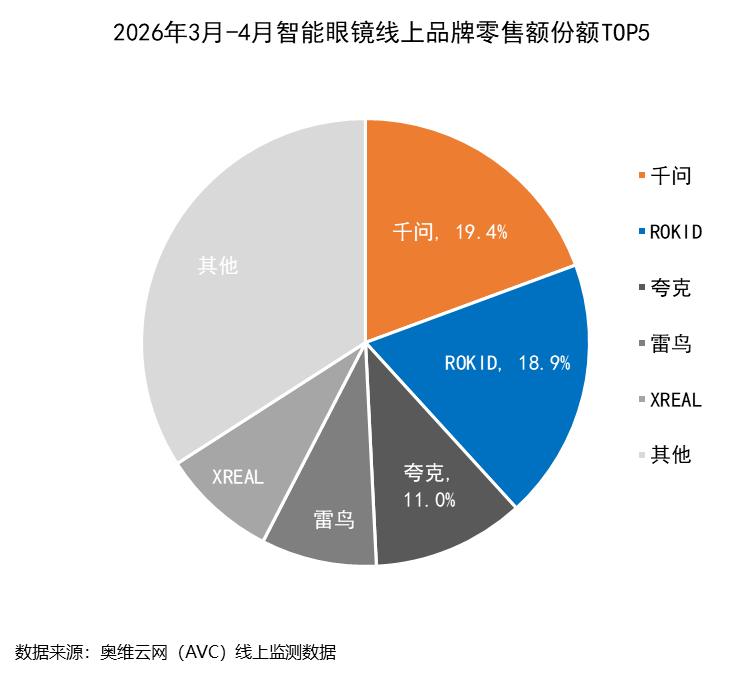
奥维云网指出,2026年中国智能眼镜市场正是从小众尝鲜到市场普及的关键节点,目前智能眼镜线上在售品牌数量已达356个,赛道竞争全面升级。在全球范围内,谷歌、苹果等国际科技巨头持续加码AI眼镜和空间计算设备布局,AI眼镜已成为大模型能力、终端形态、交互方式和生态服务的综合竞争场。

5月初,千问AI眼镜S1迎来上市后首次大版本升级,重点提升主动服务与空间3D显示能力。外媒Gizmodo这样评价,Meta AI的 Ray-Ban智能眼镜在美国或许仍处领先地位,但在中国市场似乎开始落后。阿里巴巴旗下千问AI眼镜S1的升级版本进一步扩展了AI功能,加速拉开了与Meta AI的差距。

注:文/龚作仁,文章来源:Laborer,本文为作者独立观点,不代表亿邦动力立场。

【版权提示】亿邦动力倡导尊重与保护知识产权。未经许可,任何人不得复制、转载、或以其他方式使用本网站的内容。如发现本站文章存在版权问题,烦请提供版权疑问、身份证明、版权证明、联系方式等发邮件至run@ebrun.com,我们将及时沟通与处理。

已点赞

+1

{{ praise_text }}

好文章,值得被更多人看到

FAQ回顾

2026年千问AI眼镜线上市场份额是多少?

根据奥维云网(AVC)2026年3-4月线上零售监测数据,千问AI眼镜全系列线上市场零售额份额达到30.4%,稳居市场第一。

千问AI眼镜G1与S1的上市时间和市场表现如何?

千问AI眼镜G1与S1于2026年3月8日正式发布,上市仅两个月后,其线上市场零售额份额即达到19.4%,同样位居行业第一。

2026年中国智能眼镜市场竞争格局如何?

2026年中国智能眼镜市场正从小众尝鲜走向普及,竞争全面升级,线上在售品牌数量已达356个。同时,谷歌、苹果等国际巨头也在持续加码布局。

广告

下一篇

跨境电商资源对接

《全球跨境电商服务商资源手册》第二期手册现已发布,触达更多资源,了解跨境服务商信息,欢迎点击链接下载。

了解详情

AI时代下组织能力与创新丨马蹄社×华营研学

马蹄社与华营联合推出《AI时代下组织能力与创新》研学,特别邀请华为公司前高级副总裁、公司组织干部部部长胡彦平导师,以穿越周期的实战视野,为创始人拆解组织能力建设的底层密码。

未来零售

2026-05-27 15:24:50











