• 亿邦公众号
    • APP下载

京东外卖首推AI一键复购外卖功能 搭载“京东AI付”让支付更便捷安全

作者:龚作仁 文章来源:Laborer

2026-05-27 11:15

作者:龚作仁 文章来源:Laborer

2026-05-27 11:15

邦小白快读

EN
全文速览

本文介绍了京东外卖最新推出的AI一键复购功能,搭配京东AI付,能大幅简化外卖复购流程,给普通用户带来更便捷的使用体验,相关干货如下

1. 实操方式:该功能目前已经应用在荣耀600系列新机上,用户只需要对手机的YOYO智能体说出需求,比如“请给我点一杯昨天的咖啡送到公司”,就能快速完成复购下单,最快仅需要3秒。

2. 对比传统方式优势:传统外卖复购需要经历解锁手机、找APP、进订单页、再次购买等多个步骤,全程至少需要30秒到1分钟,还要多次跳转点击,新功能把整个流程压缩成一句话,操作门槛大幅降低。

3. 安全保障:该功能的支付环节所有用户授权都有清晰留痕,资金流向透明可追溯,不会出现误下单的情况,兼顾便捷和安全。

本文展现了京东外卖的新功能落地案例,也透露出当前消费端的需求变化,能给各类品牌提供不少参考,干货如下

1. 品牌营销参考:京东外卖将自身AI功能落地到荣耀新品手机,通过跨品类场景绑定的方式,实现了双方品牌的共同曝光,同时给产品增加了差异化卖点,是非常值得参考的跨界营销合作模式。

2. 用户痛点洞察:京东外卖精准捕捉到用户外卖复购流程繁琐的高频痛点,从体验切入完成产品升级,符合当下消费者对智能化、便捷化服务的需求趋势,品牌做产品升级可参考这种从用户痛点切入的思路。

3. 品牌信任打造:新功能在追求便捷的同时,兼顾了用户资金安全和授权透明,做到了体验和信任的平衡,对品牌打造用户信任有参考价值。

本文推出的京东外卖AI一键复购功能,给外卖卖家带来了新的增长机会,也有不少值得参考的启发,干货如下

1. 转化提升机会:新功能大幅降低了用户复购的操作门槛,原本不少用户会因为流程繁琐放弃复购,现在3秒就能完成下单,能有效提升老客复购率,帮卖家提升店铺整体单量。

2. 行业趋势机会:智能化、便捷化是外卖行业的明确发展方向,AI复购功能的落地会培养用户新的使用习惯,卖家可以抓住这波功能升级的红利,提前引导老客使用该功能,抢占复购增长的先机。

3. 成本优势:该功能由京东平台开发落地,卖家不需要额外投入研发成本,就能享受功能带来的转化提升,属于对卖家的利好行业变化,卖家只需要及时跟进适配即可。

本文展示了智能终端产品结合互联网服务功能的新落地方向,给消费电子等工厂带来了不少启发和商业机会,干货如下

1. 产品设计需求参考:当前用户对智能终端产品的需求,已经不局限于基础性能,更看重场景化功能体验,集成生活化的便民服务,已经成为新品打造差异化卖点的方向,荣耀将京东AI复购功能集成到新机就是典型案例。

2. 商业合作机会:工厂可以和互联网平台合作,将平台的成熟服务功能集成到自有产品中,既能丰富产品的功能生态,又能打造差异化卖点,提升产品的市场吸引力,帮助产品打开销路。

3. 数字化升级启示:依托大模型能力拓展产品的服务场景,是智能终端产品数字化升级的重要方向,工厂可以推进开放合作,接入不同平台的服务能力,丰富产品的使用场景,提升产品竞争力。

本文展现了本地生活服务领域AI升级的行业趋势,也给出了针对用户痛点的AI解决方案参考,干货如下

1. 行业发展趋势:当前AI技术已经逐步落地到本地生活、支付等各类大众服务场景,语音交互、用户意图驱动的服务,会成为未来服务行业的主流方向,包括点外卖、订酒店在内的大量高频生活场景,都有AI升级的空间。

2. 用户核心痛点:用户在高频复购类消费场景,长期存在操作流程繁琐的痛点,传统的多步骤点击操作,已经无法满足用户对便捷性的需求,这个痛点具备很高的解决价值。

3. 可参考的解决方案:可以依托大模型能力,把复杂的多步骤操作压缩为一句话语音指令,同时做好用户授权留痕、资金流向可追溯,平衡便捷性和安全性,这个方案可以复制到更多同类场景中。

本文介绍了京东在外卖和支付领域的最新AI布局,给各类平台提供了风向借鉴和运营参考,干货如下

1. 用户与商家需求:当前用户和商家对平台的需求,越来越偏向智能化、便捷化,平台只有针对高频消费场景的痛点优化流程,才能更好地留存用户和商家,提升平台竞争力。

2. 平台最新玩法参考:京东依托自有大模型能力,打通了外卖服务和支付环节,推出AI一键复购和京东AI付,还将功能落地到智能终端、智能眼镜等多个软硬件载体,拓展了平台的服务触达渠道。

3. 风险规避方向:AI布局要兼顾便捷性和安全性,需要做好用户授权留痕、资金流向透明可追溯,避免出现支付安全、误下单等风险问题,同时可以通过和硬件品牌跨界合作的方式,拓展服务场景。

本文展现了AI赋能本地生活服务和支付领域的最新产业动向,对相关领域研究有较高的参考价值,干货如下

1. 产业新动向:当前AI大模型已经完成了从技术概念到具体商用场景的落地,外卖复购、AI语音支付就是非常典型的落地案例,目前行业已经探索出“互联网平台+智能硬件厂商”联合落地的新路径。

2. 行业新问题与解决方案参考:AI语音交互支付场景,长期存在用户授权模糊、资金安全难以保障的问题,本次京东AI付推出授权留痕、资金流向可追溯的方案,很好平衡了便捷性和安全性,给行业解决这类共性问题提供了参考样本。

3. 新商业模式参考:目前已经形成了平台输出技术和服务、硬件厂商输出流量和场景,双方共同打造用户体验、共享商业价值的新模式,为AI落地实体经济提供了新的研究方向。

声明:快读内容全程由AI生成,请注意甄别信息。如您发现问题,请发送邮件至 run@ebrun.com 。

我是 品牌商 卖家 工厂 服务商 平台商 研究者 帮我再读一遍。

Quick Summary

This article introduces JD.com Food Delivery's newly launched AI one-click reorder feature. When paired with JD AI Pay, it drastically simplifies the food reordering process and delivers a much more convenient user experience. Key takeaways are as follows:

1. How it works: The feature is currently available on Honor's new 600 Series smartphones. Users only need to voice their request to the phone's YOYO smart assistant—for example, "Order the same coffee I had yesterday and send it to my office"—to complete a reorder in as little as 3 seconds.

2. Advantages over traditional reordering: Traditional reordering requires multiple steps: unlocking your phone, opening the app, navigating to the order history page, and confirming the purchase again. The whole process takes at least 30 seconds to a full minute and requires multiple taps and page redirects. The new feature condenses the entire process into a single voice command, drastically lowering the barrier to use.

3. Security guarantees: All user authorizations for payment are clearly recorded, and fund flows are fully transparent and traceable. This eliminates the risk of accidental orders, balancing convenience with robust security.

This article presents a real-world case of JD.com Food Delivery's new AI feature and reveals shifting consumer demand trends, offering valuable insights for brands across categories. Key takeaways are as follows:

1. A reference for brand marketing: JD.com Food Delivery integrated its AI capability into Honor's new smartphones, leveraging cross-category scenario binding to drive co-exposure for both brands and add differentiated product selling points. This cross-industry marketing collaboration model is highly worthy of reference.

2. User pain point insights: JD.com Food Delivery accurately identified the widespread, high-frequency pain point of cumbersome traditional food reordering, and delivered a product upgrade focused on improving user experience. This aligns with the current consumer trend of demand for smarter, more convenient services, and brands can adopt this pain point-first approach for their own product upgrades.

3. Building brand trust: The new feature balances convenience with transparent user authorization and solid fund security, achieving a healthy balance between great experience and user trust. This offers a useful reference for brands looking to build trust with their customer base.

JD.com Food Delivery's new AI one-click reorder feature opens up new growth opportunities for food sellers and delivers actionable insights. Key takeaways are as follows:

1. Opportunities to boost conversion: The feature drastically lowers the barrier for repeat purchases. Many consumers previously abandoned reorders due to cumbersome processes, but orders can now be completed in 3 seconds, which will effectively lift repeat purchase rates among existing customers and help sellers grow overall order volume.

2. Riding industry trend opportunities: Smarter, more convenient services are a clear development direction for the food delivery industry. The rollout of AI-powered reordering will cultivate new user habits, and sellers can capitalize on this feature upgrade wave by guiding existing customers to adopt the feature early to capture an early lead in repeat purchase growth.

3. Zero additional cost advantage: The feature is developed and launched by the JD platform, so sellers do not need to invest any extra in R&D to benefit from the conversion lift it brings. This is a positive industry shift for sellers, who only need to adapt to the new feature in a timely manner.

This article showcases a new implementation direction for integrating smart end-devices with internet services, offering valuable insights and business opportunities for consumer electronics manufacturers and other factories. Key takeaways are as follows:

1. A reference for product design demand: Consumer demand for smart end-devices is no longer limited to basic performance; today, users prioritize scenario-based functional experiences. Integrating daily convenient public services has become a key direction for building differentiated selling points for new products, and Honor's integration of JD's AI reorder feature into its new handsets is a prime example.

2. New business collaboration opportunities: Factories can partner with internet platforms to integrate the platforms' mature service functions into their own products. This both enriches the product's functional ecosystem and creates differentiated selling points, boosting the product's market appeal and helping drive sales.

3. Insights for digital upgrading: Leveraging large language model capabilities to expand product service scenarios is a key direction for the digital upgrading of smart end-devices. Factories can pursue open collaboration and integrate service capabilities from multiple platforms to enrich user scenarios and improve product competitiveness.

This article outlines the industry trend of AI upgrading in the local services space and offers a reference AI solution that addresses a core user pain point. Key takeaways are as follows:

1. Industry development trend: AI technology is now steadily being rolled out across mass service scenarios including local life services and payments. Voice interaction and user intent-driven services will become the mainstream direction for the service industry going forward, and a large number of high-frequency daily scenarios from food ordering to hotel booking have room for AI-enabled upgrading.

2. Core user pain point: Consumers have long grappled with the cumbersome operation process in high-frequency repeat purchase scenarios. Traditional multi-step click-based operations no longer meet user demand for convenience, making this pain point well worth solving.

3. A replicable solution reference: Providers can leverage large model capabilities to condense complex multi-step operations into a single voice command, while implementing clear user authorization records and traceable fund flows to balance convenience and security. This solution can be replicated across many similar scenarios.

This article introduces JD.com's latest AI deployment in food delivery and payments, offering strategic and operational insights for other platform players. Key takeaways are as follows:

1. Aligning with user and merchant demand: Today, both users and merchants increasingly demand smarter, more convenient services from platforms. Only by optimizing processes to address pain points in high-frequency consumption scenarios can platforms better retain users and merchants and improve core competitiveness.

2. A reference for innovative platform operations: Leveraging its in-house large model capabilities, JD has connected food delivery services and payment processing to launch AI one-click reorder and JD AI Pay. It has also rolled out the feature across multiple software and hardware carriers including smart end-devices and smart glasses, expanding the platform's service reach.

3. Guidance for risk mitigation: AI deployments must balance convenience with security. Platforms need to implement clear records of user authorization and transparent, traceable fund flows to avoid risks such as payment security breaches and accidental orders. Cross-industry collaboration with hardware brands is also an effective way to expand service scenarios.

This article presents the latest industry developments in AI-enabled local life services and payments, offering high reference value for research in related fields. Key takeaways are as follows:

1. New industry developments: Large AI models have now moved beyond technical concepts to commercial implementation in concrete scenarios, with food reordering and AI voice payment serving as prime examples. The industry has already explored a new joint implementation path: "internet platform + smart hardware manufacturer".

2. A reference solution for common industry problems: The AI voice interaction payment space has long faced challenges including unclear user authorization and difficulty guaranteeing fund security. JD AI Pay's solution of recorded authorization and traceable fund flows strikes a solid balance between convenience and security, providing a reference model for the industry to address these common problems.

3. A new business model for research: A new model has emerged where platforms provide technology and services, while hardware manufacturers provide traffic and scenarios. The two sides collaborate to build better user experiences and share commercial value, creating a new research direction for AI's integration into the real economy.

Disclaimer: The "Quick Summary" content is entirely generated by AI. Please exercise discretion when interpreting the information. For issues or corrections, please email run@ebrun.com .

I am a Brand Seller Factory Service Provider Marketplace Seller Researcher Read it again.

AI一键复购京东外卖太方便了!用户只需一句类似“请给我点一杯昨天的咖啡送到公司”,即可在最快3秒内完成外卖复购下单的全流程。在其中的支付环节,依托“京东AI付”可精准识别用户的支付指令,真正实现“一键订外卖”。

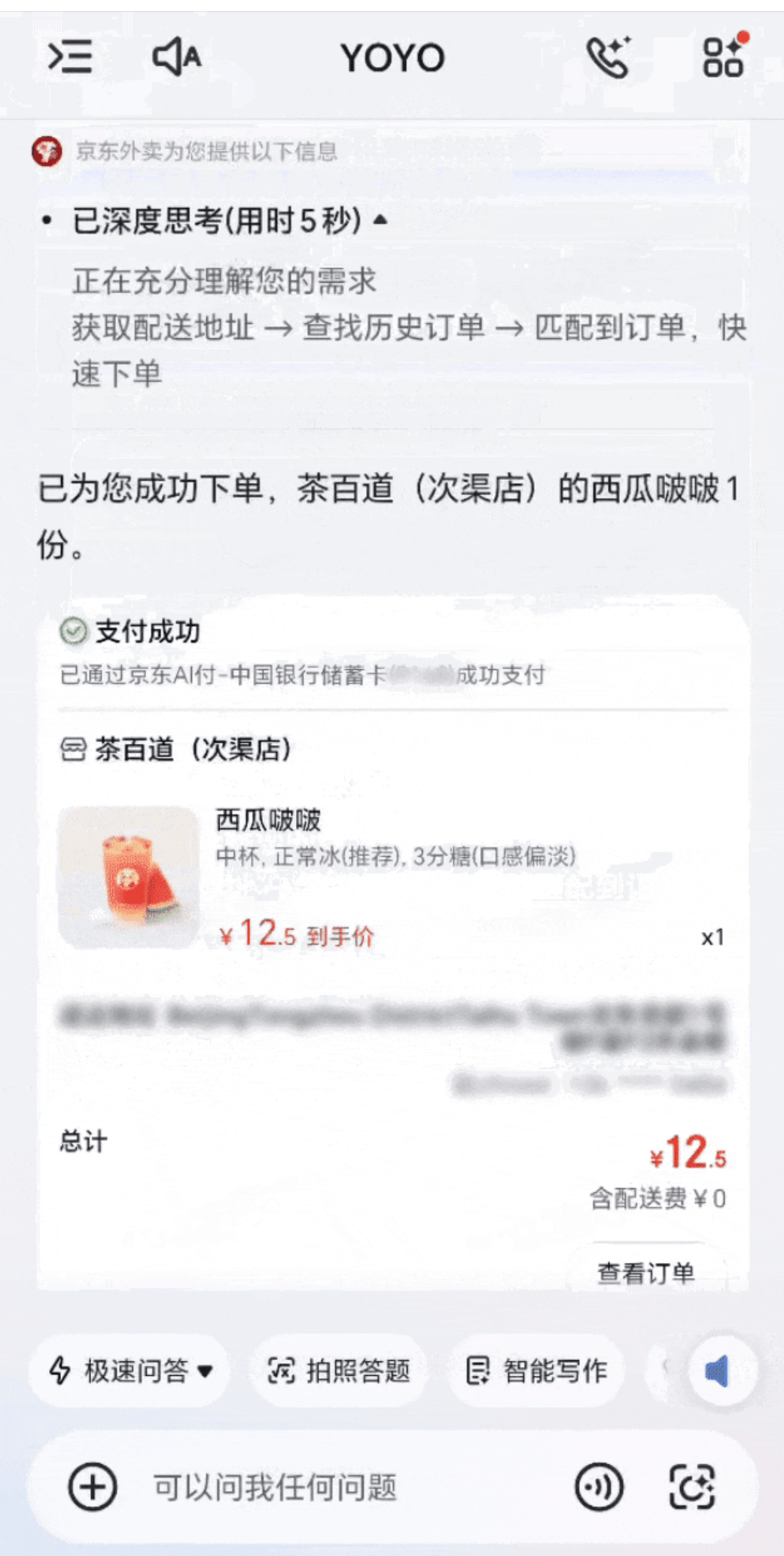
在2026年5月25日晚,荣耀600系列新品发布会上,京东外卖的AI一键复购外卖功能官宣已应用于荣耀600系列新机,用户只需对其搭载的YOYO智能体说一句话,即可在最快3秒内完成外卖复购下单的全流程。
“京东AI付”是京东推出的面向AI智能助手、智能眼镜等多种软硬件载体的新型支付形态,搭载了京东JoyAI大模型能力,可精准理解用户意图、动态匹配最优支付工具与鉴权方式。

传统外卖复购,用户通常需要经历:解锁手机、找到App、等待加载、进入“我的订单”、选中历史订单、点击“再次购买”、确认支付......全程至少需要30秒至1分钟,涉及多次点击与页面跳转。

京东外卖精准捕捉这一高频痛点,从提升用户体验出发,通过AI将复杂链路压缩至“一句话指令”,实现真正意义上的语音交互闭环。在“明确复购”场景下,用户只需一句话唤起荣耀YOYO智能体下发需求,系统后台自动完成历史订单匹配、生成及下单,并依托“京东AI付”精准识别用户的支付指令,直接为用户输出下单成功卡片。全链路无缝衔接,下单完成最快仅需3秒,真正实现“一键订外卖”。

在此环节中,“京东AI付”严格遵照用户授权意图,确保每笔“一句话语音订单”都有清晰的意图留痕与授权凭证。用户什么时候的授权、买了什么都一目了然,同时确保资金流向透明、可追溯,真正做到“意图即达”与“安全可控”的平衡。

此前,“京东AI付”已支持在智能眼镜场景通过购物智能体JoyGlance上的AI支付全链路,近期,“京东AI付”还进一步联合JoyAI万能博士,解锁了点外卖、订酒店等高频生活场景用户意图驱动的丝滑支付体验。未来,“京东AI付”还将在更多场景陆续落地,助力用户在AI时代畅享安全、流畅的支付体验。

注:文/龚作仁,文章来源:Laborer,本文为作者独立观点,不代表亿邦动力立场。

【版权提示】亿邦动力倡导尊重与保护知识产权。未经许可,任何人不得复制、转载、或以其他方式使用本网站的内容。如发现本站文章存在版权问题,烦请提供版权疑问、身份证明、版权证明、联系方式等发邮件至run@ebrun.com,我们将及时沟通与处理。

已点赞

+1

{{ praise_text }}

好文章,值得被更多人看到

FAQ回顾

京东外卖的AI一键复购功能是什么?

京东外卖的AI一键复购功能允许用户通过语音指令(如‘请给我点一杯昨天的咖啡送到公司’)快速完成外卖复购下单,系统自动匹配历史订单并依托‘京东AI付’完成支付,最快3秒即可完成全流程。

京东AI付如何保障支付安全?

京东AI付严格遵照用户授权意图,确保每笔语音订单都有清晰的意图留痕与授权凭证,资金流向透明可追溯,实现了‘意图即达’与‘安全可控’的平衡。

京东AI一键复购功能支持哪些设备?

该功能已应用于荣耀600系列新机,用户可通过其搭载的YOYO智能体使用。京东AI付还支持智能眼镜等软硬件载体,并计划在更多场景落地。

广告

下一篇

跨境电商资源对接

《全球跨境电商服务商资源手册》第二期手册现已发布,触达更多资源,了解跨境服务商信息,欢迎点击链接下载。

了解详情

北美电商物流企业Stord融资2.5亿美元 估值达30亿美元

作为亚马逊物流的替代选项,其通过仓储网络与AI软件提升配送效率,近期获得谷歌云推介。

跨境电商 仓储物流 AI 服务商

2026-05-27 10:15:29