• 亿邦公众号
    • APP下载

3D打印企业创想三维通过港交所上市聆讯 净利承压 下半年将密集推新品

作者:韩笑 文章来源:亿邦动力

2026-05-13 15:01

作者:韩笑 文章来源:亿邦动力

2026-05-13 15:01

邦小白快读

EN
全文速览

本文核心信息是全球消费级3D打印头部企业创想三维通过港交所上市聆讯,预计本月内登陆港交所,核心干货信息如下:

1. 企业基本情况:创想三维2014年成立于深圳,是全球消费级3D打印产品及服务提供商,产品覆盖3D打印机、耗材、扫描仪、激光雕刻机,还布局了线上打印社区和自有海外电商平台,市场地位突出,2025年按GMV计是全球第二大消费级3D打印公司、全球第一消费级3D扫描仪公司。

2. 业绩与未来规划:2023-2025年公司营收从18.83亿元增长到31.27亿元,受营销研发投入增加、大额分红影响净利润持续下滑,2026年第一季度硬件总销量同比增长41.5%,下半年将密集推出多款高端智能新品,目标2026年实现业绩改善。

本文为3D打印领域品牌商提供了头部企业的发展战略与行业动向干货,核心内容如下:

1. 产品研发与定价:当前消费级3D打印行业高端化趋势明显,创想三维主动缩减低端3D打印机占比,聚焦推广高端产品,带动产品平均售价从1612元提升至2404元,高端旗舰产品定价达千元美元级别,下半年还将推出多款融合AI、多色打印技术的高端新品,同时多品类布局,现有耗材SKU超1400个,配件超400个。

2. 渠道与市场布局:线上渠道营收占比从35.7%提升至48.5%,逐步接近线下,全球布局覆盖140个国家和地区,北美、欧洲市场营收占比持续提升,国内占比有所下滑。

3. 需要注意的是,当前行业营销、研发投入成本上涨明显,会直接影响净利润,品牌需要做好成本规划。

本文为消费级3D打印领域相关卖家提供了市场变化、机会与风险参考,核心内容如下:

1. 市场变化与增长机会:当前消费级3D打印呈现高端化、线上化、全球化趋势,高端产品需求持续提升,线上渠道占比已经接近半数,北美、欧洲海外市场增长稳定,是明确的增长市场,头部品牌加速布局耗材、配件等周边产品,相关细分赛道存在市场机会。

2. 行业最新动向:头部品牌2026年下半年将密集推出多色智能3D打印机、AI融合激光雕刻机等高端新品,会带动整个行业的产品升级,也会带动配套周边、服务的需求增长。

3. 风险提示:当前行业头部玩家都在加大营销和研发投入,市场竞争会进一步加剧,行业整体处于投入期,净利润普遍承压,中小卖家需要做好成本控制,避开低端价格竞争,优先关注高端配套相关机会。

本文为3D打印相关生产制造工厂提供了行业需求、商业机会与数字化转型的参考,核心内容如下:

1. 产品生产设计需求变化:当前行业整体向高端智能化升级,市场需求转向多喷嘴多色、全彩UV、融合人工智能与多轴联动技术的高端设备,高端3D打印机已经成为头部品牌的核心推广方向,上游生产工厂需要调整供应链,适配高端产品的生产要求。

2. 商业机会:头部品牌正在推进多品类布局,除核心打印机外,耗材、配件、扫描仪、激光雕刻机的品类占比逐年提升,现有SKU数量庞大,仅耗材SKU就超过1400个,给上游代工厂带来了大量的配套生产订单机会。

3. 数字化与电商启示:头部品牌已经布局自有线上社区和海外电商平台,线上渠道营收占比已经接近半数,传统生产工厂可以参考这一方向,尝试拓展直接面向终端的线上渠道,推进自身的数字化运营转型,拓展盈利空间。

本文为3D打印领域相关服务商提供了行业趋势、客户痛点与新技术方向的参考,核心内容如下:

1. 行业发展趋势:全球消费级3D打印行业保持高速增长,头部品牌营收三年间从18.83亿元增长到31.27亿元,行业整体呈现高端化、智能化、线上化、全球化的发展趋势,多品类全布局已经成为头部品牌的主流选择,单一品类的占比持续降低。

2. 客户核心痛点:当前头部品牌普遍面临净利润承压的问题,核心原因是第三方平台推广费、KOL合作费等营销成本,以及研发人员薪酬等研发成本持续上涨,同时头部品牌需要优化产品结构、提升高利润产品占比、改善营运现金流,这些都是服务商可以切入的需求点。

3. 新技术方向:AI、多色打印、多轴联动、UV全彩是行业明确的新技术发展方向,服务商可以围绕这些新技术开发对应的配套服务,抢占市场机会。

本文为布局3D打印赛道的平台商提供了品牌需求、行业风向与风险规避的参考,核心内容如下:

1. 品牌方对平台的核心需求:头部品牌近年持续增加对第三方电商平台、社交媒体搜索引擎的推广投入,营销费用大幅上涨,说明品牌方对平台的流量推广服务需求极高,愿意支付高额成本获取流量,平台可以针对性开发对应的流量产品满足需求。

2. 品牌方的最新动向:头部品牌已经开始布局自有线上渠道,包括自有3D打印社区和海外电商平台,线上渠道营收占比已经超过线下,说明品牌方对私域运营、自有渠道搭建的需求在提升,平台商需要调整运营策略,推出对应的服务满足品牌这一需求。

3. 风险规避:当前头部品牌都处于高投入阶段,净利润普遍承压,部分品牌甚至出现亏损,平台商在招商合作时需要关注品牌的现金流状况,同时结合品牌高端化升级的需求,匹配对应的高端用户流量,降低自身合作风险。

本文为3D打印产业研究者提供了头部企业的最新运营数据与产业动向,有较高的研究参考价值,核心内容如下:

1. 产业最新动向:当前全球消费级3D打印产业呈现四个明确的新趋势,分别是产品结构高端化、渠道结构线上化、营收结构多元化、市场布局全球化,头部企业主动降低低端单一品类3D打印机的占比,拓展耗材、配件、周边设备多品类,线上渠道占比反超线下,海外市场占比逐步提升。

2. 产业需要关注的新问题:当前行业虽然保持营收高速增长,但是头部企业普遍面临净利润下滑的压力,核心原因是营销推广成本、研发人力成本持续上涨,叠加分红等因素,哪怕是头部企业也会出现营收增长但净利润下滑甚至亏损的情况,这是产业发展到当前阶段需要研究解决的新问题。

3. 商业模式参考:头部企业采用“硬件+耗材+服务+自有线上平台”的全链路布局模式,通过高端化升级提升盈利能力,借助上市融资扩大发展,这一模式为产业研究提供了真实的研究样本。

声明:快读内容全程由AI生成,请注意甄别信息。如您发现问题,请发送邮件至 run@ebrun.com 。

我是 品牌商 卖家 工厂 服务商 平台商 研究者 帮我再读一遍。

Quick Summary

This article covers the core update that Creality, the global leading consumer 3D printing company, has passed the Hong Kong Stock Exchange listing hearing and is expected to go public within this month. Key takeaways are as follows:

1. Company background: Founded in Shenzhen in 2014, Creality is a global provider of consumer 3D printing products and services. Its product portfolio covers 3D printers, printing materials, scanners and laser engravers, and it has also built an online 3D printing community and self-operated overseas e-commerce platform. It holds a leading market position: as of 2025, it ranks as the world's second-largest consumer 3D printing company and the world's largest consumer 3D scanner company measured by GMV.

2. Financial performance and future plans: Creality's revenue grew from RMB 1.883 billion to RMB 3.127 billion between 2023 and 2025, but its net profit has declined continuously due to increased marketing and R&D investment and large dividend payouts. In the first quarter of 2026, the company's total hardware sales volume increased 41.5% year-over-year. It will launch multiple new high-end smart products in the second half of the year, targeting improved performance in 2026.

This article provides actionable insights on leading player strategy and industry trends for brands in the 3D printing space. Key takeaways are as follows:

1. Product R&D and pricing: The consumer 3D printing industry is currently seeing a clear shift toward premium products. Creality has proactively reduced the share of entry-level 3D printers and shifted focus to promoting high-end offerings, lifting its average selling price from RMB 1,612 to RMB 2,404, with flagship premium products priced at the thousand-dollar level. It will launch multiple new high-end products integrated with AI and multi-color printing technology in the second half of the year. Creality also maintains a broad multi-category portfolio, with over 1,400 SKUs of printing materials and more than 400 accessory SKUs currently.

2. Channel and market expansion: The share of revenue from online channels has increased from 35.7% to 48.5%, gradually approaching that of offline channels. Its global footprint covers 140 countries and regions, with the revenue share of North American and European markets rising continuously, while the share of the domestic market has declined moderately.

3. Key note: Rising marketing and R&D costs are currently putting clear pressure on industry net profits, so brands need to implement careful cost planning.

This article provides reference on market shifts, opportunities and risks for sellers in the consumer 3D printing industry. Core insights are as follows:

1. Market changes and growth opportunities: The consumer 3D printing industry is currently trending toward premiumization, online distribution and globalization. Demand for high-end products continues to grow, online channels account for nearly half of total revenue, and the North American and European markets are posting steady growth as clear high-growth regions. Leading brands are accelerating their expansion into peripheral products such as printing materials and accessories, creating opportunities in these niche segments.

2. Latest industry developments: The leading player will launch a wave of new premium products including multi-color smart 3D printers and AI-integrated laser engravers in the second half of 2026. This will drive industry-wide product upgrades and boost demand for supporting peripherals and services.

3. Risk warning: All leading industry players are increasing marketing and R&D investment, which will intensify market competition. The overall industry is still in an investment phase, with widespread net profit pressure. Small and medium-sized sellers should prioritize cost control, avoid price competition in the entry-level segment, and focus on opportunities related to high-end supporting products.

This article provides reference on industry demand, business opportunities and digital transformation for manufacturing factories in the 3D printing sector. Key insights are as follows:

1. Shifts in product design and manufacturing demand: The overall industry is upgrading toward high-end intelligent products, with market demand shifting to high-end devices featuring multi-nozzle multi-color printing, full-color UV, integrated AI and multi-axis linkage technology. High-end 3D printers have become the core promotion focus of leading brands, so upstream manufacturing factories need to adjust their supply chains to meet the production requirements of premium products.

2. Business opportunities: Leading brands are expanding their multi-category layout. Beyond core 3D printers, the share of printing materials, accessories, scanners and laser engravers is increasing year by year, with a huge number of existing SKUs—over 1,400 for printing materials alone. This brings substantial supporting production order opportunities for upstream foundries.

3. Insights on digitalization and e-commerce: The leading player has already built its own online community and overseas e-commerce platform, with online channels accounting for nearly half of total revenue. Traditional manufacturing factories can follow this example to explore direct-to-consumer online channels, advance their own digital operational transformation, and expand profit margins.

This article provides reference on industry trends, client pain points and new technology directions for service providers in the 3D printing sector. Core insights are as follows:

1. Industry development trends: The global consumer 3D printing industry maintains rapid growth, with the leading player's revenue growing from RMB 1.883 billion to RMB 3.127 billion over three years. The overall industry trends toward premiumization, intelligentization, online distribution and globalization, and full multi-category layout has become the mainstream strategy for leading brands, with the share of single-category offerings declining continuously.

2. Core client pain points: Leading brands generally face net profit pressure, driven mainly by rising marketing costs including third-party platform promotion fees and KOL collaboration fees, as well as rising R&D costs including R&D personnel compensation. Leading brands also have needs to optimize product structure, increase the share of high-margin products and improve operating cash flow—all of these are demand points that service providers can tap into.

3. New technology directions: AI, multi-color printing, multi-axis linkage and full-color UV are clear emerging technology directions in the industry. Service providers can develop corresponding supporting services around these technologies to capture market opportunities.

This article provides reference on brand demand, industry trends and risk mitigation for platforms active in the 3D printing track. Core insights are as follows:

1. Core demands of brands from platforms: Leading brands have continuously increased their investment in promotion on third-party e-commerce platforms, social media and search engines in recent years, leading to a sharp rise in marketing expenses. This indicates that brands have extremely high demand for traffic promotion services from platforms and are willing to pay high costs for traffic, so platforms can develop targeted traffic products to meet this demand.

2. Latest developments from brands: Leading brands have started building their own online channels, including proprietary 3D printing communities and overseas e-commerce platforms, and the revenue share of online channels has already surpassed that of offline channels. This shows that demand for private domain operation and self-owned channel construction is growing among brands, so platform operators need to adjust their operation strategies and launch corresponding services to meet this new demand.

3. Risk mitigation: Currently, most leading brands are in a high-investment phase with generally pressured net profits, and some are even operating at a loss. When onboarding brands for cooperation, platforms should pay close attention to brands' cash flow status, and match corresponding high-end user traffic to align with brands' premium upgrading needs to reduce cooperation risks.

This article provides the latest operational data and industry developments of a leading enterprise for 3D printing industry researchers, offering high research value. Core content is as follows:

1. Latest industry trends: The global consumer 3D printing industry is currently showing four clear new trends: premium product structure, online channel structure, diversified revenue structure and global market layout. Leading enterprises are proactively reducing the share of low-end single-category 3D printers and expanding into multiple categories including printing materials, accessories and peripheral equipment. The share of online channels has already surpassed offline, and the share of overseas markets is gradually increasing.

2. New industry issues to watch: While the industry maintains rapid revenue growth, leading enterprises generally face downward pressure on net profits. The core drivers are continuously rising marketing promotion costs and R&D labor costs, combined with factors such as large dividend payouts. Even leading enterprises can see revenue growth alongside declining net profit or even losses, which is a new issue that needs to be studied and addressed at the current stage of industry development.

3. Business model reference: The leading enterprise has adopted a full-stack layout model of "hardware + printing materials + services + proprietary online platform", boosting profitability through premium upgrading and scaling via public listing financing. This model provides a real-world research sample for industry research.

Disclaimer: The "Quick Summary" content is entirely generated by AI. Please exercise discretion when interpreting the information. For issues or corrections, please email run@ebrun.com .

I am a Brand Seller Factory Service Provider Marketplace Seller Researcher Read it again.

【亿邦原创】5月12日消息,深圳市创想三维科技股份有限公司已通过港交所上市聆讯,中金公司为独家保荐人。据悉,公司在2025年2月21日、2025年8月13日、2026年3月9日先后三次递表,于5月12日正式启动港股上市前PDIE(上市前的投资者教育环节),预计将于本月内登陆港交所。

公开资料显示,创想三维成立于2014年,作为全球消费级3D打印产品及服务提供商,其产品包括3D打印机、3D打印耗材、3D扫描仪、激光雕刻机、配件、创想云(3D打印在线社区)、Nexbie(海外电商平台)等。

招股书显示,在2023年、2024年和2025年,创想三维的营业收入分别为人民币18.83亿、22.88亿和31.27亿元,按照国际财务报告准则计量,相应的净利润分别为人民币1.29亿、0.89亿和-1.82亿元。经调整净利润(非国际财务报告准则计量)分别为人民币1.30亿、0.97亿和0.92亿元。
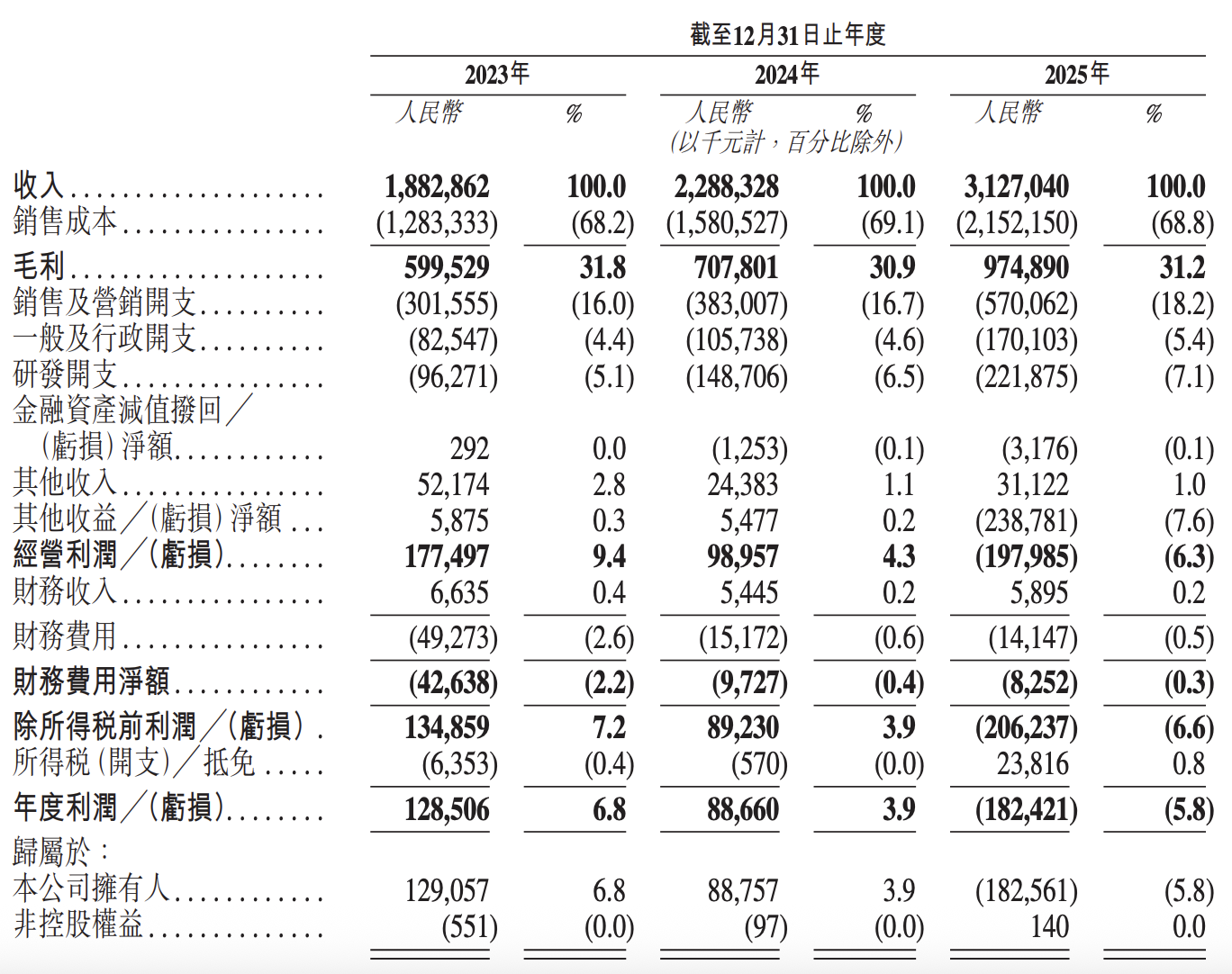
对于净利润的下滑,公司表示,2023年到2024年主要由于销售及营销开支增加,支付予第三方电商平台、社交媒体及搜索引擎的推广费增加,以及KOL合作费增加;此外,研发开支也有所增加,研发人员数目及其薪金和奖金增加,导致员工成本上升。2025年的进一步下降则主要由于向前投资者发行股份及派付股息人民币2.4亿元。

创想三维表示,公司正通过推进多个已研发项目的商业化落地、持续拓宽销售渠道以及提升内部运营效率,力求在2026年实现业绩改善。尤其自2026年下半年起,公司将密集推出多款新品,包括一款多喷嘴多色智能3D打印机、一款桌面全彩UV 3D打印机,以及一款融合人工智能与多轴联动技术的智能多材料激光雕刻机。

此外招股书披露,与2025年同期相比,2026年第一季度硬件产品(含3D打印机、耗材、3D扫描仪及激光雕刻机)总销量增长了41.5%。未来,创想三维还将持续优化产品组合与营销效率,提升高利润率产品占比,改善营运现金流。

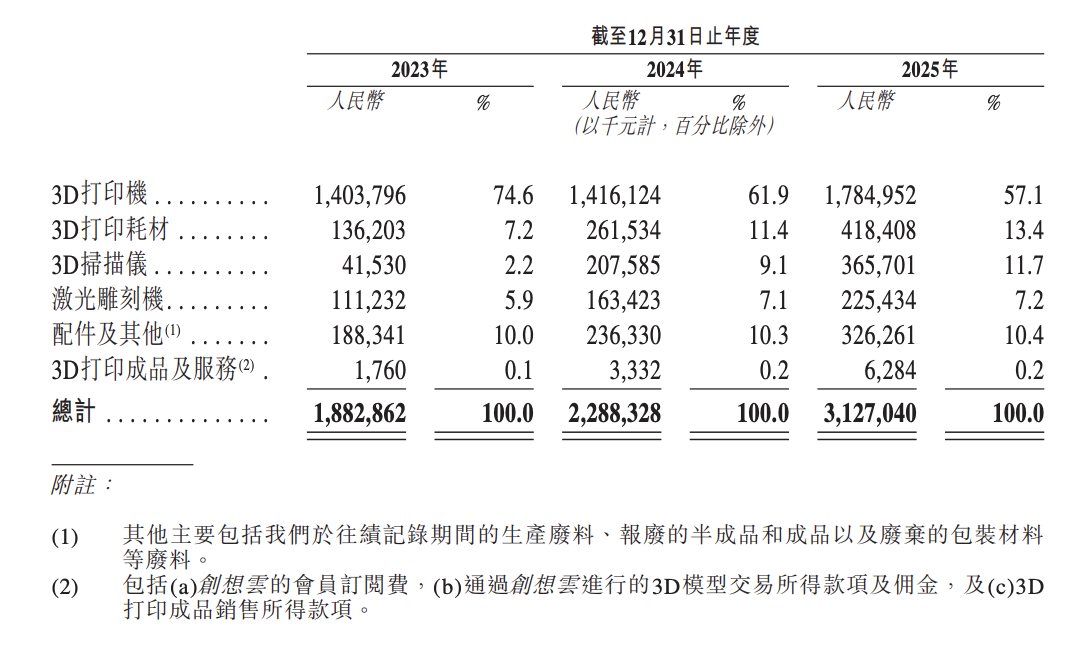
从产品线来看,创想三维产品线包括3D打印机、3D打印耗材、3D扫描仪、激光雕刻机、配件及其他、3D打印成品及服务。截至2025年12月31日,除3D打印机外,创想三维分别提供超过400个增值配件SKU、超过1,400个3D打印耗材SKU以及超过10个3D扫描仪及激光雕刻机SKU。

从2023年到2025年,公司营收来源更加平衡,最主要的3D打印机在总营收中的占比从74.6% 下降到57.1%,其他产品在总营收中的占比则有不同程度的增长。
在产品平均售价和销量方面,创想三维的3D打印机年销量从2023年到87.07万下降到2025年的74.24万,平均售价从1612.3元提升至2404.4元。招股书表示,销量下降、平均售价提高是因为公司专注于推广高端产品系列。比如,2023年,公司推出首款高端旗舰K 系列打印机K1 Max,制造商建议零售价为1,099美元,2024年进一步推出K2 Plus打印机,制造商建议零售价为1,299美元。

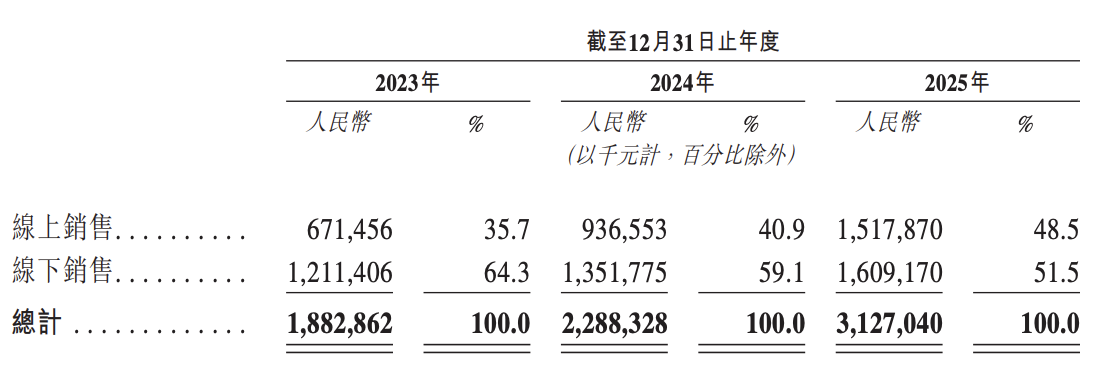
在销售渠道方面,从2023年到2025年,创想三维线上渠道的营收占比从35.7%提高到48.5%,线下渠道则从64.3% 下降到51.5%。
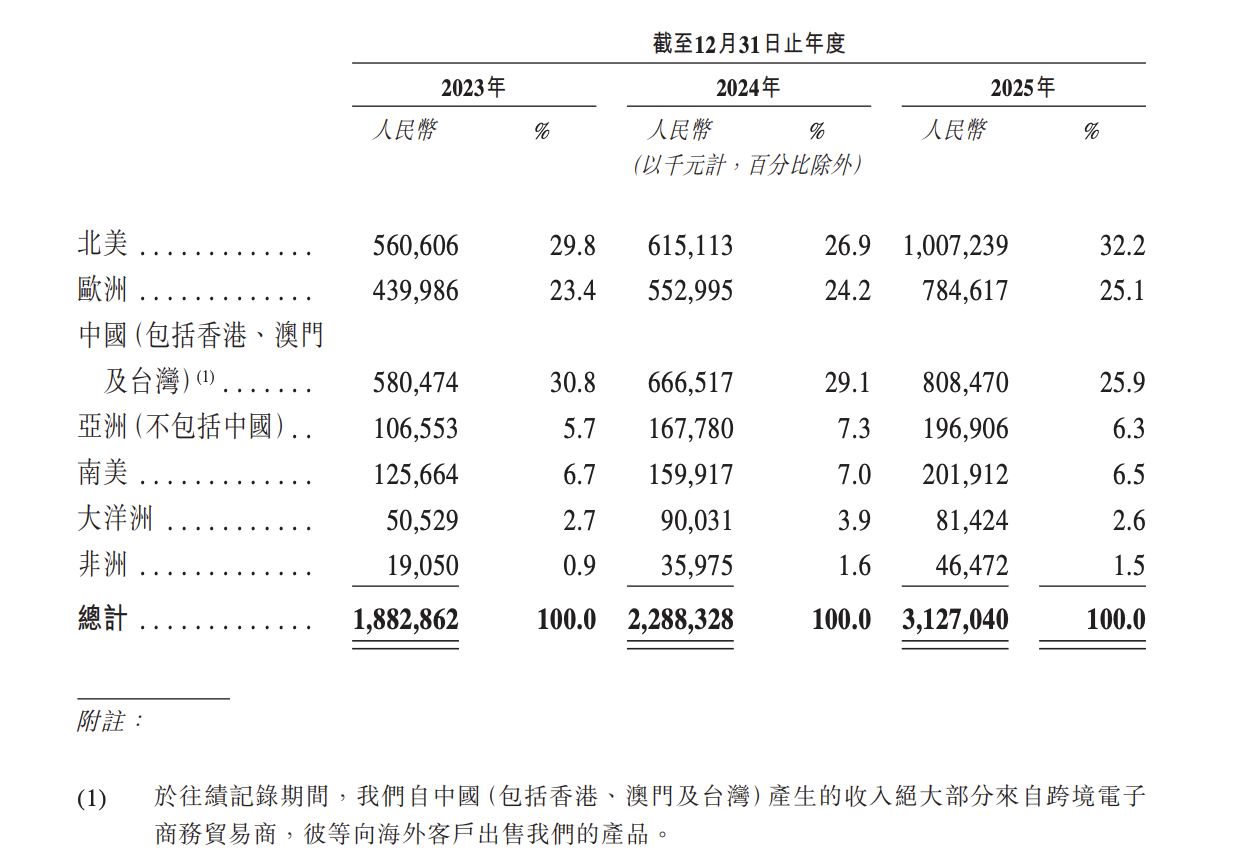
在地区市场方面,创想三维的销售市场已经覆盖全球140个国家和地区。从2023年到2025年,北美地区贡献的营收占比从29.8% 增长到32.2%;欧洲地区的贡献从23.4% 增长到25.1%,中国地区的营收贡献则从30.8% 下降到25.9%。
根据灼识咨询的资料,2025年按GMV计,创想三维是全球第二大的消费级3D打印公司,市场占有率为11.2%;2025年按GMV计,创想三维位居全球消费级3D扫描仪公司第一,市场份额为45.3%;2025年按GMV计,创想三维在全球消费级激光雕刻机公司中排名第四,市场份额为4.8%。


亿邦持续追踪报道该情报,如想了解更多与本文相关信息,请扫码关注作者微信。

【版权提示】亿邦动力倡导尊重与保护知识产权。未经许可,任何人不得复制、转载、或以其他方式使用本网站的内容。如发现本站文章存在版权问题,烦请提供版权疑问、身份证明、版权证明、联系方式等发邮件至run@ebrun.com,我们将及时沟通与处理。

已点赞

+1

{{ praise_text }}

好文章,值得被更多人看到

FAQ回顾

创想三维的上市进程如何?

创想三维已于2026年5月12日通过港交所上市聆讯,并启动PDIE环节,预计本月内登陆港交所。公司此前于2025年2月、8月及2026年3月三次递表。

创想三维2025年的财务表现如何?

2025年,创想三维营业收入为31.27亿元,但按国际财务报告准则计量的净利润为-1.82亿元。净利润下滑主因包括向前投资者发行股份及派付股息2.4亿元。

创想三维在2026年有哪些新产品规划?

公司计划自2026年下半年起密集推出多款新品,包括多喷嘴多色智能3D打印机、桌面全彩UV 3D打印机以及融合AI与多轴联动技术的智能多材料激光雕刻机。

广告

下一篇

跨境电商资源对接

《全球跨境电商服务商资源手册》第二期手册现已发布,触达更多资源,了解跨境服务商信息,欢迎点击链接下载。

了解详情

明略的C端野望 从消费级AI录音硬件Octic开始

它的成败,将在很大程度上回答一个更深层的问题:一家传统ToB公司,能否跨出自己的舒适区,在消费级市场找到新的增长曲线。