



• 亿邦公众号
    • APP下载

沃尔玛广告发布2026年营销日历 解读营销节点与广告策略

作者:龚作仁 文章来源:Laborer

2026-03-25 16:41

作者:龚作仁 文章来源:Laborer

2026-03-25 16:41

邦小白快读

EN
全文速览

沃尔玛广告发布的2026年营销日历提供全年关键节点和实操策略,帮助卖家把握流量高峰。

1. 全年营销节点:覆盖1月焕新期、2月情人节和超级碗、3月妇女节和春季、4月复活节春促、5月母亲节和宠物月、6月父亲节和年中、7月独立日和返校季预热、8月返校季和夏秋换季、9月母婴节和秋促、10月万圣节、11月黑五网一、12月圣诞节,每个节点消费需求放大。

2. 广告实操干货:1月使用自动化规则提升曝光;2月集中预算前三周,通过商品推广广告抢搜索流量、品牌推广广告占位头部、视频推广广告提升点击;3月月初测试商品曝光,月中放大表现单元;4月月初加大投入,月中转向预算优化;5月优化搜索广告竞价;6月采用商品、品牌、视频广告组合;7月预埋返校季关键词;8月提升出价30%加速清仓;9月部署商品、品牌、视频广告组合;10月聚焦高潜关键词;11月提高预算3-5倍;12月优化关键词组合。

3. 整体行动指南:科学规划全年预算,把握流量红利,如竞争强度低时铺垫营销,旺季冲刺转化,助力销售增长。

品牌可借助营销节点强化品牌心智和连接用户,基于消费趋势优化营销策略。

1. 品牌营销和渠道建设:2月利用品牌推广广告占位头部,强化品牌曝光;10月聚焦热门商品扩大品牌知名度;全年通过视频推广广告提升情感共鸣,如9月绑定休闲时光追求。

2. 消费趋势和用户行为观察:2月超级碗驱动派对用品和电子产品需求,情人节刺激珠宝和时尚品类;3月春季搜索量上升,家居焕新和户外装备需求启动;5月母亲节和宠物月带动礼品和夏季热销品;7月返校季教育采购增长;用户行为显示节点需求放大,如复活节消费信心增强。

3. 产品研发启示:基于节日主题开发相关产品,如情人节珠宝和巧克力、万圣节创意装饰;关注季节性需求变化,如夏秋换季清仓机会。

4. 价格竞争策略:8月通过打折促销加速流转,11月黑五网一精细化运营提升转化,优化广告竞价应对竞争。

全年营销机会和风险提示助力卖家增长,提供具体应对措施和商业模式启示。

1. 增长市场和消费需求变化:关键节点如2月双重消费高峰、6月节日赛事机遇、7月独立日返校预热、11月黑五网一全球狂欢,带来流量红利;需求变化如3月春季启动、5月宠物需求渐涨、8月夏秋清仓窗口。

2. 机会和风险提示:机会包括1月竞争强度低黄金铺垫期、4月放量冲刺GMV、12月年终爆发;风险如流量回落需科学规划、竞争激烈需优化广告结构、8月过渡期需精准把握衔接。

3. 事件应对措施和可学习点:针对节点,8月提升出价30%加速清仓、11月提高预算3-5倍最大化转化;可学习最新商业模式如广告组合(商品、品牌、视频推广)、自动化规则确保广告在线。

4. 扶持政策和合作方式:无直接政策,但平台提供营销行动指南,如全年规划帮助卖家合作应对变化,科学库存周转规避风险。

产品需求变化和商业机会启示生产设计,推进数字化电商应用。

1. 产品生产和设计需求:基于节日主题开发产品,如2月情人节珠宝和时尚品、5月母亲节礼品和宠物用品、10月万圣节装饰装扮;季节性需求如3月春季家居焕新用品、8月夏秋交替清仓商品。

2. 商业机会:1月焕新采购持续至春季、4月复活节春促多品类放大、6月足球赛事观赛经济、12月圣诞礼品高峰;机会窗口如8月加速季节性流转、11月黑五网一爆发。

3. 推进数字化和电商启示:通过广告优化提升曝光,如使用关键词策略、预算分配;全年规划启示科学库存管理,如测试优化再营销人群;电商应用如自动化广告规则减少低效消耗。

行业发展趋势和解决方案助力解决客户痛点,基于新技术应用。

1. 行业发展趋势:全年流量争夺激烈,节点需求放大如情人节、返校季;趋势显示消费者可支配收入增加,消费信心增强,如复活节春促。

2. 新技术应用:广告自动化规则确保在线、关键词优化工具(如商品推广广告)、视频推广技术提升点击;支持测试优化,如3月月初曝光测试。

3. 客户痛点和解决方案:痛点如竞争强度低时流量回落(1月)、过渡期衔接不畅(8月);解决方案包括组合广告投放(6月)、预算分配效率优化(4月)、竞价调整(如2月分批次提升竞价);提供数据测试和再营销积累策略(3月)。

平台需求和支持策略解析最新做法,助力招商和运营管理。

1. 商业对平台的需求和问题:卖家需要系统化营销指南应对节点流量变化,如科学规划预算、优化广告结构;问题包括竞争激烈需规避风险、旺季库存周转挑战。

2. 平台最新做法和招商:发布营销日历作为增长行动蓝图,推荐广告类型如商品推广、品牌推广、视频推广;招商吸引卖家使用服务,如提示黑五网一机会。

3. 运营管理和风向规避:运营建议包括预算优化(4月从放量转向效率)、竞价调整(8月出价提升)、关键词预埋(7月返校季);规避风向如提示流量回落期铺垫(1月)、竞争风险需科学规划(全年)。

产业新动向和商业模式启示提供政策建议洞察。

1. 产业新动向和新问题:动向如全年营销蓝图精细化节点(如美加墨三地)、消费需求在特定节点放大(如万圣节注入活力);新问题包括竞争激烈、流量自然回落需应对。

2. 商业模式启示:广告策略组合(商品、品牌、视频推广)优化ROAS、预算科学分配提升效率;启示为提前布局(如9月部署Q4策略)、全年规划提升流量捕获。

3. 政策法规建议和启示:无直接政策,但建议基于数据表现优化决策,如测试再营销人群(3月);启示包括推动数字化广告应用、规避竞争风险。

声明:快读内容全程由AI生成,请注意甄别信息。如您发现问题,请发送邮件至 run@ebrun.com 。

我是 品牌商 卖家 工厂 服务商 平台商 研究者 帮我再读一遍。

Quick Summary

Walmart's 2026 marketing calendar outlines key seasonal events and actionable strategies to help sellers capitalize on peak traffic periods.

1. Key marketing events: The calendar covers major occasions throughout the year, including January refresh, February Valentine's Day and Super Bowl, March Women's Day and spring, April Easter promotions, May Mother's Day and Pet Month, June Father's Day and mid-year, July Independence Day and back-to-school season warm-up, August back-to-school and summer-to-fall transition, September Baby & Child Festival and autumn promotions, October Halloween, November Black Friday and Cyber Monday, and December Christmas. Each event amplifies consumer demand.

2. Actionable advertising strategies: In January, use automated rules to boost exposure; in February, concentrate budgets in the first three weeks, utilizing Sponsored Products for search traffic, Sponsored Brands for top placement, and video ads to increase clicks; March involves testing product exposure early in the month and scaling successful units mid-month; April starts with increased investment, shifting to budget optimization later; May focuses on optimizing search ad bids; June employs a mix of product, brand, and video ads; July pre-places back-to-school keywords; August increases bids by 30% to accelerate clearance; September deploys a combination of ad types; October targets high-potential keywords; November raises budgets 3-5 times; and December optimizes keyword combinations.

3. Overall guidance: Scientifically plan annual budgets to capture traffic红利, such as laying the groundwork during low-competition periods and pushing for conversions during peak seasons to drive sales growth.

Brands can leverage marketing events to strengthen brand identity and connect with users, optimizing strategies based on consumer trends.

1. Brand marketing and channel building: Use Sponsored Brands in February for top placement to enhance exposure; focus on popular products in October to boost brand awareness; utilize video ads year-round to build emotional resonance, such as associating with leisure pursuits in September.

2. Consumer trends and user behavior: The Super Bowl in February drives demand for party supplies and electronics, while Valentine's Day boosts jewelry and fashion; March sees rising spring-related searches and demand for home refresh and outdoor gear; May's Mother's Day and Pet Month spur gift and summer product sales; July's back-to-school season increases education-related purchases. User behavior shows amplified demand during events, like heightened consumer confidence during Easter.

3. Product development insights: Develop themed products for holidays, such as jewelry and chocolates for Valentine's Day or creative decorations for Halloween; monitor seasonal demand shifts, like clearance opportunities during the summer-to-fall transition.

4. Pricing and competition strategy: Implement discounts in August to accelerate inventory turnover; refine operations during November's Black Friday/Cyber Monday to boost conversions; optimize ad bids to stay competitive.

The calendar highlights annual growth opportunities and risks, offering specific countermeasures and business model insights for sellers.

1. Market growth and demand shifts: Key events like February's dual peaks, June's holiday/sports opportunities, July's Independence Day/back-to-school warm-up, and November's global shopping frenzy drive traffic红利; demand evolves with spring onset in March, rising pet needs in May, and clearance windows in August.

2. Opportunities and risks: Opportunities include January's low-competition groundwork period, April's volume push for GMV, and December's year-end surge; risks involve traffic dips requiring scientific planning, intense competition necessitating ad structure optimization, and transitional periods like August needing precise management.

3. Event-specific actions and learnings: For instance, raise bids by 30% in August for clearance or increase budgets 3-5x in November for maximum conversions; adopt new models like ad combinations (Sponsored Products, Brands, Video) and automated rules to ensure ad uptime.

4. Support and collaboration: While no direct policies are mentioned, the platform provides action guides (e.g., annual planning) to help sellers adapt, with advice on scientific inventory turnover to mitigate risks.

Shifts in product demand and commercial opportunities inform production design, advancing digital e-commerce applications.

1. Production and design needs: Develop holiday-themed items, such as February's Valentine's jewelry/fashion, May's Mother's Day gifts/pet supplies, or October's Halloween decorations; address seasonal demands like spring home refresh in March or clearance goods for the summer-fall transition in August.

2. Business opportunities: January's refresh spending extends into spring; April's Easter promotions boost multiple categories; June's soccer events drive viewing economy; December peaks with Christmas gifts; windows like August's accelerated seasonal turnover or November's Black Friday/Cyber Monday surge offer potential.

3. Digital and e-commerce insights: Enhance exposure through ad optimization (e.g., keyword strategies, budget allocation); annual planning advises scientific inventory management, such as testing and remarketing audience optimization; apply e-commerce tools like automated ad rules to reduce inefficiencies.

Industry trends and tech-driven solutions address client pain points, leveraging new applications.

1. Industry trends: Fierce competition for traffic year-round, with demand spikes during events like Valentine's Day or back-to-school; trends indicate rising disposable income and consumer confidence, e.g., during Easter promotions.

2. New technology applications: Automated ad rules ensure uptime; keyword optimization tools (e.g., Sponsored Products) and video ad tech boost clicks; support A/B testing, as with exposure tests in early March.

3. Client pain points and solutions: Challenges include traffic dips during low-competition periods (January) or poor transition management (August); solutions involve combined ad campaigns (June), efficient budget allocation (April), bid adjustments (e.g., phased increases in February); offer data testing and remarketing strategies (March).

Platform demands and support strategies analyze latest practices to aid merchant acquisition and operations management.

1. Merchant needs and challenges: Sellers require systematic marketing guides to navigate traffic fluctuations, such as scientific budget planning and ad structure optimization; issues include intense competition risks and peak-season inventory turnover challenges.

2. Platform initiatives and merchant acquisition: The marketing calendar serves as a growth blueprint, recommending ad types like Sponsored Products, Brands, and Video ads; acquisition efforts attract sellers by highlighting opportunities like Black Friday/Cyber Monday.

3. Operations management and risk mitigation: Operational advice includes budget optimization (shifting from volume to efficiency in April), bid adjustments (August increases), and keyword pre-placement (July back-to-school); risk avoidance tips cover groundwork during traffic lulls (January) and scientific planning to counter competition (year-round).

Industry trends and business model insights offer policy recommendations and analytical perspectives.

1. New industry dynamics and issues: Trends include精细化 node-based marketing blueprints (e.g., covering the U.S., Canada, Mexico) and amplified demand during specific events (e.g., Halloween injecting vitality); emerging issues involve intense competition and managing natural traffic declines.

2. Business model insights: Ad strategy combinations (Sponsored Products, Brands, Video) optimize ROAS, while scientific budget allocation enhances efficiency; insights emphasize early preparation (e.g., deploying Q4 strategies in September) and annual planning to capture traffic.

3. Policy and regulatory implications: While no direct policies are cited, recommendations advise data-driven decision-making, such as testing remarketing audiences (March); implications include promoting digital ad adoption and mitigating competition risks.

Disclaimer: The "Quick Summary" content is entirely generated by AI. Please exercise discretion when interpreting the information. For issues or corrections, please email run@ebrun.com .

I am a Brand Seller Factory Service Provider Marketplace Seller Researcher Read it again.

在跨境电商竞争日趋激烈的今天,营销节奏的精准把控往往决定卖家能否在关键时刻脱颖而出。近日,沃尔玛广告正式发布《2026沃尔玛广告营销日历》,这份涵盖全年12个月、横跨美加墨三地重要节点的广告策略指南,为卖家提供了一套系统化、精细化的营销行动指南,帮助跨境卖家科学规划广告预算与节奏,把握从年初焕新、情人节、返校季到黑五网一、圣诞节等关键消费高峰。
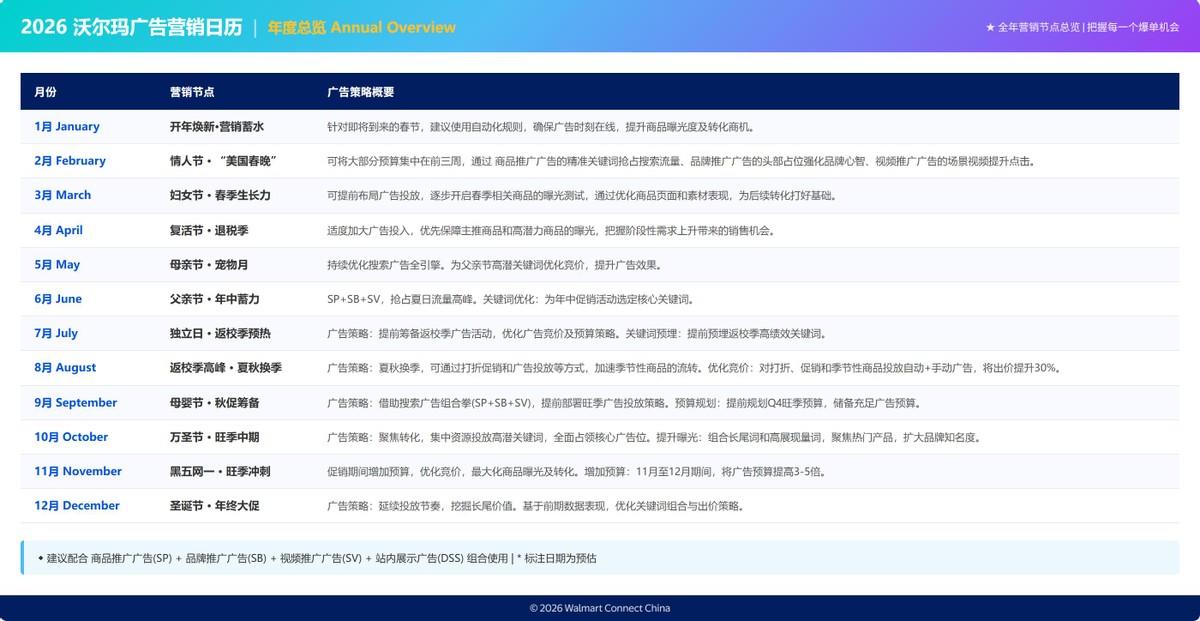
1月:开年焕新 · 营销蓄水
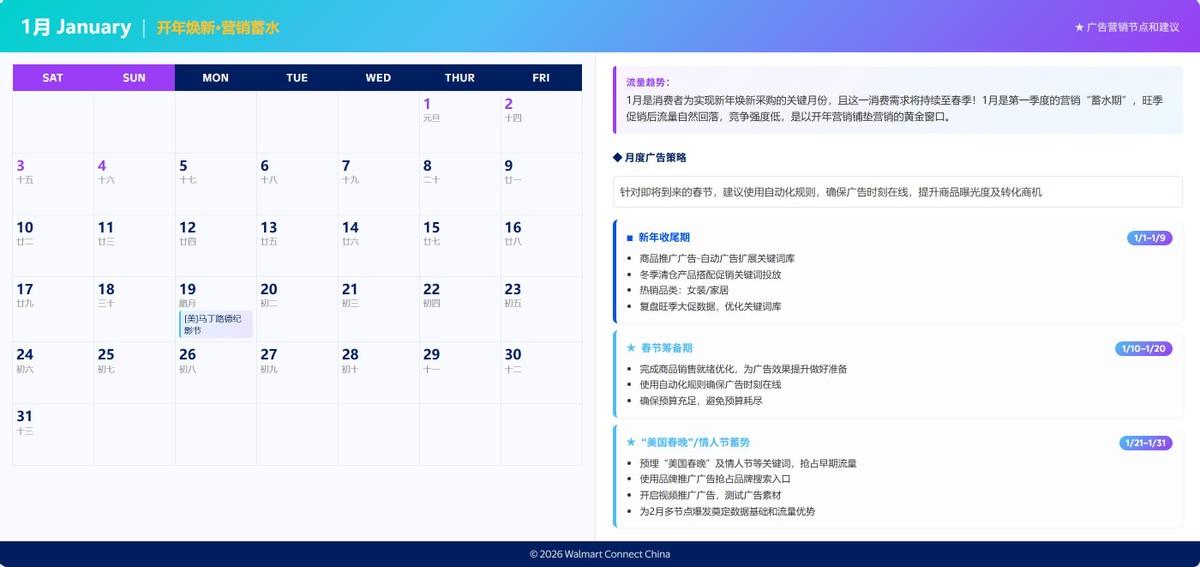
1月是消费者为实现新年焕新采购的关键月份,且这一消费需求将持续至春季!1月是第一季度的营销“蓄水期”,旺季促销后流量自然回落,竞争强度低,是以开年铺垫营销的黄金窗口。

本月核心策略是针对即将到来的春节,使用自动化规则,确保广告时刻在线,提升商品曝光度及转化商机。

2月:情人节 · "美国春晚"
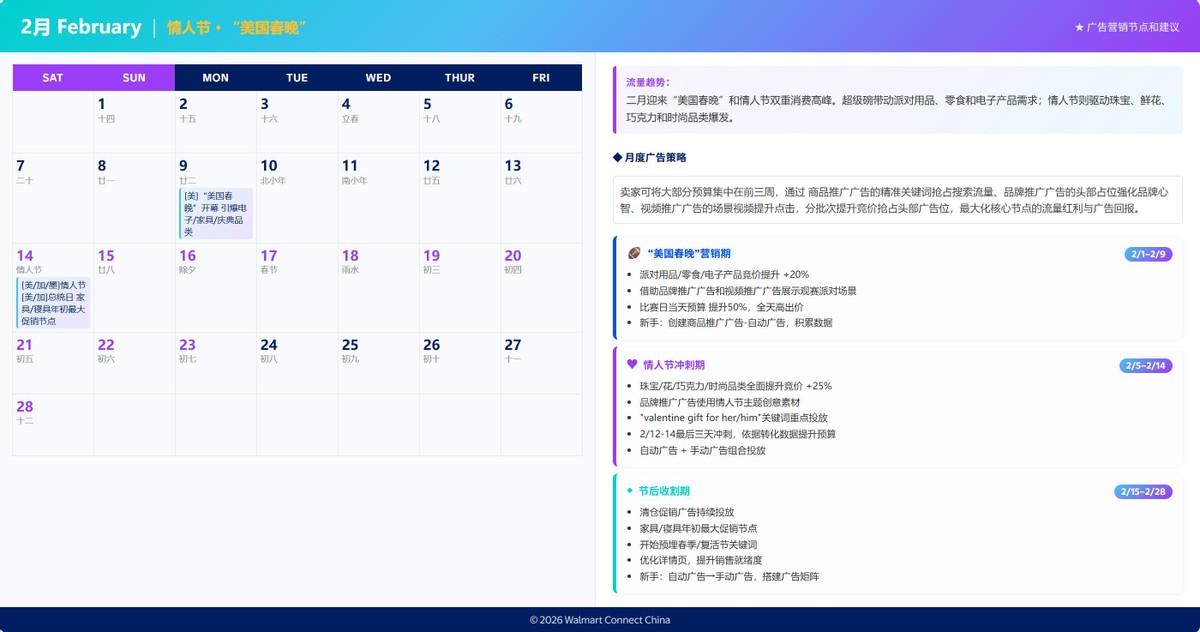
二月迎来“美国春晚”和情人节双重消费高峰。超级碗带动派对用品、零食和电子产品需求;情人节则驱动珠宝、鲜花、巧克力和时尚品类爆发。

卖家可将大部分预算集中在前三周,通过商品推广广告的精准关键词抢占搜索流量、品牌推广广告的头部占位强化品牌心智、视频推广广告的场景视频提升点击,分批次提升竞价抢占头部广告位,最大化核心节点的流量红利与广告回报。

3月:妇女节 · 春季生长力
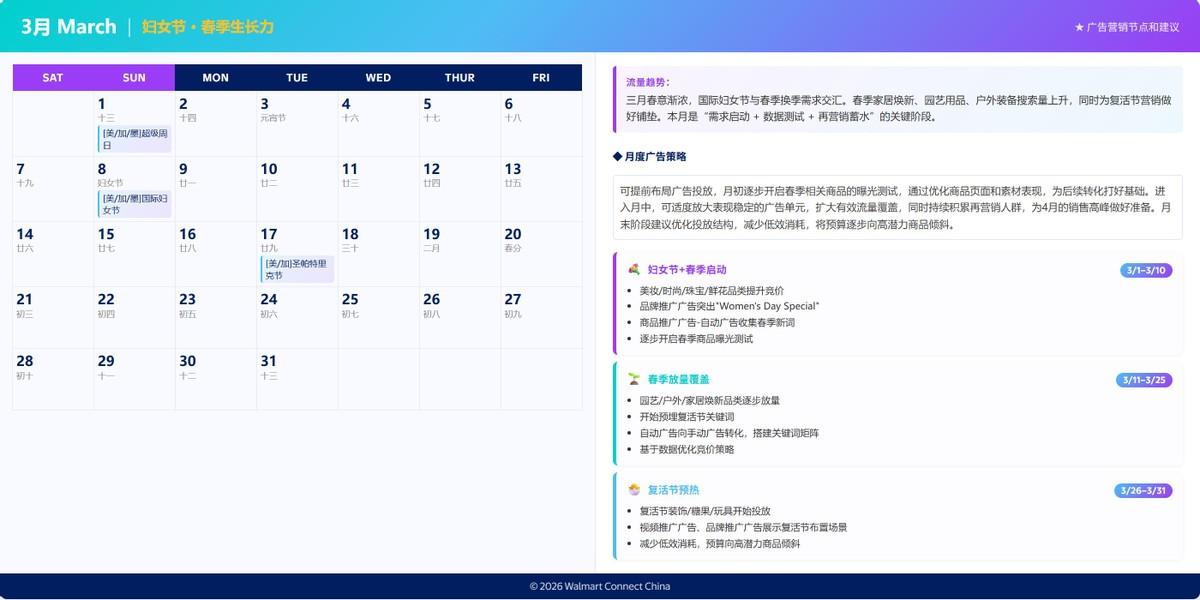
三月春意渐浓,国际妇女节与春季换季需求交汇。春季家居焕新、园艺用品、户外装备搜索量上升,同时为复活节营销做好铺垫。本月是“需求启动 + 数据测试 + 再营销蓄水”的关键阶段。

广告策略上,可提前布局广告投放,月初逐步开启春季相关商品的曝光测试,通过优化商品页面和素材表现,为后续转化打好基础。进入月中,可适度放大表现稳定的广告单元,扩大有效流量覆盖,同时持续积累再营销人群,为4月的销售高峰做好准备。月末阶段建议优化投放结构,减少低效消耗,将预算逐步向高潜力商品倾斜。

4月:复活节 · 春促增长
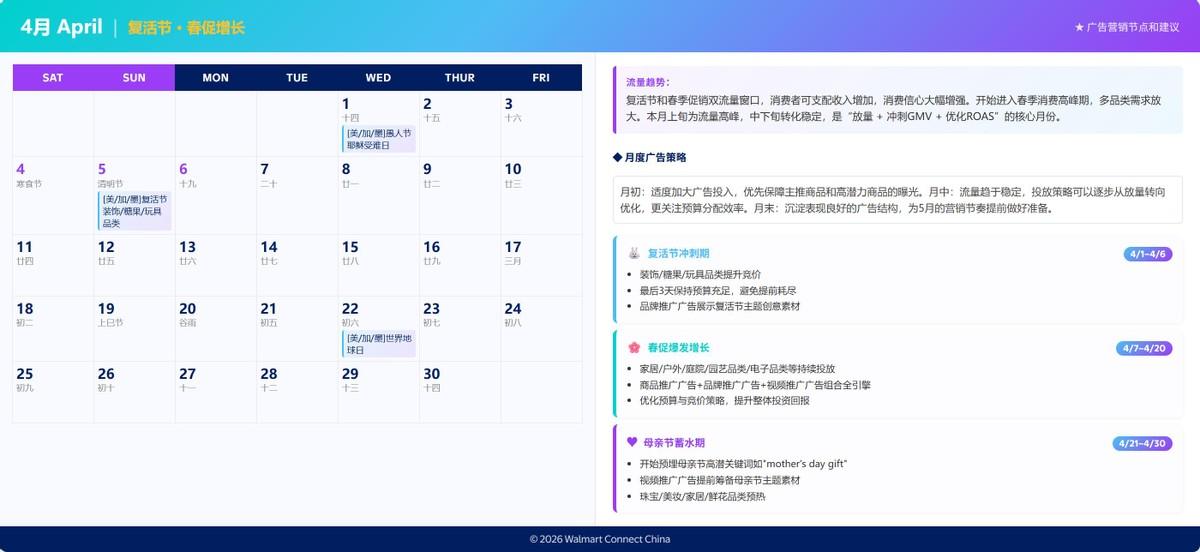
复活节和春季促销双流量窗口,消费者可支配收入增加,消费信心大幅增强。开始进入春季消费高峰期,多品类需求放大。本月上旬为流量高峰,中下旬转化稳定,是“放量+冲刺GMV+优化ROAS”的核心月份。

广告策略上,月初适度加大广告投入,优先保障主推商品和高潜力商品的曝光。月中流量趋于稳定,投放策略可以逐步从放量转向优化,更关注预算分配效率。月末沉淀表现良好的广告结构,为5月的营销节奏提前做好准备。

5月:母亲节 · 宠物月
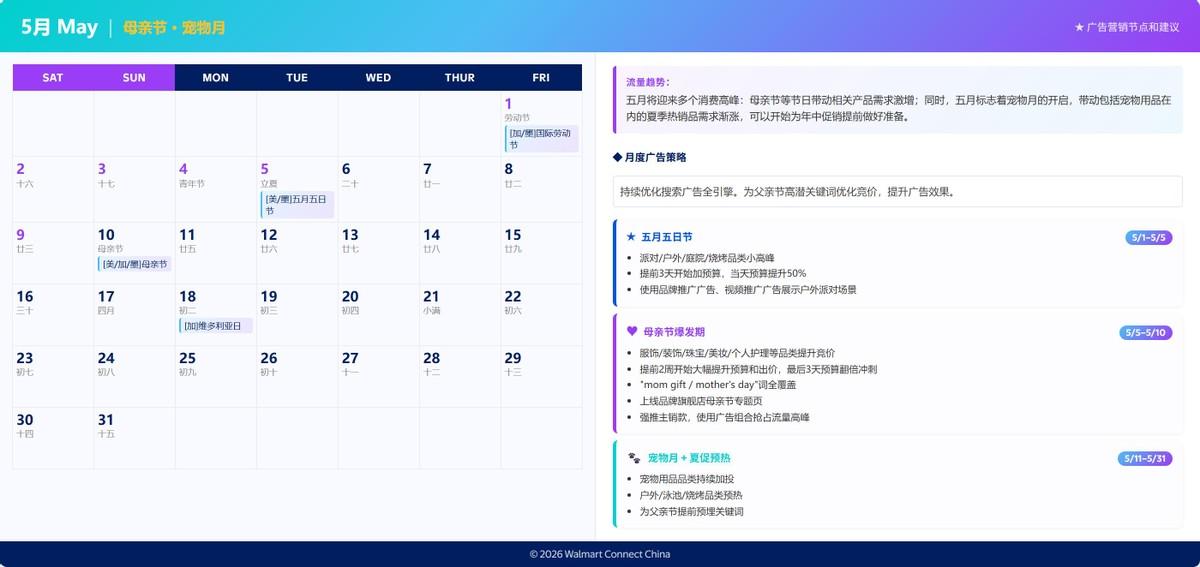
五月将迎来多个消费高峰:母亲节等节日带动相关产品需求激增;同时,五月标志着宠物月的开启,带动包括宠物用品在内的夏季热销品需求渐涨,可以开始为年中促销提前做好准备。

广告策略上,持续优化搜索广告全引擎。为父亲节高潜关键词优化竞价,提升广告效果。

6月:父亲节 · 年中蓄力
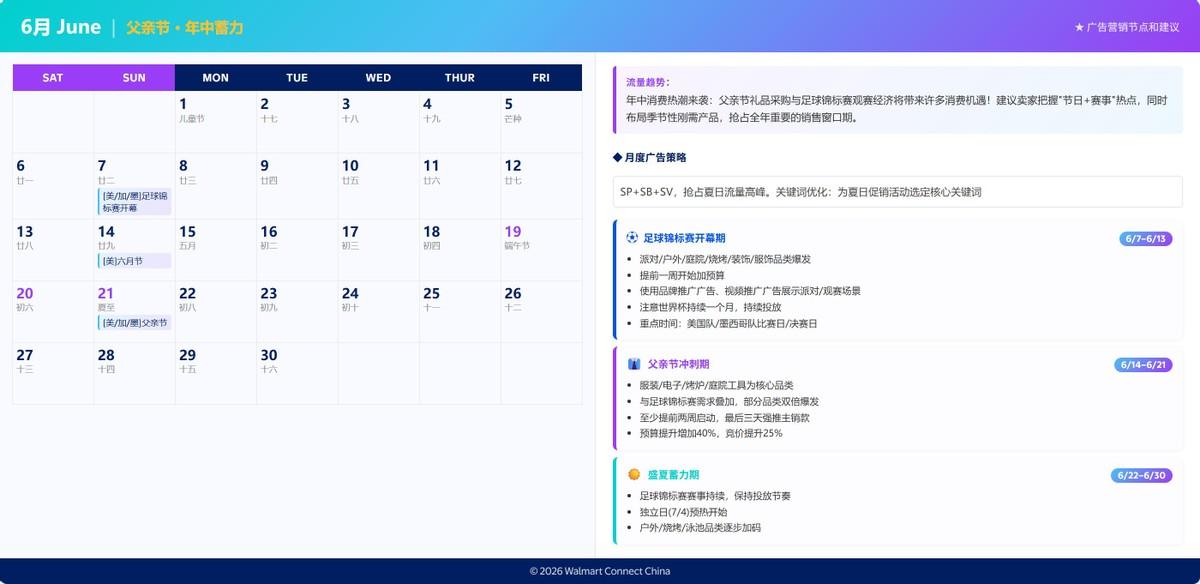
年中消费热潮来袭:父亲节礼品采购与足球锦标赛观赛经济将带来许多消费机遇!建议卖家把握"节日+赛事"热点,同时布局季节性刚需产品,抢占全年重要的销售窗口期。

广告策略采用“商品推广广告+品牌推广广告+视频推广广告”组合,抢占夏日流量高峰,为夏日促销活动选定核心关键词。

7月:独立日 · 返校季预热
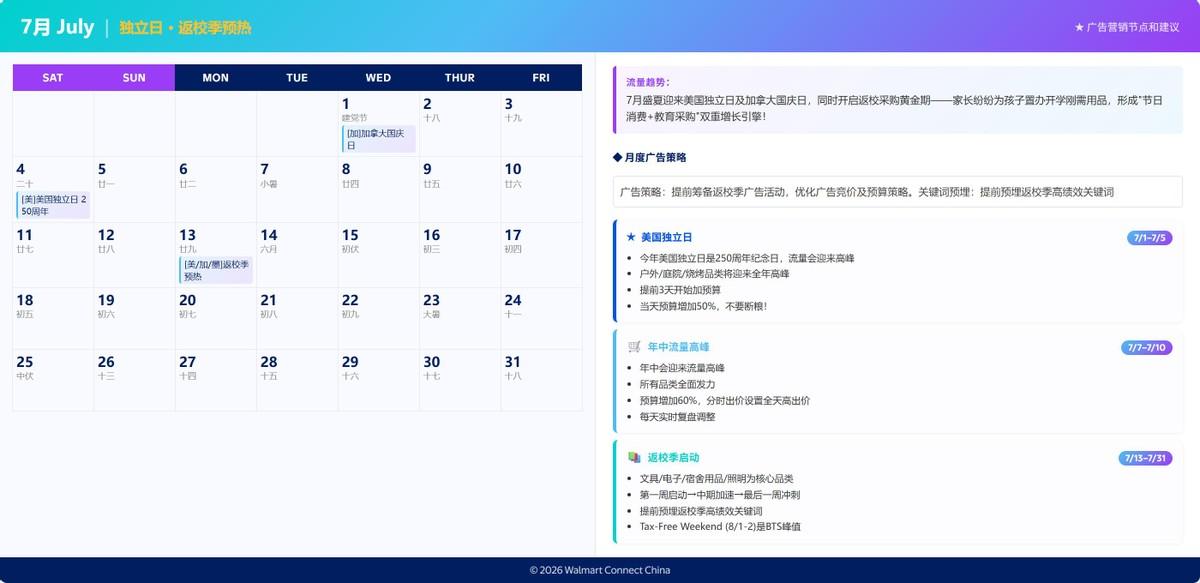
7月盛夏迎来美国独立日及加拿大国庆日,同时开启返校采购黄金期——家长纷纷为孩子置办开学刚需用品,形成“节日消费+教育采购”双重增长引擎!

广告策略上,提前筹备返校季广告活动,优化广告竞价及预算策略,提前预埋返校季高绩效关键词。

8月:返校季高峰 · 夏秋换季
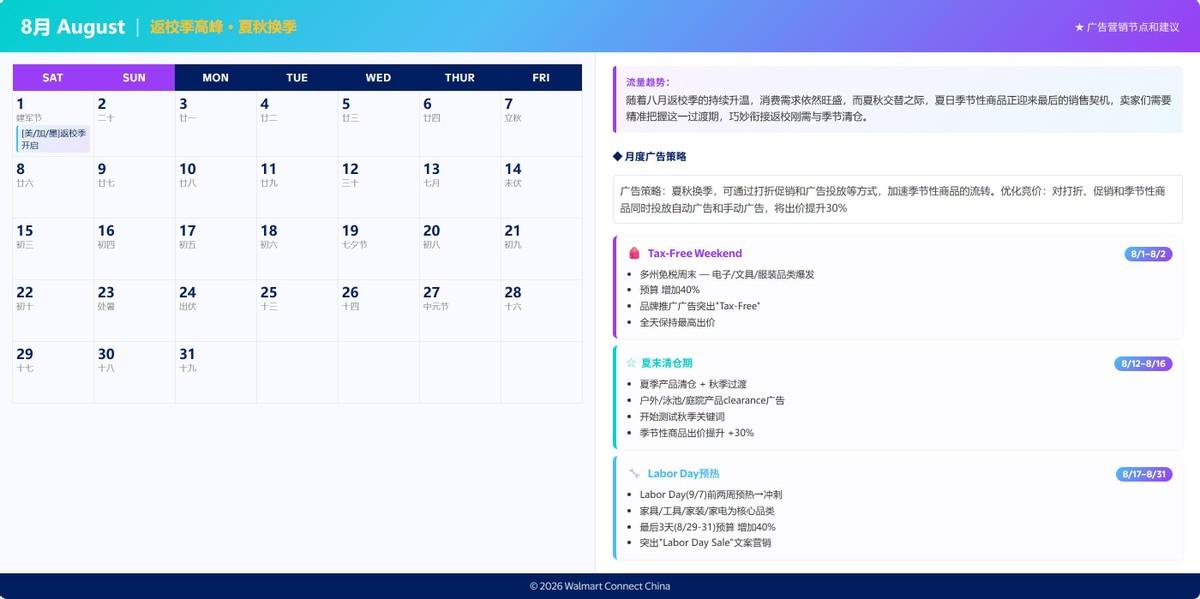
随着八月返校季的持续升温,消费需求依然旺盛,而夏秋交替之际,夏日季节性商品正迎来最后的销售契机,卖家们需要精准把握这一过渡期,巧妙衔接返校刚需与季节清仓。

广告策略上,夏秋换季,可通过打折促销和广告投放等方式,加速季节性商品的流转。对打折、促销和季节性商品同时投放自动广告和手动广告,将出价提升30%。

9月:母婴节 · 秋促筹备
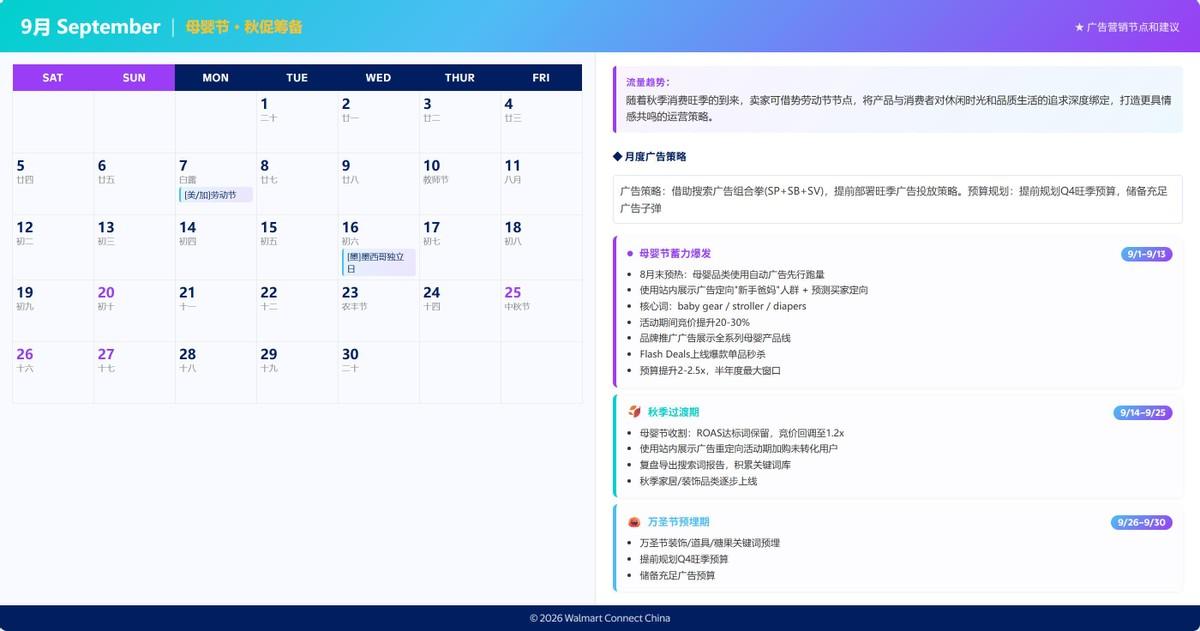
随着秋季消费旺季的到来,卖家可借势劳动节节点,将产品与消费者对休闲时光和品质生活的追求深度绑定,打造更具情感共鸣的运营策略。

广告策略上,借助搜索广告组合拳(商品推广广告+品牌推广广告+视频推广广告),提前部署旺季广告投放策略,提前规划Q4旺季预算,储备充足广告子弹。

10月:万圣节 · 旺季中期
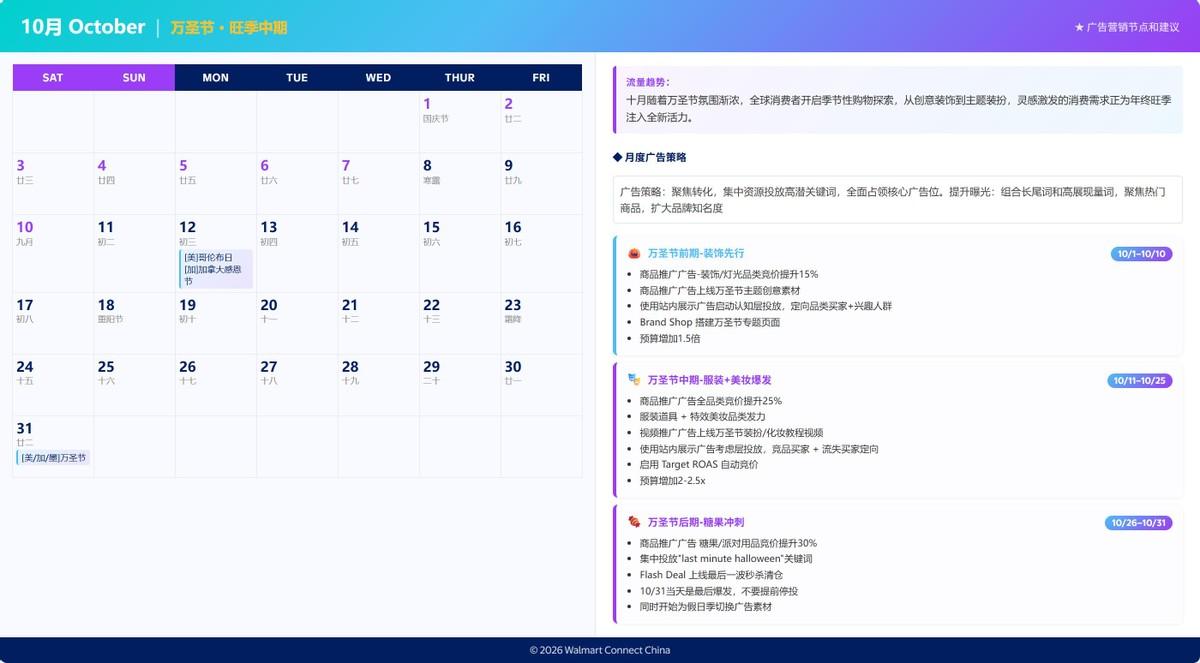
十月随着万圣节氛围渐浓,全球消费者开启季节性购物探索,从创意装饰到主题装扮,灵感激发的消费需求正为年终旺季注入全新活力。

广告策略聚焦转化,集中资源投放高潜关键词,全面占领核心广告位,通过组合长尾词和高展现量词提升曝光,聚焦热门商品,扩大品牌知名度。

11月:黑五网一 · 旺季冲刺
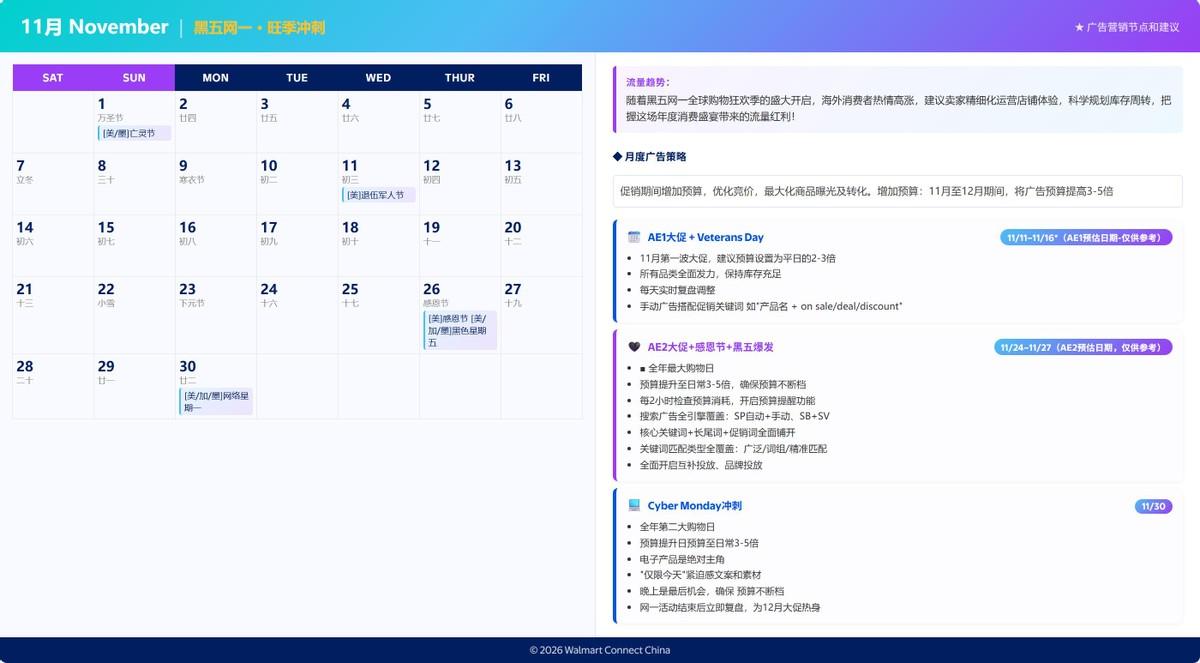
随着黑五网一全球购物狂欢季的盛大开启,海外消费者热情高涨,建议卖家精细化运营店铺体验,科学规划库存周转,把握这场年度消费盛宴带来的流量红利!

广告策略上,促销期间增加预算,优化竞价,最大化商品曝光及转化。11月至12月期间,将广告预算提高3-5倍。

12月:圣诞节 · 年终大促
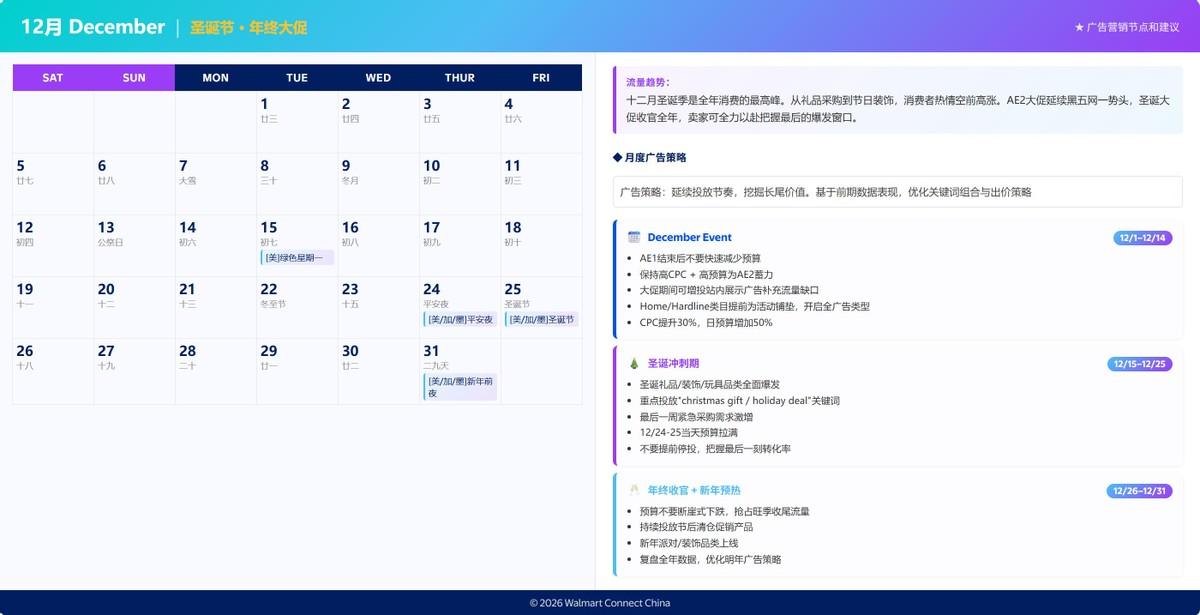
十二月圣诞季是全年消费的最高峰。从礼品采购到节日装饰,消费者热情空前高涨。AE2大促延续黑五网一势头,圣诞大促收官全年,卖家可全力以赴把握最后的爆发窗口。

广告策略延续投放节奏,挖掘长尾价值,基于前期数据表现优化关键词组合与出价策略。

全渠流量共振,销量一触即发

2026年的沃尔玛电商市场,机遇与竞争并存。消费者的需求在特定节点被显著放大,而流量的争夺也愈发激烈。这份《2026沃尔玛广告营销日历》不仅仅是一张时间表,更是一套贯穿全年的增长行动蓝图,每一个月都有明确的流量趋势研判、阶段性广告策略和具体的竞价建议,帮助卖家从容应对全年每一次流量浪潮。

2026年的机遇已经铺展开来。通过对每一个营销节点的深度理解和提前布局,合理分配预算,优化广告组合,跨境卖家将能更从容地应对市场变化,在2026年实现更高效的流量捕获与销售增长。立即规划,即刻行动,携手沃尔玛广告,让您的商品在每一个关键消费时刻都能脱颖而出。

注:文/龚作仁,文章来源:Laborer,本文为作者独立观点,不代表亿邦动力立场。

【版权提示】亿邦动力倡导尊重与保护知识产权。未经许可,任何人不得复制、转载、或以其他方式使用本网站的内容。如发现本站文章存在版权问题,烦请提供版权疑问、身份证明、版权证明、联系方式等发邮件至run@ebrun.com,我们将及时沟通与处理。

已点赞

+1

{{ praise_text }}

好文章,值得被更多人看到

FAQ回顾

沃尔玛2026年营销日历包含哪些重要节点?

日历涵盖全年12个月,包括情人节、返校季、黑五网一、圣诞节等关键消费高峰,横跨美国、加拿大、墨西哥三地重要营销节点,为卖家提供系统化行动指南。

沃尔玛广告在返校季有哪些投放策略?

7月开始预热,8月进入高峰;建议提前筹备广告活动,优化竞价策略,预埋返校季高绩效关键词,采用商品推广、品牌推广和视频广告组合抢占流量。

黑五网一期间如何调整沃尔玛广告预算?

促销期间需增加预算并优化竞价,建议在11月至12月期间将广告预算提高3-5倍,以最大化商品曝光及转化,把握年度消费盛宴的流量红利。

广告

下一篇

跨境电商资源对接

《全球跨境电商服务商资源手册》第二期手册现已发布,触达更多资源,了解跨境服务商信息,欢迎点击链接下载。

了解详情

即时零售 在县城爆单了

在一二线城市,即时零售卷哭闪电仓,不少商家卖一单赔一单。但在广袤县域市场,被主流商业叙事所遗忘的角落里,即时零售却在接住泼天富贵。

独家 未来零售

2026-03-25 16:11:47









