



• 亿邦公众号
    • APP下载

登顶“Z世代最喜爱的中国全球化品牌50强”TOP3 SHEIN以“按需时尚”重塑产业格局

作者:龚作仁 文章来源:Laborer

2025-11-04 18:30

作者:龚作仁 文章来源:Laborer

2025-11-04 18:30

邦小白快读

EN
全文速览

文章揭示“Z世代最喜爱的中国全球化品牌50强”榜单前三名及其成功的实操方法,帮助读者了解全球消费趋势。

1. 榜单排名:腾讯游戏、小米3C、SHEIN电商分别位居各品类第一,显示其市场领导力。

2. Z世代特点:占全球人口25%,精通数字技术,注重社交体验和价值优先消费理念,成为重塑市场的主力。

3. SHEIN创新供应链:通过“小单快反”模式数字化赋能供应商,实现按需生产,降低库存至低个位数,为全球提供高性价比产品。

4. 腾讯游戏成功秘诀:利用IP切入和社区建设,通过协作游戏和AR滤镜打造沉浸式体验,形成社交场域,提升海外收入。

5. 小米策略优势:以质优价宜和创新智能生态吸引科技爱好者,精准契合Z世代需求。

文章展示品牌如何通过营销和产品策略赢取Z世代消费者,重点包括品牌力构建和消费趋势洞察。

1. 品牌营销要点:腾讯游戏以社区社交和内容创新(如AR滤镜)增强情感联结;SHEIN利用短视频内容营销提供便捷购物体验,提升品牌首选度。

2. 渠道建设启示:榜单显示品牌需融入数字场域,如小米构建互联生态深化用户关联;SHEIN通过平台模式复制供应链经验,吸引多品类卖家,扩展渠道。

3. 定价与竞争:小米以“价值优先”策略避免过高定价,精准迎合Z世代;品牌整体需兼顾功能丰富性和成本控制。

4. 产品研发方向:SHEIN持续研发技术工具赋能供应商,支持产品创新;消费趋势表明应聚焦Z世代需求变化,如社交体验和可持续性。

5. 用户行为观察:Z世代偏好高性价比和新鲜感,品牌可通过数字化场域增强兴趣表达,提升全球认可度。

文章提供跨境市场机会和政策启示,帮助卖家应对变化和抓住增长点,重点包括风险管理和学习模式。

1. 政策解读与机会:榜单显示Z世代对中国品牌接受度高,提供海外市场增长空间;SHEIN平台模式吸引全国近400城市产业带卖家入驻,合作方式灵活。

2. 消费需求变化:Z世代推动全球消费转型,偏好社交购物和创新体验,事件应对需融入轻松内容如短视频营销。

3. 风险提示:传统行业高库存顽疾可通过SHEIN柔性供应链降低,减少浪费风险;榜单分析强调跨境品牌需严苛适应挑剔消费者。

4. 商业模式学习点:SHEIN的“按需时尚”模式以数字化生产减少库存,可复制到其他产业;平台模式打造“跨境大卖”新沃土。

5. 扶持政策启发:SHEIN投资超150亿元构建智慧供应链,覆盖物流枢纽,支持卖家高效拓展全球市场;增长市场需结合当地Z世代关联。

文章揭示生产数字化和电商启示带来的商业机会,重点包括制造升级和创新方法。

1. 产品生产设计需求:SHEIN模式实时洞察流行趋势,根据市场决定生产供应,工厂可学习按需制造避免库存积压。

2. 商业机会启示:SHEIN赋能供应商提供技术工具和工艺支持,工厂可参与智慧供应链体系,获得数字化投资支持。

3. 推进数字化电商:柔性供应链推进产业数字化、智能化和绿色化升级,工厂可通过SHEIN合作实现高效生产转型。

4. 设计优化方向:基于Z世代偏好丰富功能产品,工厂需整合创新如减碳工艺,提升性价比竞争力。

5. 供应链体系构建:SHEIN以广州为中心投资物流枢纽,工厂可加入覆盖多城市的生态链,获得全流程培训机会。

文章聚焦行业趋势和新技术解决客户痛点,重点包括数字化转型和方案应用。

1. 行业发展趋势:Z世代推动电商向内容营销和社交购物转变,如SHEIN超越搜索模式提供沉浸体验;全球品牌加速数字化升级。

2. 新技术启示:SHEIN的“链式改造”引入实时洞察技术和数字化工具,服务商可研发类似方案优化生产管理。

3. 客户痛点解决:传统产业高库存问题可通过按需生产模式缓解;服务商需提供工具帮助供应商实现绿色减碳过程。

4. 解决方案亮点:SHEIN模式显示数字赋能能降低库存至低个位数,服务商可推广敏捷供应链方法应对市场变化。

5. 痛点深挖:Z世代需求变化引发新挑战,服务商应开发智能系统支持快速响应趋势和可持续升级。

文章分析平台运营需求和最新做法,重点包括招商策略和风险控制。

1. 商业需求与问题:平台需解决供应链效率问题,如SHEIN通过投资超150亿元构建智慧物流体系,提升全球市场拓展。

2. 平台最新做法:SHEIN复制柔性供应链吸引第三方卖家和品牌入驻,覆盖全品类;招商策略基于产业带城市布局。

3. 平台运营管理:榜单显示需融入社交元素,如腾讯打造社区场域;平台应优化内容营销提供便捷体验。

4. 风险规避方法:通过按需生产模式降低库存风险;SHEIN实践显示数字化赋能可减少浪费。

5. 风向规避启示:面对Z世代挑剔偏好,平台需加强品牌特性维护,如SHEIN全流程绿色减碳,构建可持续生态。

文章揭示产业新动向和政策启示,重点包括模式研究和问题探讨。

1. 产业新动向:Z世代驱动全球消费主力变革,中国品牌如腾讯、小米、SHEIN通过创新策略重塑市场格局。

2. 新问题启示:高库存顽疾已被SHEIN柔性供应链破解,引发对产业链数字化、智能化改革的思考。

3. 政策法规建议:SHEIN的投资实践显示政策应支持智慧供应链和绿色升级;榜单分析建议法规需促进跨文化品牌建设。

4. 商业模式研究:SHEIN的“按需时尚”模式以按需生产和平台复制,提供经济影响案例;腾讯和小米模式强调IP生态和价值定价策略。

5. 研究深挖:产业带城市化联动如广州枢纽启示区域发展;可持续竞争力需结合Z世代全球视野,探索数字化趋势下的政策优化。

声明:快读内容全程由AI生成,请注意甄别信息。如您发现问题,请发送邮件至 run@ebrun.com 。

我是 品牌商 卖家 工厂 服务商 平台商 研究者 帮我再读一遍。

Quick Summary

The article reveals the top three brands in the "Top 50 Most Loved Chinese Global Brands Among Gen Z" ranking and their practical success strategies, helping readers understand global consumption trends.

1. Ranking: Tencent Games, Xiaomi (3C), and SHEIN (e-commerce) lead their respective categories, demonstrating strong market leadership.

2. Gen Z characteristics: Accounting for 25% of the global population, they are digital natives who prioritize social experiences and value-driven consumption, becoming the main force reshaping markets.

3. SHEIN's innovative supply chain: Its digital-enabled "small-batch quick-response" model empowers suppliers for on-demand production, reducing inventory to single-digit percentages while offering globally affordable products.

4. Tencent Games' success formula: Leveraging IP integration and community building, it creates immersive experiences through collaborative games and AR filters, fostering social engagement and boosting overseas revenue.

5. Xiaomi's strategic edge: Attracts tech enthusiasts with quality products at accessible prices and an innovative smart ecosystem, precisely aligning with Gen Z preferences.

The article illustrates how brands win Gen Z consumers through marketing and product strategies, focusing on brand-building and trend insights.

1. Key marketing tactics: Tencent Games strengthens emotional connections via community engagement and content innovation (e.g., AR filters); SHEIN leverages short-video marketing for seamless shopping experiences, enhancing brand preference.

2. Channel development insights: Brands must integrate into digital ecosystems—Xiaomi builds interconnected ecosystems to deepen user ties; SHEIN replicates its supply chain expertise via a platform model, attracting multi-category sellers to expand reach.

3. Pricing and competition: Xiaomi’s "value-first" approach avoids overpricing, resonating with Gen Z; brands must balance feature richness with cost control.

4. R&D direction: SHEIN invests in tech tools to empower suppliers for product innovation; trends indicate a focus on Gen Z demands like social experiences and sustainability.

5. User behavior: Gen Z favors affordability and novelty; brands can amplify appeal through digital touchpoints to boost global recognition.

The article highlights cross-border opportunities and operational insights for sellers, emphasizing risk management and adaptable models.

1. Policy and opportunities: High Gen Z acceptance of Chinese brands opens overseas growth potential; SHEIN’s platform attracts sellers from nearly 400 industrial hubs with flexible partnerships.

2. Shifting demand: Gen Z drives global consumption toward social shopping and innovative experiences; responses should incorporate light-hearted content like short-video marketing.

3. Risk alerts: Traditional industries can adopt SHEIN’s agile supply chain to curb high inventory risks; cross-border brands must rigorously adapt to discerning consumers.

4. Model takeaways: SHEIN’s "on-demand fashion" approach minimizes inventory via digital production, applicable to other sectors; its platform model creates fertile ground for cross-border success.

5. Support policies: SHEIN’s $15B+ investment in smart supply chains covers logistics hubs, aiding sellers in efficient global expansion; growth markets require local Gen Z engagement.

The article outlines opportunities from production digitization and e-commerce, focusing on manufacturing upgrades and innovation.

1. Production design: SHEIN’s model uses real-time trend insights to guide supply decisions; factories can adopt on-demand manufacturing to avoid overstock.

2. Business opportunities: SHEIN equips suppliers with tech tools and工艺 support; factories can join its smart supply chain for digital investment access.

3. Digital transition: Agile supply chains drive industrial digitization, intelligence, and sustainability; partnering with SHEIN enables efficient production transformation.

4. Design optimization: Factories should integrate innovations like low-carbon processes to meet Gen Z’s demand for feature-rich, cost-effective products.

5. Supply chain integration: SHEIN’s Guangzhou-centric logistics network offers factories full-process training and multi-city ecosystem participation.

The article focuses on industry trends and tech solutions for client pain points, emphasizing digital transformation and application.

1. Industry trends: Gen Z shifts e-commerce toward content-driven social shopping (e.g., SHEIN’s immersive experiences beyond search); global brands accelerate digital upgrades.

2. Tech insights: SHEIN’s "chain transformation" with real-time data tools inspires service providers to develop similar production management solutions.

3. Pain point resolution: On-demand production alleviates inventory glut; providers must offer tools for suppliers’ green and low-carbon transitions.

4. Solution highlights: SHEIN’s digital empowerment cuts inventory to single digits; providers can promote agile supply chain methods for market adaptability.

5. Deep dive: Gen Z’s evolving demands necessitate smart systems for rapid trend response and sustainable upgrades.

The article analyzes platform operational needs and latest practices, highlighting merchant strategies and risk control.

1. Business demands: Platforms must address supply chain efficiency—SHEIN’s $15B+ smart logistics investment enhances global expansion.

2. Platform practices: SHEIN’s agile supply chain attracts third-party sellers and brands across categories; merchant recruitment targets industrial hub cities.

3. Operations management: Rankings show the need for social integration (e.g., Tencent’s community spaces); platforms should optimize content marketing for seamless experiences.

4. Risk mitigation: On-demand production reduces inventory risks; SHEIN’s digitization minimizes waste.

5. Trend adaptation: To meet Gen Z’s discerning tastes, platforms must reinforce brand integrity, like SHEIN’s end-to-end sustainability, building resilient ecosystems.

The article uncovers industrial shifts and policy implications, emphasizing model analysis and issue exploration.

1. Industry trends: Gen Z drives global consumption transformation, with Chinese brands like Tencent, Xiaomi, and SHEIN reshaping markets through innovative strategies.

2. Emerging issues: SHEIN’s agile supply chain solves chronic overstock, prompting reflection on digital and intelligent industrial chain reforms.

3. Policy suggestions: SHEIN’s investments indicate policy support for smart supply chains and green upgrades; rankings advise regulations to foster cross-cultural branding.

4. Business model research: SHEIN’s "on-demand fashion" with production-platform replication offers economic case studies; Tencent and Xiaomi highlight IP ecosystems and value pricing.

5. Research depth: Industrial-urban linkages (e.g., Guangzhou’s hub) inform regional development; sustainable competitiveness requires aligning Gen Z’s global outlook with digital-era policy optimization.

Disclaimer: The "Quick Summary" content is entirely generated by AI. Please exercise discretion when interpreting the information. For issues or corrections, please email run@ebrun.com .

I am a Brand Seller Factory Service Provider Marketplace Seller Researcher Read it again.

近日,由Snapchat携手凯度正式发布的首个“Z世代最喜爱的中国全球化品牌50强”榜单出炉,腾讯、小米和SHEIN脱颖而出位居前三。其中,腾讯在游戏品类、小米在3C品类、SHEIN在电商品类排行榜中分列第一。
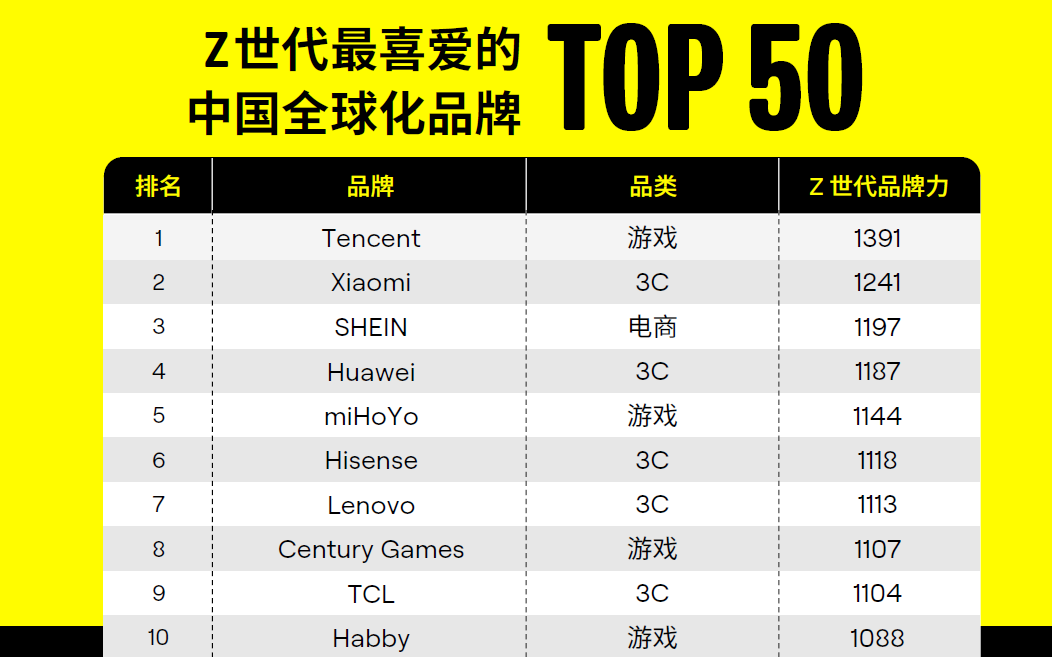
Z世代最喜爱的中国全球化品牌50强榜单前十名

腾讯、小米、SHEIN分列游戏、3C、电商品类第一

随着中国企业加速全球化进程,品牌目标已从销量增长转向打造跨文化、可持续并具有良好声誉的全球品牌。该榜单分析认为,作为“互联网原住民”,Z世代(出生于1997年至2012年间的人群)约占全球人口的25%,拥有全球视野、精通数字技术并具备文化影响力,注重数字场域中的兴趣体验与自我表达,正成为重塑全球消费市场的主力军。

此次榜单调研覆盖了包括欧洲、北美、中东等多个市场中Z世代的社交行为与态度,包括:消费者对品牌产生情感联结,认可其功能价值;消费者感知品牌在所属品类中的特色,承认其品牌特性;消费者在产生需求时,会将品牌作为首选。结果显示,相比其他世代消费群体,Z世代对跨境品牌严苛挑剔,对中国品牌接受度最高。“Z世代最喜爱的中国全球化品牌50强”榜单排名前三的分别为腾讯、小米和SHEIN,腾讯在游戏品类、小米在3C品类、SHEIN在电商品类排行榜分列第一。

其中,9家游戏品牌⼊选“Z世代最喜爱的中国全球化品牌榜单”,腾讯游戏位居榜首。腾讯游戏近年来加快全球化步伐,海外市场收入持续增长,财报数据显示,今年二季度在游戏业务收入连续四个季度刷新历史高点的同时,国际市场游戏收入占比已超30%。排行榜调研分析认为,腾讯游戏以行业领先的游戏IP为切⼊点,通过全球公认的IP自然吸引Z世代流量;通过团队协作游戏,打造沉浸式游戏社区,玩家可以交流游戏战绩,形成天然的年轻人“社交”场域;社交媒体上线AR滤镜,用户打开相机即可“佩戴头盔”,丰富游戏体验。

以小米为代表的26家3C品牌跻身“Z世代最喜爱的中国全球化品牌榜单”。调研分析认为,这些3C品牌能够脱颖而出,一是质优价宜,精准契合Z世代“价值优先”的消费理念,在提供丰富功能的同时,避免过高定价;二是以聚焦Z世代需求的创新保持领先优势,持续吸引追求新鲜感的科技爱好者;三是突破单一设备局限,构建互联互通的智能生态,与当地Z世代建立深度关联。

以SHEIN、速卖通等为代表的7家电商品牌跻身“Z世代最喜爱的中国全球化品牌榜单”,超越单纯搜索模式、融入轻松有趣的短视频内容营销,以及更加便捷沉浸以及社交购物的线上购物体验,让这些中国全球化电商品牌获得了Z世代消费者的青睐。

SHEIN以“按需时尚”重塑产业新格局

品牌力本质上是产品力和可持续发展竞争力的显现。在此次上榜名单中,近年来迅速崛起的跨境电商和时尚产业龙头SHEIN格外引人注目。

在其创新的“小单快反”柔性供应链模式下,SHEIN作为“链主”企业持续以技术创新和“链式改造”推进国内产业链的数字化、智能化、绿色化升级,从而以“按需时尚”重塑产业格局。

通过对供应商的数字化赋能,SHEIN构建了一个可以实时洞察流行趋势、并根据市场和消费者需要来安排和决定生产供应的模式,将库存率降至低个位数,从源头上破解了行业的“高库存”顽疾,并可以为全球消费者提供丰富、多元且高性价比的时尚产品。SHEIN还根据供应商生产、管理中的需求与难点,不断研发先进的技术工具、设备和工艺,并同时向供应商提供全方位的培训支持,还从产品全生命周期和全流程中推动供应商绿色减碳。

自2023年正式宣布推出平台模式以来,SHEIN还将创新的“柔性按需”供应链经验也在复制裂变到更多产业带上。截至今年6月,SHEIN平台已广泛吸引全国近400城市产业带包括服装品类在内的全品类第三方卖家与品牌入驻,SHEIN平台也成为孕育更多领域“跨境大卖”的新沃土。

同时,依托广州作为国际商贸中心的物流枢纽能力和产业配套基础,SHEIN累计将投资超150亿元,持续深耕构建以广州为中心,覆盖肇庆、佛山、江门等城市的智慧供应链体系。通过超百亿投资建设和上下游供应商的赋能,带动传统行业的数字化、智能化、绿色化变革,助力更多中国制造持续高效拓展全球市场。

注:文/龚作仁,文章来源:Laborer,本文为作者独立观点,不代表亿邦动力立场。

【版权提示】亿邦动力倡导尊重与保护知识产权。未经许可,任何人不得复制、转载、或以其他方式使用本网站的内容。如发现本站文章存在版权问题,烦请提供版权疑问、身份证明、版权证明、联系方式等发邮件至run@ebrun.com,我们将及时沟通与处理。

已点赞

+1

{{ praise_text }}

好文章,值得被更多人看到

FAQ回顾

Z世代最喜爱的中国全球化品牌50强榜单前三名是哪些品牌?

榜单前三名分别是腾讯、小米和SHEIN。腾讯在游戏品类排名第一,小米在3C品类排名第一,SHEIN在电商品类排名第一。该调研覆盖欧洲、北美、中东等市场的Z世代消费群体。

SHEIN的“按需时尚”模式如何解决行业高库存问题?

SHEIN通过“小单快反”柔性供应链和数字化赋能,实时洞察流行趋势并按需生产,将库存率降至低个位数。该模式从源头上破解了服装行业的高库存顽疾,并提供高性价比的时尚产品。

SHEIN平台模式目前覆盖了多少中国产业带?

截至今年6月,SHEIN平台已吸引全国近400个城市的产业带卖家入驻,涵盖服装等全品类。平台以广州为中心投资超150亿元建设智慧供应链体系,覆盖肇庆、佛山、江门等城市。

广告

下一篇

跨境电商资源对接

《全球跨境电商服务商资源手册》第二期手册现已发布,触达更多资源,了解跨境服务商信息,欢迎点击链接下载。

了解详情

独家 | 抖音内测“粉丝圈子” 给达人拉私域?

基于强关系的社交网络,才是流量生生不息的活水。抖音对社交赛道的布局可能远不止于此,平台或将寻找更多更稳定、更具粘性的新支点。










