• 亿邦公众号
    • APP下载

天猫为服饰新商划双11重点:节奏前置 第一波或将决定成败

作者:石航千 文章来源:亿邦动力

2024-09-11 11:53

作者:石航千 文章来源:亿邦动力

2024-09-11 11:53

邦小白快读

EN
全文速览

天猫双11备战策略强调节奏前置和第一波核心发力,实操干货包括数据支撑和行动指南。

1. 双11重要性:占品牌全年生意20%以上,是年度关键节点,需提前规划。

2. All in第一波策略:8-10月蓄水期用户占比超95%,第一波购买占全周期60%以上,建议9月前置盘点爆款库存,确保提供最佳货品和权益以锁定胜局。

3. 流量高效应用:平台重点扶持搜索爆款和新趋品,通过广告激励政策降低经营成本,实现“好商品获好流量”。

4. 爆款准备机制:结合区域温差,采用“四季爆款+冷暖冬货品”双货盘策略,把握开门红爆发机会,同时保证狂欢日库存充足。

5. 多渠道共振增长:平台在直播货架联动、百亿补贴、淘宝秒杀、淘客等多场域提供补贴和流量增量,辅助销售提升。

6. 数据案例参考:新品牌增长显著,如8个成交破亿新品牌增速超170%,20多个破5000万增速50%以上,超100个破千万增速100%以上,显示行业高潜力。

天猫双11策略为品牌商提供营销、渠道和消费趋势洞察,助力品牌建设和产品研发。

1. 品牌营销机会:平台节奏前置,建议9月蓄水期聚焦高消费用户,通过第一波提供最佳权益,强化品牌吸引力;中间波段新增降温等细分场景营销节点,拓展成交机会。

2. 渠道建设启示:多渠道共振策略如直播货架联动、百亿补贴等,可整合资源提升品牌曝光;平台扶持搜索爆款和新趋品,帮助优化渠道布局和定价竞争。

3. 消费趋势观察:区域温差人货匹配机制反映用户行为变化,双货盘策略(四季爆款+冷暖冬货品)指导产品研发,适应市场需求。

4. 数据支撑:新品牌高增长案例(如破亿品牌增速超170%)揭示消费趋势赛道,包括品牌店铺矩阵、直播内容、潮流设计师和产业趋势,为创新提供方向。

天猫双11政策解读聚焦增长机会、风险提示和扶持政策,卖家可从中学习应对措施和商业模式。

1. 政策支持:平台提供流量扶持(搜索爆款和新趋品重点扶持)和广告激励,降低经营成本;多渠道共振如直播、秒杀等提供补贴和增量,辅助大促增长。

2. 增长机会:第一波购买占60%以上,决定双11成败,建议前置蓄水和库存盘点;中间波段新增降温等营销节点,创造更多成交机会。

3. 风险与应对:节奏前置强调9月行动,避免库存不足风险;双货盘机制(四季爆款+冷暖冬货品)帮助应对区域温差需求波动。

4. 可学习点:新品牌高增长数据(如超100个破千万增速100%)显示合作方式,如品牌矩阵和直播内容赛道,卖家可借鉴最新商业模式。

5. 扶持政策:平台招商通过新商大会提供指导,鼓励卖家All in第一波,把握开门红爆发。

天猫双11策略为工厂揭示产品需求、商业机会和电商启示,指导生产和数字化转型。

1. 产品生产需求:结合区域温差,采用“四季爆款+冷暖冬货品”双货盘机制,需前置设计匹配市场需求,确保库存充足。

2. 商业机会洞察:新品牌高增长数据(如20多个破5000万增速50%以上)显示产业趋势赛道潜力,工厂可探索潮流设计师合作,开发创新产品。

3. 电商推进启示:节奏前置强调9月蓄水期盘点库存和孵化趋势品,工厂需优化供应链;平台多渠道支持(如直播联动)启示数字化整合,提升电商效率。

4. 数据支撑:增长案例如品牌店铺矩阵和产业趋势爆发,提供实际参考,工厂可从中识别机会点。

天猫双11策略反映行业趋势、客户痛点和解决方案,服务商可聚焦新技术应用和增长洞察。

1. 行业发展趋势:双11节奏前置和第一波核心策略(占成交60%)成为新动向;新品牌高增长(如8个破亿增速超170%)显示直播内容等赛道爆发。

2. 客户痛点分析:商家面临库存管理风险(需前置盘点)和流量成本压力,平台数据揭示蓄水期用户占比95%的挑战。

3. 解决方案参考:平台提供流量扶持(搜索爆款和新趋品重点支持)和广告激励,降低经营成本;多渠道共振如百亿补贴和淘客,提供增量方案。

4. 数据洞察:新品牌案例(超100个破千万增速100%)帮助识别痛点,服务商可开发定制工具支持电商优化。

天猫双11策略详述平台最新做法、招商需求和运营管理,强调风险规避。

1. 平台最新做法:节奏前置,All in第一波(用户占比60%),提供流量扶持搜索爆款和新趋品;多渠道共振如直播货架联动、秒杀等,推出补贴和激励政策。

2. 招商与需求:通过新商大会吸引卖家,强调第一波决定成败(占全年20%生意),需前置蓄水;中间波段新增营销节点(如降温布局),创造更多合作机会。

3. 运营管理指南:采用双货盘机制(四季爆款+冷暖冬货品)匹配区域温差,优化库存管理;数据支撑新品牌增长(如产业趋势赛道),指导资源分配。

4. 风险规避:强调9月行动避免库存不足,第一波重点策略帮助平台规避销售波动风险。

天猫双11策略揭示产业新动向、商业模式和政策启示,研究者可分析数据案例。

1. 产业新动向:节奏前置成为核心,第一波购买占60%以上,显示消费行为变化;新品牌高增长(如潮流设计师赛道爆发)反映行业创新趋势。

2. 商业模式分析:多渠道共振策略(直播、百亿补贴等)整合资源;双货盘机制(四季爆款+冷暖冬货品)优化供应链,提供可复制模型。

3. 政策启示:平台扶持政策(流量重点扶持和广告激励)启示降低经营成本;新商大会数据(如超100个破千万增速100%)支持政策建议,如鼓励细分场景营销。

4. 数据研究:新品牌案例(8个破亿增速超170%)揭示增长赛道,包括品牌矩阵和产业趋势,为学术研究提供实证基础。

声明:快读内容全程由AI生成,请注意甄别信息。如您发现问题,请发送邮件至 run@ebrun.com 。

我是 品牌商 卖家 工厂 服务商 平台商 研究者 帮我再读一遍。

Quick Summary

Tmall's Double 11 strategy emphasizes front-loading preparations and focusing efforts on the first sales wave, with practical guidance on data-backed actions.

1. Double 11's importance: It accounts for over 20% of a brand's annual revenue, making it a crucial event requiring early planning.

2. All-in on the first wave: Over 95% of users are acquired during the August-October priming period, with the first wave contributing over 60% of total sales. Brands should inventory bestsellers by September to secure optimal products and benefits for early success.

3. Efficient traffic utilization: The platform prioritizes search-driven bestsellers and trending products, offering ad incentives to lower operational costs and ensure quality products gain visibility.

4. Bestseller preparation: A dual inventory strategy ("year-round bestsellers + seasonal winter items") accounts for regional temperature variations, maximizing opening-day sales while ensuring sufficient stock for the main event.

5. Multi-channel growth: Subsidies and traffic boosts are provided across live-streaming integrations, billion-dollar subsidies, flash sales, and affiliate marketing to drive sales.

6. Data insights: New brands show explosive growth—e.g., 8 brands exceeding ¥100M in sales grew over 170%, 20+ brands above ¥50M grew 50%+, and 100+ brands surpassing ¥10M grew 100%+, highlighting high industry potential.

Tmall's Double 11 strategy offers brands insights into marketing, channel optimization, and consumer trends to strengthen brand building and product development.

1. Marketing opportunities: With the front-loaded timeline, focus on high-value users during September’s priming phase. Offer premium benefits in the first wave to enhance brand appeal, while leveraging new mid-campaign nodes (e.g., seasonal transitions) to expand sales opportunities.

2. Channel optimization: Integrate multi-channel strategies like live-streaming synergy and billion-dollar subsidies to boost exposure. Platform support for search-driven bestsellers and trending products aids in refining channel mix and competitive pricing.

3. Consumer trends: Regional demand variations inform product assortments. The dual inventory strategy (year-round bestsellers + seasonal items) guides R&D to align with market needs.

4. Data-backed insights: High-growth cases (e.g., ¥100M+ brands growing >170%) reveal emerging trends in brand portfolios, live-streaming content, designer collaborations, and industrial shifts, providing direction for innovation.

Tmall's Double 11 policy analysis highlights growth levers, risk mitigation, and support mechanisms, offering actionable strategies for sellers.

1. Platform support: Traffic prioritization for search bestsellers and trending products, coupled with ad incentives, reduces operational costs. Multi-channel boosts (e.g., live-streaming, flash sales) provide subsidies and incremental traffic.

2. Growth opportunities: The first wave (60%+ of sales) is critical. Sellers should prime audiences and stockpile early. Mid-campaign nodes (e.g., weather-based promotions) create additional conversion windows.

3. Risk management: Front-loaded actions in September prevent stockouts. The dual inventory system (year-round + seasonal items) mitigates regional demand fluctuations.

4. Learnings: High-growth new brands (e.g., 100+ with ¥10M+ sales growing >100%) demonstrate effective models like brand matrices and live-streaming strategies for sellers to emulate.

5. Support policies: New merchant conferences guide sellers to prioritize the first wave and capitalize on opening-day momentum.

Tmall's Double 11 strategy informs factories about product demand, commercial opportunities, and e-commerce integration to guide production and digital transformation.

1. Production planning: The dual inventory approach (year-round bestsellers + seasonal items) requires early design alignment with regional demand to ensure adequate stock.

2. Business opportunities: New brands’ rapid growth (e.g., 20+ brands exceeding ¥50M with 50%+ growth) signals potential in trend-driven categories, encouraging factories to explore collaborations with designers or innovate products.

3. E-commerce integration: The September priming period underscores the need for inventory optimization and trend incubation. Multi-channel support (e.g., live-streaming) highlights opportunities for supply chain digitization.

4. Data reference: Case studies on brand portfolios and industrial trends offer practical benchmarks for identifying growth areas.

Tmall's Double 11 strategy reflects industry shifts, merchant pain points, and solutions, guiding service providers on technology applications and growth insights.

1. Industry trends: Front-loaded timelines and first-wave focus (60%+ of sales) are key developments. New brands’ explosive growth (e.g., 8 brands surpassing ¥100M with >170% growth) indicates opportunities in live-streaming and content-driven categories.

2. Merchant challenges: Inventory management risks (requiring early stock checks) and rising traffic costs are critical, with data showing 95% of user engagement occurring pre-event.

3. Solution frameworks: Platform support for search bestsellers/trending products and ad incentives lower costs. Multi-channel initiatives (e.g., subsidies, affiliate marketing) offer incremental growth avenues.

4. Data insights: High-growth cases (100+ brands exceeding ¥10M with 100%+ growth) help identify pain points, enabling service providers to develop tailored tools for e-commerce optimization.

Tmall's Double 11 strategy details platform innovations, merchant recruitment needs, and operational guidelines, emphasizing risk avoidance.

1. Platform initiatives: Front-loaded timelines prioritize the first wave (60%+ of sales), with traffic support for search bestsellers and trending items. Multi-channel integrations (e.g., live-streaming, flash sales) offer subsidies and incentives.

2. Merchant recruitment: New merchant conferences emphasize the first wave’s decisive impact (20%+ of annual sales), urging early audience priming. Mid-campaign nodes (e.g., seasonal promotions) create partnership opportunities.

3. Operational management: The dual inventory system (year-round + seasonal items) aligns with regional demand, optimizing stock management. Data on new brands’ growth (e.g., trend-driven categories) informs resource allocation.

4. Risk mitigation: September actions prevent stockouts, while first-wave focus helps platforms stabilize sales volatility.

Tmall's Double 11 strategy reveals industrial shifts, business models, and policy implications, providing researchers with data-rich case studies.

1. Industry dynamics: Front-loaded preparations and first-wave dominance (60%+ of sales) reflect evolving consumer behavior. New brands’ high growth (e.g., designer-led categories) signals innovation trends.

2. Business model analysis: Multi-channel resonance (live-streaming, subsidies) integrates resources efficiently. The dual inventory mechanism (year-round + seasonal items) offers a replicable supply chain model.

3. Policy insights: Platform support (traffic prioritization, ad incentives) demonstrates cost-reduction strategies. Data from merchant conferences (e.g., 100+ brands with ¥10M+ sales growing >100%) informs policy recommendations like niche scenario marketing.

4. Research data: Case studies (8 brands exceeding ¥100M with >170% growth) uncover growth drivers in brand ecosystems and industrial trends, providing empirical foundations for academic study.

Disclaimer: The "Quick Summary" content is entirely generated by AI. Please exercise discretion when interpreting the information. For issues or corrections, please email run@ebrun.com .

I am a Brand Seller Factory Service Provider Marketplace Seller Researcher Read it again.

【亿邦原创】9月11日消息,日前,天猫服饰举办了双11新商大会。“双11对品牌至关重要,成交大约会占到全年生意20%以上。”会上,天猫服饰策略中心新商负责人透露了今年双11商家们要重点关注的变化,并给出了备战策略指导。

2024年天猫双11,商家们需要重点关注四个方面:

第一,All in第一波。根据平台过往数据,8月到10月的蓄水人群占比双11用户超过95%,且第一波购买用户占比全周期超过60%。商家们要All in开门红第一波,注意高消费用户的前置蓄水,做好趋势品的前置孵化。

第二,高效应用付费和免费流量。平台将对搜索爆款和新趋品做重点扶持,“好商品”将获得“好流量”,同时平台也会在广告投放方面推出多项激励政策,帮助商家降低经营成本。

第三,用充足的爆款拉动销售。平台鼓励商家结合区域温差做人货匹配,采取“四季爆款+冷暖冬货品”双货盘机制,把握开门红爆发机会的同时,保证狂欢日库存。

第四,多渠道共振爆发。平台今年将在直播货架联动、百亿补贴、淘宝秒杀、淘客等多渠道等多场域为商家提供补贴和流量增量,辅助商家拉动大促增长。
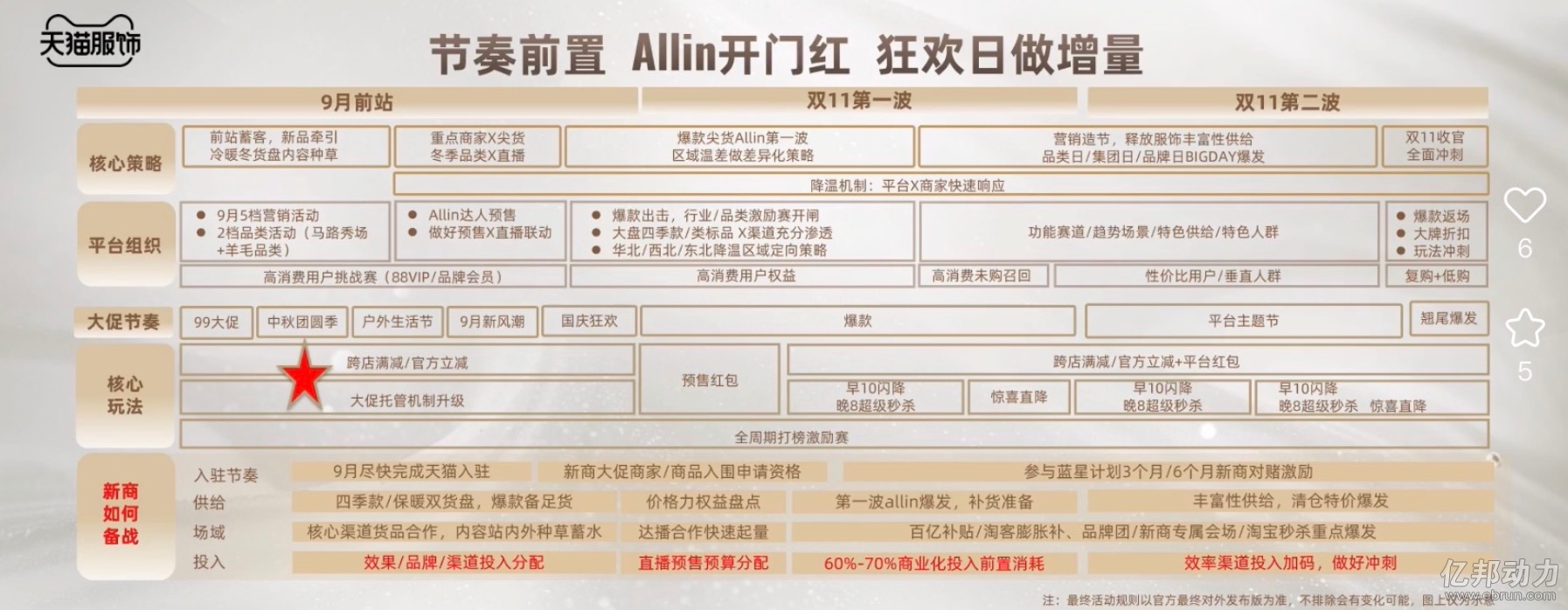
天猫为服饰新商提供的备战指南

“第一波的成败,大概率决定了这次双11最后的一个结果。”上述负责人强调,今年天猫双11的节奏还会进一步前置,建议商家在9月蓄水期就对爆款库存进行前置盘点,保证在第一波将最好的货和最好的权益提供给消费者。

而相较于去年,平台今年也会在中间波段围绕细分人群场景制造更多营销节点,比如在多个降温波段都做布局,为新商提供给更多成交机会。

据介绍,2024上半年,新品牌在天猫的成长性已经有所体现。有8个成交破亿的新品牌增速超过170%;20多个成交破5000万的新品牌实现了50%及以上的增长;还有超100个成交破千万的新品牌增速超过100%。其中,品牌店铺矩阵、直播内容、潮流设计师、产业趋势四个赛道获得了爆发式的增长。

亿邦持续追踪报道该情报,如想了解更多与本文相关信息,请扫码关注作者微信。

【版权提示】亿邦动力倡导尊重与保护知识产权。未经许可,任何人不得复制、转载、或以其他方式使用本网站的内容。如发现本站文章存在版权问题,烦请提供版权疑问、身份证明、版权证明、联系方式等发邮件至run@ebrun.com,我们将及时沟通与处理。

已点赞

+1

{{ praise_text }}

好文章,值得被更多人看到

FAQ回顾

2024年天猫双11服饰新商需要重点关注哪些策略?

天猫服饰建议商家重点关注四方面:All in第一波销售,高效应用付费与免费流量,准备充足的爆款货品,以及利用直播、百亿补贴等多渠道实现共振爆发。

为什么天猫强调双11第一波销售至关重要?

根据平台数据,8月至10月蓄水人群占双11用户超95%,且第一波购买用户占比全周期超60%,因此第一波的成败大概率决定了双11的最终结果。

天猫为服饰新商提供了哪些流量扶持政策?

平台将对搜索爆款和新趋势品重点扶持,通过“好商品”获得“好流量”,并推出广告投放激励政策,帮助商家降低经营成本,高效应用付费和免费流量。

广告

下一篇

征集报名《品牌数字化服务商资源手册》

《品牌数字化服务商资源手册》展示数字化服务商风采,亿邦全年零售大会通发,触达更多资源,马上加入!

马上入驻

入驻澳洲顶级亚洲超市 盒马自有品牌出海南半球

据了解,盒马也是首个将其自有品牌产品打入南半球市场的中国零售品牌。