



• 亿邦公众号
    • APP下载

独立站评价、品牌出海基地评价有了新标准!跨境电商两项团体标准发布

作者:龚作仁 文章来源:Laborer

2024-04-22 10:05

作者:龚作仁 文章来源:Laborer

2024-04-22 10:05

邦小白快读

EN
全文速览

本文核心内容是杭州跨境电子商务协会发布两项跨境电商领域全新团体标准,填补了该领域行业空白,自发布之日起实施,将推动品牌出海和跨境电商行业健康发展,核心干货如下

1. 当前国内跨境电商独立站赛道增长迅猛,公开数据显示2016年市场规模0.2万亿元,2020年增长至0.8万亿元,预计到2025年市场份额将从2020年的25%上升至41%,未来三年独立站卖家数量将超过50万,已经成为跨境电商核心渠道。

2. 两项标准分别为《跨境电子商务独立站评价规范》和《跨境电子商务品牌出海基地评价规范》,都明确了对应评价的原则、指标、方法和流程,可用于主体自评、同行对比和第三方评价,能够帮助相关主体提升自身经营和服务水平。

本次两项团体标准的出台,为跨境出海品牌提供了明确的行业规范指引,也反映了当下跨境出海的发展趋势,核心干货如下

1. 行业发展趋势:当前独立站已经成为跨境电商的核心增长渠道,市场占比持续快速提升,越来越多企业放弃传统OEM贴牌模式,转向打造自主品牌、搭建自有海外渠道,品牌化出海已经成为行业主流发展方向。

2. 自身运营优化:品牌商做独立站出海,可以依托《跨境电子商务独立站评价规范》开展自评,对标行业标准优化独立站运营管理,不断提升独立站运营质量和经营水平,也可以借助第三方按标准出具的评价提升自身品牌可信度。

3. 资源对接方面:品牌出海基地有了统一评价标准,品牌商可以选择符合标准的优质品牌出海基地获取配套服务,提升出海效率,降低出海成本。

本次发布的两项团体标准符合国家外贸新业态新模式发展的政策要求,给跨境电商卖家指明了发展方向,也带来了明确的机会,核心干货如下

1. 赛道机会:当前独立站是跨境电商领域核心增长赛道,预计2025年市场份额将升至41%,未来三年卖家数量将突破50万,市场空间大,是值得卖家布局的新增量赛道。

2. 运营提升:本次发布的独立站评价规范明确了评价指标、方法和流程,卖家可以按照标准开展自评,对标同行发现自身不足,针对性优化独立站运营,提升整体经营水平。

3. 配套支持:品牌出海基地有了统一的评价规范,卖家可以优先选择符合标准的优质品牌出海基地,获得更规范可靠的出海配套服务,降低自身出海运营的风险和成本。

两项跨境电商新标准的出台反映了行业发展的新趋势,给工厂转型出海带来了明确的机会和启示,核心干货如下

1. 转型机会:当前越来越多跨境商家放弃传统OEM贴牌模式,转向打造自主品牌出海,独立站渠道占比持续快速攀升,工厂可以抓住这一趋势,从代加工向自主品牌出海转型,获取更高的利润空间,打造长期竞争力。

2. 运营指引:如果工厂布局独立站出海,可以按照本次发布的《跨境电子商务独立站评价规范》开展自评,对标行业标准优化自身运营,少走转型弯路,更快提升独立站经营水平。

3. 转型支持:当前品牌出海基地已经有了统一的评价标准,工厂做品牌出海转型,可以选择符合标准的优质出海基地,获得配套的运营、资源支持,推进自身数字化和电商转型,降低转型失败风险。

本次两项团体标准的发布,明确了跨境电商行业的发展方向,也给跨境服务商带来了新的业务机会,核心干货如下

1. 行业发展趋势:当前跨境电商独立站赛道增长迅猛,预计2025年市场份额将达到41%,未来三年卖家数量将超过50万,同时品牌出海已经成为行业主流方向,市场对规范的独立站评价、品牌出海运营服务的需求持续增长。

2. 客户需求痛点:此前独立站评价和品牌出海基地评价都没有统一行业标准,卖家和基地都缺乏明确的对标优化依据,服务商可以依托本次发布的新标准,开发对应评价、咨询、运营优化服务,满足客户自评提升的需求。

3. 自身业务升级:服务商可以将新标准融入自身服务体系,提升服务的规范性和权威性,更容易获得客户信任,拓展自身业务边界,抓住品牌出海和独立站增长的行业红利。

两项团体标准的发布,为跨境电商平台的运营发展指明了新方向,也明确了行业的最新需求,核心干货如下

1. 行业需求方向:当前独立站运营和品牌出海是跨境电商的核心增长方向,行业此前缺乏统一的评价规范,平台可以对接标准要求,优化对入驻卖家和出海商家的管理服务,提升平台整体运营水平,符合国家发展外贸新业态的政策要求。

2. 招商优化方向:平台可以依托新标准建立筛选机制,引入符合标准的优质独立站卖家、品牌出海商家入驻,提升平台商家整体质量,打造差异化的竞争优势,吸引更多精准流量。

3. 风险规避:统一的评价标准可以帮助平台筛选合规优质的商家,淘汰不符合规范的经营主体,规范平台内行业秩序,降低平台的运营风险,同时也能提升平台整体服务口碑,获得更多商家和用户的信任。

本次两项团体标准的发布是跨境电商行业的重要产业新动向,填补了细分领域的空白,对产业研究有较高的参考价值,核心干货如下

1. 产业发展新动向:当前中国跨境电商独立站赛道增长迅猛,市场份额持续快速攀升,品牌出海已经成为行业主流方向,替代传统的OEM贴牌模式,杭州作为跨境电商综试区已经率先认定了12个品牌出海基地,先行推进自主品牌培育。

2. 行业规范进展:此前国内独立站评价、品牌出海基地评价都没有统一的行业标准,本次发布的两项团体标准填补了该领域的空白,明确了两类主体的评价原则、指标、方法和流程,对推动行业规范化发展有重要意义。

3. 政策研究参考:两项标准符合国家加快发展外贸新业态新模式的政策要求,对提升跨境电商品牌出海服务能级、推动综试区建设有重要实践价值,也为后续行业相关法规政策的完善提供了实践基础。

声明:快读内容全程由AI生成,请注意甄别信息。如您发现问题,请发送邮件至 run@ebrun.com 。

我是 品牌商 卖家 工厂 服务商 平台商 研究者 帮我再读一遍。

Quick Summary

This article highlights the release of two new group standards for the cross-border e-commerce industry by the Hangzhou Cross-Border E-Commerce Association, which fills gaps in domestic industry regulations and takes effect immediately, expected to accelerate brand global expansion and drive the healthy development of the sector. Key takeaways are as follows:

1. China’s cross-border DTC independent store sector is growing rapidly. Public data shows the market size expanded from RMB 0.2 trillion in 2016 to RMB 0.8 trillion in 2020, and its share of the overall cross-border e-commerce market is projected to rise from 25% in 2020 to 41% by 2025. The number of independent store sellers will exceed 500,000 within three years, making independent stores a core channel for cross-border e-commerce.

2. The two standards are *Evaluation Specification for Cross-Border E-Commerce Independent Stores* and *Evaluation Specification for Cross-Border E-Commerce Brand Global Expansion Hubs*. Both clarify the principles, indicators, methods and processes for relevant evaluations, applicable for self-assessment, peer benchmarking and third-party certification, and help relevant players improve their operations and service capabilities.

The release of these two new group standards provides clear industry guidance for cross-border brands going global, and reflects the latest development trends of the industry. Key takeaways are as follows:

1. Industry trend: Independent stores have become a core growth channel for cross-border e-commerce, with their market share rising rapidly. More and more companies are abandoning the traditional OEM model to build their own independent brands and own overseas channels. Branded global expansion has become the mainstream direction of the industry.

2. Operation optimization: Brands building independent stores for global expansion can use *Evaluation Specification for Cross-Border E-Commerce Independent Stores* for self-assessment, optimize their independent store operation and management against industry standards, continuously improve operation quality and performance. They can also boost brand credibility through third-party evaluation conducted in accordance with the standards.

3. Resource matching: With a unified evaluation standard for brand global expansion hubs, brands can select qualified high-quality hubs to access supporting services, improve global expansion efficiency and reduce related costs.

The two newly released group standards align with China’s policy requirements for developing new forms and models of foreign trade, clarify the development direction for cross-border e-commerce sellers and bring clear opportunities. Key takeaways are as follows:

1. Track opportunity: Independent stores are currently the core growth track in cross-border e-commerce, with their market share projected to reach 41% by 2025 and the number of sellers exceeding 500,000 within three years. The large market space makes it a valuable new growth track for sellers to布局.

2. Operation improvement: The released independent store evaluation specification clarifies evaluation indicators, methods and processes. Sellers can conduct self-assessment against the standard, identify gaps compared with peers, optimize independent store operations in a targeted manner, and improve overall operational performance.

3. Supporting services: With a unified evaluation standard for brand global expansion hubs, sellers can prioritize qualified high-quality hubs to access more standardized and reliable supporting services for global expansion, and reduce operational risks and costs.

The release of two new cross-border e-commerce standards reflects new industry trends, and brings clear opportunities and insights for factories looking to transform through global expansion. Key takeaways are as follows:

1. Transformation opportunity: More and more cross-border businesses are abandoning the traditional OEM model to build their own brands for global expansion, while the market share of independent stores is climbing rapidly. Factories can capitalize on this trend to transform from OEM processing to independent branded global expansion, capture higher profit margins and build long-term competitiveness.

2. Operation guidance: For factories布局 independent stores for global expansion, they can conduct self-assessment based on the newly released *Evaluation Specification for Cross-Border E-Commerce Independent Stores*, optimize operations against industry standards to avoid common transformation missteps and improve independent store performance faster.

3. Transformation support: With a unified evaluation standard for brand global expansion hubs in place, factories undergoing branded global expansion transformation can select qualified high-quality hubs to access supporting operations and resources to advance digital and e-commerce transformation, and reduce the risk of transformation failure.

The release of the two group standards clarifies the development direction of the cross-border e-commerce industry, and brings new business opportunities for cross-border service providers. Key takeaways are as follows:

1. Industry trend: The cross-border e-commerce independent store sector is growing rapidly, with its market share projected to reach 41% by 2025 and the number of sellers exceeding 500,000 within three years. Meanwhile, branded global expansion has become the industry mainstream, driving sustained growth in market demand for standardized independent store evaluation and branded global expansion operation services.

2. Addressing customer pain points: Before this release, there were no unified industry standards for independent store evaluation or brand global expansion hub evaluation, leaving sellers and hubs without clear benchmarks for optimization. Service providers can leverage the new standards to develop corresponding evaluation, consulting and operation optimization services to meet customers’ demand for self-assessment and improvement.

3. Own business upgrade: Service providers can integrate the new standards into their own service systems to improve the standardization and authority of their services, build customer trust more easily, expand business boundaries, and capture the industry dividends brought by the growth of branded global expansion and independent stores.

The release of the two group standards clarifies the new direction for the operation and development of cross-border e-commerce platforms, and outlines the latest industry demands. Key takeaways are as follows:

1. Aligning with industry demand: Independent store operation and branded global expansion are currently the core growth directions of cross-border e-commerce, but the industry lacked unified evaluation standards before this release. Platforms can align their management and services for onboarded sellers and global expansion-focused merchants with the standard requirements to improve overall platform operation performance, in line with national policy requirements for developing new forms of foreign trade.

2. Optimizing merchant recruitment: Platforms can establish a screening mechanism based on the new standards to onboard qualified high-quality independent store sellers and branded global expansion merchants, improve the overall quality of platform merchants, build differentiated competitive advantages and attract more targeted traffic.

3. Risk mitigation: Unified evaluation standards help platforms screen compliant and high-quality merchants, phase out non-compliant operators, standardize industry order on the platform, reduce platform operational risks, and improve the platform’s overall service reputation to win more trust from merchants and end users.

The release of the two group standards is an important new industry development in the cross-border e-commerce sector, filling gaps in the niche field and offers high reference value for industry research. Key takeaways are as follows:

1. New industry development trends: China’s cross-border e-commerce independent store sector is growing rapidly, with market share rising continuously, and branded global expansion has become the industry mainstream that is replacing the traditional OEM model. As a national cross-border e-commerce comprehensive pilot zone, Hangzhou has already approved 12 branded global expansion hubs to proactively advance independent brand cultivation.

2. Progress on industry regulation: Before this release, there were no unified industry standards for domestic independent store evaluation or brand global expansion hub evaluation. The two newly released group standards fill this gap, clarifying the evaluation principles, indicators, methods and processes for the two types of entities, which is of great significance for driving standardized industry development.

3. Reference for policy research: The two standards align with national policy requirements to accelerate the development of new forms and models of foreign trade. They offer important practical value for improving the service capacity for cross-border e-commerce brands going global and advancing the construction of cross-border e-commerce comprehensive pilot zones, and also provide a practical foundation for the subsequent improvement of industry-related regulations and policies.

Disclaimer: The "Quick Summary" content is entirely generated by AI. Please exercise discretion when interpreting the information. For issues or corrections, please email run@ebrun.com .

I am a Brand Seller Factory Service Provider Marketplace Seller Researcher Read it again.

近日,杭州跨境电子商务协会发布《跨境电子商务独立站评价规范》(T/HCEA 0002—2024)、《跨境电子商务品牌出海基地评价规范》(T/HCEA 0003—2024)两项团体标准,并自发布之日起实施。《跨境电子商务独立站评价规范》标准符合国家加快发展外贸新业态新模式政策要求,具有先进性和可行性;《跨境电子商务品牌出海基地评价规范》标准有助于规范跨境电子商务品牌出海基地评价、提升服务质量,具有较强的可行性和操作性;这两项标准的发布填补了该领域的行业空白,进一步推动品牌出海,对促进跨境电商行业健康发展、提升国际贸易便利化水平具有重要意义。
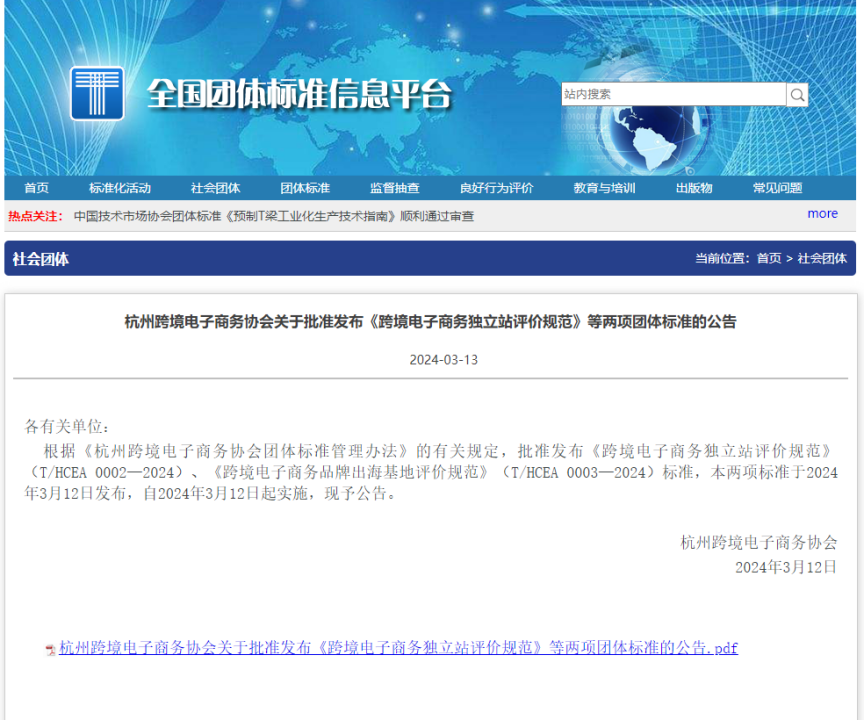
《跨境电子商务独立站评价规范》

据统计,2016年中国跨境电商独立站市场规模为0.2万亿元,2020年为0.8万亿元;2021年独立站有20万个左右,预计到2025年市场份额将从2020年的25%上升至41%,独立站已经成为跨境电商的重要渠道。据预测,未来三年中国独立站卖家数量将超过50万。

《跨境电子商务独立站评价规范》标准确立了对跨境电子商务独立站评价的原则、指标,描述了跨境电子商务独立站评价的方法和流程;适用于跨境电子商务独立站开展自身管理和同行业比较评价活动,以及第三方机构评价活动。通过制定跨境电子商务独立站评价标准,指导独立站通过自评和同行比较不断提升质量,并为第三方评价提供标准依据,提升跨境电子商务独立站经营水平,具有积极意义。

主要起草单位:浙江省标准化研究院、杭州市标准化研究院(杭州标准化国际交流中心)、杭州跨境电子商务协会、浙江沐家家居股份有限公司、数贸跨境电商服务(杭州)有限公司。

主要起草人:宋丽红、张胜权、丁凯、潘凯凌、林雯雯、陈璐、李岚、洪郡璜、杨君。

《跨境电子商务品牌出海基地评价规范》

随着跨境电商的发展,越来越多企业意识到品牌的重要性。开始摒弃传统OEM贴牌模式,构建自己的海外销售渠道。在此发展的基础上,应当构建跨境电商品牌出海基地标准体系,促进跨境电商品牌出海的可持续发展。为更好支持跨境电商品牌出海,推动国内国外双循环发展,提升杭州综试区服务能级,树立品牌出海标杆,2022年杭州市综试办组织认定了12个中国(杭州)跨境电子商务综合试验区跨境电商品牌出海基地,为加快自主品牌培育、推动跨境电商高质量发展夯实了基础。

《跨境电子商务品牌出海基地评价规范》标准确立了对跨境电子商务品牌出海基地评价的原则、指标,描述了跨境电子商务品牌出海基地评价的方法和流程;适用于跨境电子商务品牌出海基地自评和第三方评价。通过制定跨境电子商务品牌出海基地评价标准,为第三方评价提供标准依据,并指导基地开展自评,提升跨境电子商务品牌出海基地服务和管理水平,具有积极意义。

主要起草单位:浙江省标准化研究院、杭州市标准化研究院(杭州标准化国际交流中心)、杭州跨境电子商务协会、杭州起梦科技有限公司、数贸跨境电商服务(杭州)有限公司、杭州数贸港运营管理有限公司、广州易海创腾信息科技有限公司。

主要起草人:宋丽红、张胜权、丁凯、潘凯凌、林雯雯、陈璐、李岚、洪郡璜、刘波、施力、王志龙。

注:文/龚作仁,文章来源:Laborer,本文为作者独立观点,不代表亿邦动力立场。

【版权提示】亿邦动力倡导尊重与保护知识产权。未经许可,任何人不得复制、转载、或以其他方式使用本网站的内容。如发现本站文章存在版权问题,烦请提供版权疑问、身份证明、版权证明、联系方式等发邮件至run@ebrun.com,我们将及时沟通与处理。

已点赞

+1

{{ praise_text }}

好文章,值得被更多人看到

FAQ回顾

《跨境电子商务独立站评价规范》的主要内容是什么?

该标准确立了对跨境电商独立站评价的原则、指标,描述了评价方法和流程,适用于独立站自身管理、同行业比较以及第三方机构评价活动。

跨境电商独立站的市场规模和发展趋势如何?

中国跨境电商独立站市场规模从2016年的0.2万亿元增长至2020年的0.8万亿元,预计到2025年市场份额将从25%上升至41%,未来三年卖家数量将超过50万。

《跨境电子商务品牌出海基地评价规范》的发布有什么意义?

该标准有助于规范品牌出海基地评价、提升服务质量,为第三方评价提供依据,并指导基地开展自评,提升服务和管理水平。

广告

下一篇

跨境电商资源对接

《全球跨境电商服务商资源手册》第二期手册现已发布,触达更多资源,了解跨境服务商信息,欢迎点击链接下载。

了解详情

爆火的Kimi 抢了谁的生意?

Kimi是一个面向C端用户的智能助手,善于读长文、搜网页,主打功能包括整理资料、解读文件、辅助编程、文案写作等,被网友称为ChatGPT中文平替。

AI技术 未来零售

2024-04-22 09:50:24









