• 亿邦公众号
    • APP下载

中国版"星际之门"获全球关注!远景引领全球AI基建新范式

作者:龚作仁 文章来源:Laborer

2026-11-10 15:39

作者:龚作仁 文章来源:Laborer

2026-11-10 15:39

邦小白快读

EN
全文速览

总1:星河基地是文章最核心的项目信息。

1.项目计划规模3GW,堪比美国“星际之门”阿比林核心园区;一期120MW一年内交付,成本仅为美国五分之一,机房资源已被互联网巨头一抢而空。

2.SemiAnalysis今年9月实地探访乌兰察布星河基地,称其建设速度、项目规模、绿电比例和垂直整合能力令人惊叹。

总2:可操作的干货集中在绿电与供电技术。

1.项目通过自建风场、专用线路、储能系统和源网荷储模式,规划绿电覆盖比例超过80%,风电装机约为数据中心负荷1.75倍,配置4小时电池储能。

2.项目采用全球首套商业化运行的一体化SST 800V高压直流供电系统,将10kV交流电直接转换为800V直流电,省去低压变压器、UPS和整流环节。

3.项目不设中央冷水机组,液冷与风冷服务器共用一套水循环,利用乌兰察布寒冷气候自然散热;内蒙古已规划25GW数据中心项目,说明算电融合正从单点项目走向区域产业。

总1:远景借国际机构报告获得强品牌背书。

1.SemiAnalysis是知名半导体与AI产业研究机构,其首次公开披露中国数据中心实地探访,将星河基地称为中国版“星际之门”,并评价远景为新型能源系统集大成者、AIDC电力系统引领者。

2.报告用“令人惊叹”概括建设速度、项目规模、绿电比例和垂直整合能力,这种第三方评价可转化为品牌信任资产。

总2:产品与定价竞争力支撑品牌定位。

1.品牌叙事可突出算电融合和全链路垂直整合:自建风场、专用线路、储能系统、低压配电、800V直流架构和预制化变电站,角色横跨制造商、设计集成商与开发商。

2.成本仅为美国五分之一、一期一年内交付、机房被互联网巨头一抢而空,说明其产品研发和交付能力已获大客户验证。

3.全球首套商业化SST 800V高压直流系统、源网荷储绿电覆盖超80%,可作为面向AI数据中心客户的高端产品卖点。

总1:增长市场与需求变化明确。

1.星河基地计划3GW,一期120MW一年内交付,机房资源被互联网巨头一抢而空;内蒙古已规划25GW数据中心项目,显示AI算力基础设施和绿电配套存在持续放大的市场机会。

2.需求从单纯机房转向算电融合,绿电覆盖规划超80%,需要风场、储能、专用线路、SST 800V直流、预制化变电站、液冷风冷等环节协同。

总2:可学习模式与合作切入点。

1.可学习远景垂直整合和源网荷储:选址风力资源更优场址,风电装机约为负荷1.75倍,配4小时电池储能转移富余电力;用天机气象大模型预测风电出力,用天枢能源大模型调度储能。

2.合作方式上,制造商、设计集成商与开发商三重身份意味着设备供应、系统集成、工程建设、能源调度和运维都有切入空间;成本仅为美国五分之一,提示低成本快速交付是竞争关键。

3.竞争提示:大客户已抢先锁定机房资源,后来者需更早锁定绿电、设备和客户。

总1:产品生产和设计需求集中在新能源与AIDC电力系统。

1.星河基地需要自建风电场、专用线路、储能系统、低压配电、800V直流架构和预制化变电站,并采用全球首套商业化运行的一体化SST 800V高压直流供电系统,将10kV交流电直接转换为800V直流电,省去低压变压器、UPS和整流环节。

2.散热设计不设中央冷水机组,液冷与风冷服务器共用一套水循环,利用乌兰察布寒冷气候自然散热,对液冷、风冷、水循环和机房结构件提出配套设计需求。

总2:商业机会与数字化启示。

1.项目计划规模3GW、一期120MW,内蒙古已规划25GW数据中心项目,风电、储能、SST、预制化变电站、直流配电和液冷设备存在订单机会;成本仅为美国五分之一,要求工厂具备高性价比和快速交付能力。

2.数字化上,天机物理AI气象大模型预测风速、风向和风电出力,天枢能源大模型统筹储能充放,说明生产制造企业可借助AI能源管理提升绿电利用和系统协同。

3.远景横跨制造商、设计集成商与开发商,工厂可围绕其垂直整合链条寻找配套协作位置。

总1:行业趋势是算电融合和AI基础设施系统集成。

1.中国企业正探索不同于美国主流模式的路径,以新能源系统集成为基础,通过算电融合推动AI算力基础设施建设;远景被SemiAnalysis称为新型能源系统集大成者和AIDC电力系统引领者。

2.项目计划3GW、一期120MW一年交付、成本仅为美国五分之一,说明客户对快速交付、低成本和绿电比例有强需求。

总2:客户痛点与解决方案。

1.绿电供给痛点用源网荷储解决:自建风场、绿电覆盖超80%,选址风力更优,风电装机约为负荷1.75倍,配4小时电池储能;天机气象大模型预测风电出力,天枢能源大模型调度储能。

2.供电效率痛点用全球首套商业化SST 800V高压直流系统解决,10kV交流电直接转换为800V直流电,省去低压变压器、UPS和整流;散热痛点用无中央冷水机组、液冷风冷共用一套水循环和自然散热解决。

3.服务商可围绕风场、储能、SST、预制化变电站、液冷、能源大模型调度和系统集成提供方案,垂直整合能力是竞争关键。

总1:平台对低成本、快交付和绿电算力有明确需求。

1.星河基地计划3GW,一期120MW一年内交付,成本仅为美国五分之一,机房资源已被互联网巨头一抢而空,说明大客户对规模化、低成本和快速上线高度敏感。

2.内蒙古已规划25GW数据中心项目,平台招商可围绕算电融合、源网荷储和绿电覆盖超80%形成差异化。

总2:运营管理与风向判断可借鉴。

1.运营上采用自建风场、专用线路、储能和4小时电池系统,风电装机约为负荷1.75倍;天机气象大模型预测风速风向和风电出力,天枢能源大模型统筹储能充放,提高绿电利用率。

2.供电采用全球首套商业化SST 800V高压直流系统,10kV交流电直接转换为800V直流电,省去低压变压器、UPS和整流;不设中央冷水机组,液冷风冷共用一套水循环,利用寒冷气候散热。

3.风向规避上,美国SST仍处路线图阶段而中国已商业化,平台应关注技术路线成熟度和客户锁定节奏,避免在供电架构和绿电配套上滞后。

总1:产业新动向是中国AI基础设施走算电融合路径。

1.SemiAnalysis将远景乌兰察布星河基地称为中国版“星际之门”,认为中国企业以新能源系统集成为基础,通过算电融合推动AI算力基础设施建设,区别于美国主流模式。

2.星河基地计划3GW,一期120MW一年交付,成本仅为美国五分之一,绿电覆盖规划超80%,内蒙古已规划25GW数据中心项目,显示区域化、规模化趋势。

总2:技术路线与商业模式值得研究。

1.技术比较:全球首套商业化SST 800V高压直流系统将10kV交流电直接转换为800V直流电,省去低压变压器、UPS和整流,美国仍停留路线图;过去十年中国约四分之一数据中心采用直流供电,美国约97%仍用交流UPS。

2.商业模式:远景横跨制造商、设计集成商与开发商,垂直整合风场、专用线路、储能、低压配电、800V直流和预制化变电站;源网荷储通过优选场址、1.75倍风电装机、4小时储能和天机天枢大模型协同。

3.新问题与启示:无中央冷水机组、液冷风冷共用循环在中国北方已规模化运行,为美国冷水机组争论提供样本;政策规划、绿电比例和供电标准是后续研究重点。

声明:快读内容全程由AI生成,请注意甄别信息。如您发现问题,请发送邮件至 run@ebrun.com 。

我是 品牌商 卖家 工厂 服务商 平台商 研究者 帮我再读一遍。

Quick Summary

Summary 1: The Xinghe Base is the article's core project information.

1. The project is planned at 3 GW, comparable to the Abilene core campus of the U.S. "Stargate" project; the first 120 MW phase will be delivered within one year at only one-fifth of U.S. cost, and its data center capacity has already been fully booked by internet giants.

2. SemiAnalysis conducted an on-site visit to the Xinghe Base in Ulanqab in September this year and called its construction speed, project scale, green-power ratio, and vertical integration capability impressive.

Summary 2: Actionable takeaways center on green power and power-supply technology.

1. Through self-built wind farms, dedicated lines, energy storage systems, and a source-grid-load-storage model, the project plans green-power coverage above 80%, with wind capacity at roughly 1.75x data center load and four hours of battery storage.

2. The project uses the world's first commercially operated integrated SST 800V high-voltage DC power system, converting 10kV AC directly into 800V DC and eliminating low-voltage transformers, UPS, and rectification stages.

3. The project has no central chillers; liquid-cooled and air-cooled servers share one water loop and rely on Ulanqab's cold climate for natural cooling. Inner Mongolia has planned 25 GW of data center projects, indicating that compute-power integration is moving from individual projects to a regional industry.

Summary 1: Envision gains strong brand endorsement through an international research firm's report.

1. SemiAnalysis is a well-known semiconductor and AI industry research firm. Its first public on-site visit report on a Chinese data center calls the Xinghe Base China's version of "Stargate" and describes Envision as a leading integrator of new energy systems and a frontrunner in AIDC power systems.

2. The report uses "impressive" to summarize construction speed, project scale, green-power ratio, and vertical integration; this third-party assessment can be converted into brand trust assets.

Summary 2: Product and pricing competitiveness support brand positioning.

1. The brand narrative can highlight compute-power integration and end-to-end vertical integration: self-built wind farms, dedicated lines, energy storage, low-voltage distribution, 800V DC architecture, and prefabricated substations, with roles spanning manufacturer, design integrator, and developer.

2. At one-fifth of U.S. cost, with first-phase delivery within one year and data center capacity fully booked by internet giants, its product R&D and delivery capabilities have been validated by major customers.

3. The world's first commercial SST 800V high-voltage DC system and source-grid-load-storage green-power coverage above 80% can serve as high-end product selling points for AI data center customers.

Summary 1: The growth market and demand shifts are clear.

1. The Xinghe Base is planned at 3 GW, with 120 MW in the first phase delivered within one year; data center capacity has been fully booked by internet giants. Inner Mongolia has planned 25 GW of data center projects, indicating sustained and expanding market opportunities in AI computing infrastructure and green-power support.

2. Demand is shifting from standalone data centers to compute-power integration. With planned green-power coverage above 80%, coordination is required across wind farms, energy storage, dedicated lines, SST 800V DC, prefabricated substations, liquid cooling, and air cooling.

Summary 2: Learnable models and entry points for cooperation.

1. Envision's vertical integration and source-grid-load-storage model are worth studying: selecting sites with better wind resources, installing wind capacity at roughly 1.75x load, and using four-hour battery storage to shift surplus power; using the Tianji weather large model to forecast wind output and the Tianshu energy large model to dispatch storage.

2. In terms of cooperation, its three roles—manufacturer, design integrator, and developer—mean there are entry points in equipment supply, system integration, engineering construction, energy dispatch, and O&M. At one-fifth of U.S. cost, low-cost and fast delivery are key to competitiveness.

3. Competitive warning: major customers have already locked up data center capacity, so latecomers need to secure green power, equipment, and customers earlier.

Summary 1: Product manufacturing and design demand centers on new energy and AIDC power systems.

1. The Xinghe Base requires self-built wind farms, dedicated lines, energy storage systems, low-voltage distribution, 800V DC architecture, and prefabricated substations. It also uses the world's first commercially operated integrated SST 800V high-voltage DC power system, converting 10kV AC directly into 800V DC and eliminating low-voltage transformers, UPS, and rectification stages.

2. For cooling, there are no central chillers; liquid-cooled and air-cooled servers share one water loop and rely on Ulanqab's cold climate for natural cooling. This creates supporting design demand for liquid cooling, air cooling, water loops, and data center structural components.

Summary 2: Business opportunities and digitalization implications.

1. The project is planned at 3 GW, with 120 MW in the first phase; Inner Mongolia has planned 25 GW of data center projects. There are order opportunities in wind power, energy storage, SST, prefabricated substations, DC distribution, and liquid cooling equipment. At one-fifth of U.S. cost, factories need high cost-performance and rapid delivery capabilities.

2. On digitalization, the Tianji physical-AI weather large model forecasts wind speed, wind direction, and wind output, while the Tianshu energy large model coordinates battery charging and discharging. This shows that manufacturers can use AI energy management to improve green-power utilization and system coordination.

3. Envision spans manufacturer, design integrator, and developer, so factories can seek supporting collaboration positions within its vertically integrated chain.

Summary 1: The industry trend is compute-power integration and AI infrastructure system integration.

1. Chinese companies are exploring a path different from the mainstream U.S. model, using new energy system integration as a foundation and promoting AI computing infrastructure through compute-power integration. SemiAnalysis describes Envision as a leading integrator of new energy systems and a frontrunner in AIDC power systems.

2. The project is planned at 3 GW, with 120 MW in the first phase delivered within one year at one-fifth of U.S. cost, indicating strong customer demand for rapid delivery, low cost, and high green-power ratios.

Summary 2: Customer pain points and solutions.

1. Green-power supply pain points are addressed through source-grid-load-storage: self-built wind farms, green-power coverage above 80%, sites with better wind resources, wind capacity at roughly 1.75x load, and four-hour battery storage; the Tianji weather large model forecasts wind output, and the Tianshu energy large model dispatches storage.

2. Power-supply efficiency pain points are addressed through the world's first commercial SST 800V high-voltage DC system, which converts 10kV AC directly into 800V DC and eliminates low-voltage transformers, UPS, and rectification. Cooling pain points are addressed through no central chillers, a shared water loop for liquid- and air-cooled systems, and natural cooling.

3. Service providers can offer solutions around wind farms, energy storage, SST, prefabricated substations, liquid cooling, energy large-model dispatch, and system integration. Vertical integration capability is key to competitiveness.

Summary 1: Platform operators have clear demand for low-cost, fast-delivery, green-power computing capacity.

1. The Xinghe Base is planned at 3 GW, with 120 MW in the first phase delivered within one year at one-fifth of U.S. cost. Data center capacity has already been fully booked by internet giants, showing that major customers are highly sensitive to scale, low cost, and rapid activation.

2. Inner Mongolia has planned 25 GW of data center projects. Platform operators can differentiate tenant recruitment around compute-power integration, source-grid-load-storage, and green-power coverage above 80%.

Summary 2: Operations management and trend judgment provide lessons.

1. Operationally, the project uses self-built wind farms, dedicated lines, energy storage, and a four-hour battery system, with wind capacity at roughly 1.75x load. The Tianji weather large model forecasts wind speed, wind direction, and wind output, while the Tianshu energy large model coordinates battery charging and discharging to improve green-power utilization.

2. Power supply uses the world's first commercial SST 800V high-voltage DC system, converting 10kV AC directly into 800V DC and eliminating low-voltage transformers, UPS, and rectification. There are no central chillers; liquid- and air-cooled systems share one water loop and use the cold climate for cooling.

3. On trend-risk avoidance: U.S. SST technology remains at the roadmap stage, whereas China has commercialized it. Platform operators should monitor technology-route maturity and the pace of customer lock-in to avoid falling behind in power architecture and green-power support.

Summary 1: A new industry development is that China's AI infrastructure is taking a compute-power integration path.

1. SemiAnalysis calls Envision's Ulanqab Xinghe Base China's version of "Stargate" and argues that Chinese companies are using new energy system integration as a foundation to promote AI computing infrastructure through compute-power integration, differing from the mainstream U.S. model.

2. The Xinghe Base is planned at 3 GW, with 120 MW in the first phase delivered within one year at one-fifth of U.S. cost and planned green-power coverage above 80%. Inner Mongolia has planned 25 GW of data center projects, indicating regionalization and scaling trends.

Summary 2: Technology routes and business models merit research.

1. Technology comparison: the world's first commercial SST 800V high-voltage DC system converts 10kV AC directly into 800V DC and eliminates low-voltage transformers, UPS, and rectification, while the U.S. remains at the roadmap stage. Over the past decade, about one-quarter of China's data centers used DC power, while about 97% in the U.S. still use AC UPS.

2. Business model: Envision spans manufacturer, design integrator, and developer, vertically integrating wind farms, dedicated lines, energy storage, low-voltage distribution, 800V DC, and prefabricated substations. Source-grid-load-storage coordination relies on site selection, 1.75x wind capacity, four-hour storage, and the Tianji and Tianshu large models.

3. New questions and implications: no central chillers and a shared water loop for liquid- and air-cooled systems have already been operated at scale in northern China, providing a sample for the U.S. chiller debate. Policy planning, green-power ratios, and power-supply standards are key areas for further research.

Disclaimer: The "Quick Summary" content is entirely generated by AI. Please exercise discretion when interpreting the information. For issues or corrections, please email run@ebrun.com .

I am a Brand Seller Factory Service Provider Marketplace Seller Researcher Read it again.

11月8日,全球知名半导体与AI产业研究机构SemiAnalysis发布题为《探访中国"星际之门"》的深度研究报告,这是该机构研究团队首次公开披露对中国数据中心的实地探访。报告将远景乌兰察布星河基地称为中国版"星际之门",并高度评价远景为新型能源系统的集大成者、AIDC电力系统的引领者。

报告开篇即给出高度评价。SemiAnalysis团队今年9月实地探访星河基地后,用"令人惊叹"来形容其建设速度、项目规模、绿电比例和垂直整合能力。报告指出,星河基地计划规模将达到3GW,堪比美国"星际之门"阿比林核心园区;一期120MW在一年内交付,并且成本仅为美国的五分之一,目前机房资源已被互联网巨头一抢而空。

报告认为,中国企业正在探索一条不同于美国主流模式的AI基础设施发展路径:以新能源系统集成为基础,通过“算电融合”推动AI算力基础设施建设。
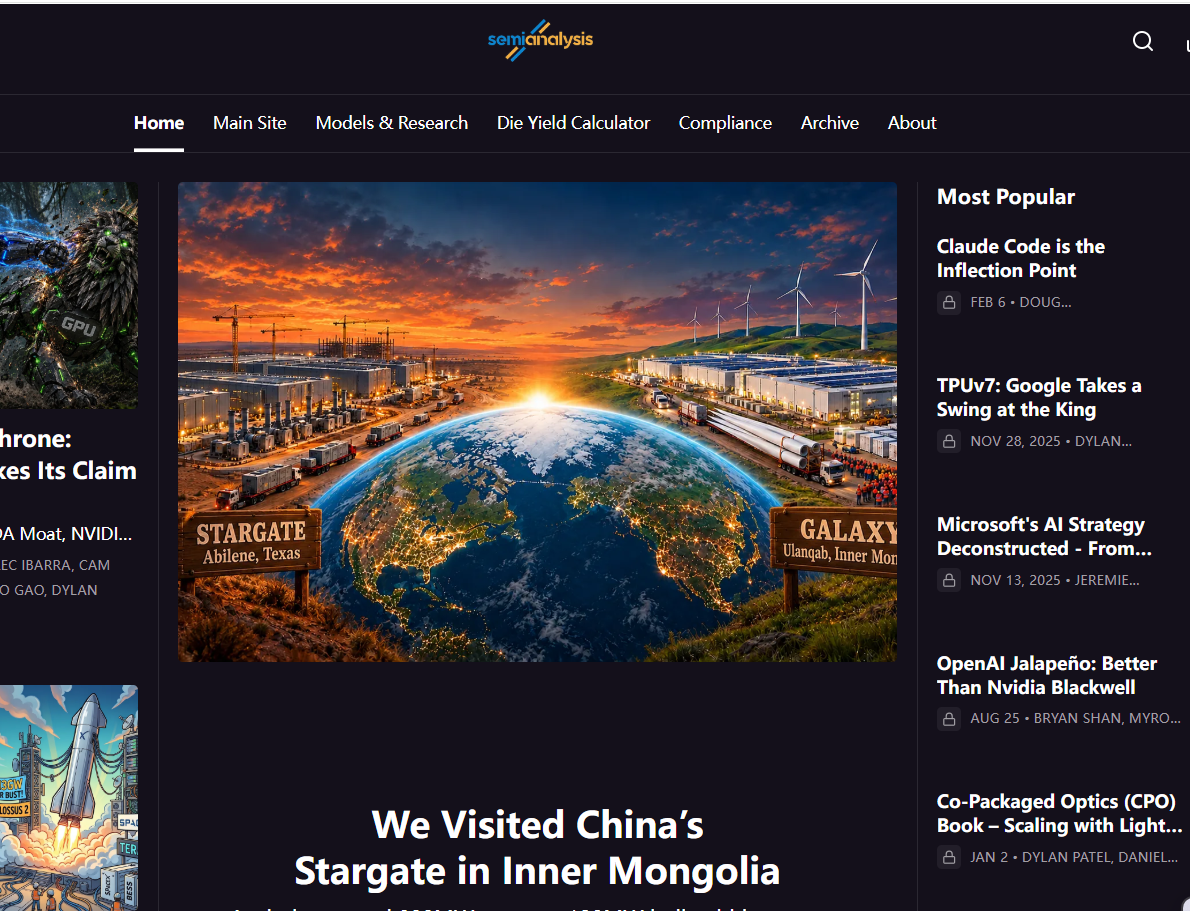
《探访中国"星际之门"》登上SemiAnalysis官网首页

从绿电生产到数据中心机柜,远景的全链路能量管理与AIDC电力系统是报告着墨最多的部分。SemiAnalysis称远景是"我们见过垂直整合程度最高的公司之一"。区别于传统的数据中心开发商,远景星河基地几乎打通了全链条:自己建风电场、自己拉专用线路、自己生产储能系统、自己设计低压配电和800V直流架构、联合设计预制化变电站。

此外,"远景天机"物理AI气象大模型能够提前预测风速、风向及风电出力变化,让发电环节提前掌握风什么时候来、什么时候减弱。在此基础上,“远景天枢”能源大模型可以统筹协调储能系统将风电富余时段的电力存起来,在风力不足时释放出来,让绿色电力尽可能多地被数据中心利用。报告写道,远景的角色横跨制造商、设计集成商与开发商三重身份。这种从新能源装备延伸至数据中心基础设施的系统集成能力,正是其AI电力系统集成设计与管理优势的体现。

在绿色电力供应上,报告详细拆解了远景"源网荷储"模式的领先实践:配套自建风场,规划绿电覆盖比例超过80%。报告分析,远景通过三个因素实现这一比例——选址上选择风力资源更优的场址,规模上风电装机约为数据中心负荷的1.75倍,储配上用4小时电池储能系统将风电富余时段电力转移至无风时段。

在供电架构方面,SemiAnalysis重点介绍了全球首套商业化运行的一体化SST 800V高压直流供电系统,并将其视为AI数据中心供电系统未来发展的下一个阶段。报告指出,固态变压器(SST)将10kV交流电直接转换为800V直流电送至机柜,省去中间的低压变压器、UPS和整流环节;而这一架构在美国仍停留在路线图阶段。报告还对比称,过去十年中国约四分之一的数据中心采用直流供电,而美国约97%的数据中心仍使用交流UPS。
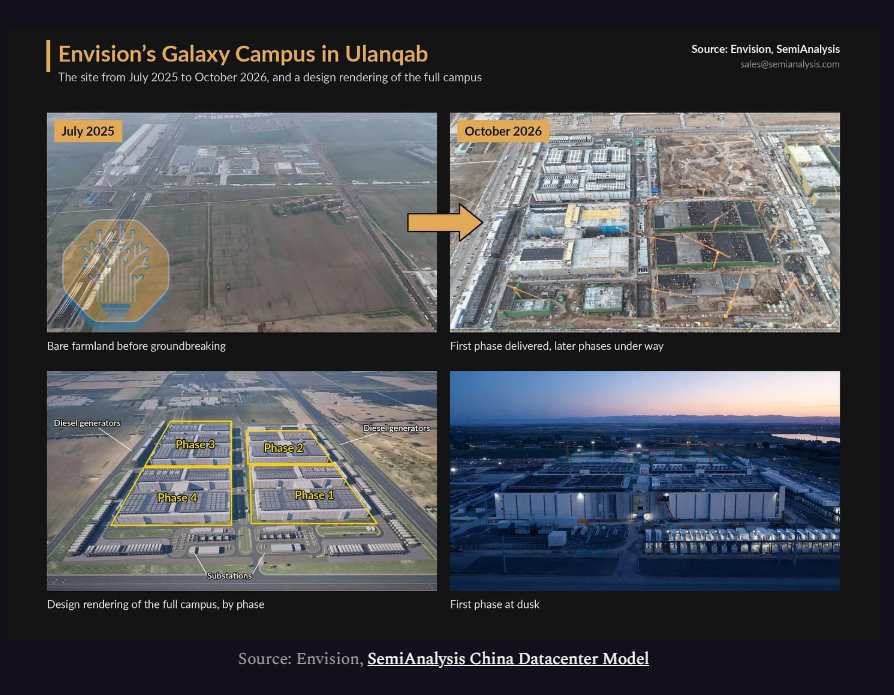
SemiAnalysis报道远景乌兰察布星河基地建设过程

报告还专门介绍了星河基地不设中央冷水机组的方案:液冷与风冷服务器共用一套水循环,充分利用乌兰察布寒冷气候自然散热。报告称,这一设计在中国北方已规模化运行多年,为美国业界关于冷水机组的争论提供了一个参考样本。

SemiAnalysis在报告结尾透露,内蒙古已规划25GW数据中心项目。"许多人以为这里只是一座座传统的数据中心大厅,但我们讲述的是另一个故事。"而远景星河基地,正是这个"中国AI数据中心"故事最有力的开篇。

注:文/龚作仁,文章来源:Laborer,本文为作者独立观点,不代表亿邦动力立场。

【版权提示】亿邦动力倡导尊重与保护知识产权。未经许可,任何人不得复制、转载、或以其他方式使用本网站的内容。如发现本站文章存在版权问题,烦请提供版权疑问、身份证明、版权证明、联系方式等发邮件至run@ebrun.com,我们将及时沟通与处理。

已点赞

+1

{{ praise_text }}

好文章,值得被更多人看到

FAQ回顾

远景乌兰察布星河基地是什么?

远景乌兰察布星河基地是远景在内蒙古乌兰察布建设的大型AI数据中心项目,被SemiAnalysis称为中国版“星际之门”。其规划规模达3GW,一期120MW在一年内交付,成本仅为美国的五分之一,机房资源已被互联网巨头预订。

中国AI数据中心的“算电融合”模式指什么?

“算电融合”指以新能源系统集成为基础,通过源网荷储和电力系统集成推动AI算力基础设施建设。远景在星河基地自建风场、配置储能并设计800V直流供电架构,规划绿电覆盖比例超过80%,探索不同于美国主流模式的AI基建路径。

远景星河基地如何实现80%以上的绿电覆盖?

远景通过三个因素提升绿电比例:选址风力资源更优的场址;风电装机约为数据中心负荷的1.75倍;配置4小时电池储能系统,将风电富余时段电力转移至无风时段,从而让绿色电力尽可能多地被数据中心利用。

800V高压直流供电系统对AI数据中心有什么价值?

一体化SST 800V高压直流供电系统将10kV交流电直接转换为800V直流电送至机柜,省去低压变压器、UPS和整流环节,是全球首套商业化运行的同类系统。报告称该架构在美国仍停留在路线图阶段,中国约四分之一数据中心已采用直流供电。

远景在AI数据中心供电领域具备哪些垂直整合能力?

远景可自建风电场和专用线路,自主生产储能系统,设计低压配电与800V直流架构,并联合设计预制化变电站;其角色横跨制造商、设计集成商与开发商,被SemiAnalysis称为垂直整合程度最高的公司之一。

广告

下一篇

跨境电商资源对接

《全球跨境电商服务商资源手册》第二期手册现已发布,触达更多资源,了解跨境服务商信息,欢迎点击链接下载。

了解详情

京喜三周年:累计成交用户6.28亿,为京东带来超3亿新用户

京喜累计成交用户达到6.28亿,其中京喜自营累计成交用户5.6亿。过去三年,京喜持续将业务重心放在产业带和下沉市场,平台累计为京东带来超过3亿新用户。2026年,京喜交易额同比增长50%。

电商平台 京东 未来零售

2026-11-10 15:11:06