• 亿邦公众号
    • APP下载

山区老师坚持11年晒学生午餐走红 网友赶到阿里公益平台继续支持

作者:龚作仁 文章来源:Laborer

2026-11-06 17:16

作者:龚作仁 文章来源:Laborer

2026-11-06 17:16

邦小白快读

EN
全文速览

总:这篇文章的核心是一个老师11年坚持公示学生午餐账目,以及普通人如何用很低门槛参与支持。

1.参与方式:可在“免费午餐”公益网店直接捐款;也可购买支持该项目的“公益宝贝”商品,成交后自动捐善款,消费者无需额外付费。

2.有人晒出每月定捐记录,“每个月都捐一笔,虽然不多但持久”,说明小额持续参与可行。

3.账目公开细节:余老师从2015年起在社交平台公示餐食、食材出入库、捐赠物资接收使用,累计3000余条动态,公示精确到分。

总2:关注公益透明与项目背景。

1.翁江小学有10名孩子,余启贵是唯一正式老师;2025学年午餐由免费午餐项目通过阿里巴巴公益网店筹款定向支持。

2.免费午餐2011年4月2日创立,当年6月开通淘宝公益网店;截至2026年10月,220多万爱心商家、超14亿笔公益宝贝订单,累计筹款约2.8亿元。

3.余老师的话“受到恩惠,就不负信任”是理解这件事的关键。

总:文章提供了一个公益与电商交易结合的品牌信任建设样本。

1.透明公示建立信任:余老师11年、3000余条动态公开餐食和开支,账目精确到分,并公示捐赠物资接收使用,形成可监督的信任资产。

2.公益参与产品化:公益宝贝让商家把商品交易与捐赠自动绑定,消费者无需额外付费,降低参与门槛,适合品牌做日常化公益营销。

3.用户行为:网友被真实故事打动后主动到淘宝下单支持,并出现按月定捐,说明情感认同可转化为持续消费与复购行为。

总2:规模与渠道启示。

1.免费午餐2011年创立,当年6月即开通淘宝公益网店,截至2026年10月通过220多万爱心商家、超14亿笔公益宝贝订单累计筹款约2.8亿元,显示公益渠道的规模化能力。

2.品牌可借鉴“真实故事+透明账目+低门槛交易捐”的组合,而不是单纯一次性捐赠。

3.风险提示:公益宣传必须与真实账目一致,公开接受监督。

总:热点事件带来公益消费机会,卖家可关注公益宝贝的参与方式和信任运营。

1.机会:网友被余老师11年公示午餐账目打动,纷纷上淘宝支持免费午餐项目,说明热点可带动公益网店订单;卖家可借公益宝贝参与,商品成交自动捐善款,消费者无需额外付费。

2.可学习点:余老师从2015年起公示餐食、食材出入库和捐赠物资使用,累计3000余条动态,账目精确到分,用透明建立信任,卖家做公益营销也应公开可核查。

3.合作方式:免费午餐2011年4月2日创立,当年6月开通淘宝公益网店;截至2026年10月,220多万爱心商家、超14亿笔公益宝贝订单,在阿里巴巴公益平台累计筹款约2.8亿元。

总2:风险与用户需求。

1.消费需求变化:用户愿意为有真实故事、账目透明的公益项目持续小额定捐,有网友晒出每月捐赠记录。

2.风险提示:公益参与不能只做表面宣传,账目不清会反噬信任。

3.事件应对:可借势热点做公益内容,但应把重点放在项目真实性和持续支持。

总:文章对工厂最直接的价值是食材采购清单、成本核算和公益电商化启示。

1.生产与采购参考:余老师公示的11月3日账目包括鲜鸡翅根1.5公斤51元、杏鲍菇1公斤10.8元、冬瓜2公斤6.8元、大米1公斤4.74元,连佐料4元也逐项列明,显示学生午餐食材采购的品类、用量和单价可精细到分。

2.商业机会:学校午餐项目需要稳定食材供应,公益项目通过电商筹款定向支持翁江小学10名孩子的午餐,工厂可关注公益项目供应链合作。

3.数字化启示:从2015年起累计3000余条动态公示食材出入库和开支,说明用社交平台做透明化记录成本低、可持续;公益网店和公益宝贝把交易与捐赠自动连接。

总2:规模与模式。

1.免费午餐2011年创立,当年6月开通淘宝公益网店;截至2026年10月,220多万爱心商家、超14亿笔公益宝贝订单累计筹款约2.8亿元。

2.工厂如参与公益宝贝,可在商品成交后自动捐善款,消费者无需额外付费。

总:文章呈现公益电商化的趋势,以及公益项目在筹款与信任上的痛点及可复制方案。

1.行业趋势:公益项目通过阿里巴巴公益网店筹款、通过公益宝贝实现交易附捐,公益与电商深度融合;免费午餐截至2026年10月在平台累计筹款约2.8亿元,220多万爱心商家、超14亿笔订单,规模可观。

2.客户痛点:公益项目需要持续筹款,也需要让捐赠人相信钱和物资用到了孩子身上;余老师11年、3000余条动态公示餐食和开支,正是解决信任问题的做法。

3.解决方案:公益网店直接捐款+公益宝贝自动捐赠+社交平台逐项公示账目,形成“筹款—执行—公示—监督”闭环;网友每月定捐说明持续运营有效。

总2:服务机会。

1.可为公益项目提供透明账目公示、内容运营、公益店铺运营等服务。

2.可借鉴“真实故事+精确到分账目”的传播素材,降低公众理解门槛。

3.热点事件能带来流量,但服务商应帮助客户把流量转为长期定捐。

总:文章显示公益项目对可信平台筹款渠道的需求,以及阿里公益平台用公益网店和公益宝贝承接需求的做法。

1.平台需求与问题:公益项目需要稳定、透明、低门槛的筹款渠道;公众需要可监督的账目。余老师11年公示餐食和开支、累计3000余条动态,回应了信任问题。

2.平台做法:免费午餐2011年4月2日创立,当年6月开通淘宝公益网店;公众可直接捐款,也可购买公益宝贝商品,成交后自动捐善款,消费者无需额外付费。

3.平台运营数据:截至2026年10月,220多万爱心商家、超14亿笔公益宝贝订单,在阿里巴巴公益平台累计筹款约2.8亿元。

总2:招商与风向。

1.热点事件中网友赶到阿里公益平台继续支持,说明真实故事可带动平台公益流量和订单。

2.平台招商可吸引商家加入公益宝贝,把日常交易转为公益捐赠。

3.运营管理应强调账目公示与监督,避免公益信任风险;余老师“受到恩惠,就不负信任”可作为平台公益运营的理念。

总:文章提供了一个公益电商化、透明化治理和微量捐赠规模化的研究样本。

1.产业新动向:公益项目通过淘宝公益网店和公益宝贝实现电商化筹款;免费午餐2011年4月2日创立,当年6月即开通淘宝公益网店,截至2026年10月通过220多万爱心商家、超14亿笔公益宝贝订单累计筹款约2.8亿元。

2.新问题:公益项目的信任如何建立与维持。余启贵老师从2015年起在社交平台公示餐食、食材出入库和捐赠物资接收使用,累计3000余条动态,账目精确到分,提供了“公开账目—社会监督”的个案。

3.商业模式:公益宝贝把商品成交与自动捐赠绑定,消费者无需额外付费;公益网店支持直接捐款和按月定捐,网友晒出每月捐赠记录,体现小额持续捐赠机制。

总2:政策法规建议与启示。

1.可研究公益项目信息公开的标准与频次,余老师连佐料4元都逐项列明。

2.可关注平台如何审核公益项目、如何公示资金流向。

3.余老师“受到恩惠,就不负信任”可作为公益伦理与制度设计的启示。

声明:快读内容全程由AI生成,请注意甄别信息。如您发现问题,请发送邮件至 run@ebrun.com 。

我是 品牌商 卖家 工厂 服务商 平台商 研究者 帮我再读一遍。

Quick Summary

Summary: The article centers on a teacher who has publicly disclosed student lunch accounts for 11 years, and on how ordinary people can support the project with very low barriers to entry.

1. Ways to participate: Donate directly through the Free Lunch charity online store; or buy products under the Charity Baby (Gongyi Baobei) program that support the project, with a donation automatically made after purchase at no extra cost to the consumer.

2. Some people posted records of monthly recurring donations: “I donate every month—not much, but sustained.” This shows that small, continuous participation is feasible.

3. Details of account disclosure: Since 2015, Mr. Yu has posted on social media the meals, ingredient receipts and usage, and receipt and use of donated supplies—more than 3,000 updates in total, with accounts accurate to the cent.

Summary 2: Focus on charity transparency and project background.

1. Wengjiang Primary School has 10 children, and Yu Qigui is its only full-time teacher. In the 2025 school year, lunches are supported by targeted fundraising by the Free Lunch project through Alibaba’s charity online store.

2. Free Lunch was founded on April 2, 2011, and opened its Taobao charity online store in June that year. As of October 2026, more than 2.2 million caring merchants and over 1.4 billion Charity Baby orders had generated about RMB 280 million in cumulative fundraising.

3. Mr. Yu’s remark—“Having received kindness, one must not let down the trust”—is key to understanding this story.

Summary: The article offers a model for building brand trust by combining charitable giving with e-commerce transactions.

1. Transparency builds trust: Mr. Yu has spent 11 years publishing meal and expense information in more than 3,000 updates, with accounts accurate to the cent and disclosure of donated supplies received and used, creating a trust asset open to scrutiny.

2. Productized charitable participation: the Charity Baby (Gongyi Baobei) program lets merchants automatically link product transactions to donations, at no extra cost to consumers. This lowers the participation barrier and suits brands seeking everyday charitable marketing.

3. User behavior: moved by the real story, netizens proactively placed orders on Taobao to support the project, and some set up monthly recurring donations. This shows that emotional identification can translate into sustained purchasing and repeat behavior.

Summary 2: Implications for scale and channels.

1. Free Lunch was founded in 2011 and opened its Taobao charity online store in June that year. As of October 2026, more than 2.2 million caring merchants and over 1.4 billion Charity Baby orders had generated about RMB 280 million in cumulative fundraising, demonstrating the scaling capacity of charity channels.

2. Brands can learn from the combination of “real story + transparent accounts + low-barrier transaction-linked donations,” rather than relying on one-off donations alone.

3. Risk note: charity communications must match the actual accounts and be open to public scrutiny.

Summary: A trending event has created charitable consumption opportunities; sellers should pay attention to how to participate in the Charity Baby program and how to manage trust.

1. Opportunity: Netizens were moved by Mr. Yu’s 11 years of publicly disclosing lunch accounts and went to Taobao to support the Free Lunch project, showing that trending events can drive orders for charity online stores. Sellers can participate through the Charity Baby program, under which a donation is automatically made after a product transaction at no extra cost to consumers.

2. Lesson to learn: Since 2015, Mr. Yu has disclosed meals, ingredient receipts and usage, and use of donated supplies in more than 3,000 updates, with accounts accurate to the cent. He builds trust through transparency; sellers doing charitable marketing should also be open and verifiable.

3. How to cooperate: Free Lunch was founded on April 2, 2011, and opened its Taobao charity online store in June that year. As of October 2026, more than 2.2 million caring merchants and over 1.4 billion Charity Baby orders had generated about RMB 280 million in cumulative fundraising on Alibaba’s charity platform.

Summary 2: Risks and user demand.

1. Changing consumer demand: Users are willing to make sustained small recurring donations to charity projects with real stories and transparent accounts; some netizens posted monthly donation records.

2. Risk note: Charitable participation cannot be mere surface-level publicity; unclear accounts will backfire on trust.

3. Response to the event: Sellers can leverage the trend to create charity content, but should focus on the project’s authenticity and sustained support.

Summary: The article’s most direct value to factories lies in its ingredient procurement list, cost accounting, and implications for charity e-commerce.

1. Production and procurement reference: Mr. Yu’s disclosed accounts for November 3 include 1.5 kg of fresh chicken wing roots for RMB 51, 1 kg of king oyster mushrooms for RMB 10.8, 2 kg of winter melon for RMB 6.8, and 1 kg of rice for RMB 4.74. Even RMB 4 for condiments is itemized. This shows that the categories, quantities, and unit prices of student lunch ingredients can be tracked down to the cent.

2. Business opportunity: School lunch programs require stable ingredient supply. The charity project raises funds through e-commerce to provide targeted support for lunches for 10 children at Wengjiang Primary School; factories can explore supply-chain cooperation with charity projects.

3. Digitalization lesson: Since 2015, more than 3,000 updates have disclosed ingredient receipts and usage and expenses, showing that using social media for transparent record-keeping is low-cost and sustainable. Charity online stores and the Charity Baby program automatically connect transactions with donations.

Summary 2: Scale and model.

1. Free Lunch was founded in 2011 and opened its Taobao charity online store in June that year. As of October 2026, more than 2.2 million caring merchants and over 1.4 billion Charity Baby orders had generated about RMB 280 million in cumulative fundraising.

2. If a factory participates in the Charity Baby program, a donation can be automatically made after a product transaction at no extra cost to consumers.

Summary: The article presents the trend of charity e-commerce, along with the pain points charity projects face in fundraising and trust, and replicable solutions.

1. Industry trend: Charity projects raise funds through Alibaba’s charity online stores and enable transaction-linked donations through the Charity Baby program, deeply integrating charity with e-commerce. As of October 2026, Free Lunch had raised about RMB 280 million cumulatively on the platform through more than 2.2 million caring merchants and over 1.4 billion orders—a considerable scale.

2. Client pain points: Charity projects need sustained fundraising and must convince donors that money and supplies are reaching the children. Mr. Yu’s 11 years and more than 3,000 updates disclosing meals and expenses are precisely a way to solve the trust problem.

3. Solution: Direct donations via charity online stores + automatic donations via the Charity Baby program + itemized account disclosure on social media form a closed loop of “fundraising—execution—disclosure—oversight.” Netizens’ monthly recurring donations show that sustained operations are effective.

Summary 2: Service opportunities.

1. Service providers can offer charity projects services such as transparent account disclosure, content operations, and charity store operations.

2. They can use communication materials built on “real stories + accounts accurate to the cent” to lower the public’s understanding barrier.

3. Trending events can bring traffic, but service providers should help clients convert traffic into long-term recurring donations.

Summary: The article shows charity projects’ demand for trusted platform fundraising channels and how Alibaba’s charity platform meets that demand through charity online stores and the Charity Baby program.

1. Platform demand and problem: Charity projects need stable, transparent, low-barrier fundraising channels; the public needs accounts that can be scrutinized. Mr. Yu’s 11 years of disclosing meals and expenses in more than 3,000 updates responds to the trust issue.

2. Platform approach: Free Lunch was founded on April 2, 2011, and opened its Taobao charity online store in June that year. The public can donate directly or buy Charity Baby products, with a donation automatically made after purchase at no extra cost to consumers.

3. Platform operating data: As of October 2026, more than 2.2 million caring merchants and over 1.4 billion Charity Baby orders had generated about RMB 280 million in cumulative fundraising on Alibaba’s charity platform.

Summary 2: Merchant recruitment and signals.

1. During the trending event, netizens went to Alibaba’s charity platform to continue supporting the project, showing that real stories can drive charity traffic and orders on the platform.

2. Platform merchant recruitment can attract merchants to join the Charity Baby program and turn everyday transactions into charitable donations.

3. Operations management should emphasize account disclosure and oversight to avoid charity trust risks; Mr. Yu’s remark “Having received kindness, one must not let down the trust” can serve as a philosophy for the platform’s charity operations.

Summary: The article provides a research case on charity e-commerce, transparent governance, and the scaling of micro-donations.

1. New industry development: Charity projects are achieving e-commerce fundraising through Taobao charity online stores and the Charity Baby program. Free Lunch was founded on April 2, 2011, and opened its Taobao charity online store in June that year. As of October 2026, it had raised about RMB 280 million cumulatively through more than 2.2 million caring merchants and over 1.4 billion Charity Baby orders.

2. New question: How trust in charity projects is built and maintained. Teacher Yu Qigui has, since 2015, disclosed meals, ingredient receipts and usage, and receipt and use of donated supplies on social media—more than 3,000 updates in total, with accounts accurate to the cent—providing a case of “public accounts—social oversight.”

3. Business model: The Charity Baby program links product transactions to automatic donations at no extra cost to consumers; charity online stores support direct donations and monthly recurring donations, with netizens posting monthly donation records, reflecting a mechanism for small, sustained donations.

Summary 2: Policy and regulatory recommendations and implications.

1. Research can examine standards and frequency for information disclosure by charity projects; Mr. Yu even itemized RMB 4 for condiments.

2. Attention can be paid to how platforms review charity projects and disclose fund flows.

3. Mr. Yu’s remark “Having received kindness, one must not let down the trust” can inform charity ethics and institutional design.

Disclaimer: The "Quick Summary" content is entirely generated by AI. Please exercise discretion when interpreting the information. For issues or corrections, please email run@ebrun.com .

I am a Brand Seller Factory Service Provider Marketplace Seller Researcher Read it again.

近日,广西桂林龙脊镇翁江小学余启贵老师坚持11年公示学校“免费午餐”公益项目餐食和开支的故事引发关注。记者了解到,2025学年以来,翁江小学的午餐均由“免费午餐”项目通过阿里巴巴公益网店筹款定向支持。不少网友被这份坚持打动,纷纷上淘宝支持该项目,用一笔笔订单为爱心接力。

“每个月都捐一笔,虽然不多但持久。”

评论区里,一位网友晒出自己每月在公益网店下单的记录,并留下这句话。两份坚持,一头是记得清楚的账目,一头是惦记着孩子们的心意。
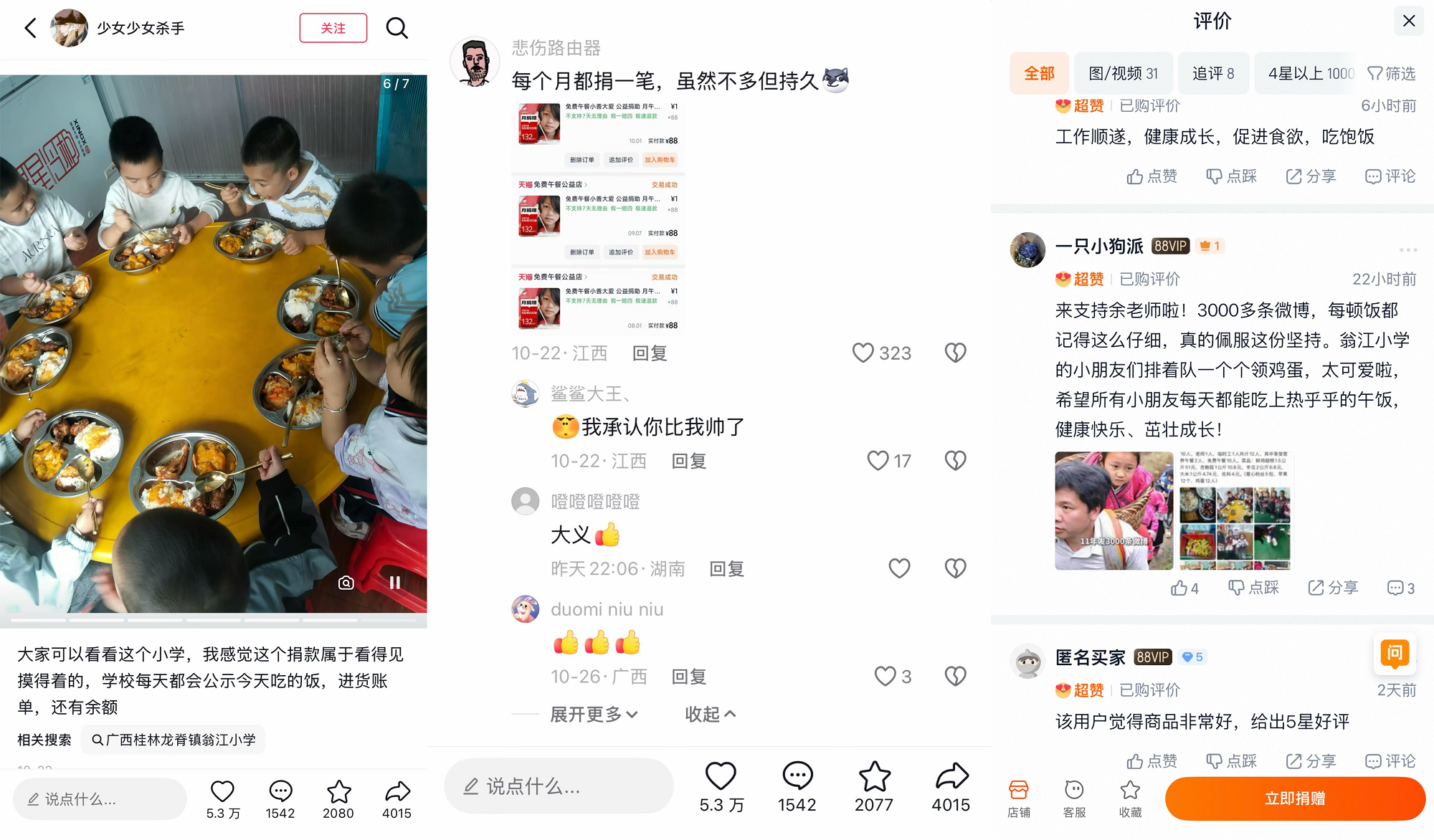
图1:网友晒出每月捐赠记录,另有网友在淘宝公益网店下单支持。

据了解,翁江小学位于广西桂林市龙胜县龙脊镇江柳村,目前有10名孩子,余启贵老师是学校唯一的正式老师。从2015年起,他坚持在社交平台公开学校的餐食、食材出入库情况,以及社会捐赠物资的接收和使用情况,至今已累计更新3000余条动态。

余老师11月3日的一份公示中,鲜鸡翅根1.5公斤、51元,杏鲍菇1公斤、10.8元,冬瓜2公斤、6.8元,大米1公斤、4.74元,连佐料的4元也逐项列明。食材买了多少、花了多少钱,账目清清楚楚,精确到分。
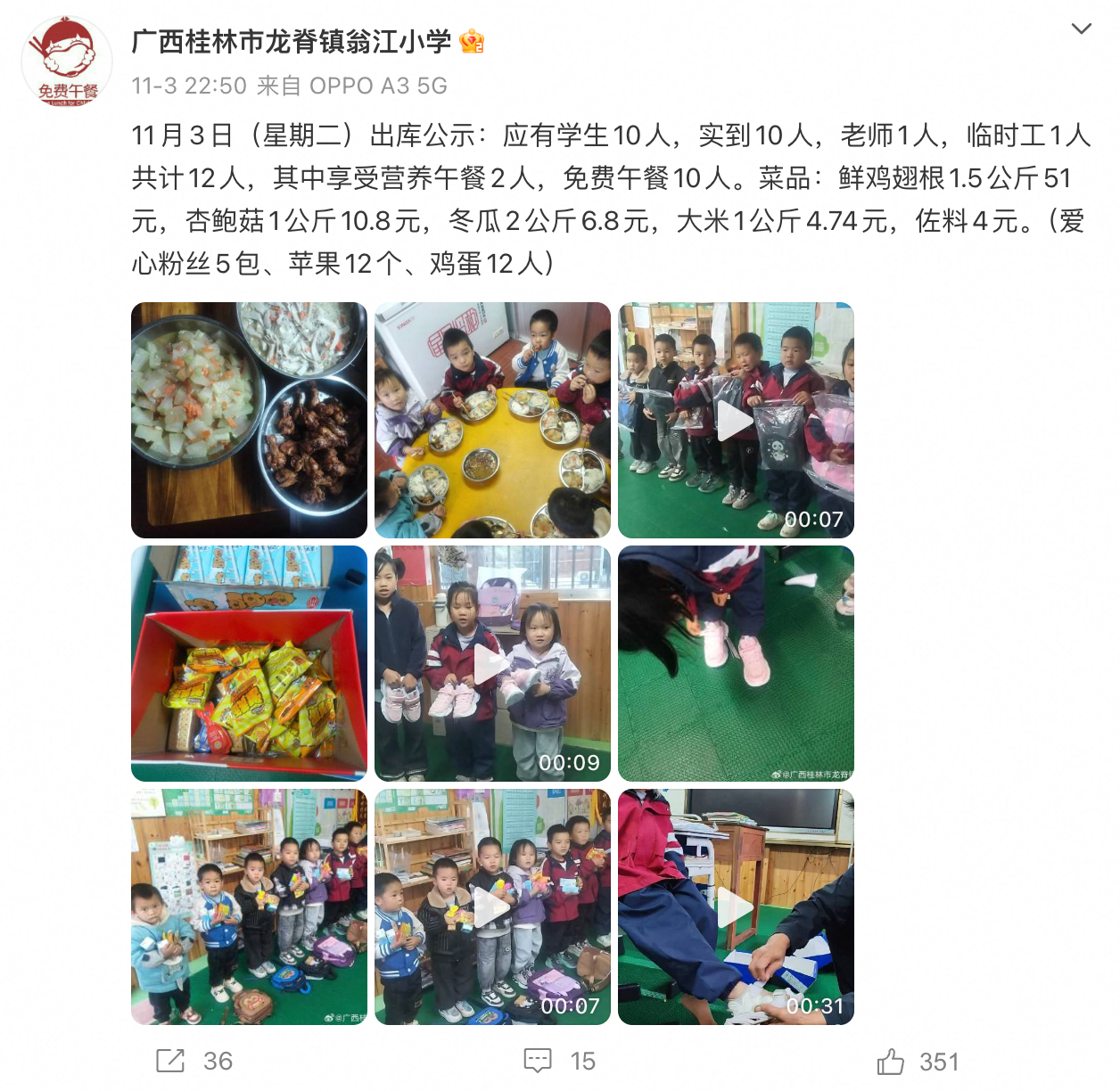
图2:余启贵老师公示每日餐食及食材用量、费用。

余启贵老师表示,学校获得“免费午餐”项目资金,收到的爱心物资也应公示,供大家监督。“受到恩惠,就不负信任。”

想为孩子们的午餐出一份力,公众可以在“免费午餐”公益网店直接捐款,也可以通过购买支持该项目的“公益宝贝”商品献一份爱心。这些商品成交后,会自动向公益项目捐出善款,支持孩子们的免费午餐,消费者无需额外付费。“免费午餐”项目2011年4月2日创立,当年6月即开通淘宝公益网店;截至2026年10月,项目透过220多万爱心商家、超14亿笔“公益宝贝”爱心订单,在阿里巴巴公益平台累计筹款约2.8亿元。

这背后,是无数网友多年来在公益平台坚持定捐的支持。十一年间,余老师把每天的餐食和开支认真记录下来;屏幕另一端,也有人把一份小小的心意坚持了下来。一笔捐赠或许不多,一顿午餐看似平常,但当有人认真记录,有人持续支持,这些平凡的行动便有了长久的力量。一份列到分的账目、一笔按月捐出的心意,最终都指向同一个朴素的愿望:让孩子们吃上一顿热乎饭。

注:文/龚作仁,文章来源:Laborer,本文为作者独立观点,不代表亿邦动力立场。

【版权提示】亿邦动力倡导尊重与保护知识产权。未经许可,任何人不得复制、转载、或以其他方式使用本网站的内容。如发现本站文章存在版权问题,烦请提供版权疑问、身份证明、版权证明、联系方式等发邮件至run@ebrun.com,我们将及时沟通与处理。

已点赞

+1

{{ praise_text }}

好文章,值得被更多人看到

FAQ回顾

免费午餐公益项目是什么?公众如何通过淘宝参与捐赠?

“免费午餐”项目于2011年4月2日创立,2011年6月开通淘宝公益网店。公众可在公益网店直接捐款,也可购买支持该项目的“公益宝贝”商品;商品成交后会自动向项目捐出善款,消费者无需额外付费。截至2026年10月,项目通过超14亿笔“公益宝贝”爱心订单等,在阿里巴巴公益平台累计筹款约2.8亿元。

余启贵老师是谁?他为什么坚持公示学生午餐账目?

余启贵是广西桂林龙脊镇翁江小学唯一的正式老师,该校目前有10名孩子。自2015年起,他坚持在社交平台公开餐食、食材出入库及社会捐赠物资接收使用情况,至今累计更新3000余条。他表示,受到恩惠就不负信任,爱心物资也应公示供大家监督。

翁江小学的免费午餐资金从哪里来?

2025学年以来,翁江小学的午餐由“免费午餐”项目通过阿里巴巴公益网店筹款定向支持。学校位于广西桂林市龙胜县龙脊镇江柳村,目前有10名孩子,余启贵是唯一正式老师。公众也可在“免费午餐”公益网店捐款,或购买相关“公益宝贝”商品支持。

“公益宝贝”如何帮助免费午餐项目筹款?

在淘宝购买支持“免费午餐”的“公益宝贝”商品后,成交会自动向公益项目捐出善款,消费者无需额外付费。免费午餐项目2011年6月开通淘宝公益网店;截至2026年10月,项目通过220多万爱心商家、超14亿笔“公益宝贝”订单,在阿里巴巴公益平台累计筹款约2.8亿元。

广告

下一篇

跨境电商资源对接

《全球跨境电商服务商资源手册》第二期手册现已发布,触达更多资源,了解跨境服务商信息,欢迎点击链接下载。

了解详情

这届“多多农研” 跟草莓较个什么劲?

一颗草莓的生长,对环境有着近乎苛刻的要求。温度高了,花芽分化可能受到影响;光照不足,果实的生长和品质也会打折扣。

拼多多 未来零售 农业 农产品

2026-11-06 16:43:02