• 亿邦公众号
    • APP下载

双11再发力 小红书启动“小红卡”招商圈定高净值买家

作者:姜琪 文章来源:亿邦动力

2026-11-05 11:20

作者:姜琪 文章来源:亿邦动力

2026-11-05 11:20

邦小白快读

EN
全文速览

总:这篇文章讲清小红书小红卡在双11前的招商动作和参与方式。

1.小红卡从此前本地生活168元线下卡转向线上电商场景,年费降至66元,是小红书市集面向高价值用户的经营阵地,也是友好商家面向高消费会员的曝光与触达阵地。

2.持卡用户权益包括开卡时过往消费积分折算抵扣年费、专属优惠券、退货包运费,以及后续在报名商家处享受会员专享价。

总:商家可关注两种实操玩法和平台给出的数据。

1.商家报名单个商品面向会员开放95折会员价,可获得小红卡专属频道增量曝光、商卡商详打标等权益。

2.参与会员积分膨胀红包时,首次进店购买由商家全额出资发红包,第二次及以上进店购买由平台与商家1:1出资;积分可兑换红包金额翻倍,用店铺券进一步撬动会员积分消耗。

3.平台数据称小红卡会员人均消费频次是非会员的17倍,人均消费金额高出非会员近50倍,商家让利5%换高消费力、高粘性用户重复进店。

总:小红卡为品牌商提供了面向高消费会员的营销和渠道触达入口。

1.小红卡年费66元,转向线上电商场景,是小红书市集面向高价值用户的经营阵地;报名商家可成为面向高消费会员的曝光与触达阵地。

2.单个商品开放95折会员价,可获得专属频道增量曝光、商卡商详打标,双11期间相当于在既有大促流量上叠加会员专属价钩子。

总:价格让利、用户行为与站内转化是品牌商要算清的关键。

1.商家让利5%提供95折,平台数据显示会员人均消费频次是非会员17倍、人均消费金额高出近50倍,指向高消费力、高粘性用户的重复进店。

2.会员积分膨胀红包按首购和复购分层出资,首次由商家全额出资,第二次及以上平台与商家1:1出资,积分兑换红包金额翻倍,并用店铺券撬动积分消耗,带动新老客消费提频。

3.平台正用会员身份和专属权益制造站内下单更划算的即时反馈,尝试把高客单、高调性交易用户留在小红书,减少看完笔记后去其他平台比价下单。

总:卖家应先读懂小红卡招商规则与权益边界。

1.小红书启动小红卡「1年1度」招商,向商家开放会员体系专属合作通道;小红卡暂未面向全量用户开放,年费66元,已从本地生活168元线下卡转向线上电商场景。

2.持卡权益含积分折算抵扣年费、专属优惠券、退货包运费、报名商家会员专享价,类似淘宝88VIP和京东PLUS会员。

总:机会在于双11叠加高价值会员,风险在于让利和红包出资。

1.商家可报名单个商品面向会员95折,获得专属频道增量曝光、商卡商详打标;双11用户购买意愿高,等于在大促流量上叠加会员专属价钩子。

2.会员积分膨胀红包中,首次进店购买由商家全额出资,第二次及以上由平台与商家1:1出资;积分兑换红包翻倍,用店铺券撬动积分消耗,带动新老客消费提频。

3.平台数据称会员人均消费频次是非会员17倍、人均消费金额高出近50倍,商家让利5%换来高消费力高粘性用户重复进店;但需核算5%让利和首购红包成本。

总:文章虽未直接讲生产设计,但工厂可从会员电商场景看到商业机会。

1.小红卡从本地生活线下卡转向线上电商场景,年费降至66元,是小红书市集面向高价值用户的经营阵地;平台过去两年跑出一批高客单、高调性的交易用户。

2.商家报名单个商品面向会员95折,可获得专属频道增量曝光、商卡商详打标,适合工厂关注能承接高消费会员的商品经营机会。

总:数字化和电商启示集中在会员运营与站内复购。

1.平台用会员身份和专属权益制造站内下单更划算的即时反馈,试图把交易留在小红书,减少看完笔记去其他平台比价下单。

2.积分膨胀红包分层设计:首次进店由商家全额出资,第二次及以上平台与商家1:1出资,积分兑换红包金额翻倍,用店铺券撬动会员积分消耗。

3.平台数据显示会员人均消费频次是非会员17倍、人均消费金额高出近50倍;商家让利5%换重复进店,工厂可据此理解高价值会员对电商经营的价值。

总:服务商可从小红卡看到会员电商运营趋势和客户痛点。

1.小红卡已从本地生活168元线下卡转向线上电商场景,年费66元,暂未全量开放,权益包括积分折算抵扣年费、专属优惠券、退货包运费、报名商家会员专享价,模式类似淘宝88VIP和京东PLUS会员。

2.平台目标是让高客单、高调性交易用户持续复购,而不是看完笔记转头去其他平台比价下单。

总:解决方案落在专属权益、曝光打标和分层红包。

1.商家报名单个商品95折,可获小红卡专属频道增量曝光、商卡商详打标;双11期间可在大促流量上叠加会员专属价钩子。

2.会员积分膨胀红包按首购和复购分层出资,首次商家全额出资,第二次及以上平台与商家1:1出资;积分兑换红包金额翻倍,用店铺券撬动积分消耗。

3.平台数据称会员人均消费频次是非会员17倍、人均消费金额高出近50倍,可作为服务商向商家解释会员运营价值的依据,同时提示商家核算5%让利和红包成本。

总:平台商可关注小红卡要解决的高价值交易留存问题。

1.过去两年小红书市集跑出高客单、高调性交易用户,但如何让这些用户持续复购、避免看完笔记去其他平台比价下单,仍是待解题。

2.平台正通过会员身份和专属权益制造站内下单更划算的即时反馈,尝试把更多交易留在小红书。

总:最新做法包括招商、权益、两种玩法和运营机制。

1.小红书启动小红卡「1年1度」招商,开放会员体系专属合作通道;小红卡从本地生活168元线下卡转向线上电商场景,年费降至66元,暂未全量开放。

2.持卡权益含积分折算抵扣年费、专属优惠券、退货包运费、报名商家会员专享价;商家可报名单个商品95折,获专属频道增量曝光和商卡商详打标。

3.会员积分膨胀红包中,首次进店由商家全额出资,第二次及以上平台与商家1:1出资,积分兑换红包翻倍,用店铺券撬动积分消耗;平台数据称会员人均消费频次是非会员17倍、人均消费金额高出近50倍,需关注商家让利5%与首购红包成本。

总:小红卡是观察小红书会员电商和站内交易闭环的新样本。

1.小红卡从本地生活168元线下卡转向线上电商场景,年费降至66元,成为小红书市集面向高价值用户的经营阵地;其权益含积分折算抵扣年费、专属优惠券、退货包运费、报名商家会员专享价,模式类似淘宝88VIP和京东PLUS会员。

2.平台面对的问题是过去两年跑出的高客单、高调性交易用户如何持续复购,而非看完笔记转头去其他平台比价下单。

总:商业模式与研究问题集中在会员身份、权益和分层出资。

1.平台用会员身份和专属权益制造站内下单更划算的即时反馈,试图把交易留在小红书。

2.商家玩法包括单个商品95折换专属频道增量曝光和商卡商详打标;会员积分膨胀红包首次由商家全额出资,第二次及以上平台与商家1:1出资,积分兑换红包翻倍,用店铺券撬动积分消耗。

3.平台数据称会员人均消费频次是非会员17倍、人均消费金额高出近50倍;文章未涉及政策法规建议,但呈现了会员权益规则、商家让利5%与红包成本等有待研究的问题。

声明:快读内容全程由AI生成,请注意甄别信息。如您发现问题,请发送邮件至 run@ebrun.com 。

我是 品牌商 卖家 工厂 服务商 平台商 研究者 帮我再读一遍。

Quick Summary

Summary: This article explains Xiaohongka's merchant recruitment campaign ahead of Double 11 and how merchants can participate.

1. Xiaohongka has shifted from a RMB 168 offline local-life card to an online e-commerce setting, with the annual fee reduced to RMB 66. It is an operating venue for Xiaohongshu Marketplace targeting high-value users, and an exposure and reach venue for eligible merchants targeting high-spending members.

2. Cardholder benefits include converting past spending points at card opening to offset the annual fee, exclusive coupons, free return shipping, and subsequent member-only prices at participating merchants.

Summary: Merchants should pay attention to two practical playbooks and the platform's data.

1. Merchants can enroll a single product at a 5% member discount (95% of price) and gain incremental exposure in the Xiaohongka dedicated channel, as well as badges on merchant cards and product detail pages.

2. In member points-boost red packets, the merchant fully funds the red packet for a customer's first purchase from the store; for second and subsequent purchases, the platform and merchant fund it 1:1. Points can be redeemed for double the red packet value, and store coupons can further drive member points usage.

3. Platform data claims that Xiaohongka members spend 17 times as frequently as non-members and nearly 50 times more per capita. Merchants give up 5% to attract high-spending, high-stickiness users back to the store repeatedly.

Summary: Xiaohongka gives brands a marketing and channel-reach entry point for high-spending members.

1. With an annual fee of RMB 66, Xiaohongka has shifted to an online e-commerce setting and is an operating venue for Xiaohongshu Marketplace targeting high-value users. Participating merchants can become an exposure and reach venue for high-spending members.

2. By enrolling a single product at a 5% member discount (95% of price), brands gain incremental exposure in the dedicated channel and badges on merchant cards and product detail pages. During Double 11, this is effectively adding a member-only price hook on top of existing promotion traffic.

Summary: Price concessions, user behavior, and on-platform conversion are key factors brands must calculate.

1. Merchants give up 5% to offer the 95% price. Platform data shows members' per-capita purchase frequency is 17 times that of non-members and per-capita spending is nearly 50 times higher, pointing to repeat store visits by high-spending, high-stickiness users.

2. Member points-boost red packets are funded differently for first and repeat purchases: the merchant fully funds the first purchase, while the platform and merchant split funding 1:1 for second and subsequent purchases. Points can be redeemed for double the red packet value, and store coupons drive points usage, increasing purchase frequency among new and existing customers.

3. The platform is using membership status and exclusive benefits to create immediate feedback that ordering on-platform is more cost-effective, seeking to keep high-ticket, premium transaction users on Xiaohongshu and reduce the behavior of reading notes and then comparing prices and ordering on other platforms.

Summary: Sellers should first understand Xiaohongka's merchant recruitment rules and the boundaries of its benefits.

1. Xiaohongshu has launched Xiaohongka's 'once-a-year' merchant recruitment, opening a dedicated cooperation channel into its membership system. Xiaohongka is not yet open to all users; the annual fee is RMB 66, and it has shifted from a RMB 168 offline local-life card to an online e-commerce setting.

2. Cardholder benefits include points converted to offset the annual fee, exclusive coupons, free return shipping, and member-only prices at participating merchants, similar to Taobao 88VIP and JD PLUS.

Summary: The opportunity lies in Double 11 combined with high-value members; the risk lies in price concessions and red packet funding.

1. Merchants can enroll a single product at a 5% member discount, gaining incremental exposure in the dedicated channel and badges on merchant cards and product detail pages. Double 11 has high purchase intent, so this is effectively adding a member-only price hook on top of promotion traffic.

2. In member points-boost red packets, the merchant fully funds the first purchase from the store, while the platform and merchant split funding 1:1 for second and subsequent purchases. Points can be redeemed for double the red packet value, and store coupons drive points usage, increasing purchase frequency among new and existing customers.

3. Platform data claims members' per-capita purchase frequency is 17 times that of non-members and per-capita spending is nearly 50 times higher. Merchants give up 5% in exchange for repeat visits by high-spending, high-stickiness users, but they need to calculate the cost of the 5% concession and first-purchase red packets.

Summary: Although the article does not directly address production or design, factories can see business opportunities in the member e-commerce setting.

1. Xiaohongka has shifted from an offline local-life card to an online e-commerce setting, with the annual fee reduced to RMB 66. It is an operating venue for Xiaohongshu Marketplace targeting high-value users; over the past two years, the platform has developed a group of high-ticket, premium transaction users.

2. Merchants can enroll a single product at a 5% member discount and gain incremental exposure in the dedicated channel and badges on merchant cards and product detail pages. This is relevant for factories watching product opportunities that can serve high-spending members.

Summary: The digital and e-commerce implications center on member operations and on-platform repurchase.

1. The platform uses membership status and exclusive benefits to create immediate feedback that ordering on-platform is more cost-effective, trying to keep transactions on Xiaohongshu and reduce the behavior of reading notes and then comparing prices and ordering on other platforms.

2. Points-boost red packets are designed in tiers: the merchant fully funds the first purchase from the store, while the platform and merchant split funding 1:1 for second and subsequent purchases. Points can be redeemed for double the red packet value, and store coupons drive member points usage.

3. Platform data shows members' per-capita purchase frequency is 17 times that of non-members and per-capita spending is nearly 50 times higher. Merchants give up 5% to drive repeat store visits; factories can use this to understand the value of high-value members to e-commerce operations.

Summary: Service providers can use Xiaohongka to observe membership e-commerce trends and customer pain points.

1. Xiaohongka has shifted from a RMB 168 offline local-life card to an online e-commerce setting, with an annual fee of RMB 66, and is not yet open to all users. Benefits include points converted to offset the annual fee, exclusive coupons, free return shipping, and member-only prices at participating merchants, similar to Taobao 88VIP and JD PLUS.

2. The platform's goal is to keep high-ticket, premium transaction users repurchasing rather than reading notes and then switching to other platforms to compare prices and order.

Summary: Solutions center on exclusive benefits, exposure badges, and tiered red packets.

1. Merchants can enroll a single product at a 5% member discount and gain incremental exposure in the Xiaohongka dedicated channel and badges on merchant cards and product detail pages. During Double 11, they can add a member-only price hook on top of promotion traffic.

2. Member points-boost red packets are funded differently for first and repeat purchases: the merchant fully funds the first purchase, while the platform and merchant split funding 1:1 for second and subsequent purchases. Points can be redeemed for double the red packet value, and store coupons drive points usage.

3. Platform data claims members' per-capita purchase frequency is 17 times that of non-members and per-capita spending is nearly 50 times higher. Service providers can use this to explain the value of member operations to merchants, while reminding them to calculate the 5% concession and red packet costs.

Summary: Marketplace sellers can focus on the high-value transaction retention problem Xiaohongka aims to solve.

1. Over the past two years, Xiaohongshu Marketplace has developed high-ticket, premium transaction users, but how to keep them repurchasing and prevent them from reading notes and then comparing prices and ordering on other platforms remains unresolved.

2. The platform is using membership status and exclusive benefits to create immediate feedback that ordering on-platform is more cost-effective, trying to keep more transactions on Xiaohongshu.

Summary: The latest moves include merchant recruitment, benefits, two playbooks, and operating mechanisms.

1. Xiaohongshu has launched Xiaohongka's 'once-a-year' merchant recruitment, opening a dedicated cooperation channel into its membership system. Xiaohongka has shifted from a RMB 168 offline local-life card to an online e-commerce setting, with the annual fee reduced to RMB 66, and is not yet open to all users.

2. Cardholder benefits include points converted to offset the annual fee, exclusive coupons, free return shipping, and member-only prices at participating merchants. Merchants can enroll a single product at a 5% member discount and gain incremental exposure in the dedicated channel and badges on merchant cards and product detail pages.

3. In member points-boost red packets, the merchant fully funds the first purchase from the store, while the platform and merchant split funding 1:1 for second and subsequent purchases. Points can be redeemed for double the red packet value, and store coupons drive points usage. Platform data claims members' per-capita purchase frequency is 17 times that of non-members and per-capita spending is nearly 50 times higher; merchants' 5% concession and first-purchase red packet costs need attention.

Summary: Xiaohongka is a new sample for observing Xiaohongshu's membership e-commerce and on-platform transaction loop.

1. Xiaohongka has shifted from a RMB 168 offline local-life card to an online e-commerce setting, with the annual fee reduced to RMB 66, becoming an operating venue for Xiaohongshu Marketplace targeting high-value users. Its benefits include points converted to offset the annual fee, exclusive coupons, free return shipping, and member-only prices at participating merchants, similar to Taobao 88VIP and JD PLUS.

2. The platform's challenge is how to keep the high-ticket, premium transaction users it has developed over the past two years repurchasing, rather than reading notes and then switching to other platforms to compare prices and order.

Summary: The business model and research questions center on membership status, benefits, and tiered funding.

1. The platform uses membership status and exclusive benefits to create immediate feedback that ordering on-platform is more cost-effective, trying to keep transactions on Xiaohongshu.

2. Merchant playbooks include offering a 5% member discount on a single product in exchange for incremental exposure in the dedicated channel and badges on merchant cards and product detail pages. For member points-boost red packets, the merchant fully funds the first purchase, while the platform and merchant split funding 1:1 for second and subsequent purchases; points can be redeemed for double the red packet value, and store coupons drive points usage.

3. Platform data claims members' per-capita purchase frequency is 17 times that of non-members and per-capita spending is nearly 50 times higher. The article does not cover policy or regulatory recommendations, but it presents issues worth studying, such as membership benefit rules, merchants' 5% concession, and red packet costs.

Disclaimer: The "Quick Summary" content is entirely generated by AI. Please exercise discretion when interpreting the information. For issues or corrections, please email run@ebrun.com .

I am a Brand Seller Factory Service Provider Marketplace Seller Researcher Read it again.

【亿邦原创】日前,小红书启动“小红卡”「1年1度」招商,向商家开放这一会员体系的专属合作通道。与之前本地生活的168元线下卡不同,此次小红卡已转向线上电商场景,年费降至66元,是小红书市集推出的面向高价值用户的经营阵地,也是友好商家面向高消费会员的曝光与触达阵地。

据此前报道,小红卡暂未面向全量用户开放,持卡用户权益包括:开卡时过往消费积分可折算抵扣年费、专属优惠券、退货包运费,以及后续在报名商家处享受会员专享价等,与淘宝88VIP和京东PLUS会员类似。双11期间,用户本就处于高购买意愿状态,此时商家报名小红卡,相当于在既有大促流量上叠加一层“会员专属价”的钩子。
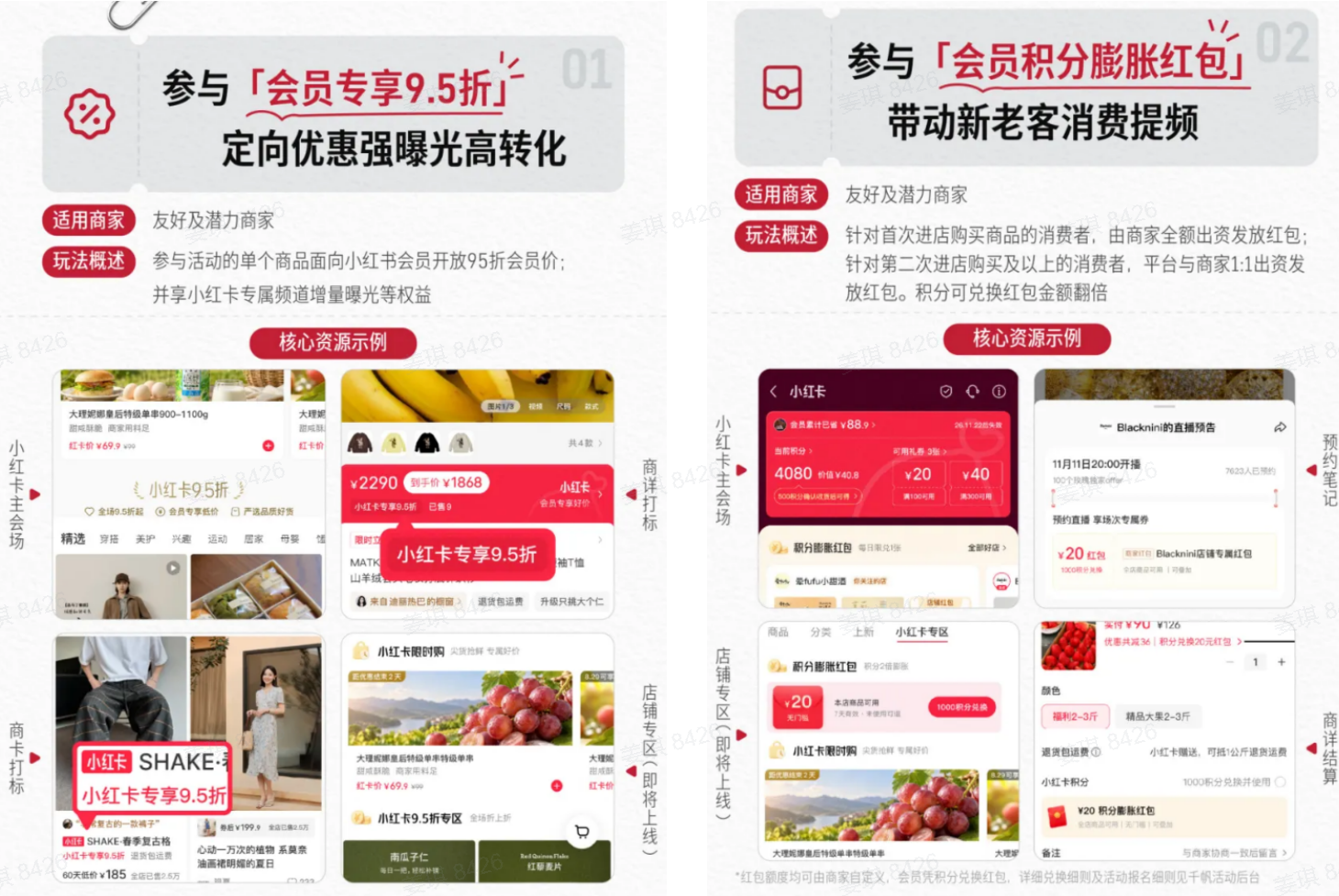
此次小红卡招商,商家可参与两种不同玩法。一是报名参与单个商品面向小红书会员开放95折会员价,可获得小红卡专属频道增量曝光、商卡商详打标等权益;二是参与“会员积分膨胀红包”,针对首次进店购买商品的消费者,由商家全额出资发放红包。针对第二次进店购买及以上的消费者,平台与商家1:1出资发放红包。积分可兑换红包金额翻倍,用店铺券进一步撬动会员的积分消耗意愿,带动新老客消费提频。

平台数据指出,小红卡会员的人均消费频次是非会员的17倍,人均消费金额高出非会员近50倍。这意味着,商家让利5%所提供的会员专享95折,换来的是一批已经被平台验证过的高消费力、高粘性用户的重复进店。

过去两年,小红书市集逐渐跑出了一批高客单、高调性的交易用户,如何让这些用户在平台内持续复购,而非看完笔记转头去其他平台比价下单,始终是待解的题。如今,平台正尝试通过会员身份和专属权益制造“站内下单更划算”的即时反馈,尝试把更多交易留在小红书。

亿邦持续追踪报道该情报,如想了解更多与本文相关信息,请扫码关注作者微信。

本文首发于 亿邦动力 官方网站

【版权提示】亿邦动力倡导尊重与保护知识产权。未经许可,任何人不得复制、转载、或以其他方式使用本网站的内容。如发现本站文章存在版权问题,烦请提供版权疑问、身份证明、版权证明、联系方式等发邮件至run@ebrun.com,我们将及时沟通与处理。

已点赞

+1

{{ praise_text }}

好文章,值得被更多人看到

FAQ回顾

小红卡是什么?

小红卡是小红书市集推出的会员体系,面向高价值用户和友好商家。此次“1年1度”招商将小红卡转向线上电商场景,年费降至66元。持卡用户可享过往消费积分折算抵扣年费、专属优惠券、退货包运费,以及在报名商家处享受会员专享价等权益,模式与淘宝88VIP、京东PLUS会员类似。

小红书小红卡适合哪些商家参与?

小红卡适合希望触达高消费会员的友好商家,尤其在双11用户购买意愿较强时参与。商家可报名单个商品面向会员开放95折会员价,获得小红卡专属频道增量曝光和商卡商详打标;也可参与“会员积分膨胀红包”,针对首次进店购买及二次及以上进店购买的消费者发放红包。

小红卡会员可以享受哪些权益?

小红卡持卡用户开卡时可将过往消费积分折算抵扣年费,并享有专属优惠券、退货包运费,以及在报名商家处享受会员专享价等权益。小红卡暂未面向全量用户开放。双11期间,商家报名后可通过会员专属价在既有大促流量上增加触达高消费会员的入口。

小红卡对商家经营有什么价值?

平台数据显示,小红卡会员的人均消费频次是非会员的17倍,人均消费金额高出非会员近50倍。商家让利5%提供会员专享95折,可换取平台验证过的高消费力、高粘性用户重复进店。小红书也希望通过会员身份和专属权益制造“站内下单更划算”的即时反馈,把更多交易留在平台内。

广告

下一篇

征集报名《品牌数字化服务商资源手册》

《品牌数字化服务商资源手册》展示数字化服务商风采,亿邦全年零售大会通发,触达更多资源,马上加入!

马上入驻

亮相跨境电商AI峰会,首款专为多平台跨境卖家打造的AI数字助理AllyNext正式发布

FastMoss中国首届跨境电商AI峰会暨AllyNext新品发布会在深圳落幕。AllyNext作为首款面向跨境电商的专业AI数字助理正式发布。

SaaS 跨境电商

2026-11-05 11:15:19