• 亿邦公众号
    • APP下载

美团CatPaw定名“妙手” AI正在本地生活经营场景加速落地

作者:姜琪 文章来源:亿邦动力

2026-09-21 13:54

作者:姜琪 文章来源:亿邦动力

2026-09-21 13:54

邦小白快读
EN
全文速览

本文核心介绍了美团正式启用原代号为CatPaw的AI产品中文名“妙手”,这是面向本地生活经营场景的实用型AI工具,不管是关注本地生活服务动态,还是有小店经营需求的读者,都能从中获得有价值的信息。

1. 妙手和普通生成文案、整理文件的办公AI不同,它打通了美团积累的餐饮、酒旅、医药、即时零售等领域的消费需求、交易、评价、履约全链路数据,能帮使用者完成从发现经营问题到决策、执行的全流程动作。

2. 工具采用“统一工作台+行业专属AI模块”的架构,既能统一承接需求、拆解任务、管理权限,也能针对不同行业提供经营分析、差评治理、多店巡检等具体功能,覆盖不同业态的经营需求。

3. 大家判断实用型AI价值可参考两个标准,一是看是否符合“高价值场景、高质量数据、闭环执行”三要素,二是落地时可遵循高重复提效、高投入提质、高收益提量、新试点提速的“四高”路径,避免为华而不实的AI概念付费。

本文介绍了美团正式启用原代号CatPaw的AI产品中文名“妙手”,这是面向本地生活赛道的垂直AI经营工具,对布局本地生活渠道的各品类品牌而言,是提升渠道运营效率、优化用户经营的重要新基础设施,核心相关信息如下。

1. 妙手可打通平台全链路经营数据,覆盖餐饮、服务零售、医药健康、酒店旅行、即时零售等多业态,能精准识别品牌在不同商圈的客群差异、商品适配度、经营时段特征,也能快速响应差评、异常闭店、天气骤变等突发经营影响因素,帮品牌解决规模扩张后标准化要求与单店因地制宜难以平衡的痛点。

2. 产品采用统一工作台加垂直行业AI模块的架构,可完成经营分析、评价治理、多店巡检等具体运营动作,核心以“懂具体生意、能拿经营结果”为衡量标准,能大幅降低品牌获取专业数据分析、经营咨询能力的成本。

3. 品牌搭建自有AI经营能力可参考《妙手·餐饮AI经营指南》提出的“四高”落地路径,即高重复环节提效、高投入环节提质、高收益环节提量、新试点环节提速,稳步推进数字化能力落地。

美团正式启用原代号CatPaw的本地生活AI产品中文名“妙手”,是平台为全品类本地生活卖家提供的新型经营提效工具,能帮助不同规模的卖家降低经营成本、提升运营效率,核心可关注的实用信息如下。

1. 妙手解决了普通办公AI无法适配本地生活强场景属性的痛点,在卖家授权范围内可调用平台积累的消费需求、交易、评价、履约全链路数据,实现从发现经营问题到决策、执行的全闭环,覆盖从差评处理、门店巡检到经营分析的各类高频需求。

2. 工具对不同规模卖家都适配:大型连锁可借助其平衡标准化管理和单店灵活调整的矛盾,中小卖家无需承担专业团队、数据分析系统的高额成本,就能获得专业级的经营指导。

3. 卖家选择和应用AI工具时可参考美团核心本地商业CEO王莆中提出的AI价值三要素,即高价值场景、高质量数据、闭环执行,避开只能生成文案、不能解决实际问题的概念型产品;可按照《妙手·餐饮AI经营指南》提出的“四高”路径找自身提效点,优先在高频重复、高投入、高收益、新试点环节应用AI,切实拿到经营结果。

美团推出的本地生活AI产品“妙手”,为布局即时零售、本地生活渠道的生产制造类工厂提供了新的商业机会和数字化转型参考,核心相关干货如下。

1. 本地生活渠道的经营具备极强的时空属性,同一品类在不同商圈的客群偏好、商品结构、动销节奏差异极大,差评、天气变化、门店营业状态等因素会快速影响商品销量,工厂可借助妙手打通的全链路消费、交易、评价、履约数据,更精准捕捉不同区域的用户商品偏好,反向指导产品设计、生产备货的动态调整,减少库存浪费、提升动销效率。

2. 妙手采用“统一工作台+行业专属AI模块”的架构,可自动完成经营分析、渠道巡检、用户反馈治理等动作,工厂拓展本地生活渠道时,无需单独搭建高成本的专业运营、数据分析团队,就能低成本获得专业经营能力,降低新渠道拓展门槛。

3. 工厂推进数字化转型可参考“四高”落地路径,优先在重复性高的生产供货流程、高投入的供应链环节、高收益的核心品类板块、新渠道试点环节应用AI能力,稳步拿到实际经营成效。

美团正式推出定名“妙手”的本地生活垂直AI产品,标志着AI在本地生活To B服务领域进入落地闭环阶段,为各类商家服务商指明了行业趋势、客户核心痛点和可落地的解决方案参考,核心信息如下。

1. 行业趋势与客户痛点层面,当前通用办公类AI已无法满足本地生活商家的真实需求:本地生活经营受时间、地点、场景影响极大,不同商圈的客群、商品、经营时段差异显著,差评、天气突变、异常闭店等变量会快速影响业绩,大型连锁难平衡标准化与灵活经营,中小商家承担不起专业服务成本,对实用型AI服务需求强烈。

2. 可参考的解决方案为三层架构:底层打通消费、交易、供给、评价、履约全链路高质量数据,中间搭建统一AI工作台承接需求、拆解任务、管理权限,上层按行业配置垂直功能模块,实现经营分析、评价治理、多店巡检等闭环执行功能。

3. 服务商开发AI产品要紧扣王莆中提出的高价值场景、高质量数据、闭环执行三要素,避免做概念性产品,场景设计可参考“四高”路径搭建服务体系。

美团推出定名“妙手”的本地生活AI经营工具,为各类本地生活、即时零售类平台的商家服务、运营管理提供了可参考的最新实践样本,核心相关内容如下。

1. 当前平台服务商家存在三类核心痛点:通用办公类AI无法适配本地生活强时空、强场景的经营属性,难以真正解决问题;大型连锁商家难以平衡标准化管理与单店灵活经营的需求;中小商家承担不起专业数据分析、经营咨询的成本,数字化门槛高,这些痛点是平台提升商家粘性的核心切入点。

2. 美团的最新实践是打造“妙手”统一AI工作台,在商家授权范围内打通平台沉淀的消费、交易、供给、评价、履约全链路数据,承接需求、拆解任务、管理权限,同时针对餐饮、酒旅、医药等不同业态配置专属AI模块,比如餐饮的智能掌柜、袋鼠管家,其他业态的“既白”模块,落地经营分析、评价治理、多店巡检等闭环服务,核心以帮商家拿到实际经营结果为衡量标准。

3. 平台布局AI商家服务要紧扣高价值场景、高质量数据、闭环执行三原则,避免上线华而不实的概念性功能,功能迭代可遵循“四高”路径稳步推进。

美团将原代号CatPaw的AI产品正式定名为“妙手”,标志着AI技术在本地生活实体经营场景进入深度落地阶段,是数字技术与实体经济融合的典型产业新动向,具备较高研究价值,核心可关注内容如下。

1. 本地生活赛道的AI应用呈现新演进方向:仅能生成文案、整理文件的通用办公AI无法适配本地生活强时空依赖、强场景属性的经营需求,产业端真正需要的是能理解行业规则、对接全链路经营数据、可在授权范围内调用系统完成执行动作的垂直AI经营专家,AI应用正从“能回答问题”向“能解决问题”转型。

2. 本地生活服务领域出现新的商业模式探索:美团打造“统一AI工作台+分行业垂直AI专家团”架构,核心是将平台积累的消费数据、经营知识、服务方法论转化为商家可使用、训练、自主管理的AI能力,最终帮商家形成自有AI经营能力,该模式或将重构本地生活商家数字化服务生态。

3. 美团提出的AI价值三要素、《妙手·餐饮AI经营指南》提出的“四高”场景筛选路径,为AI在更多实体产业落地提供了可参照的实践分析框架。

声明:快读内容全程由AI生成,请注意甄别信息。如您发现问题,请发送邮件至 run@ebrun.com 。

我是 品牌商 卖家 工厂 服务商 平台商 研究者 帮我再读一遍。

Quick Summary

This article covers Meituan’s official launch of "MiaoShou" (literally "skilled hand"), its AI tool formerly codenamed CatPaw. Designed as a practical AI solution for local business operations, it offers valuable insights for both readers following local services industry trends and small business owners running brick-and-mortar stores.

1. Unlike general office AI tools focused on copy generation or document organization, MiaoShou is integrated with Meituan’s full-stack data across catering, hotel and travel, healthcare, and instant retail, covering consumer demand, transactions, reviews, and order fulfillment. It supports users through the entire workflow from identifying operational issues to making decisions and executing actions.

2. Built on an architecture of a unified workbench paired with industry-specific AI modules, the tool centralizes request intake, task breakdown, and permission management, while also delivering tailored functions for different sectors, including operational analysis, negative review management, and multi-store inspections, to meet the operational needs of diverse business formats.

3. Two useful frameworks can help readers evaluate the value of practical AI tools: first, a qualified solution must meet three core criteria—targeting high-value scenarios, leveraging high-quality data, and enabling closed-loop execution; second, AI implementation should follow the "four highs" pathway: driving efficiency in high-repeat workflows, improving quality in high-investment processes, boosting volume in high-return segments, and accelerating pilots for new initiatives, to avoid paying for flashy but unproductive AI concepts.

This article covers Meituan’s official launch of "MiaoShou", its vertical AI operational tool for the local services sector, formerly codenamed CatPaw. For brands across categories operating local life channels, the tool represents an important new piece of infrastructure to improve channel operation efficiency and optimize customer management, with key takeaways as follows:

1. MiaoShou integrates the platform’s full-stack operational data across catering, service retail, healthcare, hotel and travel, and instant retail. It can accurately identify differences in customer demographics, product fit, and peak operating hours across different business districts for brands, while rapidly responding to unexpected operational disruptions such as negative reviews, unplanned store closures, and sudden weather changes. This addresses a core pain point for scaled brands: balancing standardized operational requirements with location-specific adaptation for individual stores.

2. Built on an architecture combining a unified workbench and vertical industry AI modules, the product supports concrete operational tasks including performance analysis, review management, and multi-store inspections. Designed with the core metric of "understanding specific business contexts and delivering tangible operational results", it significantly lowers the cost for brands to access professional data analysis and business consulting capabilities.

3. When building in-house AI operational capabilities, brands can reference the "four highs" implementation framework outlined in the *MiaoShou Catering AI Operation Guide*: drive efficiency in high-repeat workflows, improve quality in high-investment processes, boost volume in high-return segments, and accelerate rollout of new pilot initiatives, to steadily advance digital transformation.

Meituan has officially launched "MiaoShou", its AI operational tool for local services formerly codenamed CatPaw. Designed as a new efficiency-driving tool for local sellers across all categories, it helps sellers of all scales reduce operating costs and improve operational efficiency, with key practical takeaways as follows:

1. MiaoShou addresses a key limitation of general office AI tools, which fail to adapt to the highly scenario-specific nature of local business operations. With seller authorization, it can access the platform’s full-stack data covering consumer demand, transactions, reviews, and fulfillment, enabling a closed-loop workflow from problem identification to decision-making and execution, covering high-frequency needs from negative review response and store inspections to operational analysis.

2. The tool is adapted for sellers of all scales: large chain operators can use it to resolve the tension between standardized management and location-specific operational flexibility, while small and medium-sized sellers can access professional-grade operational guidance without bearing the high cost of hiring specialized teams or purchasing data analysis systems.

3. When selecting and deploying AI tools, sellers can reference the three core criteria for AI value proposed by Wang Puzhong, CEO of Meituan Core Local Commerce: high-value scenarios, high-quality data, and closed-loop execution, to avoid conceptual products that only generate copy but cannot solve practical problems. They can also identify efficiency improvement opportunities following the "four highs" pathway outlined in the *MiaoShou Catering AI Operation Guide*, prioritizing AI deployment in high-repeat, high-investment, high-return, and new pilot scenarios to deliver tangible operational results.

Meituan’s launch of "MiaoShou", its local services AI tool, creates new business opportunities and provides a digital transformation reference for manufacturing factories expanding into instant retail and local life channels, with key practical insights as follows:

1. Local life channel operations are highly location- and time-sensitive: product preferences, assortment structure, and sales turnover for the same category can vary dramatically across business districts, while factors such as negative reviews, weather changes, and store operating status can rapidly impact product sales. Leveraging MiaoShou’s integrated full-stack data on consumption, transactions, reviews, and fulfillment, factories can more accurately capture regional user product preferences, to inform dynamic adjustments to product design, production planning, and inventory allocation, reducing inventory waste and improving sell-through efficiency.

2. Built on a "unified workbench + industry-specific AI module" architecture, MiaoShou automates tasks including operational analysis, channel inspection, and user feedback management. When expanding into local life channels, factories can access professional operational capabilities at low cost without building expensive dedicated operations and data analysis teams, lowering the barrier to new channel entry.

3. Factories advancing digital transformation can reference the "four highs" implementation pathway, prioritizing AI deployment in high-repeat production and supply processes, high-investment supply chain links, high-return core category segments, and new channel pilots, to steadily deliver tangible operational results.

Meituan’s official launch of "MiaoShou", its vertical AI product for local services, marks the entry of AI in local business B2B services into the closed-loop implementation stage, and provides clear references for industry trends, core customer pain points, and actionable solutions for various merchant service providers, with key takeaways as follows:

1. In terms of industry trends and customer pain points, general office AI tools can no longer meet the real needs of local businesses: local operations are heavily influenced by time, location, and scenario, with significant differences in customer groups, product offerings, and operating hours across business districts, while variables such as negative reviews, sudden weather changes, and unplanned store closures can rapidly impact performance. Large chain brands struggle to balance standardization and flexible operations, while small and medium-sized merchants cannot afford professional service costs, creating strong demand for practical AI services.

2. A reference solution follows a three-layer architecture: the bottom layer integrates high-quality full-stack data covering consumption, transactions, supply, reviews, and fulfillment; the middle layer builds a unified AI workbench to intake requests, break down tasks, and manage permissions; the top layer deploys vertical functional modules by industry to enable closed-loop execution functions including operational analysis, review management, and multi-store inspections.

3. When developing AI products, service providers should anchor on the three core criteria proposed by Wang Puzhong—high-value scenarios, high-quality data, and closed-loop execution—to avoid building conceptual products, and can design service scenarios following the "four highs" pathway to structure their offerings.

Meituan’s launch of "MiaoShou", its AI operational tool for local services, provides a latest reference practice for merchant services and operation management across local life and instant retail platforms, with key takeaways as follows:

1. Platforms currently face three core pain points in serving merchants: general office AI tools cannot adapt to the highly time-, location-, and scenario-specific nature of local business operations, making it difficult to solve real problems; large chain merchants struggle to balance standardized management with the need for flexible, location-specific store operations; small and medium-sized merchants cannot afford the cost of professional data analysis and business consulting, facing high barriers to digitalization. These pain points are core entry points for platforms to improve merchant stickiness.

2. Meituan’s latest practice is the unified MiaoShou AI workbench, which, with merchant authorization, integrates the platform’s accumulated full-stack data on consumption, transactions, supply, reviews, and fulfillment to centralize request intake, task breakdown, and permission management. It also deploys dedicated AI modules for different sectors including catering, hotel and travel, and healthcare—such as the Smart Shopkeeper and Kangaroo Manager modules for catering, and the "JiBai" module for other sectors—to deliver closed-loop services including operational analysis, review management, and multi-store inspections, with the core success metric of helping merchants achieve tangible operational results.

3. When building AI-powered merchant services, platforms should adhere to the three principles of high-value scenarios, high-quality data, and closed-loop execution, to avoid launching flashy but unproductive conceptual features, and can advance feature iteration steadily following the "four highs" pathway.

Meituan’s official naming of its formerly codenamed CatPaw AI product as "MiaoShou" marks the in-depth implementation of AI technology in offline local business scenarios. As a notable new trend in the integration of digital technology and the real economy, the development carries high research value, with key points of interest as follows:

1. AI applications in the local services sector are showing a new evolutionary direction: general office AI tools limited to copy generation and document organization cannot adapt to the strong spatiotemporal dependence and scenario-specific nature of local business operational needs. What the industry truly needs is vertical AI operational experts that understand industry rules, connect to full-stack operational data, and can invoke system actions to execute tasks within authorized scope, representing a shift in AI applications from "answering questions" to "solving problems".

2. New business model exploration is emerging in the local services space: Meituan’s architecture of a "unified AI workbench + cross-industry vertical AI expert panel" is designed to translate the platform’s accumulated consumer data, operational knowledge, and service methodologies into AI capabilities that merchants can use, train, and manage independently, ultimately helping merchants build their own in-house AI operational capabilities. This model may restructure the digital service ecosystem for local businesses.

3. The three core criteria for AI value proposed by Meituan, and the "four highs" scenario screening pathway outlined in the *MiaoShou Catering AI Operation Guide*, provide a practical analytical framework for AI implementation across more real-economy industries.

Disclaimer: The "Quick Summary" content is entirely generated by AI. Please exercise discretion when interpreting the information. For issues or corrections, please email run@ebrun.com .

I am a Brand Seller Factory Service Provider Marketplace Seller Researcher Read it again.

【亿邦原创】9月20日,美团正式启用CatPaw中文名“妙手”。在解决写作、搜索、会议等通用办公需求的基础上,美团称希望“妙手”可以理解餐饮、服务零售、医药健康、酒店旅行、即时零售等本地生活场景,并连接平台积累的消费需求、交易、供给、评价和履约信息,帮助商家从发现问题走到决策和执行。
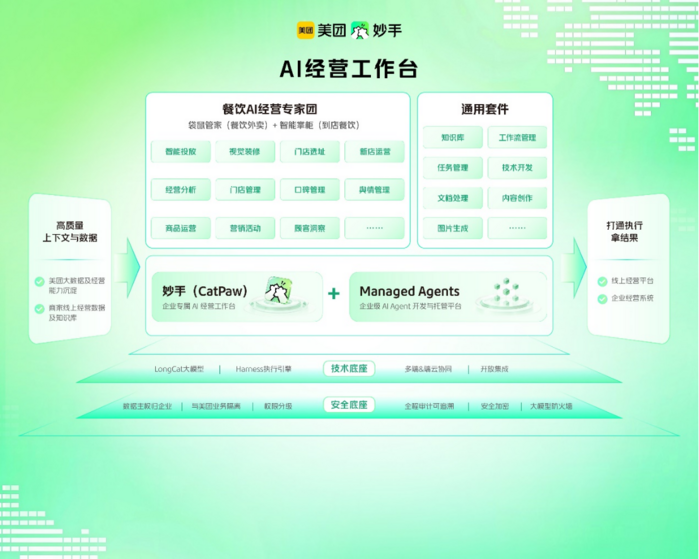
本地生活生意高度依赖时间、地点和具体场景:同一品牌在不同商圈的客群、商品和经营时段可能完全不同,一次差评、一次异常闭店或一次天气骤变,也可能迅速影响门店经营。仅能整理文件、生成文案的办公AI很难处理这些问题,真正的AI经营专家,要能在高价值经营场景中,理解行业指标和品牌规则,并在商家授权范围内调用工具与系统、完成经营任务执行。

在这一产品思路下,“妙手”是企业员工使用AI能力的统一工作台,负责承接需求、拆解任务和管理权限;智能掌柜、袋鼠管家等“妙手”上的行业AI经营专家团则将餐饮经营数据、行业经验和业务工具接入其中,完成经营分析、评价治理和多店巡检等具体任务。酒店、服务零售和医药所需的数据与流程不同,也会配置“既白”等相应的行业AI经营专家团。由此,“妙手”的定位愈发清晰,其核心衡量标准是:“是否懂具体生意、能否拿到经营结果”。

大型连锁企业虽然有专业团队和系统能力,但规模越大,标准化和因地制宜就越难两全。对更多中小商家来说,经营者往往一人身兼数职,获得数据分析、专业咨询和经营方法的成本也更高。

AI正在改变这种局面。它大幅降低了信息处理、数据分析和专业知识的使用门槛,让更多商家有机会获得过去只有专业团队才能提供的能力。

美团核心本地商业CEO王莆中表示,AI要真正创造价值,必须同时具备三个要素——高价值场景、高质量数据、能闭环执行。高价值场景决定AI解决的是不是真问题,高质量数据决定AI能否作出准确判断,闭环执行则决定这些判断能否转化为行动和结果。三者缺一,AI都可能停留在“会回答问题”,而不能真正“解决问题”。

对于如何筛选AI高价值场景,美团近日发布的《妙手·餐饮AI经营指南》提出,行动路径可概括为“在高重复中提效、在高投入中提质、在高收益中提量、在新试点中提速”。

美团相关负责人称,“妙手”希望把美团长期服务本地生活商家积累的数据、经营知识和专业方法,转化为商家可以使用、训练和管理的AI能力,并让每个商家最终能长出自己的AI经营能力。

亿邦持续追踪报道该情报,如想了解更多与本文相关信息,请扫码关注作者微信。

本文首发于 亿邦动力 官方网站

【版权提示】亿邦动力倡导尊重与保护知识产权。未经许可,任何人不得复制、转载、或以其他方式使用本网站的内容。如发现本站文章存在版权问题,烦请提供版权疑问、身份证明、版权证明、联系方式等发邮件至run@ebrun.com,我们将及时沟通与处理。

已点赞

+1

{{ praise_text }}

好文章,值得被更多人看到

FAQ回顾

美团妙手是什么产品?

美团妙手是美团正式定名的原CatPaw企业级AI产品,作为企业员工使用AI能力的统一工作台,可理解餐饮、酒旅、即时零售、医药健康等本地生活场景,整合平台交易、消费、履约等数据,对接各行业AI经营专家团,为商家提供全链路经营支持。

AI能为本地生活商家解决哪些实际经营难题?

本地生活经营受商圈客群差异、经营时段、差评、异常闭店、天气变化等多因素影响,中小商家获取专业经营分析、咨询的成本较高,大型连锁难以平衡标准化与因地制宜,AI可降低专业能力使用门槛,帮助商家完成评价治理、多店巡检、经营分析等实际任务。

面向经营场景的AI要真正创造价值需具备哪些核心要素?

美团核心本地商业CEO王莆中提出,面向经营场景的AI要真正创造价值需同时具备三个核心要素:一是高价值场景,确保解决真实经营问题;二是高质量数据,支撑AI做出准确判断;三是闭环执行能力,可将判断转化为实际行动与经营结果。

餐饮行业筛选AI高价值经营场景有哪些参考路径?

美团发布的《妙手·餐饮AI经营指南》提出,餐饮领域筛选AI高价值经营场景的行动路径可概括为四个方向:在高重复工作环节提效、在高投入环节提质、在高收益业务中提量、在新试点项目中提速。

广告

下一篇

征集报名《品牌数字化服务商资源手册》

《品牌数字化服务商资源手册》展示数字化服务商风采,亿邦全年零售大会通发,触达更多资源,马上加入!

马上入驻

制造业Agent,一个25年磨出来的新物种

双方要解决的不是AI能不能进制造业,而是AI进去之后,能不能真正接住岗位上的活,对经营结果负责。