• 亿邦公众号
    • APP下载

零售门店到电力现场 视源股份MAXHUB D3七轴仿人形双臂与生态伙伴一起实现场景落地

作者:龚作仁 文章来源:Laborer

2026-08-21 23:14

作者:龚作仁 文章来源:Laborer

2026-08-21 23:14

邦小白快读

EN
全文速览

本文核心介绍了视源股份旗下MAXHUB D3七轴仿人形双臂的产品能力与落地进展,这是当下具身智能从演示走向实用的代表性产品,普通读者可从中了解国内具身智能产品的最新发展情况。

1. 产品核心能力:该产品坚持全栈自研,拥有四项实用的类人本领,660毫米臂展可深入狭窄空间作业,3公斤额定负载满足日常物件拿取需求,动作响应低至20毫秒,比眨眼快十倍以上,还兼容主流开发工具,支持手把手高效示教积累训练数据。

2. 落地场景情况:已经在零售、电力两个场景完成落地验证,零售场景可听懂顾客开放式口语指令,完成从接单寻货到取货送货的全流程,电力场景可完成配电柜旋钮操作、按钮按压等真实作业,未来还会拓展无人商超、电力巡检等更多场景。

本文为布局智能硬件、具身智能领域的品牌商,提供了产品研发、品牌推广与场景落地的多方面可参考干货。

1. 产品研发端:可走全栈自研路线,实现从底层运动控制算法、核心关节电机到整机设计制造的自主可控,遵循“为应用而生”的设计理念,不做炫技式研发,聚焦真实场景需求打造产品能力。

2. 品牌推广方面:可借助顶级行业展会获得曝光,通过权威行业媒体的专业推荐提升品牌认可度,快速吸引行业合作伙伴与目标用户的关注。

3. 场景落地层面:紧跟消费无人化、工业智能化的趋势,联合生态伙伴共同做场景适配验证,同时布局消费端和工业端场景,有效拓展产品的应用空间。

本文给做智能服务、工业解决方案相关的卖家,梳理了具身智能落地带来的新机会与可参考的发展方向。

1. 市场机会层面:当前具身智能已经从演示阶段走向实用化,零售端的无人商超、仓储拣选,工业端的电力巡检、危化处理、消防应急都是新的增长市场,对应了消费端对无人服务的需求升级,工业端对危险作业替代人力的巨大需求缺口,市场空间广阔。

2. 落地可参考路径:不需要从零开始自研硬件,可以选择成熟的硬件产品合作,MAXHUB D3本身兼容主流开发工具和模型,开发门槛低,还已经完成基础场景验证,可降低自身的研发成本。

3. 风险提示:具身智能落地核心要解决场景适配和安全问题,工业场景需要增加外置安全层控制作业风险,一定要提前做真实场景的联合验证,再推进商业化。

本文给做智能制造、工业机器人相关的工厂,提供了产品研发方向、商业机会与数字化转型的多方面启示。

1. 产品生产设计需求:当前场景化仿人形机械臂要求掌握核心技术,走全栈自研路线才能实现高响应、高灵活的产品性能,设计上要围绕实用化目标,兼顾多场景适配需求,兼容主流开发工具降低合作门槛,支持便捷示教方便合作伙伴积累训练数据。

2. 商业拓展机会:除了传统工业场景,零售等消费服务场景也有大量的智能设备需求,工厂可以和品牌方、生态伙伴合作,开发无人零售、服务机器人相关的硬件产品,拓展自身业务范围。

3. 数字化转型启示:产品研发要围绕真实场景需求推进,避免停留在技术展示阶段,要联合生态伙伴快速完成场景验证,推进产品从技术到落地的转化,提升商业化效率。

本文给做具身智能解决方案、机器人应用服务的服务商,梳理了行业发展趋势、客户痛点与可落地的解决方案方向。

1. 行业发展趋势:当前国内具身智能已经正式从技术演示阶段走向真实场景落地阶段,市场需求已经从追求技术炫技转向追求能解决实际问题的实用化方案,零售服务、工业特种作业都是当前落地的核心领域,市场需求旺盛。

2. 客户常见痛点:大多数解决方案服务商都不具备硬件自研能力,原有硬件存在适配难度大、开发门槛高、示教效率低的问题,拖慢了项目落地的进度,也增加了研发成本。

3. 可参考的解决方案:可以和MAXHUB D3这类成熟的硬件产品合作,该硬件已经完成零售、电力场景的验证,兼容各类开发工具与模型,支持便捷示教,服务商可基于此快速开发不同场景的解决方案,降低自身研发投入。

本文给机器人、具身智能领域的平台商,梳理了当前行业参与者的需求,以及平台可布局的方向和需要规避的风险。

1. 行业参与者的核心需求:当前具身智能落地需要硬件厂商、模型开发商、解决方案服务商分工合作,硬件厂商需要对接更多生态伙伴做场景开发,开发者需要兼容性好、成熟可靠的硬件降低开发门槛,平台可搭建生态对接桥梁,满足各方的合作需求。

2. 平台可布局的方向:可围绕具身智能实用化落地打造专项招商,引入像MAXHUB D3这类已经完成真实场景验证的核心硬件产品,丰富平台的硬件供给,吸引更多解决方案开发者入驻,打造更完整的具身智能生态。

3. 需要规避的发展风向:要避开只做技术演示不落地的发展方向,平台要优先引入已经完成真实场景验证的项目和产品,引导行业往实用化方向发展,避免行业资源的无效浪费。

本文给具身智能领域的产业研究者,提供了当前产业发展的最新动向,以及值得深入研究的方向。

1. 产业最新动向:当前国内具身智能已经完成了从技术演示到实用化落地的关键转变,国内头部企业如视源股份已经实现了全栈自研核心技术,从底层关节模组、运动控制算法到整机设计都实现了自主可控,推出了可落地的商用产品,完成了零售、电力等多个场景的联合验证。

2. 产业新出现的待研究问题:当前具身智能落地需要解决同一硬件适配多场景的开放泛化能力问题,以及工业场景下的作业安全问题,本文提到的视觉语言动作一体化架构、工业场景外置安全层控制风险都是新的产业实践方向,值得深入研究。

3. 新商业模式研究方向:当前产业已经形成硬件厂商做核心硬件,生态伙伴提供模型与解决方案,共同联合验证落地的开放合作模式,这种分工模式对具身智能商业化的推动作用,值得研究者深入分析。

声明:快读内容全程由AI生成,请注意甄别信息。如您发现问题,请发送邮件至 run@ebrun.com 。

我是 品牌商 卖家 工厂 服务商 平台商 研究者 帮我再读一遍。

Quick Summary

This article centers on the product capabilities and commercial deployment progress of the MAXHUB D3 seven-axis humanoid dual-arm robot developed by CVTE (Seeyuan Corporation). As a representative product that marks embodied intelligence's transition from lab demos to real-world practical use, it offers general readers an overview of the latest progress of China's domestic embodied intelligence products.

1. Core product capabilities: The MAXHUB D3 is developed through full-stack in-house R&D, featuring four key human-like functions. Its 660mm arm span enables operation in narrow spaces, a 3kg rated load meets daily object handling requirements, and motion response latency is as low as 20 milliseconds—over 10 times faster than a human blink. It is also compatible with mainstream development tools and supports efficient hand-guided teaching to accumulate training data.

2. Deployment progress: The robot has completed validation in two scenarios: retail and electric power. In retail settings, it can understand customers' open-ended spoken commands and complete the full process from order reception, goods location to pickup and delivery. In electric power scenarios, it can perform real-world tasks such as operating distribution cabinet knobs and pressing buttons. More applications, including unmanned supermarkets and electric power inspection, are planned for future expansion.

This article provides actionable insights for brands布局ing smart hardware and embodied intelligence, covering product R&D, brand promotion and scenario deployment.

1. Product R&D: Brands can adopt a full-stack in-house R&D strategy to achieve full autonomy from underlying motion control algorithms, core joint motors to complete product design and manufacturing. Following a "application-first" design philosophy, brands should avoid R&D focused purely on technical showmanship, and instead build product capabilities centered on real-world scenario needs.

2. Brand promotion: Leveraging top-tier industry expos for exposure and gaining professional recommendations from authoritative industry media can effectively boost brand recognition, and quickly attract attention from industry partners and target users.

3. Scenario deployment: Align with the trends of unmanned consumer operations and industrial intelligence, collaborate with ecosystem partners to conduct scenario adaptation validation, and布局 both consumer-side and industrial-side scenarios to effectively expand the product's application space.

This article outlines new opportunities and actionable development directions brought by the commercialization of embodied intelligence for sellers offering smart services and industrial solutions.

1. Market opportunities: Embodied intelligence has officially moved from demonstration to practical application. New growth markets include unmanned supermarkets and warehouse picking in the consumer segment, and electric power inspection, hazardous chemical handling and fire emergency response in the industrial segment. These correspond to upgraded consumer demand for unmanned services and a huge gap for replacing human labor in dangerous industrial operations, representing a vast market space.

2. Actionable deployment path: Sellers do not need to develop hardware from scratch. Instead, they can partner with mature hardware products. The MAXHUB D3 is compatible with mainstream development tools and models, features low development barriers, and has already completed basic scenario validation, helping sellers cut R&D costs.

3. Risk reminder: The core challenges for embodied intelligence deployment are scenario adaptation and safety. For industrial scenarios, an external safety layer should be added to control operational risks. Joint validation in real-world scenarios must be completed before advancing commercialization.

This article offers multiple insights for factories engaged in intelligent manufacturing and industrial robotics regarding product R&D direction, business opportunities and digital transformation.

1. Product design and manufacturing requirements: Current scenario-specific humanoid robotic arms require mastery of core technologies. A full-stack in-house R&D approach is necessary to achieve high responsiveness and high flexibility in product performance. Product design should center on practical application goals, accommodate multi-scenario adaptation needs, be compatible with mainstream development tools to lower collaboration barriers, and support convenient teaching to help partners accumulate training data.

2. Business expansion opportunities: Beyond traditional industrial scenarios, there is substantial demand for smart devices in consumer service scenarios such as retail. Factories can partner with brands and ecosystem partners to develop hardware for unmanned retail and service robots, expanding their business scope.

3. Insights for digital transformation: R&D should be driven by real-world scenario demands rather than remaining at the technical demonstration stage. Factories should collaborate with ecosystem partners to complete rapid scenario validation, accelerate the conversion from technology to deployed product, and improve commercialization efficiency.

This article sorts out industry trends, customer pain points and actionable solution directions for providers of embodied intelligence solutions and robot application services.

1. Industry trends: China's embodied intelligence industry has officially transitioned from technical demonstration to real-world deployment. Market demand has shifted from pursuing technical showmanship to practical solutions that solve real problems. Retail services and special industrial operations are currently the core deployment areas with strong market demand.

2. Common customer pain points: Most solution providers lack in-house hardware development capabilities. Existing hardware often faces challenges including high adaptation difficulty, high development barriers, and low teaching efficiency, which slow down project deployment and increase R&D costs.

3. Reference solution: Providers can partner with mature hardware products such as the MAXHUB D3. This hardware has already completed validation in retail and electric power scenarios, is compatible with all major development tools and models, and supports convenient hand-guided teaching. Service providers can quickly develop scenario-specific solutions based on this platform while reducing their own R&D investment.

This article summarizes the current needs of industry players, as well as布局 directions and risks to avoid for platform operators in the robotics and embodied intelligence sectors.

1. Core demands of industry players: The deployment of embodied intelligence requires division of labor among hardware manufacturers, model developers and solution providers. Hardware manufacturers need to connect with more ecosystem partners for scenario development, while developers need reliable, highly compatible mature hardware to lower development barriers. Platforms can build an ecosystem connection bridge to meet the collaboration needs of all parties.

2. Strategic layout directions: Platforms can launch specialized recruitment programs focused on the practical deployment of embodied intelligence, introduce core hardware products that have completed real-world scenario validation such as the MAXHUB D3, enrich platform hardware supply, attract more solution developers to join, and build a more complete embodied intelligence ecosystem.

3. Risks to avoid: Platforms should steer clear of the development path that focuses only on technical demonstration without actual deployment. They should prioritize introducing projects and products that have completed real-world validation, guide the industry toward practical development, and avoid ineffective waste of industry resources.

This article provides the latest industry developments and worthy research directions for industrial researchers in the embodied intelligence field.

1. Latest industry developments: China's embodied intelligence industry has completed the key transition from technical demonstration to practical deployment. Leading domestic enterprises such as CVTE have achieved full-stack in-house development of core technologies, with full autonomy from underlying joint modules, motion control algorithms to complete machine design. They have launched commercially deployable products and completed joint validation in multiple scenarios including retail and electric power.

2. Emerging unaddressed research questions: Current embodied intelligence deployment requires solutions for open generalization capability that enables a single hardware to adapt to multiple scenarios, as well as operational safety in industrial scenarios. The vision-language-action integrated architecture and external safety layer risk control for industrial scenarios mentioned in this article represent new industrial practice directions that deserve in-depth research.

3. New business model research direction: The industry has formed an open cooperation model where hardware manufacturers produce core hardware, while ecosystem partners provide models and solutions, and joint validation and deployment are completed collaboratively. The role of this division-of-labor model in accelerating the commercialization of embodied intelligence deserves in-depth analysis from researchers.

Disclaimer: The "Quick Summary" content is entirely generated by AI. Please exercise discretion when interpreting the information. For issues or corrections, please email run@ebrun.com .

I am a Brand Seller Factory Service Provider Marketplace Seller Researcher Read it again.

在2026世界机器人大会(WRC)上,视源股份旗下MAXHUB D3七轴仿人形双臂凭借卓越的产品力与场景应用能力获得《中国电子报》的具身智能优秀技术、 产品、 解决方案的推荐。作为面向场景应用的机械臂产品,MAXHUB D3延续“为应用而生”的设计理念,采用全自研行星关节模组,内置6TOPS算力单元,已与生态伙伴一起实现场景落地,完成在电力、零售等场景等深度适配与联合验证。
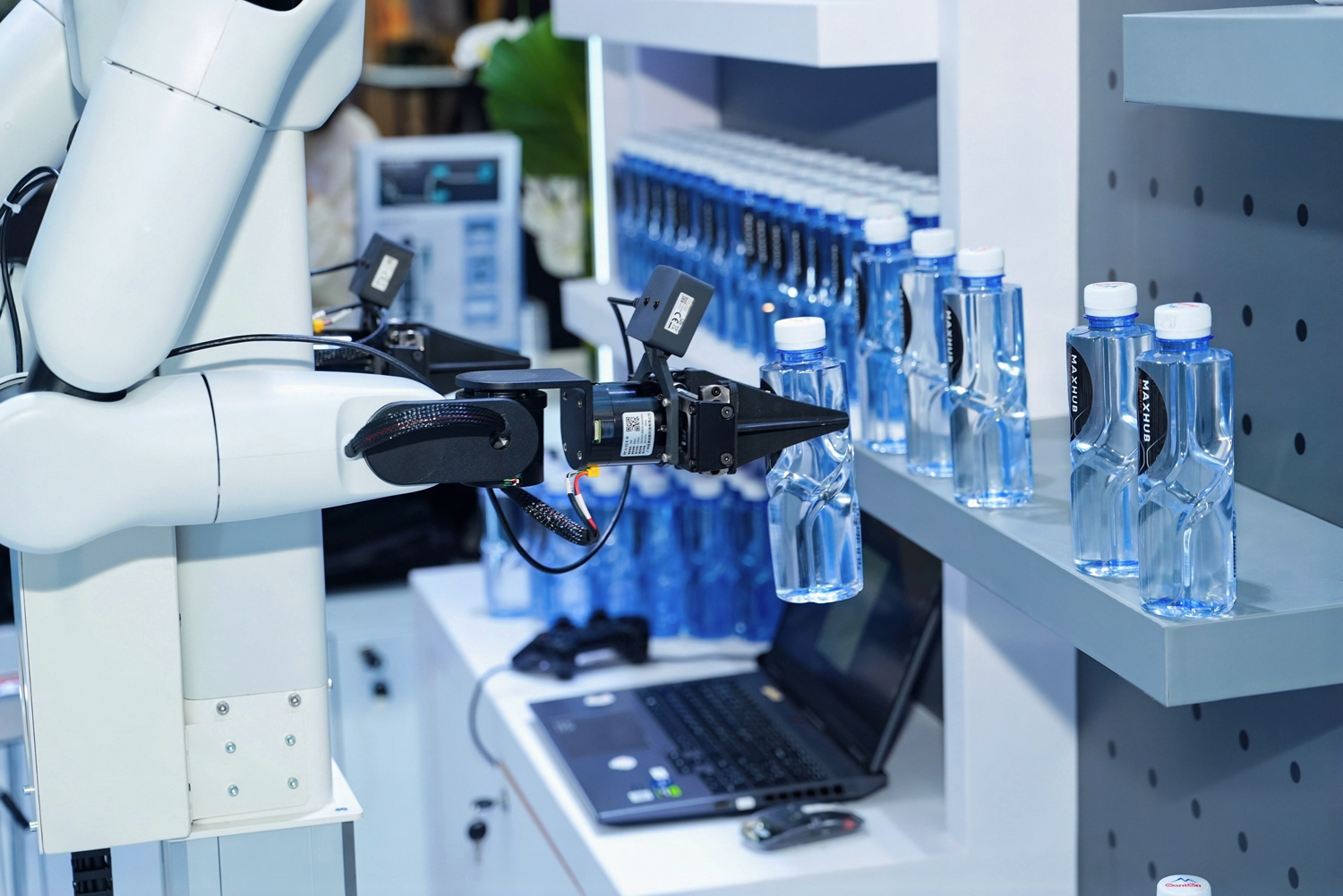
MAXHUB D3七轴仿人形双臂成为视源股份展位最受关注的展品之一。这款延续"为应用而生"理念的旗舰双臂,以全自研行星关节模组和内置6TOPS算力单元为底座,现场既在零售场景中听懂顾客口语、自主取货送货,也与生态伙伴在工业场景等精细作业进行了开发,同时凭借卓越的产品力与场景应用能力获得《中国电子报》的具身智能优秀技术、 产品、 解决方案的推荐。

视源股份在机器人领域坚持“全栈自研”——从底层运动控制算法、关节电机到整机设计制造实现核心技术自主可控。落到MAXHUB D3上,这套自研体系转化为四项看得见的“类人本领”:一是够得着、使得上劲——660毫米臂展能伸进货架深处,3公斤额定负载拎得起日常物件,还能像人手一样感知阻力、收着劲儿发力,拧旋钮不硬拧、不蛮干;二是反应比眨眼还快——动作响应低至20毫秒,不到人眨眼时间的十分之一,遇到突发状况能瞬间“收手”,快而稳、动而准;三是不挑工具、不挑模型——主流编程语言、仿真平台与具身智能模型均可直接对接,开发者拿来即用,不为适配多耗一天;四是支持高效示教——通过“手把手”示教等多种遥操方式,机器人能将看到、听到、做到的信息同步记录成高质量的训练数据,越教越熟练、越用越聪明。
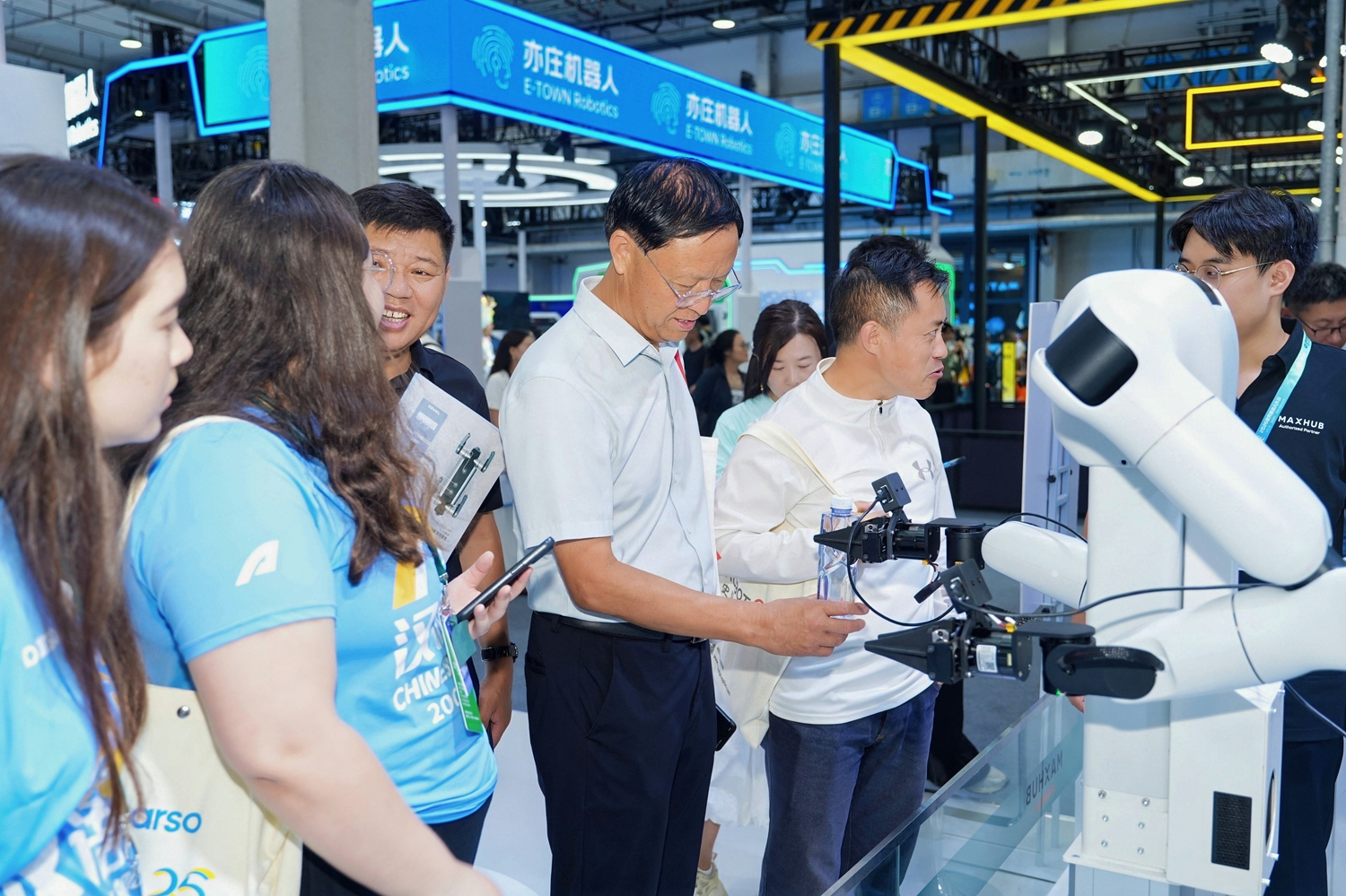
在WRC现场,视源股份展示MAXHUB D3在商业零售场景的应用。以其双臂为核心的轮式双臂具身智能机器人采用视觉—语言—动作一体化VLA端到端架构,全身20个自由度,顾客一句"帮我拿两瓶水"即可触发全流程:机器人自主理解开放式口语指令,完成定位导航与动态避障,识别货架商品后由双臂抓取、搬运并送货到手,完整复刻商超"接单—寻货—取货—送货"业务闭环。由于无需预设程序、无需预先标定商品,该方案具备开放场景泛化能力,未来可延伸至无人商超、仓储拣选、理货搬运等更多服务场景。
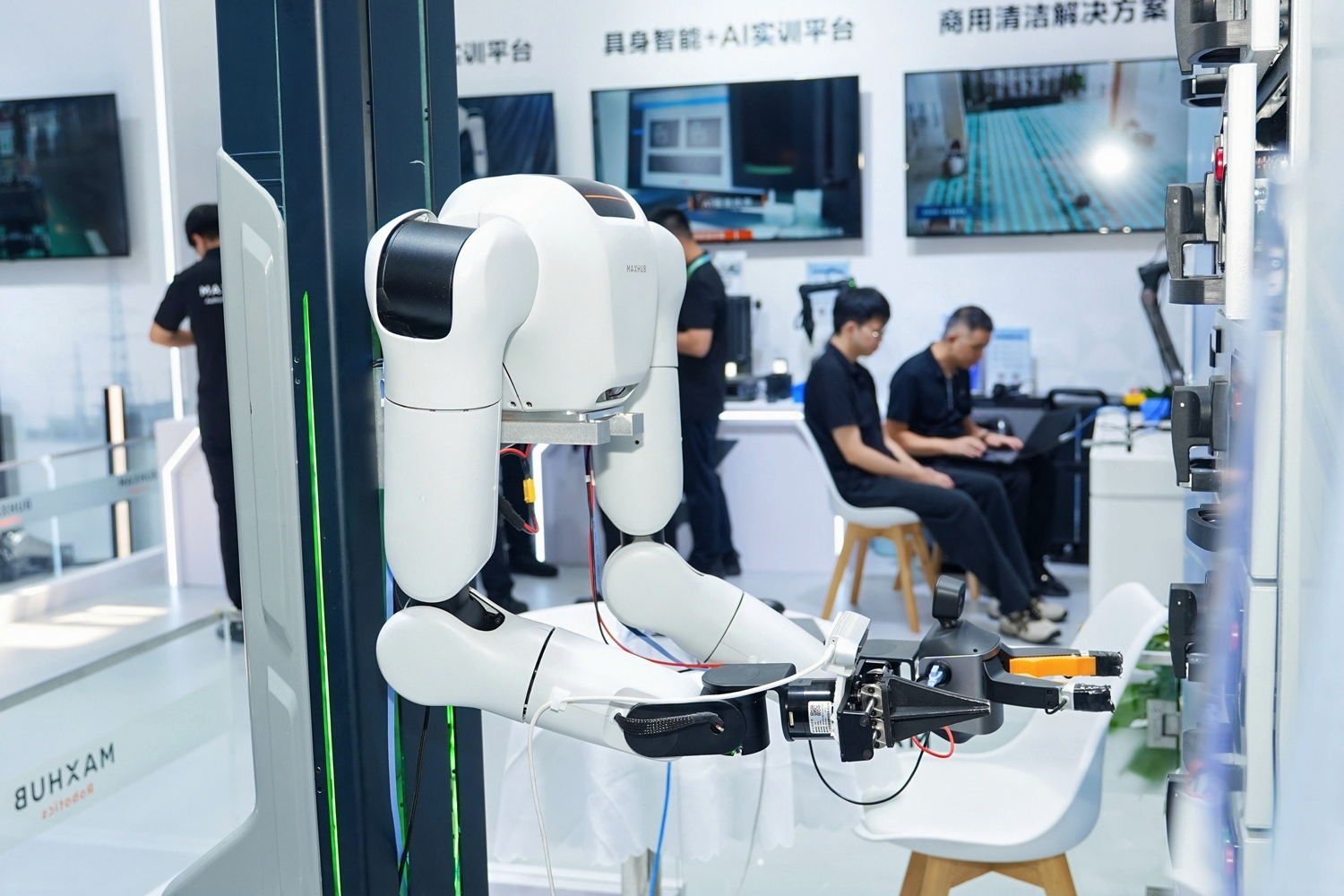
在工业侧,MAXHUB D3与T-WAVES工业具身智能模型实现落地验证,以MAXHUB D3为载体,在电柜点按插拔等典型工业场景中完成了模型与硬件的深度适配与联合验证。“看见旋钮”走向“稳定旋拧”。外置安全层控制旋拧风险,外置安全层控制旋拧风险,保障旋拧扭矩的安全可靠性。在落地验证中,MAXHUB D3已成功完成配电房旋钮操作、按钮按压、开柜门、消控盘按钮按压等真实作业任务,可进一步扩展至电力巡检、消防应急、危化处理、矿山作业等更广阔的应用领域。

从听懂一句"帮我拿两瓶水",到稳定旋拧配电柜旋钮,MAXHUB D3用同一双臂回答了具身智能落地的两个关键问题:技术如何贴近生活,如何深入产业。在具身智能从"演示"走向"实用"的这一年,这款七轴仿人形双臂正与越来越多的场景和伙伴一起实现其真正价值。

注:文/龚作仁,文章来源:Laborer,本文为作者独立观点,不代表亿邦动力立场。

【版权提示】亿邦动力倡导尊重与保护知识产权。未经许可,任何人不得复制、转载、或以其他方式使用本网站的内容。如发现本站文章存在版权问题,烦请提供版权疑问、身份证明、版权证明、联系方式等发邮件至run@ebrun.com,我们将及时沟通与处理。

已点赞

+1

{{ praise_text }}

好文章,值得被更多人看到

FAQ回顾

MAXHUB D3七轴仿人形双臂是什么?

是视源股份推出的面向场景应用的机械臂产品,采用全自研行星关节模组,内置6TOPS算力单元,具备660毫米臂展、3公斤额定负载、20毫秒动作响应等特性,可适配多场景作业需求。

MAXHUB D3七轴仿人形双臂可应用在哪些场景?

目前已完成零售、电力等场景的深度适配与联合验证,零售场景可听懂口语指令自主完成取货送货全流程,电力场景可完成配电房旋钮操作、按钮按压等作业,未来还可延伸至仓储拣选、消防应急等领域。

MAXHUB D3七轴仿人形双臂有什么核心优势?

该产品基于视源股份全栈自研体系打造,具备四项类人本领:可感知阻力适配精细作业,动作响应低至20毫秒安全性高,可对接主流开发工具降低适配成本,支持高效示教可越用越聪明。

广告

下一篇

跨境电商资源对接

《全球跨境电商服务商资源手册》第二期手册现已发布,触达更多资源,了解跨境服务商信息,欢迎点击链接下载。

了解详情

震坤Q2经调整净利润3846万元 AI能力加速商业化

GMV达28.8亿元,同比增长18.9%;净收入24.4亿元,同比增长12.8%,增速创近几个季度新高。