• 亿邦公众号
    • APP下载

京东二季度Non-GAAP净利润同比增长20.3% 外卖业务实现同比减亏超50%|财报解析

作者:郑雅 文章来源:亿邦动力

2026-08-14 12:23

作者:郑雅 文章来源:亿邦动力

2026-08-14 12:23

邦小白快读

EN
全文速览

本文披露了京东集团2026年第二季度财报的核心业绩信息,整体来看京东经营韧性较强,利润实现明确增长。

1.核心业绩数据:该季度京东总收入3464.01亿元,Non-GAAP归属于普通股股东的净利润同比增长20.3%,外卖业务同比减亏超50%,整体净利润率较去年同期提升,现金流充足,截至二季度末现金类资产总计2351亿元。年度、季度活跃用户数以及PLUS会员数均实现同比双位数增长。

2.各业务表现:商品收入同比下滑5.4%,但服务收入同比增长6.8%,占比提升至22.9%;带电品类短期承压但市占率稳步提升,日百品类同比增长5.6%,其中商超接近双位数增长,健康、工业品保持双位数以上增长。

3.成本投入变化:营销开支同比减少24.8%,研发开支同比提升37.7%,重点投入技术能力建设。

本文为品牌商提供了京东平台最新的发展趋势、合作机会与消费方向,可帮助品牌调整布局策略。

1.渠道布局机会:京东第三方商家销售增速已连续三个季度超过自营,二季度销售占比环比提升,第三方平台增长空间充足;京东带电品类市占率稳步提升,依托供应链能力可缓冲涨价压力,电子家电品牌布局京东可巩固市场地位。

2.产品研发合作机会:京东推出JoyInside AI技术,已经与近200家品牌达成合作,可为家居家电、机器人等硬件提供智能交互能力,AI给品类创新带来机遇,品牌可对接该资源开展产品智能化升级。

3.消费趋势参考:日百品类中商超、健康、工业品保持双位数增长,居家场景服务收入同比增长69.6%,相关领域消费需求旺盛,品牌可优先布局这些增长赛道。

本文为在京东经营的卖家梳理了平台最新变化、增长机会与风险提示,干货内容如下:

1.明确增长赛道机会:当前京东平台内,日百品类中的商超、健康、工业品保持双位数增长,居家场景相关服务收入同比增长达到69.6%,这些赛道需求旺盛,是卖家可以切入的增长方向;带电品类受高基数影响短期承压,下半年高基数影响消化后增速将明显回升,相关品类卖家可提前准备迎接增长。

2.平台趋势利好第三方卖家:京东第三方商家销售增速已经连续三个季度超过自营,销售占比持续环比提升,平台生态建设持续推进,第三方卖家获得更多流量支持。

3.风险缓冲优势:京东依托自身供应链能力,可通过前瞻性备货缓冲电子品类的涨价压力,帮助卖家保持商品价格竞争力,降低原材料涨价带来的经营风险。

本文给对接电商渠道的生产工厂提供了产品需求、商业机会与数字化转型的参考信息,核心干货如下:

1.产品生产设计需求方向:当前带电品类虽然短期承压,但下半年增速预期回升,且AI带动电子家电品类创新,工厂可围绕智能化方向调整产品设计与生产规划;日百品类整体保持增长,其中商超、健康、工业品均保持双位数增长,相关品类的生产需求稳定,工厂可安排对应产能布局。

2.商业合作机会:京东开放JoyInside AI技术能力,已经和近200家品牌合作打造智能化硬件,有智能化升级需求的工厂可对接该资源,提升产品附加值,拓展销路。

3.转型发展启示:京东自身持续加大研发投入,通过数字化供应链提升运营效率,缓冲价格波动风险,工厂可参考该路径,推进自身数字化升级,对接京东供应链体系,提升备货与生产效率,增强应对市场波动的能力。

本文给电商零售相关服务商提供了行业发展趋势、客户痛点与商机信息,核心干货如下:

1.行业发展趋势:当前京东等头部电商已经从规模扩张转向高质量盈利发展,服务收入占比持续提升,京东二季度服务收入占比已经达到22.9%,其中平台广告、居家服务、物流服务都保持较好增长,即时零售、本地生活服务还在持续拓展,相关服务的市场需求持续增长。

2.新技术商机:AI已经成为行业创新的核心驱动力,京东二季度研发开支同比增长37.7%,重点布局AI技术,已经开放JoyInside为硬件提供智能交互能力,品牌商、工厂都有AI赋能产品、数字化升级的需求,AI技术服务商、数字化零售服务商将获得更多商机。

3.客户需求方向:京东外卖正在推进履约协同升级,需要更多本地商家运营、即时配送相关的服务支持;品牌和工厂都有提升供应链效率、降低成本的需求,服务商可针对性开发对应解决方案,拓展客户群体。

京东这份财报的经营策略与业务布局,能给其他电商平台提供运营管理、业务拓展、风险规避的参考,核心干货如下:

1.新业务拓展可参考生态协同模式:京东拓展外卖业务依托自身原有零售与物流生态,实现了用户、跨品类、履约层面的协同,既带动了整体用户增长,也通过精细化运营快速实现减亏超50%,优化了单位经济模型,这种依托原有生态拓展新业务的模式,避免了纯烧钱扩张的风险,具备更强的韧性。

2.运营管理可借鉴提效增利路径:京东通过优化营销开支,压缩不必要投入,同时持续加大研发和履约投入提升用户体验,推动高毛利的佣金、广告等服务收入占比提升,带动整体利润率改善,第三方业务增速超过自营,平台生态化发展优化了收入结构,这种轻重结合的运营策略适合头部平台借鉴。

3.风险规避提示:拓展新业务要注重控制投入,提升补贴效率,逐步优化单位经济模型,避免长期大幅亏损;对于3C家电等标准化品类,要提前布局供应链能力,缓冲价格波动和基数变化带来的业绩扰动,巩固市场地位。

这份京东2026年二季度财报反映了当前中国自营电商行业的最新发展动向,为产业研究提供了一手信息,核心内容如下:

1.产业发展新阶段动向:头部电商已经告别过去的规模扩张阶段,进入以提升盈利为核心的高质量发展阶段,京东二季度虽然收入小幅下滑,但Non-GAAP净利润同比增长20.3%,利润迎来明确拐点,成本结构持续优化,营销开支下降,研发投入提升,行业整体进入效率竞争阶段。

2.新商业模式创新动向:京东外卖探索出了依托原有零售物流生态的即时零售发展路径,不同于纯外卖平台的烧钱扩张模式,通过生态协同快速实现减亏超50%,单位经济模型明显优化,这种差异化的即时零售商业模式具备更强的抗风险能力,是即时零售行业的新发展方向。

3.产业新特征总结:当前自营电商平台的第三方商家业务增速已经连续多个季度超过自营,生态化转型成为重要趋势;AI赋能硬件创新成为新的增长曲线,供应链能力成为应对市场波动、巩固市场地位的核心竞争力,这些新特征都为产业研究提供了新的方向。

声明:快读内容全程由AI生成,请注意甄别信息。如您发现问题,请发送邮件至 run@ebrun.com 。

我是 品牌商 卖家 工厂 服务商 平台商 研究者 帮我再读一遍。

Quick Summary

This article discloses core performance figures from JD.com’s Q2 2026 earnings report, showing that JD maintains strong operational resilience and delivers clear profit growth.

1. Core performance metrics: JD posted total revenue of RMB 346.401 billion in the quarter. Non-GAAP net income attributable to ordinary shareholders rose 20.3% year-over-year, while its food delivery business narrowed losses by more than 50% year-over-year. Overall net margin improved from a year earlier, and the company holds ample cash flow, with total cash equivalents of RMB 235.1 billion as of the end of Q2. Both annual and quarterly active users, as well as JD PLUS membership, recorded double-digit year-over-year growth.

2. Segment performance: Merchandise revenue fell 5.4% year-over-year, but service revenue grew 6.8% year-over-year, lifting its share of total revenue to 22.9%. Consumer electronics and home appliances faced short-term headwinds but saw steady market share gains; daily consumer goods grew 5.6% year-over-year, with supermarket categories approaching double-digit growth, and health and industrial goods maintaining growth above 10%.

3. Cost allocation changes: Marketing spending dropped 24.8% year-over-year, while R&D expenditure increased 37.7% year-over-year, with a focus on building technical capabilities.

This article outlines JD’s latest platform development trends, cooperation opportunities and consumer directions to help brands adjust their layout strategies.

1. Channel layout opportunities: Growth in sales from JD’s third-party merchants has outpaced that of first-party sales for three consecutive quarters, with the third-party sales share rising sequentially in Q2, leaving ample room for further growth. JD has steadily gained market share in consumer electronics and home appliances, and its supply chain capabilities help buffer price hike pressures, making it a strong channel for electronics and home appliance brands to cement their market position.

2. Product R&D cooperation opportunities: JD has launched its JoyInside AI technology and already formed partnerships with nearly 200 brands. The technology enables smart interaction for hardware products including home appliances and robots, opening up new opportunities for category innovation. Brands can leverage this resource to drive intelligent product upgrades.

3. Consumer trend insights: Supermarket, health and industrial goods within daily consumer categories are recording double-digit growth, and revenue from home-scenario services jumped 69.6% year-over-year, indicating strong consumer demand in these segments. Brands can prioritize layout in these high-growth tracks.

This article sorts out the latest platform changes, growth opportunities and risk warnings for sellers operating on JD, with key insights as follows:

1. Clear high-growth opportunities: On JD’s platform, supermarket, health and industrial goods in the daily consumer category maintain double-digit growth, while revenue from home-scenario related services grew 69.6% year-over-year. These segments boast strong demand and represent attractive growth directions for sellers. Consumer electronics face short-term pressure from a high base effect, but growth is expected to pick up notably in the second half of the year once the base effect fades. Sellers in related categories can prepare in advance for the coming growth.

2. Platform trends favor third-party sellers: Sales growth for JD’s third-party merchants has outpaced first-party sales for three straight quarters, with third-party sales share rising sequentially quarter after quarter. JD continues to advance its platform ecosystem buildout, and third-party sellers are gaining greater traffic support.

3. Advantages for risk buffering: Leveraging its in-house supply chain capabilities, JD can buffer price hike pressures for electronics categories through proactive inventory preparation, helping sellers maintain price competitiveness and reduce operational risks stemming from rising raw material costs.

This article provides references on product demand, business opportunities and digital transformation for manufacturing factories that work with e-commerce channels, with key takeaways as follows:

1. Product design and development direction: While consumer electronics face short-term headwinds, growth is expected to rebound in the second half of the year, and AI is driving innovation in the electronics and home appliance category. Factories can adjust their product design and production planning to focus on intelligent features. The overall daily consumer goods category maintains steady growth, with supermarket, health and industrial goods all posting double-digit growth, so production demand for these categories is stable, and factories can arrange capacity allocation accordingly.

2. Business cooperation opportunities: JD has opened up its JoyInside AI technology capability and already partnered with nearly 200 brands to develop smart hardware. Factories with intelligent upgrade demands can access this resource to boost product added value and expand sales channels.

3. Insights for transformation and growth: JD has consistently increased R&D investment, improving operational efficiency and buffering price volatility risks through digital supply chains. Factories can follow this example to advance their own digital upgrades, integrate with JD’s supply chain system, improve inventory and production efficiency, and strengthen their ability to withstand market fluctuations.

This article provides insights on industry development trends, customer pain points and business opportunities for e-commerce retail-related service providers, with key takeaways as follows:

1. Industry development trends: Leading e-commerce platforms including JD have shifted their focus from scale expansion to high-quality profitable growth, with the share of service revenue rising steadily. Service revenue accounted for 22.9% of JD’s total revenue in Q2, with platform advertising, home services and logistics services all posting solid growth. Instant retail and local lifestyle services continue to expand, driving sustained growth in market demand for related services.

2. New technology opportunities: AI has become a core driver of industry innovation. JD increased R&D spending by 37.7% year-over-year in Q2, with a key focus on AI development. It has already opened up JoyInside to provide smart interaction capabilities for hardware, and both brands and factories have demand for AI-powered product upgrades and digital transformation. AI technology service providers and digital retail service providers will see expanded business opportunities.

3. Customer demand directions: JD is advancing fulfillment collaboration upgrades for its food delivery business, requiring more support for local merchant operations and instant delivery-related services. Both brands and factories have demand for improving supply chain efficiency and cutting costs. Service providers can develop targeted solutions to expand their customer base.

JD’s operating strategy and business layout in this earnings report offer references for other e-commerce platforms in operations management, business expansion and risk mitigation, with key insights as follows:

1. The ecosystem collaboration model for new business expansion: JD expanded its food delivery business by leveraging its existing retail and logistics ecosystem to achieve synergy in user access, cross-category operations and fulfillment. This approach drove overall user growth, cut losses by more than 50% quickly through refined operations, and optimized the unit economic model. This model of expanding new businesses based on existing ecosystems avoids the risk of pure cash-burn expansion and delivers stronger resilience.

2. The efficiency and profit improvement path for operations management: JD optimized marketing spending to cut unnecessary costs, while continuously increasing investment in R&D and fulfillment to improve user experience. It lifted the share of high-margin service revenue including commission and advertising, driving overall margin improvement. With third-party business outgrowing first-party sales, the platform’s ecosystem-focused development has optimized its revenue structure. This balanced operating strategy that combines light and heavy asset models is a valuable reference for leading platforms.

3. Risk mitigation guidance: When expanding new businesses, platforms should focus on controlling spending, improving subsidy efficiency and gradually optimizing unit economic models to avoid sustained large losses. For standardized categories such as 3C electronics and home appliances, platforms should build out supply chain capabilities in advance to buffer performance disruptions from price volatility and base effect changes, and cement market position.

JD’s Q2 2026 earnings report reflects the latest development trends of China’s first-party e-commerce industry, providing first-hand information for industrial research, with key content as follows:

1. New phase of industry development: Leading e-commerce players have left behind the era of scale expansion and entered a high-quality development phase centered on profit improvement. While JD posted a slight revenue decline in Q2, its Non-GAAP net income grew 20.3% year-over-year, marking a clear inflection point for profit growth. The company has continued to optimize its cost structure, cutting marketing spending while increasing R&D investment, and the overall industry has entered an efficiency competition phase.

2. New business model innovation: JD Food Delivery has developed an instant retail growth path that leverages its existing retail and logistics ecosystem. Unlike the cash-burn expansion model adopted by pure-play food delivery platforms, it achieved more than 50% loss reduction quickly through ecosystem synergy and significantly optimized its unit economic model. This differentiated instant retail business model has stronger risk resistance and represents a new development direction for the instant retail industry.

3. Summary of new industry characteristics: Growth in third-party merchant business has outpaced first-party business for multiple consecutive quarters at first-party e-commerce platforms, making ecosystem transformation a key industry trend. AI-powered hardware innovation has emerged as a new growth curve, and supply chain capability has become the core competitiveness for withstanding market fluctuations and cementing market position. These new characteristics open up new directions for industrial research.

Disclaimer: The "Quick Summary" content is entirely generated by AI. Please exercise discretion when interpreting the information. For issues or corrections, please email run@ebrun.com .

I am a Brand Seller Factory Service Provider Marketplace Seller Researcher Read it again.

【亿邦原创】8月14日消息,昨日,京东集团(纳斯达克代码:JD,港交所代号:9618(港币柜台)及89618(人民币柜台))发布了2026年第二季度及中期业绩。

二季度,京东集团收入为3464.01亿元(人民币,单位下同),同比减少2.9%。归属于上市公司普通股股东的净利润为71亿元,去年同时期为62亿元。2026年第二季度归属于上市公司普通股股东的净利润率为2.1%,2025年第二季度为1.7%。

京东集团首席执行官许冉表示:“第二季度业绩体现出我们具有韧性的高质量经营表现,虽然收入增长面临阶段性扰动,但利润实现大幅改善,标志着公司盈利轨迹迎来明确拐点。利润改善主要得益于我们核心业务京东零售稳健的盈利表现,以及京东外卖业务的持续减亏。此次业绩充分证明了我们以供应链为基础的业务模式的韧性,以及团队对经营效率的聚焦。下半年我们将立足这些优势,持续发力并进一步释放潜能。”

1.服务收入占比提升至22.9% 净利润同比增长20.3%

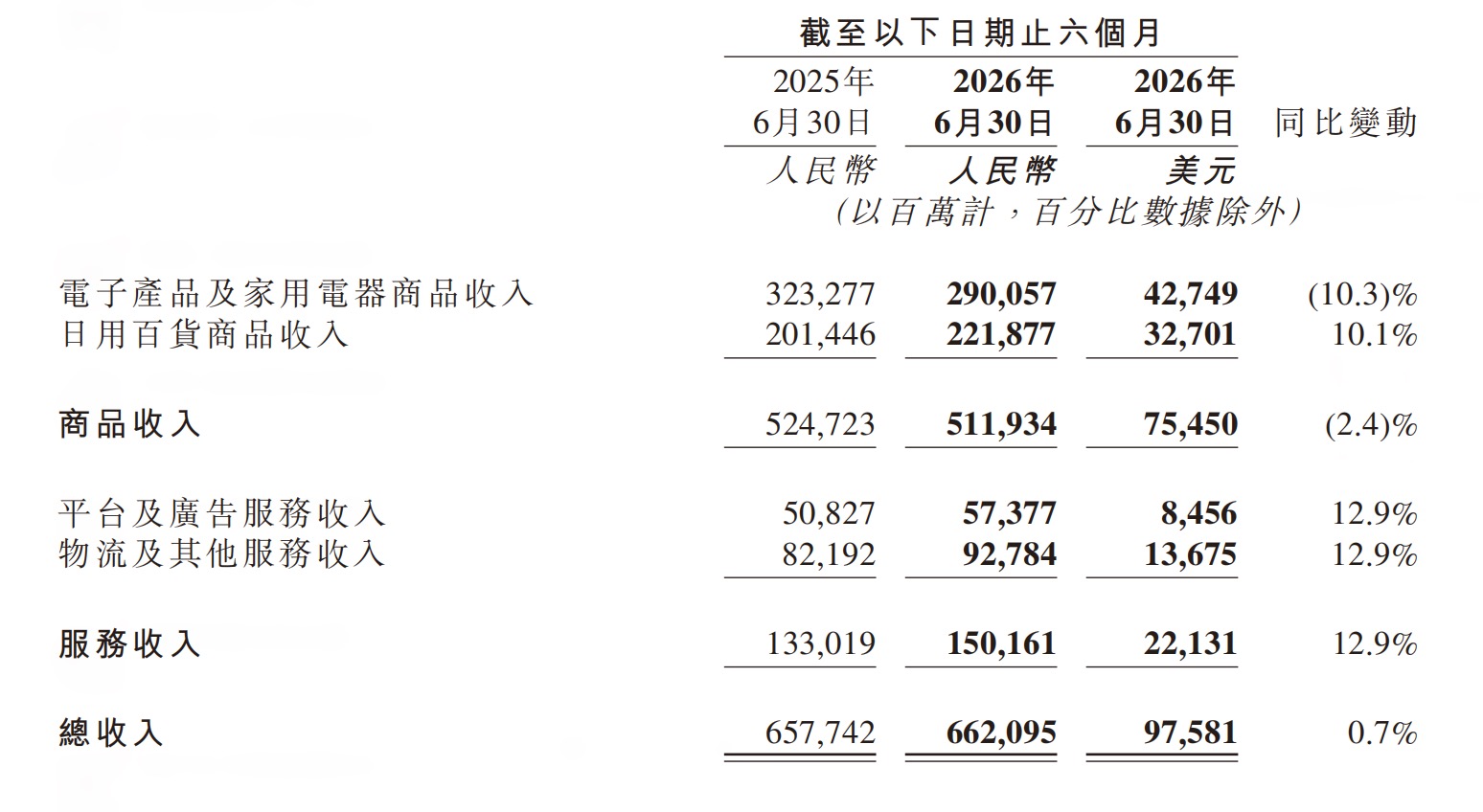
今年第二季度,京东集团收入为3464.01亿元,同比减少2.9%。收入构成上,京东集团收入由商品收入和服务收入组成。第二季度,其商品收入为2671.15亿元,同比减少5.4%。其中,电子产品及家用电器商品收入为1578.86亿元,同比减少11.8%;日用百货商品收入1092.29亿元,同比增长5.6%。

对于带电品类的表现,许冉在电话会中表示:“尽管受到去年高基数的效应以及原材料成本上涨引发的电子品类涨价等多重影响,带电品类在二季度有短期承压。但是凭借京东深厚的供应链能力和我们在这个品类坚实的用户心智,我们看到京东的带电品类也继续巩固了我们的市场地位。尤其是家电各个品类的市占率都在实现稳步提升。”

她判断,下半年,京东集团有信心看到带电品类的增速会明显改善。一是,基数会逐步回归正常。从三季度起,国补高基数的影响将逐步被消化。京东方面预期带电品类在基数回归常态化后,其增速会回升。二是,京东供应链能力会在一定程度上缓解涨价压力。京东通过加强供应链能力,能够通过前瞻性布局、相对灵活的备货调整,更有效地应对和缓冲电子品类的价格上涨。在保持经营韧性的同时,持续为用户提供有价格竞争力的商品。三是,AI技术的快速发展,带来了产品和品类的创新机遇。数据显示,京东的JoyInside已经与将近200家品牌达成了合作,为家居家电、机器人等硬件提供了智能交互能力。

对于日百品类,许冉提到,日百品类同样也在一定程度上受到了去年二季度高基数的影响。一方面,去年二季度的国补直接拉动了家居家装等品类的销售。另一方面,国补与外卖业务共同拉动了平台流量和一部分的交叉购买。

据悉,从细分品类来看,京东的日百品类中体量最大的商超品类接近双位数增长;健康和工业品品类继续保持双位数以上的增长。

京东方面认为,不断优化的品类经营能力所带来的用户体验的持续改善,以及用户的持续增长、平台生态的建设等,都是日百品类可以继续保持健康增长的核心驱动力。

同时期内,服务收入达792.86亿元,同比增长6.8%。该项收入占收入比例提升至22.9%,其中,来自居家场景下的服务收入同比增长69.6%。服务收入中平台及广告服务收入同比增长8.3%。

第二季度,京东集团经营利润为45亿元,2025年第二季度经营损失达9亿元。经营利润率为1.3%,去年同时期为负0.2%。2026年第二季度非美国公认会计准则下经营利润为55亿元,去年同时期为9亿元。2026年第二季度非美国公认会计准则下经营利润率为1.6%,2025年第二季度为0.3%。

同时期内,非美国公认会计准则下归属于上市公司普通股股东的净利润为89亿元,同比增长20.3%。非美国公认会计准则下归属于本公司普通股股东的净利润率为2.6%,2025年第二季度为2.1%。

二季度,非美国公认会计准则下EBITDA为79亿元,2025年第二季度为人民币30亿元。非美国公认会计准则下EBITDA利润率为2.3%,2025年第二季度为0.8%。
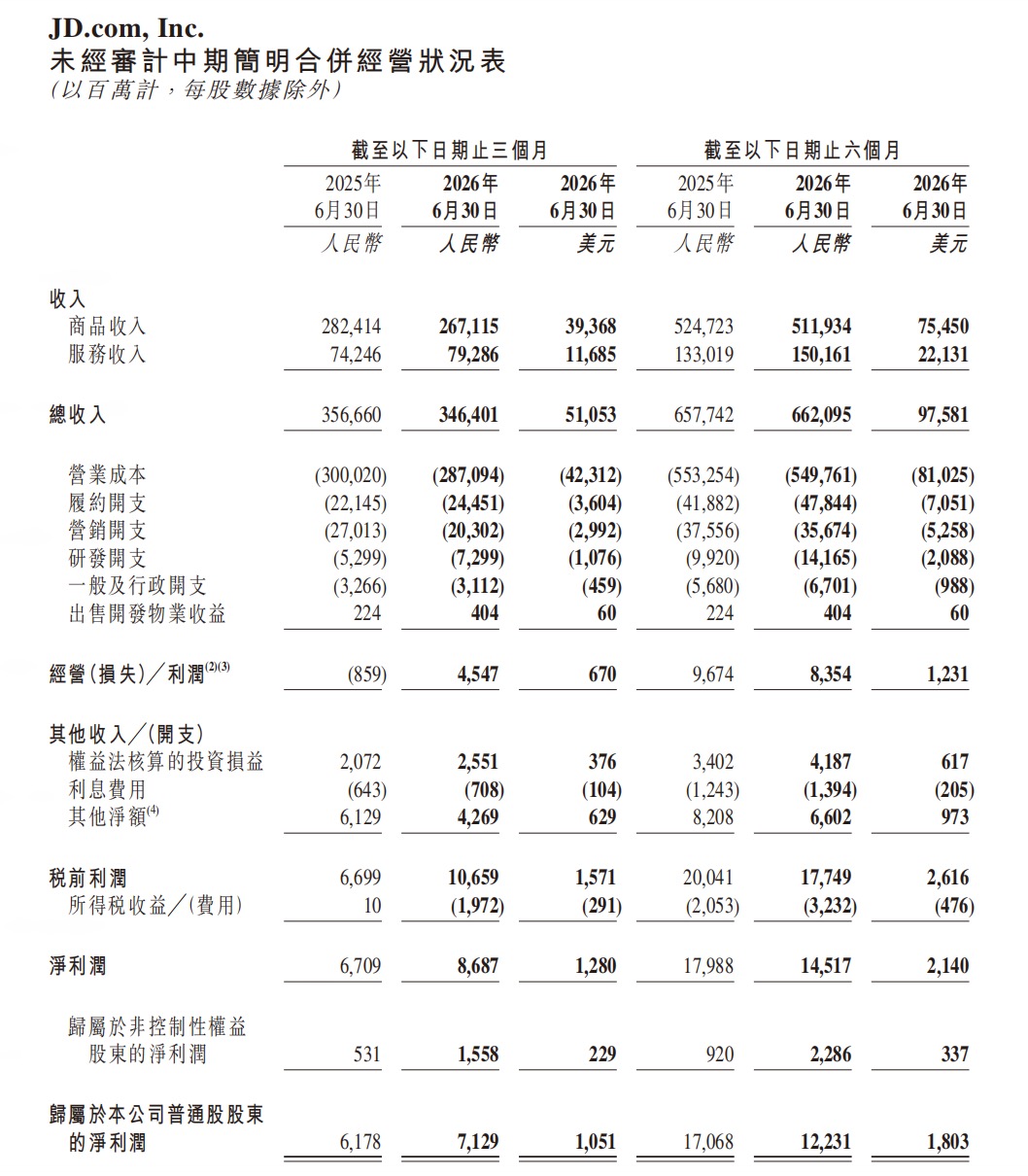
成本表现上,第二季度,京东集团的营业成本为2871亿元,同比减少4.3%。履约开支(主要包括采购、仓储、配送、客户服务及支付处理开支)达245亿元,同比增长10.4%。该项支出占收入的7.1%,去年同时期为6.2%。占比增加的主要原因为京东持续优化履约能力并加大人力投入以提升用户体验,同时为新业务构建运营基础设施。

由于京东对新业务推广活动的支出进行了优化,二季度其营销开支达203亿元,同比减少24.8%。营销开支在收入中占比5.9%,2025年第二季度为7.6%。一般及行政开支为31亿元,同比减少4.7%。

此外,在京东持续投入技术能力和人才的动作下,研发开支由2025年第二季度的53亿元增加37.7%至今年第二季度的73亿元。研发开支占收入的2.1%,去年同时期为1.5%。

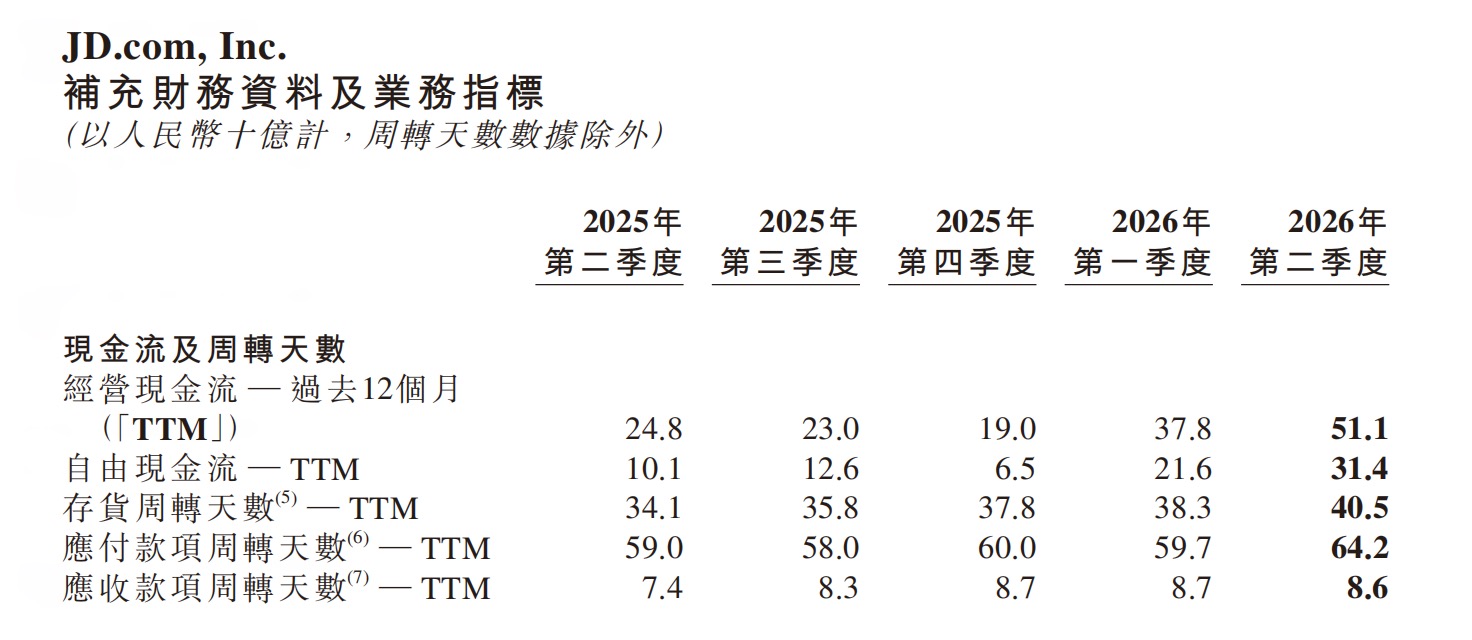
截至2026年6月30日,京东集团的现金及现金等价物、受限制现金及短期投资总计2351亿元,截至2025年12月31日为2254亿元。

从2026年上半年来看,京东集团总收入为6620.95亿元,同比微增0.7%。
2.活跃用户数保持同比双位数增长

从业务组成来看,第二季度,京东零售收入达2953.83亿元,同比减少4.7%,在总收入中占比85.27%。京东零售第二季度录得经营利润为135亿元,去年同时期为139亿元。京东零售经营利润率为4.6%,2025年第二季度为4.5%。

京东集团首席财务官单甦在电话会中表示,二季度京东零售净利润、经营利润率的稳步提升,一方面得益于毛利率的持续改善,其中运营和供应链效率的提升,带动了商品毛利率提升,以及高毛利的佣金和广告收入占比持续提升。另一方面则是市场费和费率连续4 个季度实现同比优化。

京东方面认为,长期来看,其对实现高个位数的利润率目标保持信心。这背后的核心驱动力主要有四方面,一是自营能力,京东通过自营供应链能力的强化和规模优势,商品毛利率将持续稳步提升。二是商超等品类的盈利能力仍然有较大的提升空间。三是随着商品结构的优化,带电品类长期来看也有利润率提升的空间。四是是平台生态方面,佣金和广告等高利润率的服务会保持快速增长,优化整体的收入结构,带动利润率提升。

据悉,京东零售第三方商家的销售增速在过去三个季度超过了自营品类,二季度的销售占比也在环比提升。用户表现方面,年度和季度活跃用户数以及京东PLUS会员数在二季度均实现同比双位数增长。

京东物流二季度收入为641.02亿元,同比增长24.3%。京东物流的经营利润为22.63亿元,经营利润率为3.5%。

该季度,京东的存货周转天数为40.5天。该项指标正逐季度升高。
第二季度,新业务(主要包括京东外卖、京东产发、京喜及海外业务)收入为72.60亿元,同比减少47.6%。新业务经营损失达98.54亿元,去年同期亏损147.77亿元。新业务经营利润率为负135.7%。

3.外卖业务实现同比减亏超50%

截至目前,京东外卖已经上线一年多的时间。京东集团在京东外卖业务的规划和目标是电话会上关注的重点。

许冉在电话会中表示:“京东外卖业务目前取得了不错的进展。二季度,外卖业务的单量规模保持了健康上涨的态势,同时总投入也实现了同比减亏超50% 的显著改善。”据悉,外卖业务上线一年以来,其UE模型(平台单位经济模型)取得了明显优化。京东方面认为,这主要得益于精细化的业务运营和补贴效率的提升,使得单均补贴在明显下降。此外,配送效率随着规模的增长在持续提升,以及初步产生的佣金、广告多元化的收入贡献等也是UE模型改善的原因。

业务协同方面,许冉指出,外卖作为根植于京东整体生态的业务,它所带来的协同价值也在逐步释放和体现。一是,外卖业务与核心零售业务在用户和跨品类购物的协同。二是,本地化商品供给和商家生态也进一步丰富。三是,外卖履约和物流配送的底层协同也正在打通,京东方面预计这将提升集团整体的即时配送能力与效率。

“从长期目标来看,我们在保持外卖业务规模健康增长的同时,会不断提升我们的运营效率,逐渐去改善外卖的UE。更重要的是,我们将加快外卖与核心业务的深度协同,不断的挖掘在京东生态中更多的协同价值,带动京东整体用户和收入的健康增长以及效率的提升。”许冉总结道。

亿邦持续追踪报道该情报,如想了解更多与本文相关信息,请扫码关注作者微信。

【版权提示】亿邦动力倡导尊重与保护知识产权。未经许可,任何人不得复制、转载、或以其他方式使用本网站的内容。如发现本站文章存在版权问题,烦请提供版权疑问、身份证明、版权证明、联系方式等发邮件至run@ebrun.com,我们将及时沟通与处理。

已点赞

+1

{{ praise_text }}

好文章,值得被更多人看到

FAQ回顾

京东2026年第二季度整体经营业绩如何?

2026年第二季度京东集团总营收3464.01亿元,Non-GAAP归属于普通股股东净利润89亿元,同比增长20.3%,服务收入占比提升至22.9%,年度、季度活跃用户及PLUS会员数均实现同比双位数增长。

京东外卖2026年二季度运营情况怎么样?

2026年二季度京东外卖单量规模保持健康上涨,实现同比减亏超50%,UE模型明显优化,单均补贴下降,配送效率提升,与核心零售、物流履约的生态协同价值正逐步释放。

京东带电品类2026年下半年增速预期是怎样的?

京东预计2026年下半年带电品类增速将明显改善,三季度起国补高基数影响逐步消化,供应链能力可缓冲电子品类涨价压力,AI技术发展也将带来产品创新机遇,目前家电各品类市占率正稳步提升。

京东零售利润率提升的核心驱动因素有哪些?

京东零售利润率提升核心驱动来自四方面:强化自营供应链规模优势带动商品毛利率提升,商超等品类仍有较大盈利提升空间,带电品类长期利润率有提升空间,佣金广告等高毛利服务快速增长优化收入结构。

广告

下一篇

征集报名《品牌数字化服务商资源手册》

《品牌数字化服务商资源手册》展示数字化服务商风采,亿邦全年零售大会通发,触达更多资源,马上加入!

马上入驻

京东健康上半年营收409亿 增长主要由医药和健康产品收入驱动

2026年上半年,京东健康总收入为人民币408.88亿元,同比增长15.9%;毛利106.86亿元,同比增长20.2%;经营盈利31.74亿元,同比增长49.2%;期间盈利34.35亿元,同比增长32.6%


医疗 医院 医药 未来零售

2026-08-14 11:12:36