



• 亿邦公众号
    • APP下载

拼多多力推“优惠联合营销”:平台掏钱补贴 商家仅需按优惠开票

作者:亿邦动力 文章来源:亿邦动力

2026-04-01 17:00

作者:亿邦动力 文章来源:亿邦动力

2026-04-01 17:00

邦小白快读

EN
全文速览

拼多多推出“优惠联合营销活动”,整合平台优惠资源,商家开通后可获免费流量和平台补贴,需注意开票规则和退出机制。

1. 活动整合省钱月卡、大促消费券、百亿补贴等优惠,商家统一接入后获得搜索和推荐流量加权,提升店铺曝光和销售机会。

2. 平台承担所有优惠成本,商家仅需按优惠金额向平台开服务费发票(税率6%、3%、1%或免税),不影响报税成本;例如订单200元优惠50元,商家开50元发票,仍按200元报税。

3. 资金管理规则:平台限制提现待开票金额的30%,待发票审核后解除;逾期未开票扣30%优惠金额(如50元优惠扣15元)。

4. 活动自动在商家后台弹出开通,需在公示期(4月7-13日)主动退出,否则视为同意;不开通可能被踢出补贴池,商家需谨慎操作避免误开通。

5. 多多国际和多多买菜商家不支持,其他商家可通过电脑或移动端后台开通或关闭活动。

此活动为品牌商提供品牌营销和渠道建设机会,通过平台整合优惠提升用户吸引力和定价策略。

1. 品牌营销:利用统一优惠资源如省钱月卡、百亿补贴券,增强品牌曝光和用户粘性,迎合消费趋势提升转化率。

2. 渠道建设:接入全站平台优惠池,获得免费流量加权,扩大品牌覆盖和销售渠道,优化用户行为观察。

3. 定价策略:平台承担优惠成本,品牌商可降低实际价格竞争压力,保持收入稳定;例如用户支付150元(原200元订单),品牌商无损收益。

4. 产品研发启示:活动鼓励顺应电商趋势,品牌需评估税务影响(如免增值税类目开票增成本),调整策略以利用扶持政策。

拼多多活动解读提供增长机会和风险提示,卖家应把握政策扶持并应对潜在挑战。

1. 政策解读:活动整合大促、月卡等优惠,商家开通获免费流量加权;需开服务费发票,平台承担成本,无额外税负。

2. 机会提示:免费流量提升销售增长,顺应趋势避免淘汰;平台招商策略如自动开通,商家可学习最新合作模式。

3. 风险提示:不开通可能被踢出补贴池,丧失平台扶持;开票增加增值税成本(免增值税类目商家需另交税)。

4. 应对措施:在公示期主动退出或评估税务影响;资金管理规则(如提现限制)需及时处理发票;关注消费需求变化以优化店铺运营。

活动提供电商商业机会和数字化启示,工厂可借此推进产品销售和在线转型。

1. 商业机会:通过平台优惠整合,工厂产品获更多曝光和销售渠道,提升市场份额;例如流量加权吸引用户,扩大产品需求。

2. 产品生产需求:参与活动需确保产品符合平台标准,利用免费资源优化设计以应对消费趋势。

3. 数字化启示:统一优惠管理展示电商整合优势,启示工厂推进在线销售和供应链数字化;学习平台资金规则简化流程。

4. 潜在挑战:开票流程可能增加管理负担;税务担忧需评估,如免增值税类目开票带来额外成本,但平台明确无报税影响。

活动反映行业趋势和客户痛点,服务商可借鉴解决方案开发新技术服务。

1. 行业趋势:电商平台整合分散优惠如省钱月卡、百亿补贴,统一资源池提升用户体验,展示数字化营销发展。

2. 客户痛点:商家开票担忧税负增加和流程复杂;平台提供方案:承担成本并简化税务处理(商家按总收入报税)。

3. 解决方案:资金管理规则(如提现限制和逾期扣款)确保合规;服务商可参考开发自动化开票或风险控制工具。

4. 新技术启示:活动展示统一优惠系统,服务商可研究类似整合方案,解决商家痛点并推动行业创新。

拼多多最新做法展示平台招商和运营管理,重点规避风险并提升商家合作。

1. 平台需求:整合分散优惠资源统一管理,解决商家接入痛点;通过流量加权和成本承担吸引更多商家参与。

2. 最新做法:自动开通弹窗强制商家参与(未退出视为同意);招商策略如威胁不开通踢出补贴池;运营管理包括发票规则和资金限制。

3. 风险规避:设置提现待开票金额30%限制和逾期扣款规则,确保发票合规;明确税务处理(商家无额外报税成本)减少纠纷。

4. 运营启示:活动范围排除多多国际和多多买菜,针对不同商家定制;后台支持电脑和移动端操作,优化管理效率。

活动揭示产业新动向和商业模式,引发政策法规和问题思考。

1. 产业新动向:电商平台创新联合营销模式,整合优惠资源如大促消费券,优化商家合作机制,反映行业整合趋势。

2. 新问题:开票税负担忧(免增值税类目商家需另交税);平台强制措施(如自动开通和踢出威胁)引发公平性讨论。

3. 政策法规启示:税务处理规则明确商家按订单总收入报税,开票金额不影响税基;研究者可分析其对电商法规的借鉴意义。

4. 商业模式:平台补贴承担成本换取流量和商家忠诚度;资金管理规则展示风险控制机制,启示可持续商业模型设计。

声明:快读内容全程由AI生成,请注意甄别信息。如您发现问题,请发送邮件至 run@ebrun.com 。

我是 品牌商 卖家 工厂 服务商 平台商 研究者 帮我再读一遍。

Quick Summary

Pinduoduo has launched a "Joint Marketing Promotion," integrating various platform discounts. Sellers who enroll receive free traffic exposure and platform subsidies but must pay attention to invoice rules and the opt-out mechanism.

1. The promotion consolidates discounts like the Savings Monthly Card, major sales coupons, and the "10 Billion Subsidies" program. Enrolled sellers receive weighted search and recommendation traffic, boosting store visibility and sales opportunities.

2. The platform covers all discount costs. Sellers only need to issue service fee invoices to the platform for the discounted amount (tax rates: 6%, 3%, 1%, or tax-exempt), with no impact on tax reporting costs. For example, on a ¥200 order with a ¥50 discount, the seller issues a ¥50 invoice but still reports ¥200 for tax purposes.

3. Fund management rules: The platform restricts withdrawals for 30% of the amount pending invoice issuance; this limit is lifted after invoice review. Failure to issue invoices on time results in a 30% deduction of the discount amount (e.g., a ¥15 deduction on a ¥50 discount).

4. The enrollment prompt automatically appears in the seller backend. Sellers must actively opt out during the announcement period (April 7-13); otherwise, enrollment is assumed. Not enrolling may lead to removal from the subsidy pool, so sellers should carefully manage their settings to avoid unintended enrollment.

5. The promotion is not available for Duoduo International and Duoduo Grocery sellers. Other sellers can enable or disable the promotion via computer or mobile backend.

This initiative offers brands opportunities for marketing and channel building by leveraging integrated platform discounts to enhance user appeal and pricing strategies.

1. Brand Marketing: Utilize unified discount resources like the Savings Monthly Card and 10 Billion Subsidies coupons to increase brand exposure and user loyalty, aligning with consumption trends to improve conversion rates.

2. Channel Building: Access the platform's full discount pool to gain free traffic weighting, expanding brand reach and sales channels while optimizing user behavior observation.

3. Pricing Strategy: With the platform absorbing discount costs, brands can reduce price competition pressure and maintain stable revenue. For instance, if a user pays ¥150 for a ¥200 order, the brand's revenue remains unaffected.

4. Product Development Insight: The promotion encourages adapting to e-commerce trends. Brands should assess tax implications (e.g., potential increased costs for VAT-exempt categories when issuing invoices) and adjust strategies to leverage platform support policies.

Pinduoduo's promotion presents growth opportunities and risks; sellers should capitalize on policy support while managing potential challenges.

1. Policy Overview: The activity integrates discounts from major sales and monthly cards. Enrolled sellers receive free traffic weighting. They must issue service fee invoices, but the platform covers the costs, incurring no additional tax burden.

2. Opportunities: Free traffic boosts sales growth; adapting to trends avoids obsolescence. The platform's recruitment strategy, like automatic enrollment, allows sellers to learn the latest cooperation models.

3. Risks: Not enrolling may lead to removal from the subsidy pool, losing platform support. Invoicing may increase VAT costs for sellers in VAT-exempt categories.

4. Mitigation: Actively opt out during the announcement period or assess tax impacts. Manage fund rules (e.g., withdrawal restrictions) by promptly handling invoices. Monitor consumer demand shifts to optimize store operations.

The promotion offers e-commerce opportunities and digital insights, helping factories advance product sales and online transformation.

1. Business Opportunity: Through integrated platform discounts, factory products gain more exposure and sales channels, increasing market share. For example, traffic weighting attracts users and expands product demand.

2. Production Requirements: Participation requires ensuring products meet platform standards. Use free resources to optimize designs in line with consumption trends.

3. Digital Insight: Unified discount management demonstrates the advantages of e-commerce integration, inspiring factories to enhance online sales and supply chain digitization. Learn from platform fund rules to streamline processes.

4. Potential Challenges: Invoicing may increase administrative load. Assess tax concerns, such as potential extra costs for VAT-exempt categories, though the platform clarifies no impact on tax reporting.

The activity reflects industry trends and merchant pain points, offering insights for service providers to develop new technical solutions.

1. Industry Trend: E-commerce platforms are consolidating scattered discounts (e.g., Savings Monthly Card, 10 Billion Subsidies) into unified pools to enhance user experience, showcasing the evolution of digital marketing.

2. Client Pain Points: Sellers worry about increased tax burdens and complex invoicing processes. The platform's solution: absorbing costs and simplifying tax handling (sellers report total revenue).

3. Solution: Fund management rules (e.g., withdrawal limits and late fees) ensure compliance. Service providers can develop automated invoicing or risk control tools inspired by these mechanisms.

4. Technical Insight: The unified discount system highlights opportunities for similar integrated solutions, addressing merchant challenges and driving industry innovation.

Pinduoduo's latest approach demonstrates platform recruitment and operational management, focusing on risk mitigation and enhancing seller cooperation.

1. Platform Needs: Integrate scattered discount resources for unified management, addressing seller onboarding pain points. Attract more participants through traffic weighting and cost absorption.

2. Latest Practices: Automatic enrollment pop-ups compel participation (non-opt-out implies consent). Recruitment tactics include threats of removal from the subsidy pool for non-participation. Operations management covers invoice rules and fund restrictions.

3. Risk Mitigation: Impose a 30% withdrawal limit on pending invoice amounts and late fee rules to ensure invoice compliance. Clarify tax handling (no extra reporting costs for sellers) to reduce disputes.

4. Operational Insight: Exclude Duoduo International and Duoduo Grocery sellers, tailoring the approach to different merchant types. Backend support for computer and mobile operations optimizes management efficiency.

The activity reveals industry shifts and business models, raising questions about policies and regulations.

1. Industry Shift: E-commerce platforms are innovating with joint marketing models, integrating discount resources like major sales coupons and optimizing merchant cooperation mechanisms, reflecting a trend toward industry consolidation.

2. Emerging Issues: Concerns about invoicing tax burdens (e.g., extra costs for VAT-exempt sellers) and platform coercive measures (e.g., automatic enrollment and removal threats) spark debates on fairness.

3. Policy Implications: Clear tax rules stipulate sellers report total order revenue, with invoice amounts not affecting the tax base. Researchers can analyze its relevance for e-commerce regulations.

4. Business Model: The platform subsidizes costs in exchange for traffic and seller loyalty. Fund management rules demonstrate risk control mechanisms, offering insights for sustainable business model design.

Disclaimer: The "Quick Summary" content is entirely generated by AI. Please exercise discretion when interpreting the information. For issues or corrections, please email run@ebrun.com .

I am a Brand Seller Factory Service Provider Marketplace Seller Researcher Read it again.

【亿邦原创】4月1日消息,亿邦动力获悉,日前拼多多面向商家上线“优惠联合营销活动”,将原本分散在省钱月卡、大促消费券、百亿补贴、秒杀优惠券等多个场景中的平台优惠资源进行统一整合。
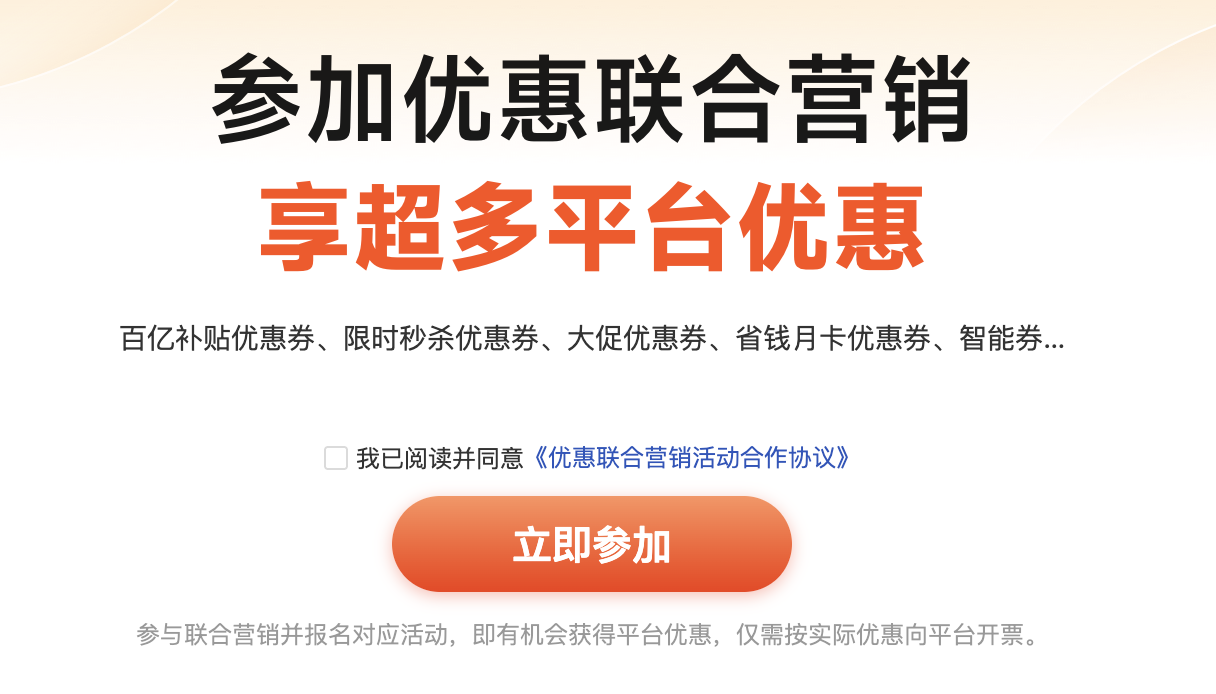
商家开通后,相当于统一接入全站平台优惠资源池,并获得搜索、推荐场景的免费流量加权。有的行业小二甚至表示,后续所有的平台优惠、流量都会给开通的商家加权,“这周开始流量倾斜体感会更强,所有店铺应开尽开。”

不仅如此,商家参与上述活动后,店内的商品有机会享受各类平台优惠,成本由平台承担。覆盖目前平台主流优惠类型,包括省钱月卡优惠券、大促消费券、百亿补贴优惠券、秒杀优惠券及智能优惠券等。

根据平台披露,用户在订单中实际获得多少平台优惠,平台即按等额优惠金额,向商家结算合作服务费。平台将在次月10日左右,向参与商家推送上一个自然月的合作服务费账单,商家按账单金额向平台开具服务费发票。发票类型支持专票和普票,通常为6%税率,小规模纳税人可按 3%、1%或免税规则开具。

例如,一笔订单成交金额为200元,其中平台优惠50元,消费者实际支付150元,则平台将向商家生成50元合作服务费账单,商家需按该金额完成开票。平台同时明确,此次开票不会增加额外报税成本:上述订单中,商家仍按总收入200元依法申报纳税,仅分别向消费者和平台对应开具不同金额发票。

需要注意的是,联合营销功能并不替代原有活动报名流程,商家如需参与百亿补贴、大促或月卡等具体活动,仍需前往对应营销页面单独报名。

在履约要求上,平台同步设置了与开票相关的资金管理规则。商家收到合作服务费账单后,平台将限制提现待开票金额的30%,待商家提交发票并通过验票审核后解除。

若上一年度相关账单在次年5月31日前仍未完成开票,平台将扣除对应合作服务费账单金额的30%。例如,平台优惠金额为50元,若逾期未开票,平台将扣除15元。平台特别说明,扣除比例基于优惠金额,而非订单成交金额。

适用范围方面,多多国际和多多买菜商家暂不支持参与该活动。已开通商家可在电脑端通过“商家后台—店铺营销—平台优惠”进入,也可在移动端 App“应用中心—平台优惠”访问,活动支持后续自主关闭。

不少商家都表示,开通上述活动的弹窗会在商家后台、商品管理、编辑商品等经常使用的操作页面出现,甚至会自动勾选阅读并同意《优惠联合营销活动合作协议》。“一不小心就容易被开了。”

根据平台方面的信息,上述活动规则将在4月7日-13日进行公示,并在公示期结束后正式生效。“而未在公示期内向平台提交退出申请的商家,则视为同意并接受上述条款的约束。”

不过,有商家担心,向平台开具服务费发票自己会多出一笔成本。因为自己的类目免交增值税,开服务费发票,补贴金额需要算服务收入,需另交增值税。

据商家透露,有行业小二劝大家一定要开,甚至于“4月1日0点没开的,直接踢出所有官补池,踢出平台官方补贴券以及消费者使用券池商品池。”

有参与上述活动的商家表示:“(开通前后)并没啥区别。一个店开,一个店没开,没开通的店铺流量也正常。”有的商家则称,建议开通,要顺应趋势,不然就会被淘汰。

亿邦持续追踪报道该情报,如想了解更多与本文相关信息,请扫码关注作者微信。

【版权提示】亿邦动力倡导尊重与保护知识产权。未经许可,任何人不得复制、转载、或以其他方式使用本网站的内容。如发现本站文章存在版权问题,烦请提供版权疑问、身份证明、版权证明、联系方式等发邮件至run@ebrun.com,我们将及时沟通与处理。

已点赞

+1

{{ praise_text }}

好文章,值得被更多人看到

FAQ回顾

拼多多优惠联合营销活动对商家有哪些好处?

商家开通后统一接入全站平台优惠资源池,获得搜索和推荐场景的免费流量加权,且平台承担各类优惠券成本,如省钱月卡、百亿补贴券等。

商家参与优惠联合营销活动后如何与平台结算?

平台次月10日推送服务费账单,商家按订单中平台优惠金额(如50元优惠开50元发票)向平台开具6%税率服务费发票,但纳税申报仍按订单总收入计算。

商家未按时开具服务费发票会有什么后果?

平台将限制提现待开票金额的30%,若次年5月31日前仍未开票,会扣除对应服务费账单金额的30%(如50元优惠扣15元)。

广告

下一篇

征集报名《品牌数字化服务商资源手册》

《品牌数字化服务商资源手册》展示数字化服务商风采,亿邦全年零售大会通发,触达更多资源,马上加入!

马上入驻

1688获“驰名商标”司法认定 有效降低中小企业合规成本

1688近年来专门设立了“1688法律服务中心”。平台商家可根据实际经营场景和需求,在平台获取专业法律支持。











