• 亿邦公众号
    • APP下载

美的鲸吞锐珂国际业务 全球医疗版图落下关键一子

作者:胡镤心 文章来源:亿邦动力

2026-01-06 17:07

作者:胡镤心 文章来源:亿邦动力

2026-01-06 17:07

邦小白快读

EN
全文速览

美的收购锐珂国际业务是近期全球医疗行业重大事件,涉及关键并购和业务重组细节。

1. 收购内容:美的集团关联公司完成对Carestream International全部股权的收购,锐珂医疗分拆为两家独立公司——锐珂医疗保留美国本土业务、墨西哥胶片生产基地和中国胶片业务,而锐珂国际(前身为锐珂(上海)医疗器材有限公司)整合美国以外全球资产,成为美的医疗新成员。

2. 背景意义:锐珂医疗是传统医疗影像设备龙头,2022年营收约10.51亿美元,但因财务困境申请Chapter 11破产保护,且面临“GPS”高端品牌压制和市场萎缩;美的自2017年探索医疗业务,收购万东医疗、库卡医疗等,2025年4月成立“美的医疗”事业部,此收购补齐高端技术和全球销售网络。

3. 实操干货:收购后美的高端护城河增强,直接获得锐珂的高端影像系统、图像处理算法及探测器核心技术,帮助万东医疗冲击高端市场;同时获得全球销售与服务网络,降低渠道建设成本;后续整合挑战包括如何协调锐珂与万东业务、保持品牌稳定。

本次收购展示美的在医疗领域的品牌战略和消费趋势洞察。

1. 品牌营销:美的通过收购强化医疗品牌定位,将医学影像设备视为整个医疗生态的“核心入口”,整合手术机器人、医院自动化物流等板块,旨在向全球医院输出整体解决方案,提升品牌整合力;锐珂作为柯达医疗正统继承者,曾代表“黄金标准”,品牌价值被美的利用以补强高端市场。

2. 产品研发:美的高端研发聚焦影像诊断设备,通过收购获得锐珂的核心技术如高端影像系统和探测器,支持产品创新;同时消费趋势显示全球医疗影像数字化和“云胶片”普及加速,传统胶片市场萎缩,驱动品牌转向数字化产品研发。

3. 用户行为观察:美的关注医院需求,医学影像设备连接诊断、信息系统,用户行为变化推动整体解决方案战略;锐珂案例体现用户从传统产品转向数字化,提示品牌需适应市场转型。

并购事件提供政策影响、增长机会和风险提示。

1. 政策解读:中国集采政策导致万东医疗在DR市场面临“越卖越便宜”和毛利率压力,收购锐珂是应对策略;国际层面,美国Chapter 11破产保护法规允许锐珂分拆优化资产负债表。

2. 增长市场与机会提示:高端医疗影像市场为增长点,美的通过收购获得全球销售网络,提供快速入场机会;事件应对措施包括分拆优化资源(如锐珂集中美国市场),并提示卖家可学习美的的全球整合模式。

3. 风险提示:内部竞争风险如协调锐珂与万东业务可能消耗资源;正面影响是通过整合手术机器人等业务构建整体解决方案商业模式;合作方式涉及保持锐珂原有团队稳定。

收购启示生产需求和数字化机会。

1. 产品生产需求:锐珂的墨西哥胶片生产基地被保留,显示传统胶片生产在特定地区仍有需求;但数字趋势要求工厂转向高端影像系统和探测器等核心部件生产。

2. 商业机会:美的通过并购获得全球资源,工厂可借鉴以进入高端市场;锐珂财务困境源于数字化普及,提示工厂抓住医疗影像设备升级机会。

3. 推进数字化启示:医疗影像数字化和“云胶片”趋势启示工厂需推进电商和智能化生产;美的整合案例展示如何通过数字化生态(如医院物流自动化)挖掘新机会。

行业趋势和技术方案是核心焦点。

1. 行业趋势:全球医疗影像数字化快速普及,传统市场萎缩(如锐珂案例),推动行业向高端技术和云服务转型;中国龙头企业如美的通过收购参与高端竞争,显示产业整合动向。

2. 新技术:收购带来图像处理算法、探测器等核心技术,服务商可关注这些创新;客户痛点如锐珂面临的财务困境、价格战和“GPS”压制,需求专业解决方案。

3. 解决方案:美的提供整体医疗生态方案,如整合诊断信息系统;启示服务商开发类似整合服务以解决医院痛点。

平台需求和管理策略提供参考。

1. 商业需求:平台商需关注医院对整体解决方案的需求,如美的定位医学影像为“核心入口”,连接诊断、管理和物流系统;全球销售网络建设需求通过收购实现。

2. 平台做法:美的采用并购方式快速获取资源(如锐珂国际全球资产),类似平台招商策略;运营管理涉及后续整合挑战,如协调内部业务。

3. 风险规避:分拆优化(锐珂保留本土业务)示范风险控制;风向规避包括避免内部竞争消耗和保持品牌稳定。

产业动向和政策模式值得分析。

1. 产业新动向:中国企业如美的通过全球资源整合(如收购锐珂)直接参与高端市场竞争,显示产业升级;新问题包括后续整合挑战(如业务协调)和数字化趋势下的传统市场萎缩。

2. 政策法规建议:集采政策导致价格战,启示政策需平衡创新支持;商业建议利用并购优化资产负债表。

3. 商业模式:美的构建覆盖“临床医技”与“医院建设运维”的生态模式,通过核心入口整合多元业务,提供全球整体解决方案。

声明:快读内容全程由AI生成,请注意甄别信息。如您发现问题,请发送邮件至 run@ebrun.com 。

我是 品牌商 卖家 工厂 服务商 平台商 研究者 帮我再读一遍。

Quick Summary

Midea's acquisition of Carestream International is a significant recent event in the global medical industry, involving key M&A and business restructuring details.

1. Acquisition Details: A Midea Group affiliate completed the acquisition of all shares of Carestream International. Carestream Health was split into two independent companies: Carestream Health retained its U.S. domestic business, its Mexican film production base, and its Chinese film business. Carestream International (formerly Carestream (Shanghai) Medical Equipment Co., Ltd.) integrated global assets outside the U.S. and became a new member of Midea Medical.

2. Background and Significance: Carestream Health is a leader in traditional medical imaging equipment, with 2022 revenue of approximately $1.051 billion. However, it faced financial difficulties, filed for Chapter 11 bankruptcy protection, and was pressured by high-end "GPS" brands and market contraction. Midea has been exploring the medical business since 2017, acquiring companies like Wandong Medical and KUKA's medical division, and established the "Midea Medical" division in April 2025. This acquisition helps Midea fill gaps in high-end technology and global sales networks.

3. Practical Insights: Post-acquisition, Midea's high-end competitive moat is strengthened, directly gaining Carestream's high-end imaging systems, image processing algorithms, and core detector technology, which will help Wandong Medical target the high-end market. It also acquires a global sales and service network, reducing channel construction costs. Subsequent integration challenges include coordinating the businesses of Carestream and Wandong Medical and maintaining brand stability.

This acquisition demonstrates Midea's brand strategy and consumer trend insights in the medical field.

1. Brand Marketing: Midea strengthens its medical brand positioning through acquisition, viewing medical imaging equipment as the "core gateway" to the entire medical ecosystem. It aims to integrate sectors like surgical robots and hospital automated logistics to provide holistic solutions to global hospitals, enhancing its brand integration capability. As the legitimate successor to Kodak Health, Carestream once represented the "gold standard," and Midea leverages this brand value to reinforce its position in the high-end market.

2. Product R&D: Midea's high-end R&D focuses on imaging diagnostic equipment. The acquisition provides core technologies like high-end imaging systems and detectors to support product innovation. Consumer trends show the accelerated global adoption of medical imaging digitalization and "cloud-based film," while the traditional film market shrinks, driving brands towards digital product R&D.

3. User Behavior Observation: Midea focuses on hospital needs. Medical imaging equipment connects diagnosis and information systems, and changing user behavior promotes the holistic solution strategy. The Carestream case reflects users shifting from traditional products to digital, indicating brands must adapt to market transformation.

The M&A event provides insights into policy impacts, growth opportunities, and risk warnings.

1. Policy Interpretation: China's volume-based procurement policy led Wandong Medical to face "selling more for less" and margin pressure in the DR market; acquiring Carestream is a counter-strategy. Internationally, U.S. Chapter 11 bankruptcy laws allowed Carestream to split and optimize its balance sheet.

2. Growth Markets and Opportunity Tips: The high-end medical imaging market is a growth area. Midea's acquisition provides immediate access to a global sales network, offering a fast entry opportunity. Event responses include splitting to optimize resources (e.g., Carestream focusing on the U.S. market), suggesting sellers can learn from Midea's global integration model.

3. Risk Warnings: Internal competition risks, such as coordinating Carestream and Wandong businesses, may consume resources. A positive impact is building a holistic solution business model by integrating sectors like surgical robots. Cooperation methods involve maintaining the stability of Carestream's original team.

The acquisition reveals production demands and digitalization opportunities.

1. Product Production Demand: Carestream's Mexican film production base was retained, indicating persistent demand for traditional film in specific regions. However, digital trends require factories to shift towards producing core components like high-end imaging systems and detectors.

2. Business Opportunities: Midea's acquisition of global resources provides a model for factories to enter high-end markets. Carestream's financial troubles stemmed from digitalization, highlighting the opportunity for factories to capitalize on medical imaging equipment upgrades.

3. Digitalization Insights: The trends of medical imaging digitalization and "cloud-based film" suggest factories need to advance e-commerce and smart production. Midea's integration case demonstrates how to uncover new opportunities through digital ecosystems, like hospital logistics automation.

Industry trends and technical solutions are the core focus.

1. Industry Trends: The rapid global adoption of medical imaging digitalization is shrinking traditional markets (as seen with Carestream), pushing the industry towards high-end technology and cloud services. Leading Chinese companies like Midea participating in high-end competition through acquisition indicates industry consolidation trends.

2. New Technologies: The acquisition brings core technologies like image processing algorithms and detectors; service providers should monitor these innovations. Client pain points, such as Carestream's financial distress, price wars, and "GPS" competition, create demand for professional solutions.

3. Solutions: Midea provides holistic medical ecosystem solutions, like integrating diagnostic information systems. This inspires service providers to develop similar integrated services to address hospital pain points.

Platform needs and management strategies offer reference points.

1. Business Needs: Platform operators must note hospital demand for holistic solutions, as Midea positions medical imaging as the "core gateway" connecting diagnosis, management, and logistics systems. The need for global sales network construction is met through acquisition.

2. Platform Strategies: Midea used M&A to quickly acquire resources (e.g., Carestream International's global assets), similar to platform merchant recruitment strategies. Operational management involves subsequent integration challenges, like coordinating internal businesses.

3. Risk Mitigation: The split-and-optimize approach (Carestream retaining domestic operations) demonstrates risk control. Risk avoidance includes preventing resource drain from internal competition and maintaining brand stability.

Industry movements and policy models warrant analysis.

1. Industry Developments: Chinese companies like Midea are directly competing in high-end markets through global resource integration (e.g., acquiring Carestream), indicating industrial upgrading. New issues include post-acquisition integration challenges (e.g., business coordination) and traditional market contraction under digitalization trends.

2. Policy and Regulation Suggestions: Volume-based procurement policies lead to price wars, suggesting a need for policies that balance innovation support. A business suggestion is to use M&A to optimize balance sheets.

3. Business Model: Midea is building an ecosystem model covering "clinical techniques" and "hospital construction/operation," integrating diverse businesses through a core gateway to provide global holistic solutions.

Disclaimer: The "Quick Summary" content is entirely generated by AI. Please exercise discretion when interpreting the information. For issues or corrections, please email run@ebrun.com .

I am a Brand Seller Factory Service Provider Marketplace Seller Researcher Read it again.

【亿邦原创】近日,美的集团关联公司正式完成对Carestream International(锐珂国际)全部股权的收购,作为交易的一部分,锐珂医疗宣布完成战略重组,分拆为两家独立运营的公司。

分拆后,原锐珂医疗的美国本土业务、墨西哥胶片生产基地及中国的胶片与无损检测业务继续保留在 “锐珂医疗” 主体内。

而整合了美国以外全球大部分资产的新主体——“锐珂国际”(前身为锐珂(上海)医疗器材有限公司),则成为美的集团医疗版图新成员。

锐珂医疗是全球传统医疗影像设备领域的龙头企业,2022年营收约10.51亿美元。前身是柯达公司的医疗影像部门,自2007年被私募股权公司Onex收购后独立运营。

此次收购并非美的集团在医疗领域的首次布局。

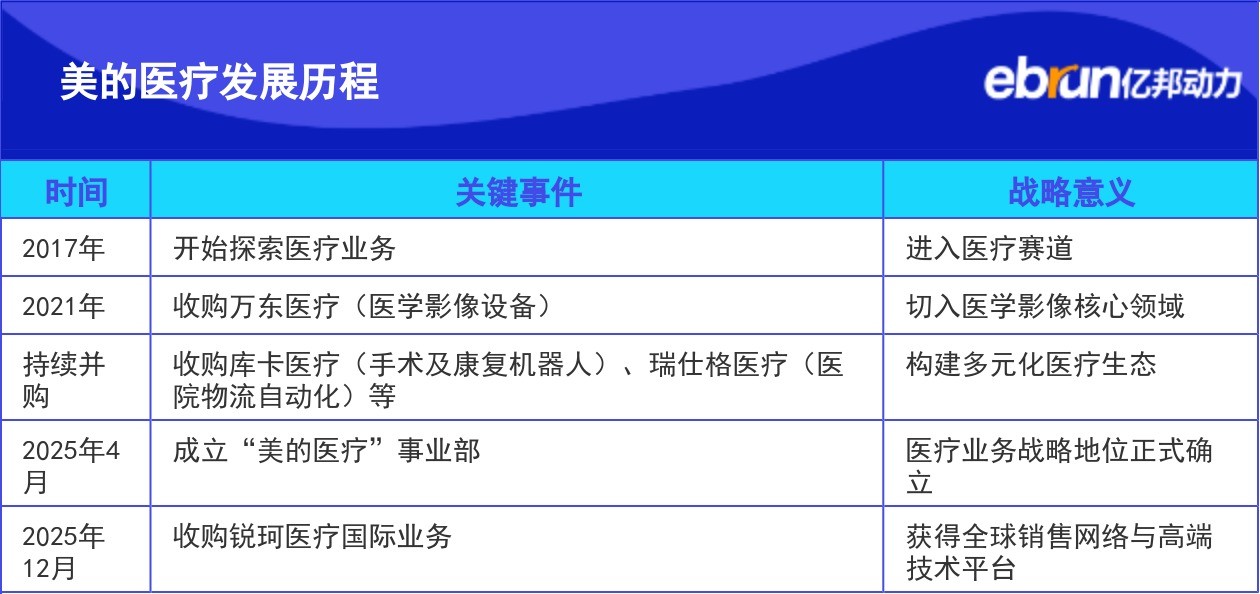
美的对医疗业务的探索始于2017年,经过一系列并购与整合,构建了覆盖 “临床医技”与“医院建设运维” 两大板块的医疗业务体系。

美的医疗发展历程
时间 关键事件 战略意义
2017年 开始探索医疗业务 进入医疗赛道
2021年 收购万东医疗(医学影像设备) 切入医学影像核心领域
持续并购 收购库卡医疗(手术及康复机器人)、瑞仕格医疗(医院物流自动化)等 构建多元化医疗生态
2025年4月 成立“美的医疗”事业部 医疗业务战略地位正式确立
2025年12月 收购锐珂医疗国际业务 获得全球销售网络与高端技术平台

2025年4月,美的将医疗板块清晰定位为深耕影像诊断设备,显示出聚焦核心的决心。美的集团董事长方洪波曾明确表示:“对医疗业务板块的投入是坚定不移的。”

作为被收购方,锐珂医疗是柯达医疗影像业务的正统继承者,曾代表全球放射影像的 “黄金标准”。

随着全球医疗影像数字化和“云胶片” 的快速普及,传统胶片市场系统性萎缩。2022年,锐珂医疗因财务困境申请了Chapter 11破产保护。尽管通过债务重组削减了约2.2亿美元负债,但现金牛业务已难以为继。

在全球市场,锐珂同时面临 “GPS”(通用电气、飞利浦、西门子) 在高端市场的压制,以及中低端品牌的价格冲击,增长乏力。

此次分拆,被锐珂医疗首席执行官Todd Clegg称为“优化发展路径、提升长期竞争力的核心举措”。通过剥离国际业务,锐珂旨在优化资产负债表,集中资源巩固美国本土市场。

收购锐珂医疗,对美的来说,意味着跳出内卷,补强高端护城河。美的旗下的万东医疗虽是国内DR(数字X线摄影)市场龙头,但在价格战和集采政策下,面临“越卖越便宜”的困境,毛利率承压。收购锐珂,美的直接获得高端影像系统、图像处理算法及探测器等核心部件上的核心技术,帮助万东医疗冲击高端市场。

而锐珂在国际市场经营数十年的全球销售与服务网络,也随之转移,相当于美的直接获得了一张全球医疗影像市场的“快速入场券”,大幅降低自建渠道的时间与资金成本。

同时,影像设备天然连接着医院的诊断、信息和管理系统。美的将医学影像设备定位为其整个医疗生态的“核心入口”。通过收购锐珂国际,进一步强化了这一入口,可以整合手术机器人、医院自动化物流、医疗冷链、智慧楼宇等其他业务板块,向全球医院输出整体解决方案奠定了基础。

收购仅是第一步,后续整合才是真正的考验,比如如何协调锐珂国际与万东医疗的业务,避免内部竞争消耗?如何在保持锐珂原有品牌价值和技术团队稳定的前提下,实现与美的体系的融合?

这起收购意味着,中国龙头企业开始通过全球资源整合,直接参与高端市场的竞争。美的集团执行总裁王建国近期同时兼任新能源事业部与美的医疗总裁,肩负两条 “第二增长曲线”业务。

【版权提示】亿邦动力倡导尊重与保护知识产权。未经许可,任何人不得复制、转载、或以其他方式使用本网站的内容。如发现本站文章存在版权问题,烦请提供版权疑问、身份证明、版权证明、联系方式等发邮件至run@ebrun.com,我们将及时沟通与处理。

已点赞

+1

{{ praise_text }}

好文章,值得被更多人看到

FAQ回顾

美的集团收购锐珂国际业务的主要内容是什么?

美的集团关联公司正式完成对Carestream International(锐珂国际)全部股权的收购,获得了锐珂医疗美国以外全球大部分资产,包括高端影像系统、图像处理算法及全球销售与服务网络。

美的集团在医疗领域有哪些关键布局?

美的自2017年探索医疗业务,2021年收购万东医疗切入医学影像,后续收购库卡医疗(手术机器人)、瑞仕格医疗(医院物流自动化),并于2025年4月成立美的医疗事业部,12月完成对锐珂国际的收购。

收购锐珂国际对美的医疗业务有何战略意义?

此次收购使美的获得高端影像核心技术,帮助旗下万东医疗冲击高端市场;同时直接获取全球销售网络,为整合手术机器人、医院自动化等业务,向全球输出整体解决方案奠定基础。

广告

下一篇

征集报名《品牌数字化服务商资源手册》

《品牌数字化服务商资源手册》展示数字化服务商风采,亿邦全年零售大会通发,触达更多资源,马上加入!

马上入驻

小红书内测“笔记付费”功能 招募视觉与写作创作者

小红书启动“笔记付费”新功能内测,主要招募对象为,摄影师/画师等视觉类创作者,以及长文章故事/公共写作类创作者。