• 亿邦公众号
    • APP下载

光峰科技在LIPA 2025大会发声:激光 + LCoS 方案引领 AR 眼镜体验革新

作者:龚作仁 文章来源:Laborer

2025-11-19 13:16

作者:龚作仁 文章来源:Laborer

2025-11-19 13:16

邦小白快读

EN
全文速览

光峰科技推出激光+LCoS方案革新AR眼镜体验

1. 激光光源优势突出,方向性强、亮度高、能量利用率高,相较LED避免了约一半的能量损耗

2. LCoS方案适配激光偏振特性,优化光机体积和显示效果,提升图像对比度和色域表现

两款新型AR光机产品发布

1. 蜻蜓G1光机体积小(单目约0.35cc),低功耗(双目总功耗约100mW),支持镜面设计提升佩戴舒适性,单目分辨率640x200,视场角25°可定制

2. 彩虹C1光机RGB全彩,支持单目双目方案,分辨率最高960x720,视场角30°,亮度≤3lm,体积约0.8cc,易集成定制

推动消费级AR普及

1. 技术突破使AR眼镜价格有望下探至1500元以内

2. 改善亮度和续航,减少隐私性问题,实现全天候AR体验,加速从小众向日常必备转变

光峰科技品牌力强化与国际展示

1. 作为LIPA协会中国唯一理事会成员亮相全球大会,与德州仪器等行业巨头同台,提升品牌国际影响力和信任度

2. 以主题演讲形式强调创新精神(敢为天下先),将技术优势转化为品牌差异化卖点

产品研发与消费趋势洞察

1. 激光+LCoS方案针对AR眼镜痛点,研发蜻蜓G1和彩虹C1产品,适应消费级市场对小型化、舒适性和全彩的需求

2. 当前AR眼镜加速渗透消费级,用户行为倾向于轻便、高清显示和多场景应用(如导航、游戏),光峰方案精准匹配市场迭代需求

消费趋势与产品升级路径

1. 从LED向激光光源升级是核心方向,结合光波导技术路径优化显示效果,体现品牌技术领先

2. 产品研发中注重实用性与未来扩展,例如蜻蜓G1计划快速迭代至全彩,反映对用户偏好的响应

AR市场增长机遇与产品机会

1. 消费级AR市场加速崛起,需求从专业场景向日常扩展,提供销售新渠道和客户群体扩张

2. 光峰科技技术突破推动产品上市(蜻蜓G1和彩虹C1),预量产已准备好,可直接对接销售合作

正面影响与商业模式启示

1. 价格预期下探至1500元内,降低消费者门槛,提升销量潜力

2. LCoS+光波导方案优化供应链(如减少光机数量),支持卖家采用一站式销售模式,简化库存管理

风险提示与应对措施

1. 传统LED方案虽成本低但亮度不足,卖家需转向更高技术方案以避风险

2. 产品特性如低功耗改善续航短板,应对用户隐私和体验问题,确保客户满意度

生产工艺优化与成本控制

1. 基于创新光学系统设计,系统性优化生产流程,大幅提高成品率并降低制造成本

2. 制造环节注重激光光源特性,通过直接控制偏振态减少辅助元件添加,简化产线提高效率

产品设计需求与商业机会

1. 激光光源小发散角(小于1°)利于光机小型化设计(如蜻蜓G1体积0.35cc),为工厂提供模具和集成参考

2. 推动AR眼镜普及,如价格下探至1500元内,创造大规模量产订单机会,支持批量生产数字化升级

制造启示

1. 使用三色激光替换LED,结合光学准直投影技术,启示工厂采用精密设备提升精度

2. 成品率提升策略实现定价竞争力,启示成本压缩路径

新技术与行业痛点解决方案

1. 激光+LCoS方案解决AR眼镜核心痛点:亮度不足(激光亮度高适用强光场景)、体积大(发散角小缩小光机体积)、续航短(低功耗如蜻蜓G1100mW总功耗)

2. 提升显示效果,如更高对比度、纯净色域和虚像距优化,增强用户视觉体验

发展趋势与客户服务机会

1. AR眼镜从专业向消费级渗透,需求多样(如蜻蜓G1适配单色定制、彩虹C1支持全彩拍摄preview),为服务商提供定制化服务空间

2. 技术落地带来服务升级机会,例如协助客户集成小巧光机到设备,优化场景适配(如游戏、导航)

解决方案优势

1. LCoS光波导路径显示清晰,如彩虹C1对比度超400:1,应对不同光线环境

2. 成本降低和成品率提升,支持服务商提供经济高效维护方案

技术支撑平台需求与集成可能

1. 光机小巧设计(如蜻蜓G0.35cc、彩虹C10.8cc)易集成到AR设备平台,支持镜面角度定制,方便平台统一适配

2. 方案兼容性强,支持单目和双目显示,满足平台多样化应用场景需求(如导航预览或内容分发)

平台运营与风险规避

1. 低功耗和改善续航减少用户投诉风险,强化平台粘性

2. 价格下探至1500元内及成品率提升,降低平台招商成本,支持规模化运营

定制化与需求响应

1. 视场角和分辨率可定制(如彩虹C1提供分辨率选项),适应平台内容优化需求

2. 提升隐私性和体验,降低平台服务风险

产业新动向与技术革新

1. 激光+LCoS方案在AR光学中的突破:激光偏振适配性提升能量利用率,减少光损;小发散角实现光机体积缩小,创新光学设计路径

2. 市场加速崛起,从专业级向消费级渗透,趋势向人机交互视觉化、场景化演变

商业模式与政策启示

1. 技术驱动AR眼镜价格下探至1500元内,普及路径启示政策支持消费电子产品转型

2. LCoS+光波导最优路径结合制造优化(如成品率提升),提供规模化应用研究案例

研究问题与应用前景

1. 解决原有短板(如LED亮度不足),推动全天候AR场景,为研究者提供真实世界验证数据

2. 工程化落地转化竞争力,启示产学研结合模式

声明:快读内容全程由AI生成,请注意甄别信息。如您发现问题,请发送邮件至 run@ebrun.com 。

我是 品牌商 卖家 工厂 服务商 平台商 研究者 帮我再读一遍。

Quick Summary

Appotronics' Laser+LCoS Solution Revolutionizes AR Glasses Experience

1. Laser light source offers distinct advantages: strong directionality, high brightness, and high energy efficiency, avoiding approximately 50% energy loss compared to LED.

2. The LCoS solution is compatible with laser polarization characteristics, optimizing the optical engine's size and display performance, while enhancing image contrast and color gamut.

Two New AR Optical Engine Products Launched

1. The Dragonfly G1 optical engine is compact (monocular ~0.35cc), low-power (binocular total power consumption ~100mW), supports mirror design for enhanced comfort, offers 640x200 monocular resolution, and a customizable 25° field of view.

2. The Rainbow C1 optical engine features full RGB color, supports monocular/binocular configurations, offers up to 960x720 resolution, a 30° field of view, brightness ≤3lm, a volume of ~0.8cc, and is easy to integrate and customize.

Driving Consumer AR Adoption

1. Technological breakthroughs could bring AR glasses prices below ¥1,500.

2. Improvements in brightness, battery life, and reduced privacy concerns enable all-day AR experiences, accelerating the shift from niche to essential daily gear.

Appotronics Enhances Brand Strength and Global Presence

1. As the sole Chinese council member of the LIPA association, Appotronics presented at a global conference alongside industry giants like Texas Instruments, boosting international brand influence and trust.

2. Through keynote speeches emphasizing an innovative spirit ('daring to be the first'), the company translates its technical advantages into differentiated brand selling points.

Product Development and Consumer Trend Insights

1. The Laser+LCoS solution addresses AR glasses pain points, leading to the Dragonfly G1 and Rainbow C1 products tailored for consumer market demands for miniaturization, comfort, and full color.

2. With AR glasses accelerating into the consumer market, user behavior favors lightweight designs, high-definition displays, and multi-scenario applications (e.g., navigation, gaming); Appotronics' solutions precisely match evolving market needs.

Consumer Trends and Product Upgrade Path

1. Upgrading from LED to laser light sources is a core direction, combined with optical waveguide technology to optimize display effects, showcasing the brand's technical leadership.

2. Product development focuses on practicality and future scalability; for instance, the Dragonfly G1 is planned for rapid iteration to full color, reflecting responsiveness to user preferences.

AR Market Growth Opportunities and Product Potential

1. The consumer AR market is rapidly emerging, with demand expanding from professional to daily scenarios, offering new sales channels and customer base growth.

2. Appotronics' technological breakthroughs enable product launches (Dragonfly G1, Rainbow C1), with pre-mass production ready, allowing direct sales collaboration.

Positive Impacts and Business Model Implications

1. Expected price points below ¥1,500 lower consumer barriers and increase sales potential.

2. The LCoS+waveguide solution optimizes the supply chain (e.g., reducing the number of optical engines), supporting sellers in adopting one-stop sales models and simplifying inventory management.

Risk Warnings and Countermeasures

1. While traditional LED solutions are lower cost, their insufficient brightness poses a risk; sellers should transition to higher-tech solutions.

2. Product features like low power consumption address battery life shortcomings and user privacy/experience concerns, ensuring customer satisfaction.

Production Process Optimization and Cost Control

1. Innovative optical system design enables systematic optimization of production processes, significantly improving yield rates and reducing manufacturing costs.

2. Manufacturing focuses on laser source characteristics, simplifying production lines by directly controlling polarization states to reduce auxiliary components.

Product Design Requirements and Business Opportunities

1. The laser's small divergence angle (<1°) facilitates miniaturized optical engine design (e.g., Dragonfly G1's 0.35cc volume), providing factories with mold and integration references.

2. Driving AR glasses adoption (e.g., prices below ¥1,500) creates opportunities for large-scale production orders, supporting batch production and digital upgrades.

Manufacturing Insights

1. Replacing LED with tri-color lasers, combined with optical collimation projection technology, suggests adopting precision equipment to enhance accuracy.

2. Yield rate improvement strategies enable competitive pricing, revealing paths for cost compression.

New Technology Solutions for Industry Pain Points

1. The Laser+LCoS solution addresses core AR glasses issues: insufficient brightness (laser's high brightness suits bright environments), large size (small divergence angle shrinks optical engines), and short battery life (low power, e.g., Dragonfly G1's 100mW total consumption).

2. Enhances display effects with higher contrast, pure color gamut, and optimized virtual image distance, improving user visual experience.

Development Trends and Customer Service Opportunities

1. AR glasses' shift from professional to consumer use creates diverse demands (e.g., Dragonfly G1's monochrome customization, Rainbow C1's full-color preview support), offering service providers customization opportunities.

2. Technology implementation enables service upgrades, such as assisting clients with compact optical engine integration and optimizing scenario adaptation (e.g., gaming, navigation).

Solution Advantages

1. The LCoS waveguide path ensures clear displays (e.g., Rainbow C1's >400:1 contrast), suitable for various lighting conditions.

2. Cost reduction and yield improvements support service providers in offering cost-effective maintenance solutions.

Technical Support for Platform Needs and Integration Potential

1. Compact optical engine designs (e.g., Dragonfly G1's 0.35cc, Rainbow C1's 0.8cc) facilitate easy integration into AR device platforms, supporting mirror angle customization for unified platform adaptation.

2. Strong solution compatibility, supporting monocular and binocular displays, meets diverse platform application needs (e.g., navigation previews, content distribution).

Platform Operations and Risk Mitigation

1. Low power consumption and improved battery life reduce user complaint risks, strengthening platform stickiness.

2. Prices below ¥1,500 and higher yield rates lower platform merchant acquisition costs, supporting scaled operations.

Customization and Demand Responsiveness

1. Customizable field of view and resolution (e.g., Rainbow C1's resolution options) adapt to platform content optimization needs.

2. Enhanced privacy and user experience lower platform service risks.

Industry Developments and Technological Innovation

1. Breakthroughs in Laser+LCoS for AR optics: laser polarization compatibility improves energy efficiency, reducing light loss; small divergence angles enable optical engine miniaturization, innovating optical design paths.

2. Market acceleration from professional to consumer adoption, with trends evolving towards visualized, scenario-based human-computer interaction.

Business Model and Policy Implications

1. Technology-driven price reductions (below ¥1,500) for AR glasses inform policies supporting consumer electronics transformation.

2. The optimal LCoS+waveguide path combined with manufacturing optimization (e.g., yield improvement) provides a case study for large-scale application.

Research Questions and Application Prospects

1. Addressing previous shortcomings (e.g., LED's insufficient brightness) enables all-day AR scenarios, offering real-world validation data for researchers.

2. Engineering implementation competitiveness highlights the potential of industry-academia-research collaboration models.

Disclaimer: The "Quick Summary" content is entirely generated by AI. Please exercise discretion when interpreting the information. For issues or corrections, please email run@ebrun.com .

I am a Brand Seller Factory Service Provider Marketplace Seller Researcher Read it again.

近日,国际激光照明投影协会LIPA(Laser Illuminated Projector Association)2025年度大会在美国纽约州举行。本次年度大会吸引了来自德州仪器(TI)、巴可、爱普生、松下、日亚、科视等知名头部企业及高校的行业顶尖专家参会。

作为该协会在中国唯一一家理事会成员单位,科创板首批上市企业光峰科技受邀出席,光峰科技业务发展高级总监田朝晖(James Tian)发表了主题为《Dare to be the first》(敢为天下先)的演讲,并在演讲中,深入阐述了激光+LCoS方案在AR眼镜领域的核心优势与应用价值。
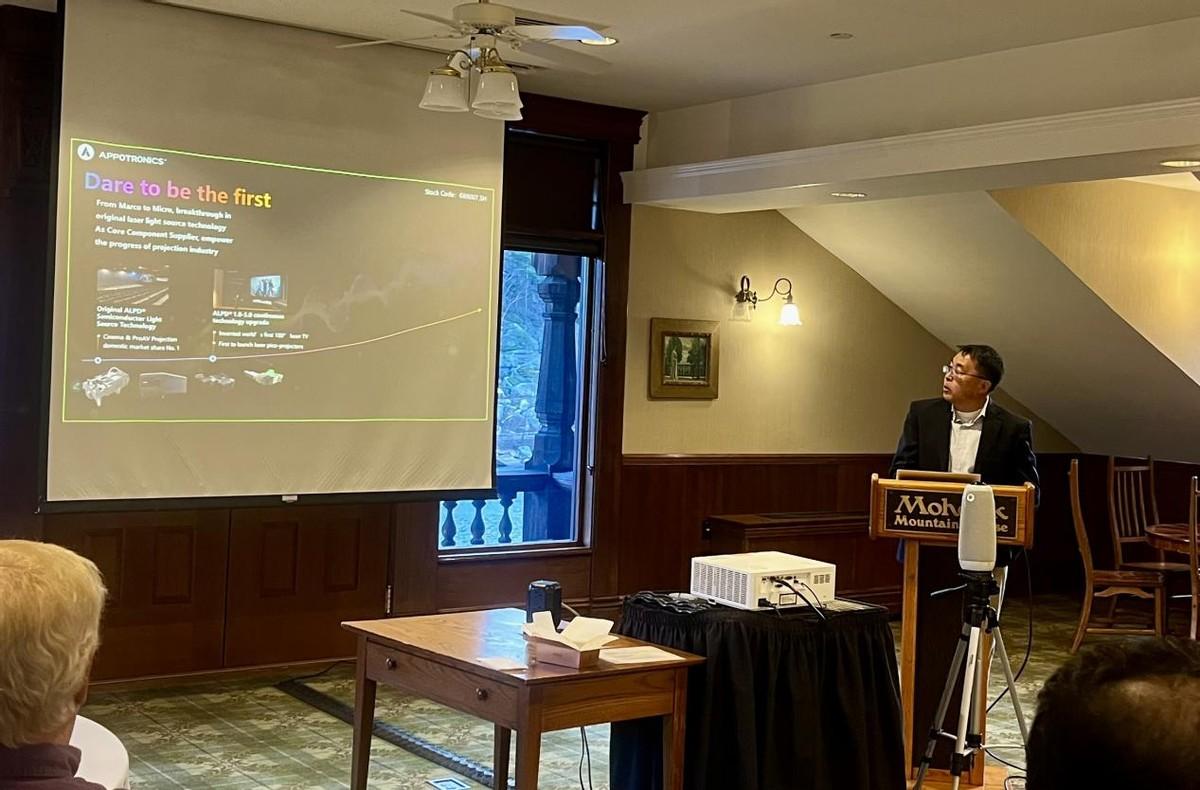
(图注:光峰科技田朝晖发表主题为《Dare to be the first》的演讲)

在人工智能技术的驱动下,AR眼镜正从专业级场景向消费级市场加速渗透,成为下一代人机交互的核心载体。LCoS方案的照明模组主要分为LED光源与激光光源两种,其中LED光源方案相对成熟可靠,具有成本低、功耗低等优势,但是由于LED光源为半球面内发光(发光全角度为180°),导致其亮度不足,不适用于强光场景使用。

光峰科技田朝晖在演讲中指出,LCoS方案是基于偏振光调制原理,与激光的天然偏振性高度适配。激光光源具备光束方向性强、单色性好、亮度高等特性,这些特性,在光学显示性能方面,直接与亮度、色域、功耗和光机的体积等显性指标密切相关。与LED光源不同,激光的出射偏振态可在激光器端直接控制,无需额外添加偏振片,避免了LED光源因加装偏振片导致的一半能量损耗,大幅提升能量利用率。

同时,激光具有极佳的准直性,发散角小于1°,远低于LED的几十度发散角,可大幅缩小光学准直投影系统体积,助力AR光机实现小型化设计。加之激光能量集中度高、杂散光易控制的优势,能带来更高的图像对比度,同时实现更高亮度、更纯净且更宽广的色域表现,显著优化显示效果。基于这些天然优势,将传统LED光源替换为三色激光光源,已成为LCoS方案迭代升级的核心突破方向。

实践证明,LCoS+ 光波导方案是消费级AR的最优技术路径。依托十余年的技术沉淀,光峰科技通过原创技术创新与工程化落地,成功将技术优势转化为产品竞争力。在大会现场,田朝晖详细介绍了光峰科技9 月发布的两款LCoS AR光机 —— 蜻蜓G1与彩虹C1,两款产品凭借全维度的卓越性能,突破AR眼镜光学方案技术瓶颈,为消费级AR眼镜带来更优的显示效果与使用体验。

此外,光峰科技通过基于第一性原理的创新光学系统设计,对生产工艺进行了系统性优化,实现了制造环节成品率的显著提升,有效降低了生产成本。这一核心技术突破,让AR眼镜得以具备更具市场竞争力的定价,为消费级AR产品的大众化普及奠定关键基础。

蜻蜓G1:小巧低耗,适配多元场景

显示效果上,蜻蜓G1光机采用的LCoS模组的单目分辨率为640x200,可清晰呈现细腻画面细节;视场角(FOV)约25°且支持定制化调整,满足不同场景下的视野需求;虚像距约为5m,能营造出较为舒适的视觉距离。颜色上目前采用单色,将会快速迭代为全彩,精准匹配市场需求。

在形态与功耗控制上,蜻蜓G1光机单目体积约为0.35cc,这种小巧的光机形态更易适配眼镜设计,另外,与传统的“一拖二”方案相比,蜻蜓方案支持镜面角度设计,同时外观也更符合眼镜形态,这些特点极大地提升了AR眼镜的佩戴舒适性和便携性;典型应用场景下,单目光源功耗约为55nit/mW,100%APL总功耗约为100mW(双目总功耗+硬件功耗),在能耗控制上表现出色,有助于延长设备的续航时间,再叠加 “一拖二” 方案减少光机数量的优势,进一步降低设备整体功耗,从根本上改善AR眼镜续航短板,为“全天候AR”体验提供可能。

彩虹C1:全彩适配,拓展应用边界

光峰科技推出的彩虹C1 RGB全彩LCoS光机,功能与应用适配性出色。支持单目和双目AR显示方案,还能适配拍摄preview等全彩AR场景,且样品及预量产工作已准备好。

视觉表现上,分辨率有640x480或 960*720可选,画面清晰;视场角约30°,为导航、游戏等场景带来更广阔视野;虚像距约5m,符合人眼观看习惯,长时间使用不易疲劳。色彩采用RGB全彩设计,能精准还原丰富色彩,让AR内容更鲜活。亮度≤3lm,FOFO对比度超400:1,不同光线下画面都清晰分明。体积约0.8cc,小巧易集成,支持定制化设计,助力AR设备实现轻薄化。

当前,AR眼镜消费级市场正加速崛起,光学技术方案的选择成为行业突破的关键。随着光峰科技方案的落地与推广,预计将推动消费级AR眼镜的“价格下探”与“体验升级”,AR眼镜的价格有望下探至1500元以内,而亮度、续航、隐私性等核心体验将实现大幅提升。

这一突破将加速AR眼镜从“小众尝鲜”向“日常必备”转变,最终推动人机交互进入“视觉化、场景化”的全新阶段,为智能生活带来更多可能。

注:文/龚作仁,文章来源:Laborer,本文为作者独立观点,不代表亿邦动力立场。

【版权提示】亿邦动力倡导尊重与保护知识产权。未经许可,任何人不得复制、转载、或以其他方式使用本网站的内容。如发现本站文章存在版权问题,烦请提供版权疑问、身份证明、版权证明、联系方式等发邮件至run@ebrun.com,我们将及时沟通与处理。

已点赞

+1

{{ praise_text }}

好文章,值得被更多人看到

FAQ回顾

激光光源相比LED光源在AR眼镜LCoS方案中有哪些优势?

激光光源具备方向性强、亮度高、天然偏振特性,无需偏振片可避免50%能量损耗,发散角小于1度有助于缩小光学系统体积,提升对比度和色域表现。

光峰科技推出的LCoS AR光机具体有哪些型号和性能参数?

光峰科技推出蜻蜓G1和彩虹C1两款LCoS光机。蜻蜓G1单目体积0.35cc、功耗100mW,支持25度视场角;彩虹C1体积0.8cc,支持全彩显示,对比度超400:1,分辨率最高达960x720。

消费级AR眼镜的价格和体验将如何变化?

光峰科技方案通过优化生产工艺降低成本,预计推动AR眼镜价格下探至1500元以内,同时提升亮度、续航和隐私性,加速从专业场景向日常消费级普及。

广告

下一篇

跨境电商资源对接

《全球跨境电商服务商资源手册》第二期手册现已发布,触达更多资源,了解跨境服务商信息,欢迎点击链接下载。

了解详情

拼多多Q3营收1083亿元同比增长9% 国内主站增速首降至个位数

拼多多的Q3季度总收入同比增长9.0%,达到1083亿元(人民币,下同),主要由在线营销服务和交易服务收入增长推动。

未来零售 电商平台 拼多多

2025-11-19 11:40:44