• 亿邦公众号
    • APP下载

独家|利好中小商家!拼多多将调整秒杀 大促等活动缺货订单赔付标准

作者:亿邦动力 文章来源:亿邦动力

2025-03-28 17:51

作者:亿邦动力 文章来源:亿邦动力

2025-03-28 17:51

邦小白快读

EN
全文速览

拼多多调整商家活动缺货赔付标准,利好中小商家。

1. 新赔付标准简化实用:订单实收金额不超过100元时,每单赔付10元;超过100元时,赔付实收金额的10%,最高1000元/单,金额取整数部分。例如,500元订单从旧标准200元赔付降为50元赔付。2. 活动覆盖范围包括秒杀(如限时秒杀、品牌秒杀)、大促(如官方大促、大促搜索池)等活动,其他活动沿用旧规则。3. 调整减轻中小商家负担:客单价低商家受益大,高客单价商家可能面临更高风险,需注意库存管理。4. 拼多多计划投入千亿资源扶持中小商家转型升级,提供发展机会。

实操建议:商家应熟悉新规则,参与活动时避免缺货以降低损失。

拼多多赔付调整影响品牌运营策略,利于成本控制和渠道优化。

1. 品牌定价和价格竞争:新标准基于实收金额比例赔付(如≤100元赔10元/单,>100元赔10%上限1000元),降低中小品牌缺货成本,便于定价灵活性和促销策略。2. 消费趋势和用户行为:平台向中小商家倾斜,反映电商普惠化趋势,消费者可能更偏好低价活动商品,品牌需适应用户需求变化。3. 品牌渠道建设:赔付减轻风险,品牌可借机加强秒杀、大促等渠道合作,同时利用拼多多千亿扶持资源优化产品研发和布局。

影响评估:高客单价品牌需警惕赔付增加风险,强化库存管理以避免缺货。

拼多多缺货赔付政策解读,提供增长机会和风险提示。

1. 政策细节:参与秒杀、大促等活动时,缺货赔付新标准简化(实收金额≤100元赔10元/单,>100元赔10%最高1000元),旧标准基于成本价赔付(如超过100元赔200元),变化利好中小卖家。2. 正面影响和机会:大幅降低低客单价订单赔付成本,支持增长市场;拼多多计划投入千亿资源扶持中小商家转型升级,提供合作方式如参与活动。3. 风险提示和应对措施:高客单价卖家赔付可能增加,需加强库存管理;消费需求变化要求卖家优化供应链避免缺货。4. 可学习点:新商业模式鼓励卖家聚焦中小商品,学习平台最新做法如利用限时抢活动。

赔付调整启示生产需求和电商机会,推动工厂数字化转型。

1. 产品生产和设计需求:缺货赔付新标准(实收金额比例赔付)强调库存稳定,工厂需优化生产计划以满足秒杀、大促活动需求,减少缺货风险。2. 商业机会:平台利好中小商家,工厂可拓展合作机会,提供定制化产品支持中小卖家,契合拼多多千亿扶持政策。3. 推进数字化启示:电商赔付规则简化(如基于实收金额),启示工厂导入数字化工具管理库存,提升效率响应平台趋势。

实际应用:工厂应关注活动类型(如秒杀竞价),适配产品设计以降低风险。

行业趋势和解决方案聚焦平台赔付调整,应对客户痛点。

1. 行业发展趋势:拼多多简化赔付标准(实收金额比例赔付),反映电商向中小商家支持倾斜,平台投入千亿资源显示行业强化扶持。2. 客户痛点:商家缺货风险高,新规则(如低额订单仅赔10元)减轻痛点,但高客单商家风险增加。3. 解决方案:服务商可提供库存管理系统或数据分析工具,帮助商家避免缺货;针对平台变化,优化服务如秒杀活动支持。

拼多多最新做法强化平台管理和招商,优化风险规避。

1. 平台最新做法:调整活动缺货赔付标准(秒杀、大促等),基于实收金额比例赔付(≤100元赔10元/单,>100元赔10%最高1000元),旧标准复杂(成本价赔付)。2. 平台招商:新规则利好中小商家,吸引更多卖家入驻;配合千亿扶持资源,提升招商吸引力。3. 运营管理:简化规则降低争议,强化库存要求;需平衡高低客单价商家影响。4. 风向规避:政策优化风险控制,通过固定赔付上限(1000元)规避高额损失。

产业新动向揭示政策问题和商业模式启示。

1. 产业新动向:拼多多赔付调整显示电商平台优化商家关系,新标准基于实收金额比例赔付,利好中小商家,平台投入千亿资源支持升级。2. 新问题:高低客单价差异暴露公平性问题,高客单商家可能负担加重;政策法规建议需完善以保护各方权益。3. 商业模式启示:平台通过简化规则增强生态系统,鼓励中小电商发展;研究案例如500元订单赔付减少,分析趋势可推广。

声明:快读内容全程由AI生成,请注意甄别信息。如您发现问题,请发送邮件至 run@ebrun.com 。

我是 品牌商 卖家 工厂 服务商 平台商 研究者 帮我再读一遍。

Quick Summary

Pinduoduo adjusts its out-of-stock penalty standards for merchant activities, benefiting small and medium-sized merchants.

1. The new penalty standard is simplified and practical: For orders with a net receipt amount not exceeding 100 RMB, the penalty is 10 RMB per order; for amounts over 100 RMB, the penalty is 10% of the net receipt amount, capped at 1,000 RMB per order (only the integer portion is used). For example, the penalty for a 500 RMB order drops from 200 RMB under the old standard to 50 RMB.

2. The activities covered include flash sales (e.g., limited-time flash sales, brand flash sales) and major promotions (e.g., official promotions, promotion search pools), while other activities follow the old rules.

3. The adjustment reduces the burden on small and medium-sized merchants: Low average order value merchants benefit significantly, while high average order value merchants may face higher risks and need to pay attention to inventory management.

4. Pinduoduo plans to invest hundreds of billions in resources to support the transformation and upgrading of small and medium-sized merchants, providing development opportunities.

Practical Advice: Merchants should familiarize themselves with the new rules and avoid stockouts during activities to minimize losses.

Pinduoduo's penalty adjustment impacts brand operation strategies, benefiting cost control and channel optimization.

1. Brand pricing and price competition: The new standard, based on a percentage of the net receipt amount (e.g., ≤100 RMB penalizes 10 RMB/order, >100 RMB penalizes 10% up to 1,000 RMB), reduces out-of-stock costs for small and medium-sized brands, facilitating pricing flexibility and promotional strategies.

2. Consumer trends and user behavior: The platform's tilt towards small and medium-sized merchants reflects the trend of e-commerce inclusivity; consumers may prefer lower-priced promotional goods, requiring brands to adapt to changing user demands.

3. Brand channel development: Reduced penalty risk allows brands to strengthen cooperation in channels like flash sales and major promotions, while leveraging Pinduoduo's hundred-billion-yuan support resources to optimize product R&D and layout.

Impact Assessment: High average order value brands need to be cautious of increased penalty risks and strengthen inventory management to avoid stockouts.

Interpretation of Pinduoduo's out-of-stock penalty policy, highlighting growth opportunities and risks.

1. Policy details: For activities like flash sales and major promotions, the new penalty standard is simplified (net receipt ≤100 RMB penalizes 10 RMB/order, >100 RMB penalizes 10%, max 1,000 RMB), unlike the old cost-based standard (e.g., over 100 RMB penalized 200 RMB), a change beneficial to small and medium sellers.

2. Positive impacts and opportunities: Significantly reduces penalty costs for low average order value orders, supporting growth markets; Pinduoduo's plan to invest hundreds of billions supports merchant transformation, offering cooperation methods like activity participation.

3. Risk warnings and countermeasures: High average order value sellers may face increased penalties, requiring enhanced inventory management; changing consumer demands necessitate optimized supply chains to avoid stockouts.

4. Key takeaways: The new business model encourages sellers to focus on small and medium-sized goods, learning from platform practices like utilizing limited-time flash sale activities.

Penalty adjustments highlight production demands and e-commerce opportunities, driving factory digital transformation.

1. Product production and design needs: The new penalty standard (percentage of net receipt) emphasizes inventory stability, requiring factories to optimize production plans to meet demand for flash sales and major promotions, reducing out-of-stock risks.

2. Business opportunities: The platform's favorable policies for small and medium-sized merchants create collaboration opportunities for factories to provide customized products, aligning with Pinduoduo's massive support policy.

3. Impetus for digitalization: Simplified e-commerce penalty rules (e.g., based on net receipt) suggest factories should adopt digital tools for inventory management to improve efficiency and respond to platform trends.

Practical Application: Factories should monitor activity types (e.g., flash sale bidding) and adapt product design to mitigate risks.

Industry trends and solutions focus on platform penalty adjustments to address client pain points.

1. Industry development trends: Pinduoduo's simplified penalty standard (percentage of net receipt) reflects e-commerce's shift towards supporting small and medium-sized merchants; the platform's massive resource investment indicates intensified industry support.

2. Client pain points: High merchant out-of-stock risk is alleviated by the new rules (e.g., low-value orders penalize only 10 RMB), but risk increases for high average order value merchants.

3. Solutions: Service providers can offer inventory management systems or data analysis tools to help merchants avoid stockouts; optimize services like flash sale activity support in response to platform changes.

Pinduoduo's latest practices strengthen platform management and merchant acquisition, optimizing risk avoidance.

1. Latest platform practices: Adjusted out-of-stock penalty standards for activities (flash sales, major promotions, etc.) based on a percentage of net receipt (≤100 RMB penalizes 10 RMB/order, >100 RMB penalizes 10% max 1,000 RMB), replacing the complex old cost-based standard.

2. Platform merchant acquisition: The new rules benefit small and medium-sized merchants, attracting more sellers; combined with massive support resources, it enhances acquisition appeal.

3. Operational management: Simplified rules reduce disputes and strengthen inventory requirements; requires balancing the impact on high and low average order value merchants.

4. Risk mitigation: The policy optimizes risk control through a fixed penalty cap (1,000 RMB) to avoid high losses.

New industry developments reveal policy issues and business model implications.

1. Industry developments: Pinduoduo's penalty adjustment shows e-commerce platforms optimizing merchant relations; the new standard, based on a percentage of net receipt, benefits small and medium-sized merchants, supported by platform investment.

2. Emerging issues: The disparity between high and low average order values exposes fairness concerns, potentially burdening high average order value merchants; policy regulations need refinement to protect all parties' rights.

3. Business model implications: Platforms enhance their ecosystem through simplified rules, encouraging small and medium e-commerce development; research cases, like the reduced penalty for a 500 RMB order, can be analyzed to identify generalizable trends.

Disclaimer: The "Quick Summary" content is entirely generated by AI. Please exercise discretion when interpreting the information. For issues or corrections, please email run@ebrun.com .

I am a Brand Seller Factory Service Provider Marketplace Seller Researcher Read it again.

【亿邦原创】亿邦动力独家获悉,拼多多将调整商家参与秒杀、大促等活动缺货订单赔付标准。

现在,当商家参加“秒杀”、“9块9特卖”、“潮流好价”、“多人团”以及“大促”活动发生缺货情形,订单实收金额不超过100元时,商家只需要按照10元/单的标准对消费者进行赔付;超过100元时,则每单按照订单实收金额的10%进行赔付,但最高不超过1000元/单。

当商家需赔付金额存在小数的,则取整数部分。例如,实收金额为437元,437元×10%=43.7元,赔付标准为43元。

其中,秒杀包括补贴秒杀、限时秒杀、品牌秒杀、万人团秒杀、秒杀竞价等活动;大促包括官方大促、大促搜索池、大促限量抢、三单挑战、抢单神器、限时限量抢等。

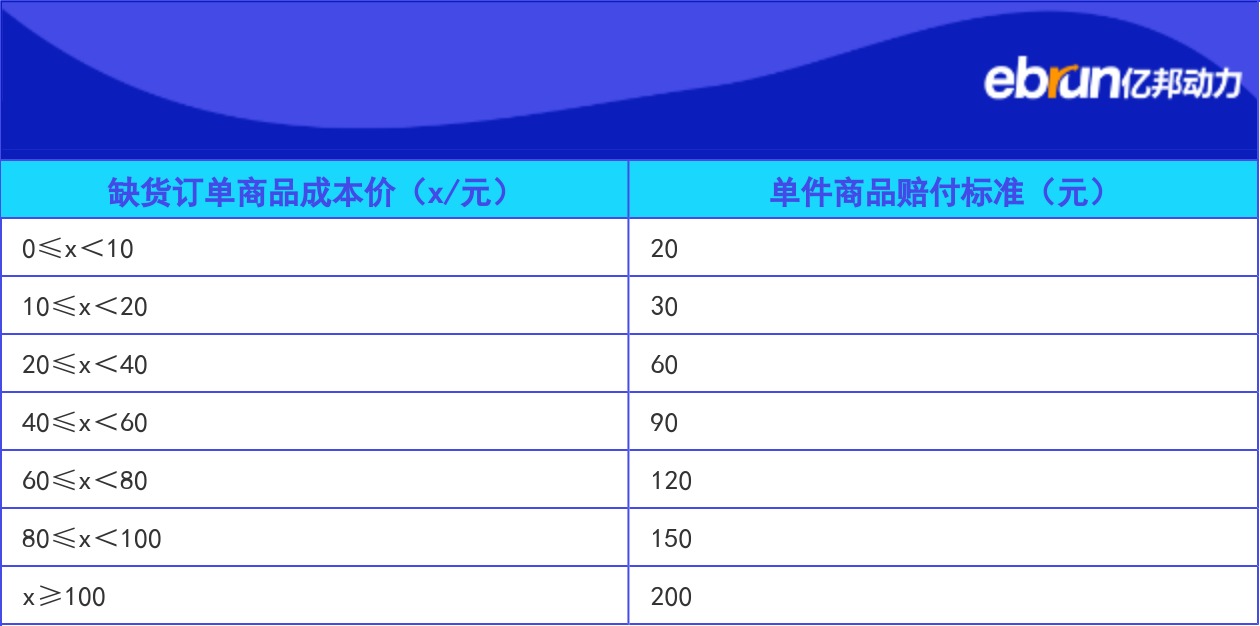
而此前,商家参与上述活动发生缺货情况时,缺货订单商品成本价不超过100元时,单件商品需要赔付20-150元不等;缺货订单商品成本价超过100元时,单件商品需要赔付200元。其中,商品成本价,是指消费者下单时的活动商品成本价,具体需要参照拼多多平台系统记录。


缺货订单商品成本价(x/元) 单件商品赔付标准(元)
0≤x<10 20
10≤x<20 30
20≤x<40 60
40≤x<60 90
60≤x<80 120
80≤x<100 150
x≥100 200

举例来说,现在,当商家一件实收金额为500元的商品(成本价超过100元)参与秒杀、潮流好价等活动,发生缺货情形后,需要向消费者赔付50元,但按照此前赔付标准,则需要赔付200元。

需要强调的是,除了上述提及的秒杀、大促等活动外,商家其他活动商品订单缺货赔付标准和此前一样,按照不同缺货订单商品成本价进行单件商品的赔付。

看起来,这样的调整对于客单价不算太高的商家更为有利。对于售价在数千元左右的商家而言,即使参与上述活动,发生缺货情形时也可能会比之前赔付更多。

就在日前,拼多多方面表示,将进一步加码商家扶持力度,计划投入资源或超过千亿元人民币,主要用于帮助中小商家高质量转型升级。

亿邦持续追踪报道该情报,如想了解更多与本文相关信息,请扫码关注作者微信。

【版权提示】亿邦动力倡导尊重与保护知识产权。未经许可,任何人不得复制、转载、或以其他方式使用本网站的内容。如发现本站文章存在版权问题,烦请提供版权疑问、身份证明、版权证明、联系方式等发邮件至run@ebrun.com,我们将及时沟通与处理。

已点赞

+1

{{ praise_text }}

好文章,值得被更多人看到

FAQ回顾

拼多多调整后的缺货订单赔付标准是什么?

新标准为:订单实收金额不超过100元时赔付10元/单;超过100元时按实收金额的10%赔付,最高不超过1000元/单。适用于秒杀、9块9特卖、大促等活动。

拼多多此次调整对哪些商家更有利?

调整对客单价不高的中小商家更有利。例如成本超100元的商品,旧标准需赔200元,新标准按实收金额10%计算(如500元商品仅赔50元)。

拼多多此次调整涉及哪些具体活动类型?

包括秒杀(补贴秒杀、限时秒杀等)、9块9特卖、潮流好价、多人团及大促(官方大促、大促搜索池等)活动,其他活动仍按原成本价分档标准赔付。

广告

下一篇

征集报名《品牌数字化服务商资源手册》

《品牌数字化服务商资源手册》展示数字化服务商风采,亿邦全年零售大会通发,触达更多资源,马上加入!

马上入驻

话题播放量超百亿 脆皮年轻人捧红“中式养生”

今年2月,隐居了20年的影星王祖贤忽然“罕见”地在社交平台发布了一条视频,公开了自己在温哥华开设艾灸馆的近况。

新消费 未来零售

2025-03-28 17:48:04