• 亿邦公众号
    • APP下载

京东双11划重点:10月12日正式开启 用“超级服务日”新营销IP扶持服务型消费商家

作者:郑雅 文章来源:亿邦动力

2026-09-30 12:08

作者:郑雅 文章来源:亿邦动力

2026-09-30 12:08

邦小白快读

EN
全文速览

京东双11将在10月12日晚8点进入起售期,之后依次是开门红、专场期、高潮期、返场期,有超级秒杀日、超级补贴日、巅峰秒杀日三大高点,还新增了超级服务日。

1. 重点时间点:10月12日晚8点起售;超级秒杀日为10月20日20点至22日24点,巅峰秒杀日为11月9日20点至11日24点;超级服务日每月28日。

2. 核心省钱玩法:官方直降、跨店满减、低价热卖;低价热卖商品满足全网低价、同款低价、近N天最低价或开通买贵双倍赔服务任一规则,就能进入商品池。

3. 购物体验升级:商品卡片会显示配送时效、卖点、榜单、真实评价;秒杀频道有用户下单弹幕、火苗动效;特价频道有1元或9.9元深折扣钩子品,月黑风高盛典还新增1元捡漏活动。

4. 服务型消费:每月28日可囤购居家、出行、健康、养老、宠物和AI等生活服务。

京东双11为品牌商提供了丰富的营销资源和新的服务型消费IP,适合围绕大促节点做品牌曝光与用户互动。

1. 营销IP:新增超级服务日,每月28日可围绕居家、出行、健康、养老、宠物和AI等生活服务做品牌共建,切入服务型消费趋势。

2. 品牌促销机会:秒杀频道设品牌秒杀日、品类惊喜日,超级秒杀日和巅峰秒杀日有大牌整点直降;特价频道新增品牌特价日,支持人群定向投放,帮助触达潜在用户。

3. 用户互动工具:京东新品提供粉丝打榜裂变、群星红包、粉丝共创定制周边等明星营销玩法;试用频道有大牌试用日和试用排位赛,排位赛回购期提供千万曝光流量包激励。

4. 价格与权益设计:官方直降可叠加单品促销、跨店满减、总价促销、店铺券、限品类券、全品类券、满赠促销和国家补贴;秒杀频道展示配送时效、卖点、榜单、真实评价等信息,利于品牌建立信任。

对卖家而言,京东双11核心是免报名模式与流量分配规则变化,需抓住低价和秒杀渠道机会。

1. 招商与报名:招商持续至11月13日24时,采用免报名模式,符合规则的商品由系统自动圈选报名。

2. 费用与玩法:跨店满减和官方直降活动费用均由商家100%承担,官方尚未公布力度;官方直降可叠加多种促销,跨店满减不支持叠加普通限品类券、店铺券、总价促销。

3. 流量获取:低价热卖货盘分基础、精选、降价尖货三档,按流量进阶分档;满足全网低价、同款低价、近N天最低价或买贵双倍赔可进入商品池。秒杀频道售前价差越大、预约越多位置越靠前,售中价格力越强曝光越大,售罄后增加店铺优质商品分发。

4. 专门机会:月黑风高盛典新增1元捡漏,为未形成动销与好评的SKU提供冷启动场域;特价频道天天有特价可定制化跳转店铺,配合后链路运营提升转化;试用排位赛争TOP3可获得千万曝光流量包。

京东双11的大促规则和玩法给工厂提供了产品设计和电商合作的方向。

1. 产品组合需求:早市夜市・3001活动从用户场景出发做产品组合,如邪修解压礼盒中有火鸡面冰淇淋、见手青鸡尾酒、手机等,提示工厂可关注场景化、解压类和跨界组合的新品研发。

2. 低价商品机会:1元或9.9元深折扣钩子品以及1元捡漏活动,意味着工厂可承接大批量低成本订单,为冷启动SKU和特价渠道供货。

3. 商品信息展示要求:秒杀频道商品卡片会增加配送时效、卖点、榜单、真实评价等关键信息,工厂需在生产端保证产品卖点清晰、评价真实,以支持前端转化。

4. 服务型消费趋势:京东超级服务日覆盖居家、出行、健康、养老、宠物和AI等生活服务,工厂可考虑从实体产品延伸到相关服务链,或探索AI等服务型产品。

京东双11透露了平台大促机制的新趋势,服务商可从中找到客户需求和解决方案的切入点。

1. 行业趋势:京东新增超级服务日IP,将服务型消费常态化,每月28日覆盖居家、出行、健康、养老、宠物和AI,服务商可在这些领域提供数字化运营、会员管理和营销服务。

2. 新技术与工具需求:秒杀频道比价逻辑从近多少天低价升级到与用户上次购买价格比较,并增加弹幕、火苗动效等互动表达,服务商需要帮助商家做价格策略、用户数据分析和互动内容制作。

3. 客户痛点:商家100%承担跨店满减和官方直降费用,且要争取低价热卖的高阶流量,成本压力大;服务商可提供定价优化、货盘分级和流量运营方案。

4. 解决方案:秒杀频道功能升级(商品特征扩充、券包露出、预约任务解锁等)说明平台需要精细化运营工具,服务商可开发帮助商家管理预约、复访复购和品牌特价日人群定向投放的系统或代运营服务。

京东双11的规则和玩法展示了平台通过流量机制创新和活动IP拉动大促增长。

1. 平台最新做法:推出超级秒杀日、超级补贴日、巅峰秒杀日三大高点,增设超级服务日这个常态化IP,每月28日聚合居家、出行、健康、养老、宠物、AI等生活服务,为平台扩展非实物消费场景。

2. 招商与运营管理:采用免报名模式,系统自动圈选符合规则的商品,招商持续至11月13日24时;低价热卖货盘分基础、精选、降价尖货三档,按流量进阶分档,让商家自运营获得高阶流量。

3. 流量分配机制:秒杀频道售前看价差和预约,售中看价格力,售罄后分发店铺优质商品;特价频道天天有特价用1元或9.9元钩子品导流店铺,并新增预约及任务解锁提升复购。

4. 风险与风向规避:跨店满减和官方直降费用由商家承担,平台需平衡商家毛利与低价吸引力;比价逻辑改为与用户上次购买价格比较,更贴近用户视角,同时要求商家管理历史价格体系,平台需防范虚假低价。

京东双11的规则和玩法体现了电商大促在流量分配、价格机制和服务消费方面的创新动向。

1. 产业新动向:京东将超级服务日作为首个常态化生活服务IP,每月28日覆盖居家、出行、健康、养老、宠物和AI,反映电商平台从商品销售向生活服务生态延伸的趋势。

2. 平台商业模式创新:免报名模式降低商家参与门槛,低价热卖货盘按基础、精选、降价尖货分档实现流量进阶分配;月黑风高盛典新增1元捡漏,为长尾SKU提供冷启动场域,形成平台侧孵化新品的机制。

3. 价格竞争机制变化:低价热卖引入近N天最低价标签,比价逻辑从历史周期转向用户上次购买价格,更强调用户感知价格;官方直降可叠加多种促销,跨店满减费用全由商家承担,可能影响商家定价策略和平台补贴模式。

4. 政策法规建议与启示:平台对秒杀频道新增商品特征展示(配送时效、卖点、榜单、真实评价)和买贵双倍赔服务,有助于规范信息透明度,但仍需关注商家成本压力与消费者权益的平衡,以及服务型消费的标准化监管问题。

声明:快读内容全程由AI生成,请注意甄别信息。如您发现问题,请发送邮件至 run@ebrun.com 。

我是 品牌商 卖家 工厂 服务商 平台商 研究者 帮我再读一遍。

Quick Summary

JD.com's Double 11 sales event will enter its pre-sale period at 8 PM on October 12, followed by the opening day, special promotion period, peak period, and encore period. There are three major high points: Super Flash Sale Day, Super Subsidy Day, and Peak Flash Sale Day, along with a newly added Super Service Day.

1. Key dates: Pre-sale begins at 8 PM on October 12; Super Flash Sale Day runs from 8 PM on October 20 to midnight on October 22; Peak Flash Sale Day runs from 8 PM on November 9 to midnight on November 11; Super Service Day falls on the 28th of each month.

2. Core money-saving mechanics: Direct official price cuts, cross-store full-reduction coupons, and low-price bestsellers. Products labeled as low-price bestsellers qualify for the product pool if they meet any one of these criteria: lowest price across the web, lowest price for the same item, lowest price in the last N days, or enrollment in the double-refund-if-overpriced service.

3. Shopping experience upgrades: Product cards will display delivery time, selling points, rankings, and verified reviews; the flash sale channel features user order bullet comments and flame animations; the bargain channel offers 1-yuan or 9.9-yuan deep-discount hook products, and the "Moon Dark Wind High" event adds a new 1-yuan bargain-hunting activity.

4. Service-based consumption: On the 28th of each month, shoppers can stock up on life services covering home, travel, health, elderly care, pets, and AI.

JD.com's Double 11 provides brands with rich marketing resources and a new service-oriented consumption IP, suitable for brand exposure and user engagement around major promotion nodes.

1. Marketing IP: The newly added Super Service Day, held monthly on the 28th, allows brands to co-build around life services such as home, travel, health, elderly care, pets, and AI, tapping into the service-consumption trend.

2. Brand promotion opportunities: The flash sale channel features Brand Flash Sale Day and Category Surprise Day; Super Flash Sale Day and Peak Flash Sale Day offer direct price cuts at set times for major brands. The bargain channel adds Brand Bargain Day with targeted audience delivery to reach potential users.

3. User engagement tools: JD New Products offers fan voting and fission campaigns, group-star red packets, and fan co-created custom peripherals as celebrity marketing tools. The trial channel includes Big Brand Trial Day and Trial Leaderboard; the leaderboard's repurchase period provides incentivized traffic packages worth tens of millions of exposures.

4. Pricing and benefits design: Direct official price cuts can be stacked with single-product promotions, cross-store full reductions, total-price promotions, store coupons, category-limited coupons, platform-wide coupons, gift-with-purchase promotions, and national subsidies. The flash sale channel displays delivery time, selling points, rankings, and verified reviews to help brands build trust.

For sellers, the core of JD Double 11 lies in the no-registration model and changes in traffic allocation rules. Sellers should seize opportunities in low-price and flash-sale channels.

1. Recruitment and registration: Recruitment runs until 24:00 on November 13 and uses a no-registration model; eligible products are automatically enrolled by the system.

2. Costs and mechanics: The costs of cross-store full reductions and direct official price cuts are 100% borne by merchants; official intensity has not yet been announced. Direct official price cuts can be stacked with multiple promotions, while cross-store full reductions do not support stacking with ordinary category-limited coupons, store coupons, or total-price promotions.

3. Traffic acquisition: The low-price bestseller assortment is divided into three tiers—basic, selected, and price-cut hot items—with traffic progressively allocated by tier. Products meeting any one of the criteria—lowest price across the web, lowest price for the same item, lowest price in the last N days, or double-refund-if-overpriced—enter the product pool. In the flash sale channel, a larger pre-sale price gap and more reservations push the product higher; during the sale, stronger price competitiveness increases exposure; after sellout, the system redistributes the store's quality products.

4. Dedicated opportunities: The Moon Dark Wind High event adds 1-yuan bargain-hunting to provide a cold-start arena for SKUs that have not yet generated sales momentum or reviews. The bargain channel's "Everyday Bargains" can be customized to jump to the store, supporting post-click conversion through backend operations. In the Trial Leaderboard, sellers can compete for the top three to win traffic packages worth tens of millions of exposures.

JD.com's Double 11 promotion rules and playbooks offer factories direction for product design and e-commerce collaboration.

1. Product portfolio demand: The "Morning Market/Night Market · 3001" activity builds product combinations around user scenarios, such as "evil-relief" gift boxes containing fire chicken noodle ice cream, magic mushroom cocktails, and phones—suggesting factories should pay attention to R&D in scenario-based, stress-relief, and cross-category combination products.

2. Low-price product opportunities: The 1-yuan or 9.9-yuan deep-discount hook products and the 1-yuan bargain-hunting activity mean factories can take on large-volume, low-cost orders to supply cold-start SKUs and bargain channels.

3. Product information display requirements: Product cards in the flash sale channel will add key information such as delivery time, selling points, rankings, and verified reviews; factories must ensure clear product selling points and genuine reviews at the production end to support front-end conversion.

4. Service consumption trend: JD's Super Service Day covers home, travel, health, elderly care, pets, AI, and other life services; factories can consider extending from physical products to related service chains or exploring service-oriented offerings such as AI.

JD Double 11 reveals new trends in the platform's promotion mechanisms, offering service providers entry points to identify client needs and deliver solutions.

1. Industry trends: JD has added the Super Service Day IP, making service consumption a regular feature. On the 28th of each month, it covers home, travel, health, elderly care, pets, and AI—service providers can offer digital operations, membership management, and marketing services in these areas.

2. Demand for new technologies and tools: The flash sale channel's price comparison logic has been upgraded from comparing with historical lows in recent days to comparing with the user's last purchase price, and it adds interactive features such as bullet comments and flame animations. Service providers need to help merchants with pricing strategy, user data analysis, and interactive content production.

3. Client pain points: Merchants bear 100% of the costs for cross-store full reductions and direct official price cuts, and face pressure to secure higher-tier traffic for low-price bestsellers—creating significant cost burdens. Service providers can offer pricing optimization, assortment tiering, and traffic operation solutions.

4. Solutions: Upgrades to the flash sale channel (expanded product features, coupon display, reservation task unlocking, etc.) indicate the platform's need for refined operational tools. Service providers can develop systems or agency-operation services that help merchants manage reservations, repeat visits and repurchases, and audience targeting for Brand Bargain Day.

JD Double 11's rules and playbooks demonstrate the platform's approach to driving promotion growth through traffic mechanism innovation and activity IPs.

1. The platform's latest practices: It has rolled out three major high points—Super Flash Sale Day, Super Subsidy Day, and Peak Flash Sale Day—and added Super Service Day as a regular IP. On the 28th of each month, it aggregates life services across home, travel, health, elderly care, pets, and AI, expanding the platform into non-physical-consumption scenarios.

2. Recruitment and operations management: It uses a no-registration model where the system automatically enrolls qualifying products; recruitment runs until 24:00 on November 13. The low-price bestseller assortment is divided into three tiers—basic, selected, and price-cut hot items—with traffic progressively allocated, allowing merchants to earn higher-tier traffic through their own operations.

3. Traffic allocation mechanism: In the flash sale channel, pre-sale ranking depends on price gap and reservations; during sale, price competitiveness; after sellout, the system redistributes the store's quality products. The bargain channel's "Everyday Bargains" uses 1-yuan or 9.9-yuan hook products to drive store traffic, and adds reservation and task-unlocking features to boost repeat purchases.

4. Risk and trend mitigation: Cross-store full reductions and direct official price cuts are borne by merchants, so the platform must balance merchant gross margins against the appeal of low prices. The price comparison logic has been changed to compare with the user's last purchase price, which is more user-centric but requires merchants to manage historical price systems; the platform must also guard against false low-price claims.

JD Double 11's rules and playbooks reflect innovative trends in e-commerce promotions concerning traffic allocation, pricing mechanisms, and service consumption.

1. New industry trends: JD has made Super Service Day its first regular life-services IP, covering home, travel, health, elderly care, pets, and AI on the 28th of each month—signaling a shift from product sales toward a life-service ecosystem.

2. Platform business model innovation: The no-registration model lowers merchant participation barriers; the low-price bestseller assortment is divided into basic, selected, and price-cut hot tiers to enable progressive traffic allocation. The Moon Dark Wind High event adds 1-yuan bargain-hunting, providing a cold-start arena for long-tail SKUs and forming a platform-side mechanism for incubating new products.

3. Changes in price competition mechanisms: Low-price bestsellers introduce a "lowest price in the last N days" label, and price comparison logic shifts from historical cycles to the user's last purchase price, emphasizing perceived user price. Direct official price cuts can be stacked with multiple promotions, while cross-store full reduction costs are fully borne by merchants—potentially affecting merchant pricing strategies and platform subsidy models.

4. Policy recommendations and implications: The platform adds product feature displays (delivery time, selling points, rankings, and verified reviews) and a double-refund-if-overpriced service in the flash sale channel, helping standardize information transparency. However, attention is still needed to balance merchant cost pressures with consumer rights, as well as to regulatory standards for service-oriented consumption.

Disclaimer: The "Quick Summary" content is entirely generated by AI. Please exercise discretion when interpreting the information. For issues or corrections, please email run@ebrun.com .

I am a Brand Seller Factory Service Provider Marketplace Seller Researcher Read it again.

【亿邦原创】9月30日消息,日前,京东公布了2026年双11的活动节奏和玩法。今年京东双11将在10月12日晚8点进入起售期,之后依次是开门红、专场期、高潮期、返场期。官方表示,超级秒杀日、超级补贴日、巅峰秒杀日是本次大促的三大高点。惊喜日与品类日也会贯穿整个大促周期。此次京东双11,京东还新增了“超级服务日”活动。
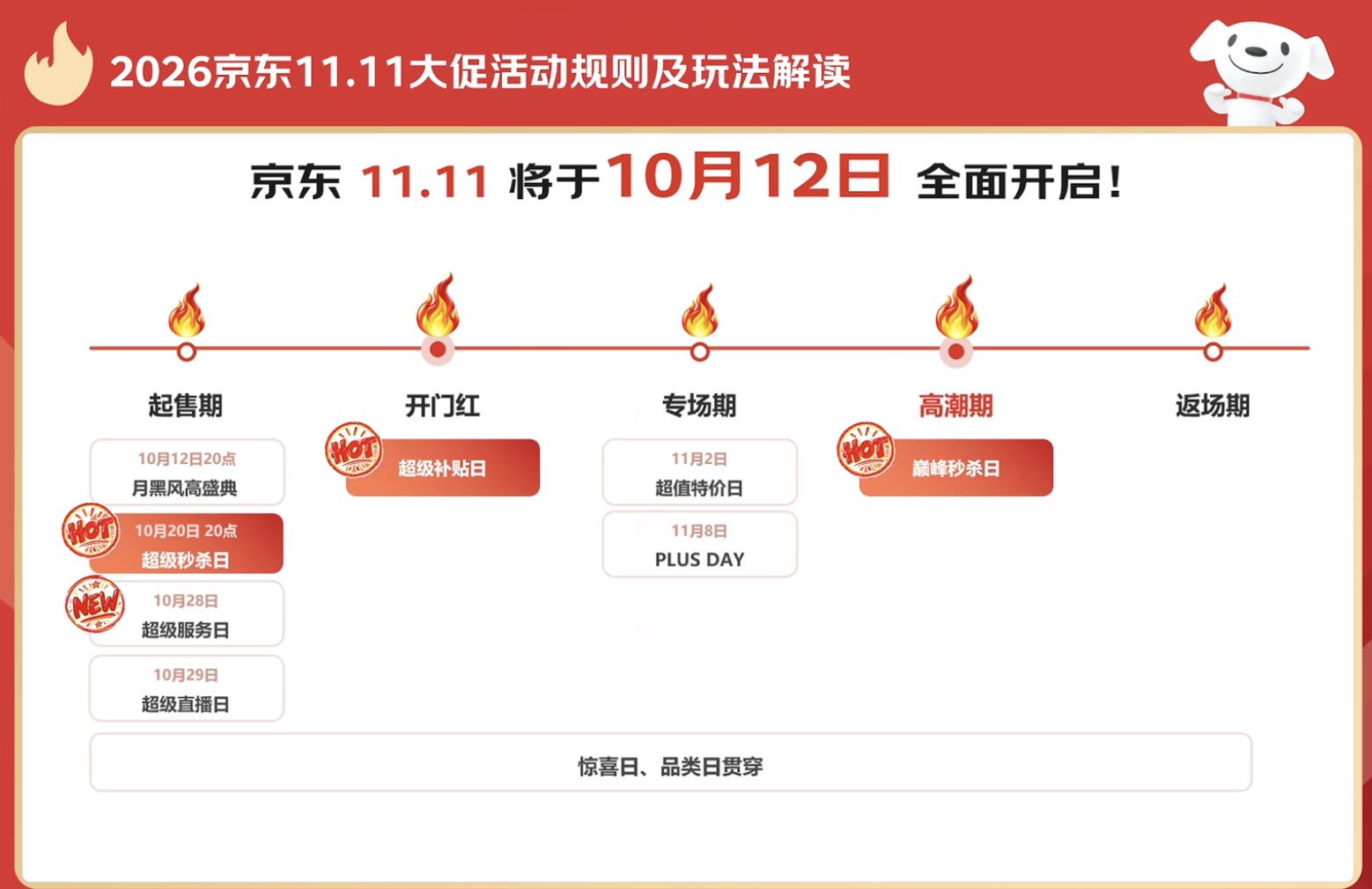
目前已经进入双11招商阶段,招商将持续至11月13日24时。今年京东双11继续延续此前采用的“免报名”模式,符合规则的产品即可通过系统自动被圈选报名,具体规则如下。
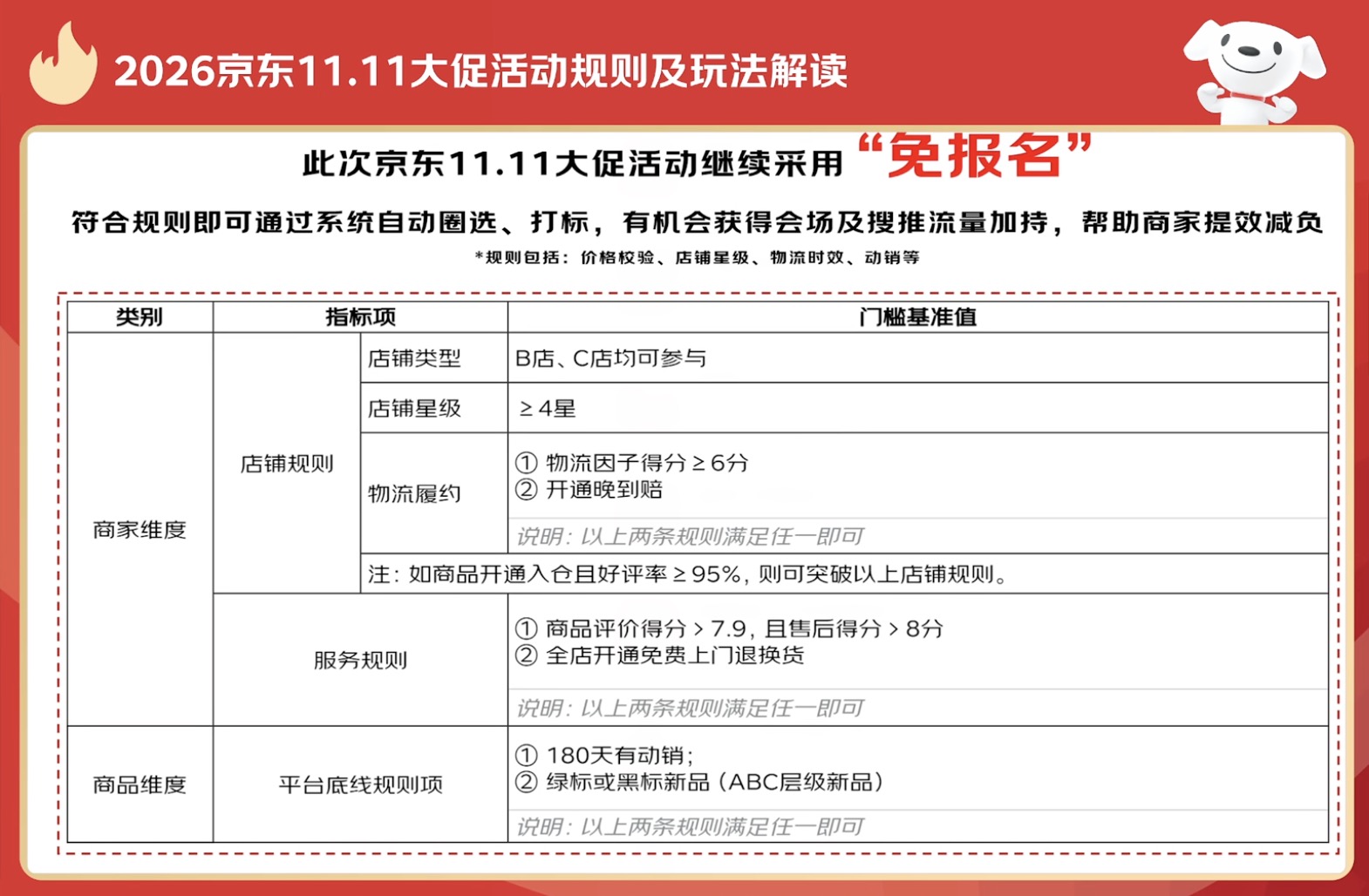
除了大促节奏外,亿邦动力整理了“2026京东双11大促活动规则及玩法解读”会上提到的大促重点:

1.今年京东双11的活动玩法有官方直降、跨店满减和低价热卖。其中,跨店满减活动支持加单品促销、官方直降、单品直降、超市黑五劵以及满赠促销等,不支持叠加普通限品类券、店铺优惠券、总价促销。官方直降活动支持叠加单品促销、跨店满减、普通总价促销(满减、满折等)、店铺券、普通限品类券、全品类券、满赠促销以及国家补贴。

跨店满减、官方直降活动的费用均由商家100%承担。会上官方并未公布这两个活动的活动力度。

2.此次京东双11升级了低价热卖活动的货盘规则。今年的低价热卖活动新增了“近N天最低价”价格标签,比历史价更低即可。商品满足全网低价、同款低价、近N天最低价、开通“买贵双倍赔服务”中的任一规则,均可以进入商品池。

在流量扶持上,京东将低价热卖货盘分成了基础货盘、精选货盘、降价尖货三种。也就是说,货盘按流量进阶模式分档,商家自运营获得高阶流量。

3.京东升级了京东秒杀频道的流量分配机制和部分功能。流量分配机制上,售前环节,商品的价差越大、预约越多,那么商品的位置将越靠前。售中时,价格力越强,曝光越大。当产品售罄时,秒杀频道会增加对店铺里优质商品的分发,成为店铺流量的关键获取入口。

秒杀频道的功能升级方面,一是比价逻辑升级,从“近多少天低价”的逻辑,升级为从用户视角出发,与用户上次购买价格作比较。二是扩充了商品特征,商品卡片会增加显示配送时效、卖点、榜单、真实评价等关键信息。三是集中曝光品牌/品类券包,增加商品权益信息的露出。四是页面中用用户下单弹幕、火苗动效等增加了商品热度的表达。

4.双11期间,京东秒杀频道在10月20日20点至22日24点设置了“超级秒杀日”活动,在11月9日20点至11日24点设置了“巅峰秒杀日”活动。这两个活动中,京东会用大牌整点直降的形式,从商品维度进行秒杀活动。

品牌和品类维度上,大促周期内,秒杀频道还设置了品牌秒杀日、品类惊喜日等活动。

大促期间,秒杀频道还设置了“早市夜市・3001”活动。这个活动会从用户场景出发来做产品组合,放大品类性价比。比如“邪修解压礼盒”中包括火鸡面冰淇淋、“见手青鸡尾酒、手机等产品。

5.10月12日开启的“月黑风高盛典”中,今年京东双11在月黑风高频道新增了“1元捡漏”活动。这个活动主要聚焦未形成动销与好评的SKU,给这些产品打造冷启动专属场域。

6.京东特价频道在双11期间升级了“天天有特价”栏目。该栏目的货盘构成主要是通过做1元或9.9元等深折扣价格钩子品。该栏目页支持定制化的跳转店铺能力,钩子品可以导流店铺并配合后链路运营提升店铺整体转化。“天天有特价”栏目此次新增了预约及任务解锁等新玩法,帮商家提升复访复购。

7.双11期间,特价频道在“品类特价日”活动的基础上,新增了“品牌特价日”活动。通过与品牌营销共建的方式,“品牌特价日”中,特价频道弹窗升级了置换权益,支持人群定向投放,帮商家触达潜在用户。

8.京东新品在大促期间设置了明星营销、全渠道营销和娱乐营销三种玩法。其中,明星营销玩法中,京东新品提供了粉丝打榜裂变、群星红包等工具,还有粉丝共创定制周边新权益,来帮品牌将明星资源扩大化。

9.京东试用频道在大促期间针对品牌设置了“大牌试用日”活动,还针对品类新增了“试用排位赛”活动。“试用排位赛”活动在蓄水期针对试用头部二级品类,综合订单增速、订单量PK TOP3席位,回购期提供千万曝光流量包激励,帮助品牌销售增长。

10.9月28日,京东推出首个常态化生活服务IP“京东超级服务日”。每月28日,消费者可以在京东囤购居家、出行、健康、养老、宠物和AI等各类生活服务。

亿邦持续追踪报道该情报,如想了解更多与本文相关信息,请扫码关注作者微信。

本文首发于 亿邦动力 官方网站

【版权提示】亿邦动力倡导尊重与保护知识产权。未经许可,任何人不得复制、转载、或以其他方式使用本网站的内容。如发现本站文章存在版权问题,烦请提供版权疑问、身份证明、版权证明、联系方式等发邮件至run@ebrun.com,我们将及时沟通与处理。

已点赞

+1

{{ praise_text }}

好文章,值得被更多人看到

FAQ回顾

京东2026年双11活动什么时候开始?

2026年京东双11于10月12日晚8点进入起售期,后续依次为开门红、专场期、高潮期、返场期,招商阶段从9月30日持续至11月13日24时。

京东“超级服务日”是什么?

京东超级服务日是京东于9月28日推出的首个常态化生活服务IP,每月28日消费者可囤购居家、出行、健康、养老、宠物和AI等各类生活服务,今年双11新增该活动以扶持服务型消费商家。

京东双11低价热卖活动的参与规则有哪些?

商品需满足全网低价、同款低价、近N天最低价、开通买贵双倍赔服务中的任一规则即可进入商品池,今年新增“近N天最低价”价格标签,并分为基础货盘、精选货盘、降价尖货三档获取差异化流量扶持。

商家如何报名参加京东双11?

京东双11延续免报名模式,符合规则的产品可通过系统自动圈选报名,商家无需手动申报,招商将持续至11月13日24时。

京东秒杀频道在双11期间有哪些规则升级?

秒杀频道比价逻辑从历史低价改为与用户上次购买价格比较,商品卡片增加配送时效、卖点、榜单、真实评价等信息,并设置超级秒杀日(10月20日20点至22日24点)和巅峰秒杀日(11月9日20点至11日24点),采用大牌整点直降玩法。

广告

下一篇

征集报名《品牌数字化服务商资源手册》

《品牌数字化服务商资源手册》展示数字化服务商风采,亿邦全年零售大会通发,触达更多资源,马上加入!

马上入驻

美团闪购发布潮饮IP阵地Mchao:酒饮的增长 从读懂年轻人开始

“下一杯,先发生在生活里,才会出现在货架上。看见年轻人的生活方式,才能看见酒饮生意的下一次增长。”

本地生活服务 美团 未来零售

2026-09-30 11:32:03