



• 亿邦公众号
    • APP下载

拼多多新功能:春节非休息期 平台将视情况为商品开启“不打烊”服务

作者:亿邦动力 文章来源:亿邦动力

2026-02-13 09:53

作者:亿邦动力 文章来源:亿邦动力

2026-02-13 09:53

邦小白快读

EN
全文速览

拼多多上线“春节休息时间工具”,帮助商家管理节假日运营,降低压力。

1.工具功能:商家可设置具体休息时间段,系统根据时间段自动切换发货要求和非休息期“不打烊”标签,实现流量倾斜;休息期内无需下架商品。

2.履约规则:在平台物流免罚期内,无需设置预售;超出免罚期需通过预售明确发货时间,否则按承诺时效发货;平台在休息开始前48小时关闭“不打烊”服务并提醒处理订单。

3.操作机制:每天最多编辑3次休息时间,变更记录在“自动操作记录”中便于追溯;特殊场景如手动修改打烊状态或参与活动可能导致自动设置失效,商家需在商品列表处理;功能开启后不能直接取消,需通过记录修改。

4.实操好处:自动化运营降低管理成本,保障消费者体验,工具已在商家后台上线支持弹窗直达。

该工具为品牌商提供节假日营销支持和成本优化启示。

1.品牌营销机会:非休息期商品自动开启“不打烊”标签,获得平台流量倾斜,增强品牌曝光和销售潜力。

2.渠道建设启示:自动化切换标签和履约要求减少人工干预,帮助品牌优化电商渠道管理;无需下架商品提升用户行为观察效率。

3.成本降低趋势:系统化配置替代人工操作,降低节假日运营压力,支持聚焦产品研发和定价策略。

4.消费趋势适应:工具响应节假日购物需求,提示品牌关注用户行为变化,如及时处理预售设置以防履约风险。

拼多多工具解读政策细节,揭示增长机会和操作风险。

1.政策与规则:商家可自主配置休息时间,系统自动根据时间段切换“不打烊”标签、流量权益和发货要求;非休息期获流量倾斜,休息期无需下架商品。

2.机会提示:流量倾斜带来销售增长,自动化降低管理成本,支持参与“春节不打烊”活动;履约免罚期简化预售设置。

3.风险提示:操作限制每天编辑3次,特殊场景如营销活动可能导致设置失效;功能开启后不能直接取消,需通过记录修改,提示首次配置谨慎规划。

4.应对措施:平台在休息前48小时关闭服务并提醒处理订单,卖家需在商品列表或活动页面监控失效情况。

5.可学习点:自动化运营模式降低中小卖家压力,支持合作方式优化。

工具启示工厂推进数字化和电商参与的商业机会。

1.商业机会:利用平台流量倾斜,工厂可优化产品销售策略;非休息期“不打烊”标签提升曝光,把握节假日需求。

2.生产需求启示:自动化工具减少运营负担,工厂可专注产品设计和生产;履约规则简化预售处理。

3.数字化启示:系统化配置替代人工操作,降低电商管理成本,鼓励工厂学习平台自动化模式。

4.操作建议:了解工具设置如编辑限制和记录变更,避免特殊场景失效;平台支持可帮助工厂优化电商策略。

工具反映行业自动化趋势,解决客户痛点。

1.行业趋势:电商平台强化自动化运营,通过系统化配置替代人工,降低管理成本。

2.新技术应用:休息时间工具自动切换商品标签、流量和履约要求;配套记录功能便于追溯变更。

3.客户痛点:解决中小商家节假日运营压力问题,如发货要求和流量管理。

4.解决方案:提供设置界面实现自动切换;平台在休息前提醒处理风险,但需注意特殊场景失效等局限。

拼多多工具展示平台最新运营管理策略。

1.最新做法:推出“春节休息时间工具”,联动“不打烊”活动,自动切换商品标签、流量权益和履约要求。

2.运营管理:系统根据商家设置时间段自动操作;休息前48小时统一关闭服务并提醒,规避履约风险;支持弹窗直达配置。

3.平台招商:工具降低商家节假日压力,吸引卖家参与;流量倾斜机制增强平台吸引力。

4.风险规避:操作限制如编辑次数和变更记录预防错误;特殊场景失效提示商家自行处理。

工具揭示电商产业新动向和商业模式创新。

1.产业动向:自动化运营成为趋势,平台通过系统化配置降低管理成本,响应中小商家挑战。

2.新问题:解决节假日运营压力,如履约规则细化免罚期和预售设置。

3.政策启示:平台支持商家自主配置休息时间,优化用户体验;规则如休息前提醒提示政策设计。

4.商业模式:总-分结构工具替代人工操作,实现标签和流量自动切换;启示数字化降本增效。

声明:快读内容全程由AI生成,请注意甄别信息。如您发现问题,请发送邮件至 run@ebrun.com 。

我是 品牌商 卖家 工厂 服务商 平台商 研究者 帮我再读一遍。

Quick Summary

Pinduoduo launches a "Spring Festival Break Time Tool" to help merchants manage holiday operations and reduce stress.

1. Tool functionality: Merchants can set specific break periods, and the system automatically adjusts shipping requirements and toggles the "Open for Business" label during non-break periods, enabling traffic prioritization. Products remain listed during breaks.

2. Fulfillment rules: No presale setup is needed within the platform's logistics penalty-free period. Beyond that, presales must specify shipping dates, or orders ship per promised timelines. The platform disables the "Open for Business" service 48 hours before breaks and sends order reminders.

3. Operation mechanism: Up to 3 daily edits allowed, with changes logged in "Auto-Operation Records" for traceability. Manual overrides or campaign participation may disable auto-settings, requiring manual product list adjustments. Once enabled, the tool cannot be directly canceled—modifications must be made via records.

4. Practical benefits: Automated operations lower management costs and maintain consumer experience. The tool is live in merchant dashboards with pop-up access.

The tool offers brands holiday marketing support and cost optimization insights.

1. Marketing opportunity: Products automatically display the "Open for Business" label during non-break periods, gaining platform traffic prioritization to boost brand exposure and sales potential.

2. Channel management: Automated label and fulfillment adjustments reduce manual intervention, optimizing e-commerce channel efficiency. Keeping products listed enhances user behavior tracking.

3. Cost reduction trend: Systemized configurations replace manual operations, easing holiday operational pressure and freeing resources for product development and pricing strategies.

4. Consumer trend adaptation: The tool addresses holiday shopping demands, reminding brands to monitor user behavior shifts, such as timely presale setups to avoid fulfillment risks.

Pinduoduo's tool clarifies policy details, highlighting growth opportunities and operational risks.

1. Policies and rules: Merchants customize break periods, with auto-toggling of "Open for Business" labels, traffic benefits, and shipping requirements. Non-break periods receive traffic prioritization; products stay listed during breaks.

2. Opportunities: Traffic boosts drive sales growth, automation cuts management costs, and participation in "Spring Festival Open for Business" campaigns is facilitated. Penalty-free periods simplify presale setups.

3. Risks: A 3-edit daily limit applies; manual overrides or campaigns may disable settings. The tool cannot be directly canceled once enabled—changes require record edits, urging careful initial planning.

4. Mitigation: The platform disables services 48 hours pre-break with order reminders. Sellers must monitor product lists or campaign pages for setting failures.

5. Key takeaway: Automated operations ease pressure on small sellers, enabling optimized collaboration models.

The tool highlights digitalization and e-commerce engagement opportunities for factories.

1. Business opportunity: Leverage platform traffic prioritization to refine product sales strategies. The "Open for Business" label during non-break periods increases visibility and captures holiday demand.

2. Production insights: Automation reduces operational burdens, allowing factories to focus on product design and manufacturing. Simplified fulfillment rules streamline presale handling.

3. Digitalization启示: Systemized configurations replace manual processes, lowering e-commerce management costs and encouraging factories to adopt platform automation models.

4. Operational advice: Understand tool settings like edit limits and change logs to avoid failures in special scenarios. Platform support can optimize e-commerce strategies.

The tool reflects industry automation trends and addresses client pain points.

1. Industry trend: E-commerce platforms are advancing automated operations, using systemized setups to replace manual work and reduce management costs.

2. Tech application: The break time tool auto-toggles product labels, traffic, and fulfillment requirements, with logging features for change tracking.

3. Client pain points: It alleviates holiday operational pressures for small merchants, such as shipping rules and traffic management.

4. Solution: Provides an interface for auto-switching settings. The platform sends pre-break risk reminders, though limitations like special scenario failures require attention.

Pinduoduo's tool demonstrates the platform's latest operational management strategies.

1. Latest approach: The "Spring Festival Break Time Tool" integrates with "Open for Business" campaigns, auto-adjusting product labels, traffic benefits, and fulfillment rules.

2. Operations management: The system auto-operates based on merchant-set periods; services are disabled 48 hours pre-break with reminders to mitigate fulfillment risks. Pop-up access streamlines configuration.

3. Merchant attraction: The tool reduces holiday pressure, encouraging seller participation. Traffic prioritization enhances platform appeal.

4. Risk prevention: Edit limits and change logs prevent errors; merchants must manually address setting failures in special scenarios.

The tool reveals new e-commerce industry trends and business model innovations.

1. Industry动向: Automated operations are trending, with platforms using systemized configurations to cut management costs and address small merchant challenges.

2. Emerging issues: It tackles holiday operational pressures, such as refined fulfillment rules with penalty-free periods and presale setups.

3. Policy启示: Platform support for merchant-configured break times optimizes user experience; rules like pre-break reminders inform policy design.

4. Business model: The hierarchical tool replaces manual operations, enabling auto-switching of labels and traffic, highlighting digitalization's role in cost efficiency.

Disclaimer: The "Quick Summary" content is entirely generated by AI. Please exercise discretion when interpreting the information. For issues or corrections, please email run@ebrun.com .

I am a Brand Seller Factory Service Provider Marketplace Seller Researcher Read it again.

【亿邦原创】2月13日消息,亿邦动力获悉,日前拼多多面向商家上线“春节休息时间工具”,允许商家在春节期间自主配置店铺休息与发货节奏,并与平台“春节不打烊”活动联动,实现商品标签、流量权益和履约要求的自动切换。
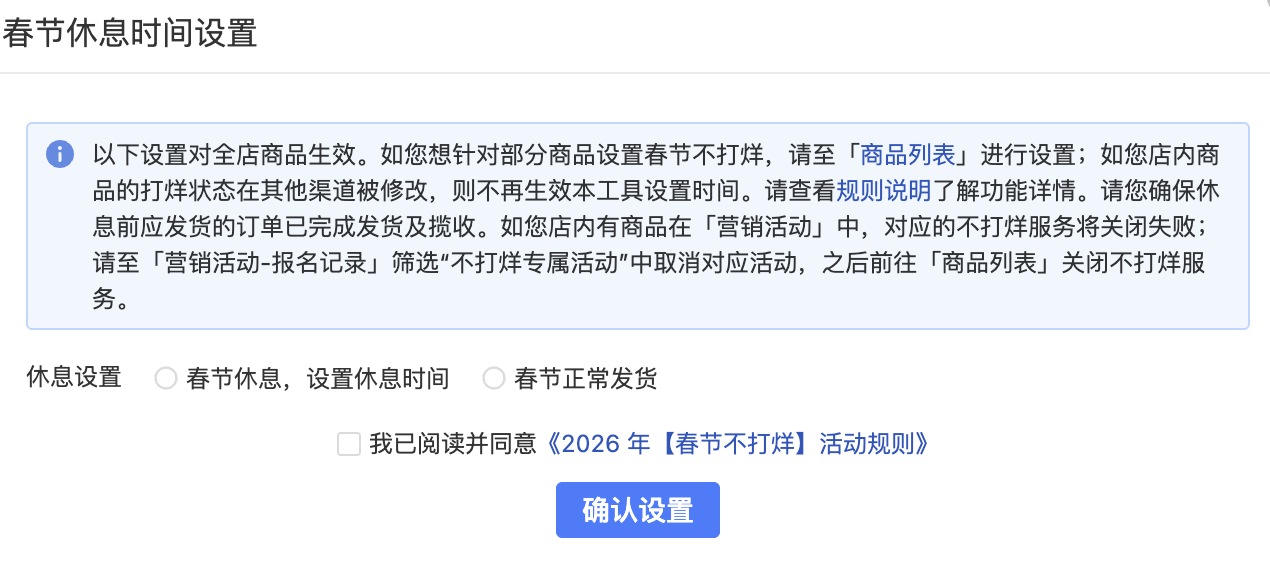
整体来看,该工具试图在保障消费者体验的同时,降低中小商家的节假日运营压力。

比如,在功能设计上,商家可提前设置具体休息时间段。系统会根据不同时间段,自动展示对应的发货要求:在非休息时间,平台将结合“春节不打烊”活动及商家设置情况,为商品自动开启“不打烊”标签,获得相应流量倾斜;在休息时间内,商家无需下架商品。

此外,履约规则也更加细化。若订单处于平台物流免罚期内,商家无需额外设置预售;若超出免罚期,仍需通过预售等方式明确发货时间,否则需按照承诺时效发货。为确保履约稳定,平台还将在休息开始前48小时统一关闭“不打烊”服务,并通过站内信提醒商家提前处理订单。

在操作层面,工具提供一定限制与配套机制。商家每天最多可编辑3次休息时间,相关变更会同步记录在“自动操作记录”中,便于追溯。若商品在其他渠道被手动修改打烊状态,或参与营销活动、预售等特殊场景,可能导致自动设置失效或关闭失败,商家需自行在商品列表或活动页面处理。

值得注意的是,功能开启后暂不支持直接取消,如需调整,只能通过自动操作记录重新修改时间。这意味着商家在首次配置时需更审慎规划。目前,该工具已在商家后台上线,同时支持弹窗直达配置。

总之,这一功能延续了拼多多近年来在大促和节假日节点强化“自动化运营”的思路,通过系统化配置替代人工逐条操作,降低中小商家的管理成本。

亿邦持续追踪报道该情报,如想了解更多与本文相关信息,请扫码关注作者微信。

【版权提示】亿邦动力倡导尊重与保护知识产权。未经许可,任何人不得复制、转载、或以其他方式使用本网站的内容。如发现本站文章存在版权问题,烦请提供版权疑问、身份证明、版权证明、联系方式等发邮件至run@ebrun.com,我们将及时沟通与处理。

已点赞

+1

{{ praise_text }}

好文章,值得被更多人看到

FAQ回顾

拼多多春节休息时间工具有哪些核心功能?

该工具允许商家自主设置春节休息时段,系统自动切换商品标签和发货要求。非休息期商品可获“不打烊”标签及流量倾斜,休息期无需下架商品,平台在休息前48小时关闭服务并提醒处理订单。

拼多多春节不打烊活动的履约规则是什么?

订单在平台物流免罚期内无需设置预售;超出免罚期需通过预售明确发货时间,否则按承诺时效发货。休息开始前48小时统一关闭“不打烊”服务,确保履约稳定。

商家使用春节休息时间工具有哪些操作限制?

商家每日最多编辑3次休息时间,变更记录在自动操作记录中。若商品手动修改状态或参与特殊活动可能导致设置失效,功能开启后不支持直接取消,需通过记录重新修改时间。

广告

下一篇

征集报名《品牌数字化服务商资源手册》

《品牌数字化服务商资源手册》展示数字化服务商风采,亿邦全年零售大会通发,触达更多资源,马上加入!

马上入驻

从月销售额1万美金到100万美金,一家糖果品牌是如何在TikTok Shop 卖爆的?

如何实现一个月在TikTok登顶类目榜首?如何通过内容电商打造一个食品爆款?











