• 亿邦公众号
    • APP下载

独家|拼多多下调部分类目的特殊店铺保证金 涉及二手电脑 洗碗机等!

作者:亿邦动力 文章来源:亿邦动力

2025-03-27 11:36

作者:亿邦动力 文章来源:亿邦动力

2025-03-27 11:36

邦小白快读

EN
全文速览

拼多多下调部分类目的特殊店铺保证金,帮助商家降低成本并优化服务。

1. 类目细分调整:二手数码类目细分为二手平板电脑、二手数码影音等、二手电脑/手机三个二级类目;厨房大电新增洗碗机、消毒柜三级类目,其他如冰洗套装、商用电器、黄金首饰等也涉及调整。

2. 保证金变化细节:基于近30天成交金额阶梯式下调,例如二手平板电脑N≤10万只需500元(原20000元),10万100万需5000元;洗碗机类目N≤2万需1500元,2万50万需10000元(原10000元)。

3. 操作注意事项:同一店铺经营多个类目时按最高原则收取保证金;商家必须按时缴纳,否则平台会采取屏蔽、下架商品等惩罚措施。

4. 背景利好:拼多多此前已下调基础保证金,此次调整进一步减轻中小商家成本,并计划投入超千亿资源扶持商家转型升级。

拼多多保证金调整可能影响品牌竞争环境和消费趋势,提供渠道建设机会。

1. 品牌营销机会:保证金下调吸引更多商家入驻二手数码、厨房电器等类目,可能扩大市场覆盖并加剧竞争,品牌需关注用户需求如二手商品增长。

2. 消费趋势洞察:类目细分反映用户行为变化,例如洗碗机、消毒柜新增类目显示健康家电需求上升,二手电脑/手机类目调整表明循环经济趋势。

3. 产品研发启示:平台扶持政策如投入千亿资源,可能间接支持品牌创新,品牌可借机开发相关产品线。

4. 风险提示:不缴纳保证金导致惩罚可能损害品牌声誉,需及时合规管理。

拼多多特殊店铺保证金下调为卖家提供政策利好和增长机会。

1. 政策解读:类目细分后保证金阶梯式降低,如二手平板电脑N≤10万只需500元(原20000元),洗碗机N≤2万需1500元(原10000元),嵌入式烤箱等类目也类似下调。

2. 机会提示:成本减轻可提升中小卖家竞争力,二手数码、厨房电器等类目需求增长提供新市场入口;平台计划投入超千亿扶持资源帮助转型升级。

3. 风险应对:必须按时足额缴纳保证金,否则面临商品屏蔽或下架惩罚;多类目经营时需计算最高保证金金额。

4. 正面影响:此前基础保证金已下调,此次调整进一步降低经营成本,增强可持续性。

拼多多保证金下调降低电商门槛,为工厂提供生产需求和商业机会。

1. 产品生产需求:类目细分如洗碗机、消毒柜新增和二手数码调整,显示市场对厨房电器、二手设备的需求增长,工厂可针对性开发相关产品。

2. 商业机会:保证金阶梯式降低(例如洗碗机N≤2万只需1500元)使工厂更易通过电商销售,成本减少可提升利润率;平台扶持计划投入超千亿资源支持中小商家,间接利好供应链。

3. 电商启示:推进数字化销售,利用平台规则优化生产计划;风险提示如不缴纳保证金惩罚,需加强合规管理。

拼多多保证金调整反映行业发展趋势和客户痛点解决方案。

1. 行业趋势:电商平台持续优化规则,如类目细分和保证金分层下调,显示向商家资金扶持方向发展,拼多多计划投入超千亿资源强化此趋势。

2. 客户痛点解决:商家资金压力大,阶梯式保证金(如二手平板电脑N≤10万仅500元)提供门槛降低方案;新增类目如洗碗机显示需求变化,服务商可开发配套服务。

3. 平台做法:规则细化包括多类目取高原则和惩罚措施,服务商可协助商家合规运营;机会在提供保证金计算、风险管理等服务。

拼多多优化特殊店铺保证金规则,提升招商和运营管理效率。

1. 商业需求响应:针对商家资金压力,下调保证金如二手数码影音类目N≤10万只需500元(原20000元),吸引更多中小商家入驻。

2. 最新平台做法:类目细分新增洗碗机、消毒柜等三级类目,保证金基于成交金额阶梯设置(例如洗碗机N>50万需10000元);多类目时取高原则简化管理。

3. 招商策略:通过降低门槛和计划投入超千亿资源扶持商家,增强平台吸引力;运营管理强调保证金缴纳合规,否则实施屏蔽、下架商品等惩罚。

4. 风向规避:规则明确风险点,如不及时缴纳的后果,帮助平台规避运营问题。

拼多多保证金调整揭示产业新动向和政策启示,提供商业模式研究案例。

1. 产业新动向:电商平台细化规则扶持中小商家,如类目细分和保证金阶梯下调(二手电脑N≤50万需5000元),反映二手市场、厨房电器等领域的增长趋势;拼多多投入超千亿资源显示政策倾斜。

2. 新问题分析:保证金制度变化可能影响市场结构,例如门槛降低促进竞争但需监管合规;惩罚措施如商品下架暴露运营风险。

3. 商业模式启示:拼多多的扶持策略(如此前基础保证金下调)可作为案例,探讨如何通过资金优化提升平台可持续性;政策建议包括加强商家保护机制。

声明:快读内容全程由AI生成,请注意甄别信息。如您发现问题,请发送邮件至 run@ebrun.com 。

我是 品牌商 卖家 工厂 服务商 平台商 研究者 帮我再读一遍。

Quick Summary

Pinduoduo has lowered the special store deposit requirements for certain categories, aiming to help merchants reduce costs and optimize services.

1. Category adjustments: The second-hand digital category has been subdivided into second-hand tablets, second-hand audio/video equipment, and second-hand computers/mobile phones. The major kitchen appliances category has added new subcategories for dishwashers and sterilizers. Other categories like washer-dryer sets, commercial appliances, and gold jewelry have also been adjusted.

2. Deposit changes: Deposits are now reduced on a tiered basis according to the transaction volume over the past 30 days. For example, for second-hand tablets, a turnover of ≤¥100k requires only ¥500 (previously ¥20k), ¥100k¥1M requires ¥5k. For dishwashers, N≤¥20k requires ¥1.5k, ¥20k¥500k requires ¥10k (previously ¥10k).

3. Operational notes: If a store operates in multiple categories, the highest applicable deposit amount will be charged. Merchants must pay on time, or face penalties such as product delisting or store restrictions.

4. Background benefits: Following a previous reduction in base deposits, this move further alleviates costs for small and medium-sized merchants. Pinduoduo also plans to invest over ¥100 billion in resources to support merchant transformation and upgrades.

Pinduoduo's deposit adjustment may impact brand competition and consumer trends, offering opportunities for channel development.

1. Marketing opportunities: Lower deposits are likely to attract more merchants to categories like second-hand digital and kitchen appliances, potentially expanding market reach and intensifying competition. Brands should monitor consumer demand shifts, such as growth in second-hand goods.

2. Consumer trend insights: Category refinements reflect changing user behavior. For instance, new subcategories for dishwashers and sterilizers indicate rising demand for health-focused appliances, while adjustments in second-hand computer/phone categories highlight the circular economy trend.

3. Product development implications: Platform support policies, including a planned ¥100+ billion resource investment, may indirectly foster brand innovation, creating opportunities to develop related product lines.

4. Risk warning: Failure to pay deposits on time could lead to penalties and damage brand reputation, necessitating timely compliance management.

Pinduoduo's reduction in special store deposits offers policy benefits and growth opportunities for sellers.

1. Policy interpretation: Following category refinements, deposits are now tiered and lowered. For example, second-hand tablets with N≤¥100k require only ¥500 (previously ¥20k), while dishwashers with N≤¥20k require ¥1.5k (previously ¥10k). Similar reductions apply to categories like built-in ovens.

2. Opportunity highlights: Lower costs enhance competitiveness for small and medium sellers. Growing demand in categories like second-hand digital and kitchen appliances provides new market entry points, supported by Pinduoduo's plan to invest over ¥100 billion in merchant upgrades.

3. Risk management: Deposits must be paid in full and on time to avoid penalties like product delisting. Sellers operating in multiple categories should calculate the highest applicable deposit.

4. Positive impact: This adjustment, following a previous base deposit reduction, further lowers operational costs and improves sustainability.

Pinduoduo's deposit reduction lowers e-commerce barriers, creating production demand and business opportunities for factories.

1. Production demand insights: Category refinements, such as new subcategories for dishwashers and sterilizers and adjustments in second-hand digital, signal growing market demand for kitchen appliances and refurbished equipment, guiding targeted product development.

2. Business opportunities: Tiered deposit reductions (e.g., dishwashers with N≤¥20k require only ¥1.5k) make e-commerce sales more accessible for factories, potentially improving profit margins. Pinduoduo's ¥100+ billion support plan for small merchants also benefits supply chains indirectly.

3. E-commerce implications: Factories should advance digital sales strategies and align production plans with platform rules. Compliance is critical, as deposit non-payment risks penalties.

Pinduoduo's deposit adjustments reflect industry trends and solutions to merchant pain points.

1. Industry trends: E-commerce platforms are refining rules, such as category segmentation and tiered deposit reductions, indicating a shift toward financial support for merchants. Pinduoduo's planned ¥100+ billion investment reinforces this direction.

2. Pain point solutions: Tiered deposits (e.g., ¥500 for second-hand tablets with N≤¥100k) alleviate financial pressure on merchants. New categories like dishwashers reveal evolving demand, creating opportunities for service providers to develop配套 services.

3. Platform practices: Detailed rules, including the "highest deposit" principle for multi-category stores and penalty mechanisms, enable service providers to assist merchants with compliance. Opportunities exist in offering deposit calculation and risk management services.

Pinduoduo has optimized special store deposit rules to enhance merchant recruitment and operational efficiency.

1. Addressing merchant needs: Deposit reductions, such as ¥500 for second-hand audio/video with N≤¥100k (previously ¥20k), attract more small and medium-sized merchants.

2. Platform practices: Categories are refined with new subcategories like dishwashers and sterilizers. Deposits are tiered based on transaction volume (e.g., dishwashers with N>¥500k require ¥10k). The "highest deposit" principle simplifies management for multi-category stores.

3. Recruitment strategy: Lower barriers and a planned ¥100+ billion resource investment boost platform appeal. Operations emphasize deposit compliance, with penalties like product delisting for non-payment.

4. Risk mitigation: Clear rules on consequences of late payment help the platform avoid operational issues.

Pinduoduo's deposit adjustments reveal industry shifts and policy implications, offering a case study for business model analysis.

1. Industry trends: E-commerce platforms are细化 rules to support small merchants, such as category segmentation and tiered deposit reductions (e.g., ¥5k for second-hand computers with N≤¥500k), reflecting growth in second-hand markets and kitchen appliances. Pinduoduo's ¥100+ billion investment indicates policy倾斜.

2. Analysis of new issues: Deposit changes may alter market structures—lower barriers could boost competition but require regulatory compliance. Penalties like product delisting highlight operational risks.

3. Business model insights: Pinduoduo's support strategy (e.g., prior base deposit cuts) serves as a case study on how financial optimization enhances platform sustainability. Policy suggestions include strengthening merchant protection mechanisms.

Disclaimer: The "Quick Summary" content is entirely generated by AI. Please exercise discretion when interpreting the information. For issues or corrections, please email run@ebrun.com .

I am a Brand Seller Factory Service Provider Marketplace Seller Researcher Read it again.

【亿邦原创】亿邦动力独家获悉,日前,为了促进商家更优质地服务拼多多用户,拼多多对部分类目需要缴纳的特殊店铺保证金进行调整。其中,最大的变化是,拼多多对于部分类目进一步细分,并对其需要缴纳的特殊店铺保证金进行了不同程度的下调。

根据平台规定,商家除了缴纳基础的店铺保证金外,当店铺发布特定商品时,还需要缴存特殊店铺保证金,平台将用于对第三方进行赔付、赔偿平台损失或支付其他应由商家承担的款项或费用。

具体来看,此次调整后,二手数码类目将被细分为以下三个二级类目。

(1)二手平板电脑

(2)二手数码影音、二手网络设备、二手智能设备、其他二手数码、二手数码配件

(3)二手电脑、二手手机

此前,当商家售卖上述任一类目商品时,都需要缴纳20000元特殊店铺保证金。

现在,当商家售卖二手平板电脑,近30天对应类目成交金额少于10万元时,只需要缴纳500元特殊店铺保证金即可;超过10万元但少于100万元时,只需要缴纳3000元特殊店铺保证金;超过100万元时,则需要缴纳5000元特殊店铺保证金。

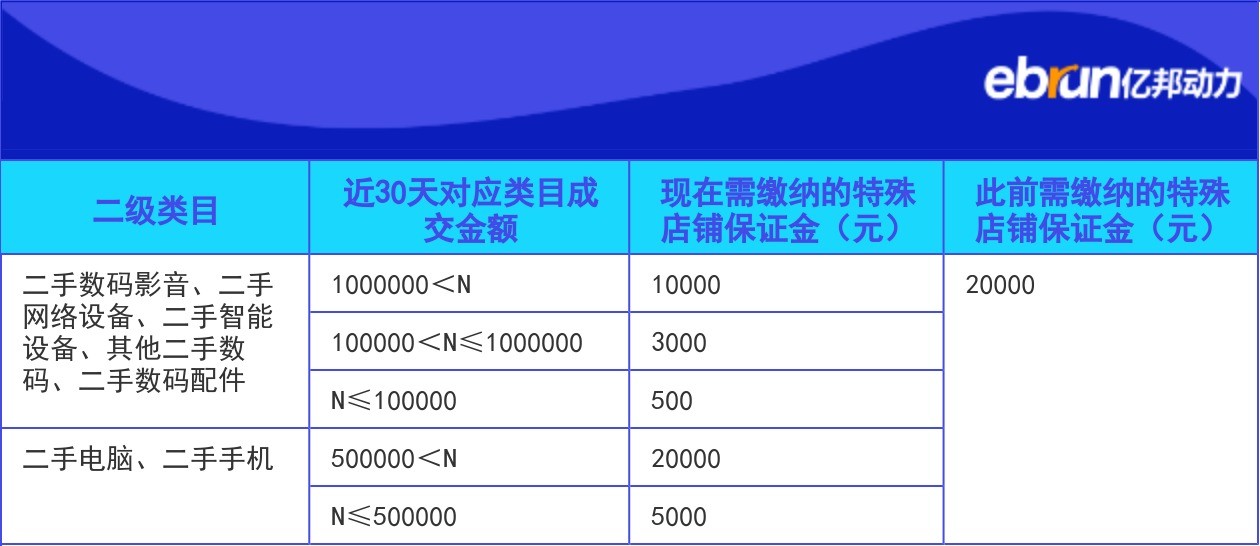
当商家售卖二手数码影音、二手网络设备、二手智能设备、其他二手数码、二手数码配件以及二手电脑、二手手机类目商品时,需要缴纳不同的特殊店铺保证金,参照下图所示。


二级类目 近30天对应类目成交金额 现在需缴纳的特殊店铺保证金(元) 此前需缴纳的特殊店铺保证金(元)
二手数码影音、二手网络设备、二手智能设备、其他二手数码、二手数码配件 1000000<N 10000 20000
100000<N≤1000000 3000
N≤100000 500
二手电脑、二手手机 500000<N 20000
N≤500000 5000

根据最新的保证金规则,在平台的二级类目“厨房大电”类目下,新增了“洗碗机、消毒柜”的三级类目。

当商家售卖洗碗机或消毒柜类目商品,近30天对应类目成交金额少于2万元时,只需要缴纳1500元特殊店铺保证金;超过2万元但少于10万元时,需要缴纳3000元特殊店铺保证金;超过10万元但少于50万元时,需要缴纳5000元特殊店铺保证金;超过50万元时,需缴纳10000元特殊店铺保证金。

而此前,商家售卖上述类目(洗碗机、消毒柜)商品时,只要近30天对应类目成交金额大于0元,即需缴纳10000元特殊店铺保证金。

与此同时,对于售卖嵌入式烤箱、嵌入式蒸箱、嵌入式微波炉类目的商家而言,需缴纳的特殊店铺保证金相比此前的20000元,也有不同程度的下调。

现在,上述商家近30天对应类目成交金额不超过2万元,需要缴纳1500元特殊店铺保证金;超过2万元但少于10万元时,需缴纳3000元特殊店铺保证金;超过10万元但少于50万元时,需缴纳5000元特殊店铺保证金;超过50万元后,才需缴纳20000元特殊店铺保证金。

此外,此次保证金调整还涉及“冰洗套装、洗烘套装、洗鞋机、烘干机、衣物护理机、全屋互联网智能电器”、“商用电器”、“黄金首饰”等不同类目商品。

需要注意的是,当同一店铺经营多个类目时,平台将按照取高原则收取特殊店铺保证金。

平台方面强调,商家需要按照平台相关规定缴纳店铺保证金、活动保证金等。当商家没有在规定期限内足额缴存店铺保证金,或者货款及活动保证金余额不足以补足店铺保证金的,平台将对商家进行惩罚措施。比如,对商家店铺部分或全部商品或信息采取屏蔽、降权、下架等措施。

此前,拼多多推出“百亿减免”等扶持商家举措,已经下调了商家的基础店铺保证金,此次下调部分类目的特殊店铺保证金或将进一步减轻中小商家的经营成本。

另外,亿邦动力还了解到,日前拼多多方面表示,将进一步加码商家扶持力度,计划投入资源或超过千亿元人民币,主要用于帮助中小商家高质量转型升级。

亿邦持续追踪报道该情报,如想了解更多与本文相关信息,请扫码关注作者微信。

【版权提示】亿邦动力倡导尊重与保护知识产权。未经许可,任何人不得复制、转载、或以其他方式使用本网站的内容。如发现本站文章存在版权问题,烦请提供版权疑问、身份证明、版权证明、联系方式等发邮件至run@ebrun.com,我们将及时沟通与处理。

已点赞

+1

{{ praise_text }}

好文章,值得被更多人看到

FAQ回顾

拼多多特殊店铺保证金调整涉及哪些类目?

调整涉及二手数码(如平板电脑、电脑、手机)、厨房大电(如洗碗机、消毒柜)、嵌入式厨电、商用电器和黄金首饰等多个类目,按近30天销售额分级设定保证金金额。

拼多多二手平板电脑类目的特殊店铺保证金如何计算?

销售额低于10万元缴500元,10万至100万元缴3000元,超过100万元缴5000元。相比此前统一的20000元,新规大幅降低了低销售额商家的保证金压力。

拼多多调整保证金政策对商家有何影响?

新政策按销售额分级收费,降低了中小商家的资金占用,如洗碗机类目保证金最低降至1500元。平台称此举是千亿资源扶持计划的一部分,旨在帮助商家转型升级。

广告

下一篇

征集报名《品牌数字化服务商资源手册》

《品牌数字化服务商资源手册》展示数字化服务商风采,亿邦全年零售大会通发,触达更多资源,马上加入!

马上入驻

二线崛起 银发狂飙 高端坚挺 解码2025旅游业增长引擎!

3月将尽,今年一季度酒旅行业的业绩已大致明朗,市场行情偏向保守。然而,有行业调研显示,旅游消费信心仍具韧性、二线城市潜力凸显、银发旅游经济后劲可观。

旅游 平台 旅行服务 未来零售

2025-03-27 11:34:50