• 亿邦公众号
    • APP下载

净利润均不超2亿?四家上市美妆企业公布2024年业绩预告

作者:张从容 文章来源:亿邦动力

2025-02-10 17:03

作者:张从容 文章来源:亿邦动力

2025-02-10 17:03

邦小白快读
EN
全文速览

总:2024年四家上市美妆企业净利润均未超过2亿元,且同比大幅减少50%以上,市场整体表现严峻。

1. 华熙生物净利润预计1.46亿元至1.75亿元,同比减少70.47%至75.36%,创近五年最低水平。

2. 上海家化亏损7.1亿元至8.8亿元,同比减少242%至276%,同样为五年最低。

3. 水羊股份净利润1亿元至1.3亿元,同比减少56%至66%,若低于1.25亿元也将是五年新低。

4. 丽人丽妆亏损0.17亿元至0.28亿元,同比减少156.67%至193.33%,显示行业普遍承压。

5. 中国化妆品市场零售总额4357亿元,同比下滑1.1%,全年有6个月负增长,包括618和双11促销月份,实操干货为关注企业财报和市场数据以规避投资风险。

总:美妆市场消费趋势疲软,企业业绩下滑提示品牌需调整营销和产品策略。

1. 消费趋势:零售总额下滑1.1%,促销月份如618和双11负增长,反映用户购买行为缩减,品牌应优化促销活动。

2. 品牌营销:代表企业如上海家化亏损扩大,华熙生物利润减少,显示价格竞争加剧,品牌需创新定价策略以吸引消费者。

3. 产品研发:市场整体萎缩,用户行为观察表明需求减弱,品牌商应加强新品研发以适应变化。

4. 渠道建设:业绩数据提示电商渠道效果不佳,品牌需探索多渠道合作提升销售。

总:美妆行业风险高企,净利润大减和市场下滑带来挑战与学习机会。

1. 风险提示:四家企业净利润均减超50%,上海家化等亏损严重,市场零售额下滑1.1%,全年6个月负增长,卖家需警惕需求萎缩。

2. 机会提示:促销月份表现差,如618和双11未提振销售,卖家可调整事件应对措施,如优化库存管理。

3. 可学习点:企业业绩降至五年最低,反映最新商业模式需创新,卖家可借鉴数据监控市场变化。

4. 消费需求变化:数据表明行业增长市场受限,卖家应关注消费者行为转变,寻找细分机会。

总:美妆企业业绩不佳启示生产和电商需创新,工厂应关注产品需求变化。

1. 产品生产需求:代表企业如华熙生物和水羊股份利润减少,可能影响订单量,工厂需优化设计以提升竞争力。

2. 商业机会:市场整体下滑,但电商促销月份负增长提示工厂可探索新合作方式,如与平台联合开发产品。

3. 推进数字化启示:618和双11销售不佳,显示电商策略需调整,工厂应加强数字化生产流程以应对市场波动。

4. 代表企业案例:上海家化亏损扩大,工厂可分析其供应链挑战,寻求改进生产效率的机会。

总:美妆行业发展趋势下行,企业痛点明显,服务商需提供针对性解决方案。

1. 行业趋势:零售总额同比下滑1.1%,全年6个月负增长,包括关键促销月份,趋势持续疲软。

2. 客户痛点:四家上市企业净利润大减,华熙生物和上海家化创五年最低水平,痛点在于市场萎缩和利润压力。

3. 解决方案启示:数据如618和双11表现差,服务商可开发数据分析工具帮助客户预测需求。

4. 新技术应用:企业业绩不佳提示需创新服务,如基于案例提供风险管理系统。

总:电商平台在美妆领域面临销售压力,需调整招商和运营以规避风险。

1. 商业对平台需求:促销月份如618和双11零售负增长,显示平台活动效果减弱,平台需优化招商策略吸引品牌商。

2. 平台最新做法启示:企业净利润大减,如丽人丽妆亏损,平台应加强运营管理,提供扶持政策以稳定合作。

3. 风向规避:市场整体下滑1.1%,全年多个月份负增长,平台需规避风险,如调整促销节奏。

4. 代表企业需求:水羊股份等业绩不佳,平台可分析其问题,改进合作方式以提升整体表现。

总:美妆产业出现新动向,企业业绩创低点和市场萎缩引发新问题。

1. 产业新动向:四家企业净利润均未超2亿元,同比减超50%,华熙生物等降至五年最低,显示行业下行趋势。

2. 新问题:市场零售总额下滑1.1%,促销月份负增长,问题在于消费疲软原因和政策影响。

3. 政策法规建议:数据表明经济因素影响大,研究者可提出政策支持建议,如刺激消费措施。

4. 商业模式启示:企业如上海家化亏损扩大,提示需探索创新模式,研究者应分析案例以提供理论框架。

声明:快读内容全程由AI生成,请注意甄别信息。如您发现问题,请发送邮件至 run@ebrun.com 。

我是 品牌商 卖家 工厂 服务商 平台商 研究者 帮我再读一遍。

Quick Summary

Summary: In 2024, none of the four listed cosmetics companies achieved a net profit exceeding 200 million yuan, with all experiencing a year-on-year decline of over 50%, indicating a severe overall market performance.

1. Huaxi Biotech's net profit is projected to be between 146 million and 175 million yuan, a decrease of 70.47% to 75.36% year-on-year, marking its lowest level in nearly five years.

2. Shanghai Jahwa reported a loss of 710 million to 880 million yuan, down 242% to 276% year-on-year, also a five-year low.

3. Shu Yang Co., Ltd.'s net profit is estimated at 100 million to 130 million yuan, falling 56% to 66% year-on-year; if it falls below 125 million yuan, it would also be a five-year low.

4. Li Ren Li Zhuang incurred a loss of 17 million to 28 million yuan, declining 156.67% to 193.33% year-on-year, reflecting widespread pressure across the industry.

5. China's total cosmetics retail sales reached 435.7 billion yuan, down 1.1% year-on-year, with negative growth recorded in six months of the year, including major promotional periods like the 618 and Double 11 shopping festivals. Practical advice includes closely monitoring corporate financial reports and market data to mitigate investment risks.

Summary: The weak consumption trend in the cosmetics market and declining corporate performance signal that brands need to adjust their marketing and product strategies.

1. Consumption Trend: Total retail sales fell by 1.1%, with negative growth during promotional months like 618 and Double 11, indicating reduced consumer purchasing. Brands should optimize promotional activities.

2. Brand Marketing: Leading companies like Shanghai Jahwa reporting expanded losses and Huaxi Biotech seeing profit declines highlight intensified price competition. Brands need to innovate pricing strategies to attract customers.

3. Product R&D: Overall market contraction and observed shifts in user behavior suggest weakening demand. Brands should strengthen new product development to adapt.

4. Channel Development: Performance data indicates poor effectiveness of e-commerce channels. Brands should explore multi-channel collaborations to boost sales.

Summary: High risks in the cosmetics industry, with significant net profit declines and market downturns presenting both challenges and learning opportunities for sellers.

1. Risk Warning: All four companies saw net profits drop over 50%, with severe losses at firms like Shanghai Jahwa. Market retail sales fell 1.1%, with negative growth in six months, signaling demand contraction that sellers must heed.

2. Opportunity Alert: Poor performance during key promotional events like 618 and Double 11 suggests sellers can adjust event response measures, such as optimizing inventory management.

3. Learning Points: Corporate performance hitting five-year lows reflects the need for innovative business models. Sellers can learn from data-driven market monitoring.

4. Shifting Consumer Demand: Data indicates limited growth in the sector. Sellers should focus on changing consumer behavior to identify niche opportunities.

Summary: Poor performance of cosmetics companies underscores the need for innovation in production and e-commerce. Factories should monitor changes in product demand.

1. Production Demand: Profit declines at representative companies like Huaxi Biotech and Shu Yang Co. may impact order volumes. Factories need to optimize designs to enhance competitiveness.

2. Business Opportunities: Overall market decline, coupled with negative growth during e-commerce promotions, suggests factories can explore new collaborations, such as co-developing products with platforms.

3. Digitalization Insights: Weak sales during 618 and Double 11 indicate e-commerce strategies need adjustment. Factories should strengthen digital production processes to cope with market volatility.

4. Case Study: Shanghai Jahwa's expanding losses offer factories a chance to analyze supply chain challenges and seek efficiency improvements.

Summary: The cosmetics industry shows a downward trend with clear corporate pain points, requiring service providers to offer targeted solutions.

1. Industry Trend: Total retail sales fell 1.1% year-on-year, with negative growth in six months, including key promotional periods, indicating sustained weakness.

2. Client Pain Points: Significant net profit declines at the four listed companies, with Huaxi Biotech and Shanghai Jahwa at five-year lows, highlight issues like market contraction and profit pressure.

3. Solution Insights: Poor performance during events like 618 and Double 11 suggests service providers can develop data analytics tools to help clients forecast demand.

4. Technology Application: Weak corporate performance signals a need for innovative services, such as risk management systems based on case studies.

Summary: E-commerce platforms face sales pressure in the cosmetics sector and need to adjust merchant recruitment and operations to mitigate risks.

1. Platform Demand: Negative retail growth during promotional months like 618 and Double 11 indicates weakened platform campaign effectiveness. Platforms must optimize recruitment strategies to attract brands.

2. Operational Insights: Significant net profit declines, such as losses at Li Ren Li Zhuang, suggest platforms should enhance operational management and offer support policies to stabilize partnerships.

3. Risk Mitigation: A 1.1% overall market decline with multiple months of negative growth requires platforms to adjust promotional cadence to avoid risks.

4. Merchant Needs: Poor performance from companies like Shu Yang Co. offers platforms an opportunity to analyze issues and refine collaboration methods for better overall results.

Summary: New developments in the cosmetics industry, with corporate performance hitting lows and market contraction raising fresh research questions.

1. Industry Dynamics: None of the four companies exceeded 200 million yuan in net profit, all declining over 50% year-on-year, with firms like Huaxi Biotech at five-year lows, signaling a sector-wide downturn.

2. Emerging Issues: A 1.1% drop in total retail sales, including negative growth during promotional months, raises questions about the causes of consumption fatigue and policy impacts.

3. Policy Recommendations: Data suggests significant economic influences; researchers could propose supportive policies, such as measures to stimulate consumption.

4. Business Model Insights: Expanded losses at companies like Shanghai Jahwa indicate a need for innovative models. Researchers should analyze cases to develop theoretical frameworks.

Disclaimer: The "Quick Summary" content is entirely generated by AI. Please exercise discretion when interpreting the information. For issues or corrections, please email run@ebrun.com .

I am a Brand Seller Factory Service Provider Marketplace Seller Researcher Read it again.

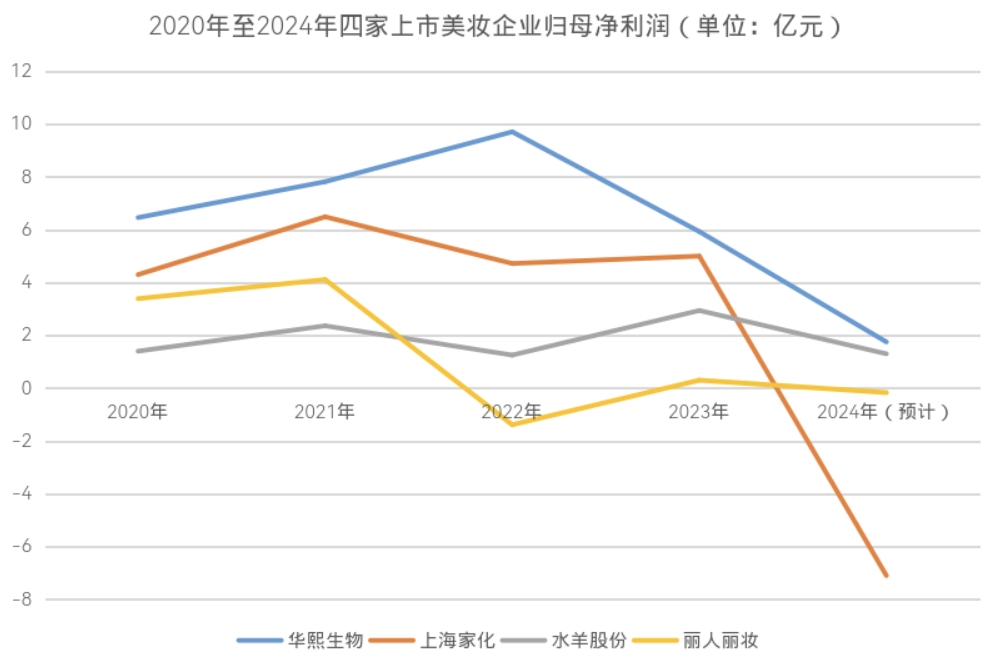
【亿邦原创】日前,华熙生物、上海家化、水羊股份、丽人丽妆四家上市美妆企业发布2024年全年业绩预告。三家美妆企业2024年的归母净利润,均同比减少50%以上、均未超过2亿元。

预告显示,2024全年,华熙生物的归母净利润预计为1.46亿元到1.75亿元,同比减少70.47%到75.36%;上海家化的归母净利润为-7.1亿元到-8.8亿元,同比减少242%到276%;水羊股份的归母净利润为1亿元到1.3亿元,同比减少56%到66%;丽人丽妆的归母净利润为-0.28亿元至-0.17亿元,同比减少156.67%至193.33%。

值得注意的是,华熙生物和上海家化的2024年归属于母公司所有者的净利润均为近五年(2020年至2024年)的最低水平;若水羊股份的归母净利润低于1.25亿元,则水羊股份的归母净利润也将降至5年来的最低水平。
实际上,2024年中国化妆品市场不容乐观。国家统计局统计显示,2024年全年限额以上化妆品类零售总额为4357亿元,同比下滑1.1%,且全年有6个月为负增长,包括包含“618”和“双11”的6月和11月。

亿邦持续追踪报道该情报,如想了解更多与本文相关信息,请扫码关注作者微信。

【版权提示】亿邦动力倡导尊重与保护知识产权。未经许可,任何人不得复制、转载、或以其他方式使用本网站的内容。如发现本站文章存在版权问题,烦请提供版权疑问、身份证明、版权证明、联系方式等发邮件至run@ebrun.com,我们将及时沟通与处理。

已点赞

+1

{{ praise_text }}

好文章,值得被更多人看到

FAQ回顾

哪四家上市美妆企业公布了2024年业绩预告?

华熙生物、上海家化、水羊股份和丽人丽妆四家上市美妆企业公布了2024年全年业绩预告,其归母净利润均未超过2亿元。

2024年中国化妆品市场整体表现如何?

2024年中国限额以上化妆品类零售总额为4357亿元,同比下滑1.1%,全年有6个月出现负增长,包括6月(含618)和11月(含双11)。

华熙生物2024年的预计归母净利润是多少?

华熙生物2024年归母净利润预计为1.46亿元到1.75亿元,同比减少70.47%到75.36%,为其近五年最低水平。

广告

下一篇

征集报名《品牌数字化服务商资源手册》

《品牌数字化服务商资源手册》展示数字化服务商风采,亿邦全年零售大会通发,触达更多资源,马上加入!

马上入驻

蛇年美妆 以大裁员开始

经历了多年来的首个负增长年后,化妆品行业开始减员过冬。没想到,美妆行业蛇年是以大裁员开始的。

品牌故事 化妆品 未来零售

2025-02-10 16:44:03