• 亿邦公众号
    • APP下载

拼多多旗舰店商家注意!不开通消费者体验提升计划将被降级

作者:亿邦动力 文章来源:亿邦动力

2024-07-15 17:35

作者:亿邦动力 文章来源:亿邦动力

2024-07-15 17:35

邦小白快读

EN
全文速览

拼多多旗舰店商家必须注意新考核规范变化,否则面临降级风险。

1. 新规范于2024年7月19日生效,新增必须开通消费者体验提升计划的要求,店铺需持续满足此条件才能保留旗舰店标识和权益。

2. 开通计划后,商家需提供退货包运费、部分订单极速退款、闪电退货等服务,平台根据历史经营情况收取服务费,并获得服务标识和优先售后处理。

3. 考核指标包括店铺综合体验星级、开通计划、成交金额或支付订单量、商品价格竞争力,不达标时平台立即降级处理,比之前更快。

4. 商家应尽快开通计划并优化服务,以避免降级影响店铺运营。

品牌商需重视新规范对品牌营销和用户行为的影响。

1. 必须开通消费者体验提升计划以维持旗舰店标识,否则降级损害品牌形象和渠道建设。

2. 开通计划后获得退货包运费等服务标识,提升消费者信任和忠诚度,助力品牌定价和价格竞争策略。

3. 平台提供的优先售后处理和专业客服支持优化产品研发,应对消费趋势如提升用户体验。

4. 商品价格竞争力要求影响品牌策略,需关注用户行为观察以保持竞争力。

卖家应解读政策变化,识别风险与增长机会。

1. 政策要求:必须开通消费者体验提升计划,否则无法通过考核,旗舰店将被降级。

2. 风险提示:不开通计划导致权益丧失,降级处理更快(立即执行),影响店铺增长。

3. 机会提示:开通计划获得服务标识和优先售后支持,可能提升销售转化;消费需求变化强调用户体验,可学习最新商业模式如强化退货服务。

4. 应对措施:商家需满足退货包运费、极速退款等要求,平台收取服务费但提供扶持政策如专业客服。

5. 事件应对:优化商品价格竞争力以避免系统判定为低竞争力天数超标。

工厂可从新规范中获取产品生产和电商启示。

1. 产品生产和设计需求:商品价格竞争力要求影响生产优化,需控制成本以保持竞争力。

2. 商业机会:提升用户体验如退货服务可能增加产品吸引力,推动销售增长。

3. 推进数字化和电商启示:平台强化服务标准,启示工厂整合类似数字化服务(如快速退货)以适配电商趋势。

4. 间接机会:通过满足平台要求,工厂可探索合作方式提升产品市场表现。

服务商应关注行业趋势和解决方案。

1. 行业发展趋势:平台强化用户体验要求,如退货包运费、极速退款,推动服务标准化。

2. 客户痛点:商家需实施新服务要求,痛点在于如何高效满足退货和售后需求。

3. 解决方案:平台提供售后处理方案和专业客服团队,服务商可借鉴提供类似支持服务。

4. 新技术启示:趋势指向提升服务效率,服务商可开发工具优化退货流程。

平台商可参考新做法优化运营管理。

1. 平台最新做法:新增必须开通消费者体验提升计划作为考核项,提升整体用户体验。

2. 商业需求和问题:通过严格规范(如开通计划要求)吸引高质量商家,解决平台招商问题。

3. 运营管理:考核不达标时立即降级处理,比之前更快,强化平台标准;提供优先售后支持以管理商家。

4. 风向规避:强化服务要求如退货包运费,减少风险并提升平台信誉。

研究者应分析产业新动向和政策启示。

1. 产业新动向:拼多多引入消费者体验提升计划作为旗舰店考核标准,推动电商服务升级。

2. 新问题:如何平衡商家服务成本(如平台收取服务费)与用户体验提升。

3. 政策法规建议和启示:新规范变化对电商法规的参考,如强化平台监管和商家责任。

4. 商业模式:平台通过收取服务费提供增值服务(如优先售后),创新电商商业模式。

声明:快读内容全程由AI生成,请注意甄别信息。如您发现问题,请发送邮件至 run@ebrun.com 。

我是 品牌商 卖家 工厂 服务商 平台商 研究者 帮我再读一遍。

Quick Summary

Pinduoduo flagship store merchants must pay attention to new assessment criteria changes, or face downgrade risks.

1. The new criteria take effect on July 19, 2024, adding a mandatory requirement to activate the Consumer Experience Enhancement Program. Stores must continuously meet this condition to retain their flagship store status and benefits.

2. After activating the program, merchants must provide services like free return shipping, instant refunds for select orders, and expedited returns. The platform charges a service fee based on historical performance, granting service badges and priority after-sales support in return.

3. Assessment metrics include overall store experience rating, program activation, sales volume or order count, and product price competitiveness. Failure to meet standards triggers immediate downgrade, a faster process than before.

4. Merchants should activate the program promptly and optimize services to avoid operational impacts from downgrading.

Brands must recognize the new criteria's impact on marketing and consumer behavior.

1. Activating the Consumer Experience Enhancement Program is essential to maintain flagship store status; otherwise, downgrades harm brand image and channel development.

2. Program activation grants service badges (e.g., free return shipping), boosting consumer trust and loyalty, which aids brand pricing and competitive strategies.

3. Priority after-sales support and professional customer service from the platform refine product R&D and help address trends like enhanced user experience.

4. The product price competitiveness requirement influences brand strategy, necessitating focus on user behavior analysis to maintain market position.

Sellers should interpret policy shifts to identify risks and growth opportunities.

1. Policy requirement: The Consumer Experience Enhancement Program is mandatory; non-compliance leads to assessment failure and flagship store downgrade.

2. Risk alert: Skipping the program results in lost privileges, with faster downgrades (immediate enforcement) hindering store growth.

3. Opportunity insight: Program activation yields service badges and priority after-sales support, potentially improving sales conversion. Evolving consumer demand emphasizes user experience, urging adoption of modern models like streamlined returns.

4. Action plan: Meet requirements such as free return shipping and instant refunds. The platform charges a service fee but offers support like dedicated客服.

5. Contingency: Optimize product price competitiveness to avoid exceeding low-competitiveness thresholds set by the system.

Factories can derive production and e-commerce insights from the new criteria.

1. Production/design needs: The product price competitiveness requirement affects production optimization, necessitating cost control to stay competitive.

2. Business opportunity: Enhancing user experience (e.g., via return services) may increase product appeal and drive sales growth.

3. Digital/e-commerce启示: Platform-driven service standards inspire factories to integrate similar digital services (e.g., rapid returns) to align with e-commerce trends.

4. Indirect opportunity: By meeting platform requirements, factories can explore collaborations to boost product market performance.

Service providers should monitor industry trends and solutions.

1. Industry trend: Platforms are tightening user experience mandates (e.g., free return shipping, instant refunds), accelerating service standardization.

2. Client pain points: Merchants need to implement new service requirements, struggling with efficient return and after-sales fulfillment.

3. Solution: Platforms offer after-sales solutions and professional客服 teams; providers can emulate these support services.

4. Tech启示: The push for service efficiency inspires tools to optimize return processes.

Platform operators can reference new practices to refine management.

1. Latest practice: Mandatory Consumer Experience Enhancement Program activation is added to assessments, elevating overall user experience.

2. Business need: Strict criteria (e.g., program requirement) attract high-quality merchants, addressing platform recruitment challenges.

3. Operations: Immediate downgrades for non-compliance enforce standards more rigorously than before; priority after-sales support aids merchant management.

4. Risk mitigation: Enhanced service demands (e.g., free return shipping) reduce platform risks and boost credibility.

Researchers should analyze industry shifts and policy implications.

1. Industry trend: Pinduoduo’s inclusion of the Consumer Experience Enhancement Program in flagship assessments drives e-commerce service upgrades.

2. New issue: Balancing merchant service costs (e.g., platform fees) with user experience improvements.

3. Policy启示: Criteria changes inform e-commerce regulations, such as strengthening platform oversight and merchant accountability.

4. Business model: Platforms monetize value-added services (e.g., priority after-sales) via fees, innovating e-commerce models.

Disclaimer: The "Quick Summary" content is entirely generated by AI. Please exercise discretion when interpreting the information. For issues or corrections, please email run@ebrun.com .

I am a Brand Seller Factory Service Provider Marketplace Seller Researcher Read it again.

【亿邦原创】7月15日消息,亿邦动力独家获悉,为了加强对旗舰店店铺经营的管理,日前拼多多修改了对于旗舰店的考核规范,新规范将于2024年7月19日正式生效。

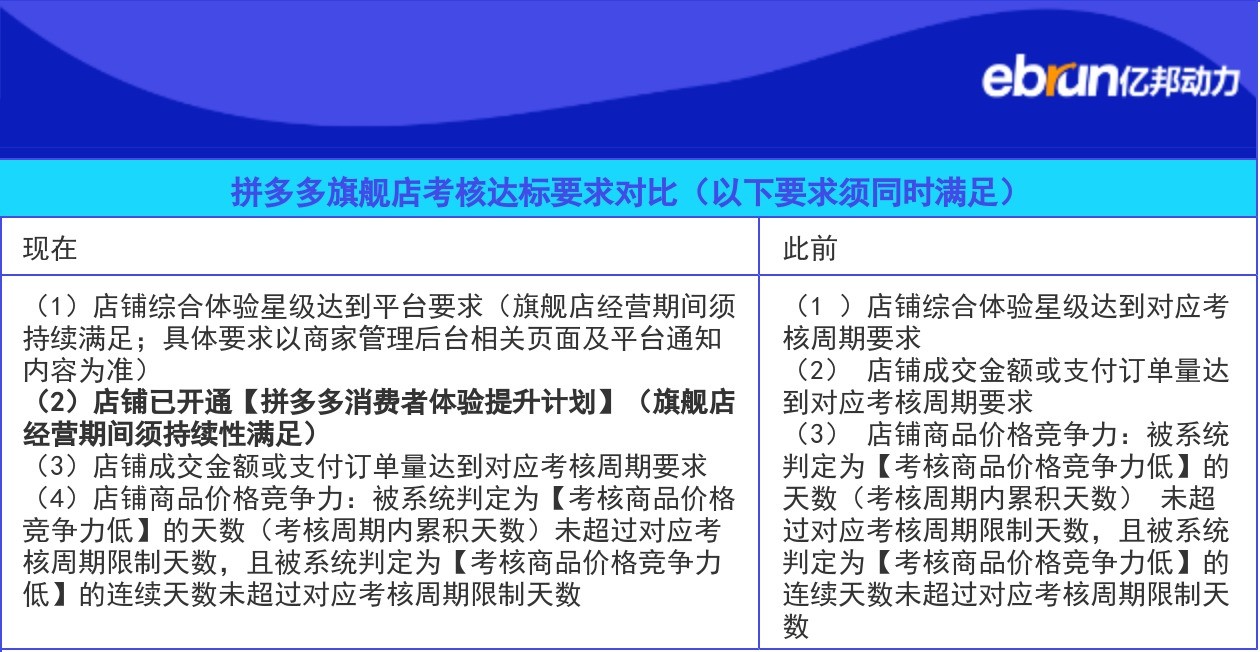
与此前相比,亿邦动力发现,拼多多最新的旗舰店考核要求更为严格。具体来说,除了支付订单量、店铺成交金额等,考核要求还新增了一条“店铺已开通‘拼多多消费者体验提升计划’”,且旗舰店在平台经营期间须持续满足这一要求。

这意味着,没有开通上述计划的店铺无法通过最新考核,也无法在拼多多平台上获得旗舰店的标识、享受旗舰店的相关权益。


拼多多旗舰店考核达标要求对比(以下要求须同时满足)
现在 此前

(1)店铺综合体验星级达到平台要求(旗舰店经营期间须持续满足;具体要求以商家管理后台相关页面及平台通知内容为准)

(2)店铺已开通【拼多多消费者体验提升计划】(旗舰店经营期间须持续性满足)

(3)店铺成交金额或支付订单量达到对应考核周期要求

(4)店铺商品价格竞争力:被系统判定为【考核商品价格竞争力低】的天数(考核周期内累积天数)未超过对应考核周期限制天数,且被系统判定为【考核商品价格竞争力低】的连续天数未超过对应考核周期限制天数

(1 )店铺综合体验星级达到对应考核周期要求

(2) 店铺成交金额或支付订单量达到对应考核周期要求

(3) 店铺商品价格竞争力:被系统判定为【考核商品价格竞争力低】的天数(考核周期内累积天数) 未超过对应考核周期限制天数,且被系统判定为【考核商品价格竞争力低】的连续天数未超过对应考核周期限制天数

亿邦动力了解到,当商家店铺开通拼多多消费者体验提升计划后,需要满足“退货包运费”、“部分订单极速退款”、“闪电退货”等要求,平台会收取一定的服务费,服务费标准由平台根据店铺的历史经营情况(包括商品质量、售后服务等情况等)确定及调整。

与此同时,开通上述计划的商家将被标注退货包运费的服务标识,平台也会为上述商家提供售后处理方案,并配备专业的客服团队,优先处理售后问题。

值得注意的是,根据最新的旗舰店考核规范,对于考核不达标的商家,平台降级处理的速度也更快了。现在,当商家出现任一考核指标不达标情形后,平台即有权对不达标的店铺进行降级处理。此前,商家旗舰店考核不达标的,在对应考核周期结束后次日才被降级处理。

亿邦持续追踪报道该情报,如想了解更多与本文相关信息,请扫码关注作者微信。

【版权提示】亿邦动力倡导尊重与保护知识产权。未经许可,任何人不得复制、转载、或以其他方式使用本网站的内容。如发现本站文章存在版权问题,烦请提供版权疑问、身份证明、版权证明、联系方式等发邮件至run@ebrun.com,我们将及时沟通与处理。

已点赞

+1

{{ praise_text }}

好文章,值得被更多人看到

FAQ回顾

拼多多旗舰店2024年新考核规范有哪些主要变化?

新规于2024年7月19日生效,新增强制开通‘消费者体验提升计划’作为考核指标,并加快了对不达标店铺的降级处理速度,由原考核周期结束后次日降级改为指标不达标即有权降级。

开通拼多多消费者体验提升计划需要满足哪些服务要求?

商家需提供‘退货包运费’、‘部分订单极速退款’和‘闪电退货’等服务,平台会根据店铺历史经营情况收取相应服务费,并为开通商家标注服务标识、提供售后方案和优先客服支持。

拼多多旗舰店未开通消费者体验提升计划会有什么后果?

未开通该计划的店铺将无法通过最新考核,无法获得旗舰店标识及相关权益,并可能因任一考核指标不达标而被平台立即降级处理。

广告

下一篇

征集报名《品牌数字化服务商资源手册》

《品牌数字化服务商资源手册》展示数字化服务商风采,亿邦全年零售大会通发,触达更多资源,马上加入!

马上入驻

Shopify大中华区合作伙伴业务负责人蒋涛确认出席第八届全球跨境电商峰会

7月18日,Shopify大中华区合作伙伴业务负责人蒋涛受邀出席第八届全球跨境电商峰会。

跨境电商

2024-07-15 17:23:33