• 亿邦公众号
    • APP下载

20家酒企仅3家双增长 讨好年轻人救不了白酒?|财报解析

作者:李金津 文章来源:亿邦动力

2026-09-01 16:20

作者:李金津 文章来源:亿邦动力

2026-09-01 16:20

邦小白快读
EN
全文速览

本文核心披露了2026年上半年国内上市白酒行业的整体发展现状与转型方向,整理核心干货信息如下:

1. 行业整体现状:20家上市酒企仅3家实现营收、净利润双增长,行业整体仍在收缩,调整尚未见底;九成利润集中在头部前五家酒企,腰部酒企大多大幅下滑甚至亏损,超过半数经销商面临更严重的价格倒挂问题。

2. 行业最新转型动作:酒企已经从传统向渠道压货的模式,转向直连消费者拉动动销,茅台直销占比首次超过批发渠道,旗下i茅台贡献超4成营收,多家头部酒企跟进渠道扁平化改革。

3. 年轻化尝试进展:酒企集体推出低度酒、小瓶装试水年轻化,目前单个新品对企业整体营收贡献有限,行业已经从盲目追逐网红年轻化转向理性调整,开始重新匹配消费者的需求变化。

本文披露了当前白酒行业的整体趋势与头部品牌的最新实践,整理对品牌商的干货内容如下:

1. 消费与行业趋势:当前白酒整体需求疲软,渠道库存高企、批价倒挂,行业进入深度收缩调整期,年轻消费者的饮酒需求、场景、偏好都发生变化,更在意低负担、性价比和情绪价值,行业整体从增量竞争转向存量竞争。

2. 渠道建设方向:传统层层分销、靠囤货赚差价的模式已经失效,头部品牌已经转向直连消费者的扁平化渠道,茅台直销占比超过五成,多家品牌跟进布局直销、会员运营、宴席渠道,经销商逐步转型服务商。

3. 产品研发与品牌营销参考:此前行业集体尝试跨界联名、低度酒、小瓶装做年轻化,目前多数新品贡献的营收十分有限,头部品牌已经开始反思盲目跨界,提出要追求长红而非网红,品牌需要更理性地匹配新需求,而非盲目追热点。

本文梳理了当前白酒行业的变化与风险机会,整理对卖酒卖家的干货内容如下:

1. 风险提示:当前白酒行业整体处于收缩阶段,中国酒业协会数据显示超七成受访酒企营业额下降、超八成营业利润下降,超半数经销商的价格倒挂程度同比增加,传统靠囤货赚差价的盈利模式已经走不通,腰部酒企产品下滑幅度大,需要警惕库存亏损风险。

2. 机会提示:渠道扁平化后,新增了很多面向终端的机会,团购、企业客户、私域、餐饮店、宴席都成为新的卖酒渠道,传统经销商可以转型做服务商,靠运营、服务、会员返点盈利,仍然有生存空间。

3. 可学习的方向:可以跟随头部品牌的转型方向,布局匹配年轻消费场景的产品,对接酒企给到终端的补贴政策,抓住酒企直连消费者过程中给到终端的红利,调整自身的产品结构,优先扛跌能力强的头部品牌产品。

本文分析了白酒行业的最新变化与需求,整理对白酒生产工厂的干货内容如下:

1. 产品生产设计的新需求:当前消费者需求已经发生明显变化,年轻群体偏好低度、小容量产品,核心消费场景转向居家自饮、露营、宵夜,更看重产品的低负担、性价比和情绪价值,工厂开发产品需要贴合这些新需求,调整传统的高度数、大包装、高端化的开发思路。

2. 可把握的商业机会:当前所有头部酒企都在推进渠道扁平化,减少中间环节,直接对接终端和消费者,工厂可以对接头部品牌的直供需求,也可以尝试自身布局直达C端的销售渠道,抓住渠道变革带来的新机会。

3. 数字化与电商转型的启示:茅台打造的i茅台数字化平台上半年就实现402.64亿元收入,贡献了茅台总营收的43.63%,充分说明数字化直销的增长空间,工厂需要重视自身的数字化渠道建设,积累直连用户的能力,减少对传统经销商的依赖。

本文梳理了白酒行业当前的痛点与转型方向,整理对白酒相关服务商的干货内容如下:

1. 行业发展趋势:白酒行业已经进入整体收缩调整期,渠道结构发生根本性变化,从原来的层层分销金字塔结构逐步走向扁平化,传统经销商向服务商转型是明确的大趋势,酒企也需要大量第三方服务支撑直连C端的业务,行业对专业服务商的需求正在快速增长。

2. 核心客户痛点:当前全行业的核心痛点是动销不足,传统压货走量的模式已经失效,酒企缺乏直连C端的运营能力,传统经销商缺乏转型做用户运营、服务的经验,都需要外部专业服务商提供支持。

3. 解决方案与机会:服务商可以围绕C端运营、会员管理、私域运营、终端场景营销开发解决方案,对接酒企的品鉴、宴席、会员运营需求,也可以帮助传统经销商完成转型,抓住渠道变革过程中释放出来的服务增量市场。

本文披露了白酒行业转型对平台的新需求,整理对白酒相关平台商的干货内容如下:

1. 酒企对平台的新需求:酒企已经从依赖传统批发代理渠道转向直连消费者,对能直接触达C用户的电商平台、即时零售平台、自有运营平台的需求大幅提升,同时需要平台提供会员运营、私域运营、场景营销等相关功能支持,来满足直连动销的需求。

2. 平台的机会方向:头部酒企都在加码直销渠道,茅台自有平台i茅台半年就实现400多亿元收入,充分说明白酒直销市场的增量空间,各类平台可以加大白酒品类的招商力度,对接酒企的直供需求,拓展即时零售、场景化卖酒的相关业务。

3. 风险规避提示:当前白酒行业整体收缩,腰部酒企经营下滑幅度大,亏损风险高,平台招商需要优先选择抗跌能力强的头部品牌,同时要警惕价格倒挂带来的市场混乱问题,规范平台内白酒价格体系,避免影响用户体验和平台秩序。

本文梳理了2026年上半年白酒行业的最新财报数据与产业变化,整理对产业研究者的干货内容如下:

1. 产业发展新动向:白酒行业结束了过去小酒企掉队、头部酒企持续增长的分化格局,进入全行业整体收缩的新阶段,利润集中度大幅提升,前五家头部酒企占据了上市酒企九成以上的利润,多数百亿规模酒企都出现了两位数的营收净利润下滑,腰部酒企更是大量出现亏损,行业调整尚未见底。

2. 商业模式新变化:传统靠价格上涨、经销商囤货实现增长的商业模式已经失效,行业整体转向直连消费者的扁平化渠道,经销商的盈利逻辑从囤货赚差价转向赚运营服务费,酒企的增长逻辑从向渠道要回款转向向消费者要动销,整个产业的商业模式发生根本性变化。

3. 产业新问题:行业集体尝试的讨好年轻人的年轻化转型,目前还没有形成足够支撑行业增长的新增量,如何匹配年轻消费者新的饮酒需求与场景,是行业需要解决的核心新问题,为研究白酒产业转型提供了真实的研究样本。

声明:快读内容全程由AI生成,请注意甄别信息。如您发现问题,请发送邮件至 run@ebrun.com 。

我是 品牌商 卖家 工厂 服务商 平台商 研究者 帮我再读一遍。

Quick Summary

This article discloses the overall development status and transformation direction of China's listed baijiu (Chinese liquor) industry in the first half of 2026, with key takeaways as follows:

1. Overall industry status: Among 20 listed baijiu companies, only 3 achieved double growth in both revenue and net profit. The industry as a whole is still contracting, and the adjustment has not yet hit bottom. 90% of total industry profit is concentrated in the top five players. Most mid-tier companies have seen sharp declines in performance or even slipped into losses, and more than half of distributors face worsening price inversion issues.

2. Latest industry transformation moves: Baijiu companies have shifted from the traditional model of pushing inventory to distributors to a new approach of connecting directly with consumers to drive sales. For Kweichow Moutai, the share of direct sales has surpassed wholesale channels for the first time, with its self-operated platform iMoutai contributing over 40% of total revenue. Multiple other leading players are following suit with channel flattening reforms.

3. Progress in youth-oriented strategies: Baijiu companies have collectively launched low-alcohol and small-bottle products to test the young consumer market. Currently, individual new products contribute very little to overall corporate revenue. The industry has shifted from blindly chasing "internet-famous" youth-oriented trends to rational adjustment, and has begun re-aligning its offerings with changing consumer demand.

This article discloses the overall current trend of the baijiu industry and the latest practices of leading brands, with key takeaways for brand owners as follows:

1. Consumption and industry trends: Overall baijiu demand remains weak, channel inventory is high, and wholesale price inversion is widespread. The industry has entered a period of deep contraction and adjustment. Young consumers' drinking needs, scenarios and preferences have changed, with greater focus on low drinking burden, cost-performance and emotional value. The industry has shifted from incremental competition to stock competition.

2. Channel development direction: The traditional multi-layer distribution model that relies on distributor inventory hoarding for profit is no longer viable. Leading brands have shifted to flat channels that connect directly with consumers. For Moutai, direct sales account for more than 50% of total revenue, and multiple brands are following up by building out direct sales, membership operation and banquet channel systems. Traditional distributors are gradually transforming into service providers.

3. Reference for product R&D and brand marketing: The industry previously made collective attempts at youth orientation via cross-border collaborations, low-alcohol products and small-bottle offerings. Currently, most new products contribute very little revenue. Leading brands have begun to reflect on blind cross-border expansion, emphasizing the goal of building long-standing popular brands rather than short-lived viral hits. Brands need to align with new consumer demand rationally instead of blindly chasing hot trends.

This article sorts out the current changes, risks and opportunities in the baijiu industry, with key takeaways for baijiu sellers as follows:

1. Risk warning: The baijiu industry is currently in a overall contraction phase. Data from the China Alcoholic Drinks Association shows that over 70% of surveyed baijiu companies saw declining turnover, and over 80% saw declining operating profit. More than half of distributors reported year-on-year worsening of price inversion. The traditional profit model of earning price differences via inventory hoarding is no longer viable. Products from mid-tier baijiu companies have seen sharp sales declines, so sellers need to be alert to inventory and loss risks.

2. Opportunity outlook: Channel flattening has created many new opportunities for terminal sellers. Group buying, corporate clients, private domain traffic, food service outlets and banquets have all emerged as new sales channels. Traditional distributors can transform into service providers, earning profit through operation, customer service and membership rebates, which still leaves room for sustainable operation.

3. Actionable directions: Sellers can follow the transformation direction of leading brands, stock products that fit young consumer scenarios, leverage terminal subsidy policies offered by baijiu brands, capture the dividends for terminals brought by brands' direct-to-consumer push, and adjust their own product mix to prioritize products from leading brands with stronger downside resistance.

This article analyzes the latest changes and demand in the baijiu industry, with key takeaways for baijiu manufacturing factories as follows:

1. New demand for product design and development: Consumer demand has changed significantly. Young consumers prefer low-alcohol, small-capacity products, with core consumption scenarios shifting to home drinking, camping and late-night meals. They value low drinking burden, cost-performance and emotional value more. Factories need to align product development with these new demands and adjust the traditional development strategy focused on high-alcohol, large-packaging and premium positioning.

2. Available business opportunities: All current leading baijiu brands are pushing forward channel flattening, cutting intermediate links to connect directly with terminals and consumers. Factories can partner with leading brands to meet their direct supply demand, or try to build their own direct-to-consumer sales channels to capitalize on new opportunities brought by channel restructuring.

3. Insights for digital and e-commerce transformation: Moutai's digital platform iMoutai generated 40.264 billion yuan in revenue in the first half of 2026, accounting for 43.63% of Moutai's total revenue, which fully demonstrates the growth potential of digital direct sales. Factories need to prioritize building their own digital channels, develop capabilities to connect directly with users, and reduce reliance on traditional distributors.

This article sorts out the current pain points and transformation direction of the baijiu industry, with key takeaways for baijiu-related service providers as follows:

1. Industry development trend: The baijiu industry has entered a period of overall contraction and adjustment, and its channel structure has undergone fundamental changes. It is gradually shifting from the traditional multi-layer pyramid distribution structure to a flat structure. The transformation of traditional distributors into service providers is a clear major trend. Baijiu companies also need a large amount of third-party service support to run their direct-to-consumer businesses, so demand for professional service providers in the industry is growing rapidly.

2. Core pain points of clients: The core industry-wide pain point currently is insufficient end consumption. The traditional model of pushing inventory to hit volume targets is no longer viable. Baijiu companies lack operational capabilities for direct-to-consumer engagement, while traditional distributors lack experience in user operation and service transformation. Both groups require support from external professional service providers.

3. Solutions and opportunities: Service providers can develop solutions centered on C-end operation, membership management, private domain operation and terminal scenario marketing. They can serve baijiu companies' demand for product tasting, banquets and membership operation, and also help traditional distributors complete their transformation, capturing the incremental service market released during the channel restructuring process.

This article discloses new demand from the baijiu industry's transformation for platforms, with key takeaways for baijiu-related platform operators as follows:

1. New demand from baijiu brands for platforms: Baijiu companies have shifted from relying on traditional wholesale and agency channels to connecting directly with consumers, so demand for e-commerce platforms, instant retail platforms and self-operated operation platforms that can reach C-end users directly has increased significantly. At the same time, brands need platforms to provide functional support for membership operation, private domain operation and scenario marketing to meet the demand of direct-to-consumer sales.

2. Opportunity directions for platforms: Leading baijiu brands are all ramping up investment in direct sales channels. Moutai's self-operated platform iMoutai generated more than 40 billion yuan in revenue in just six months, which fully demonstrates the incremental space of the baijiu direct sales market. All types of platforms can increase investment in baijiu category recruitment, partner with brands to meet their direct supply demand, and expand instant retail and scenario-based baijiu sales business.

3. Risk mitigation tips: The overall baijiu industry is currently contracting, and mid-tier baijiu companies have seen sharp performance declines with high loss risks. When recruiting merchants, platforms should prioritize leading brands with stronger downside resistance. They also need to guard against market chaos caused by price inversion, standardize the price system for baijiu products on the platform, and avoid negative impacts on user experience and platform order.

This article sorts out the latest financial report data and industrial changes of the baijiu industry in the first half of 2026, with key takeaways for industrial researchers as follows:

1. New trends in industrial development: The baijiu industry has ended the previous differentiation pattern where smaller players exited the market while leading players sustained growth, and entered a new stage of overall industry-wide contraction. Profit concentration has increased sharply, with the top five listed baijiu companies accounting for more than 90% of total industry profit. Most baijiu companies with 10 billion yuan-plus annual revenue have seen double-digit declines in both revenue and net profit, and a large number of mid-tier players have slipped into losses. The industry's adjustment has not yet hit bottom.

2. New changes in business model: The traditional growth model that relied on price increases and distributor inventory hoarding is no longer viable. The entire industry has shifted to flat channels that connect directly with consumers. Distributors' profit logic has changed from earning price differences via inventory hoarding to earning operation service fees, while baijiu companies' growth logic has shifted from chasing revenue from channels to driving sales from end consumers. The entire industry's business model has undergone fundamental changes.

3. New industrial issues: The industry's collective efforts at youth-oriented transformation to cater to young consumers have not yet generated enough new incremental demand to support industry growth. How to align with young consumers' new drinking needs and consumption scenarios remains the core new issue for the industry to solve, which provides real-world research samples for studying the transformation of the baijiu industry.

Disclaimer: The "Quick Summary" content is entirely generated by AI. Please exercise discretion when interpreting the information. For issues or corrections, please email run@ebrun.com .

I am a Brand Seller Factory Service Provider Marketplace Seller Researcher Read it again.

【亿邦原创】白酒还在收缩,而且赚钱越来越难。

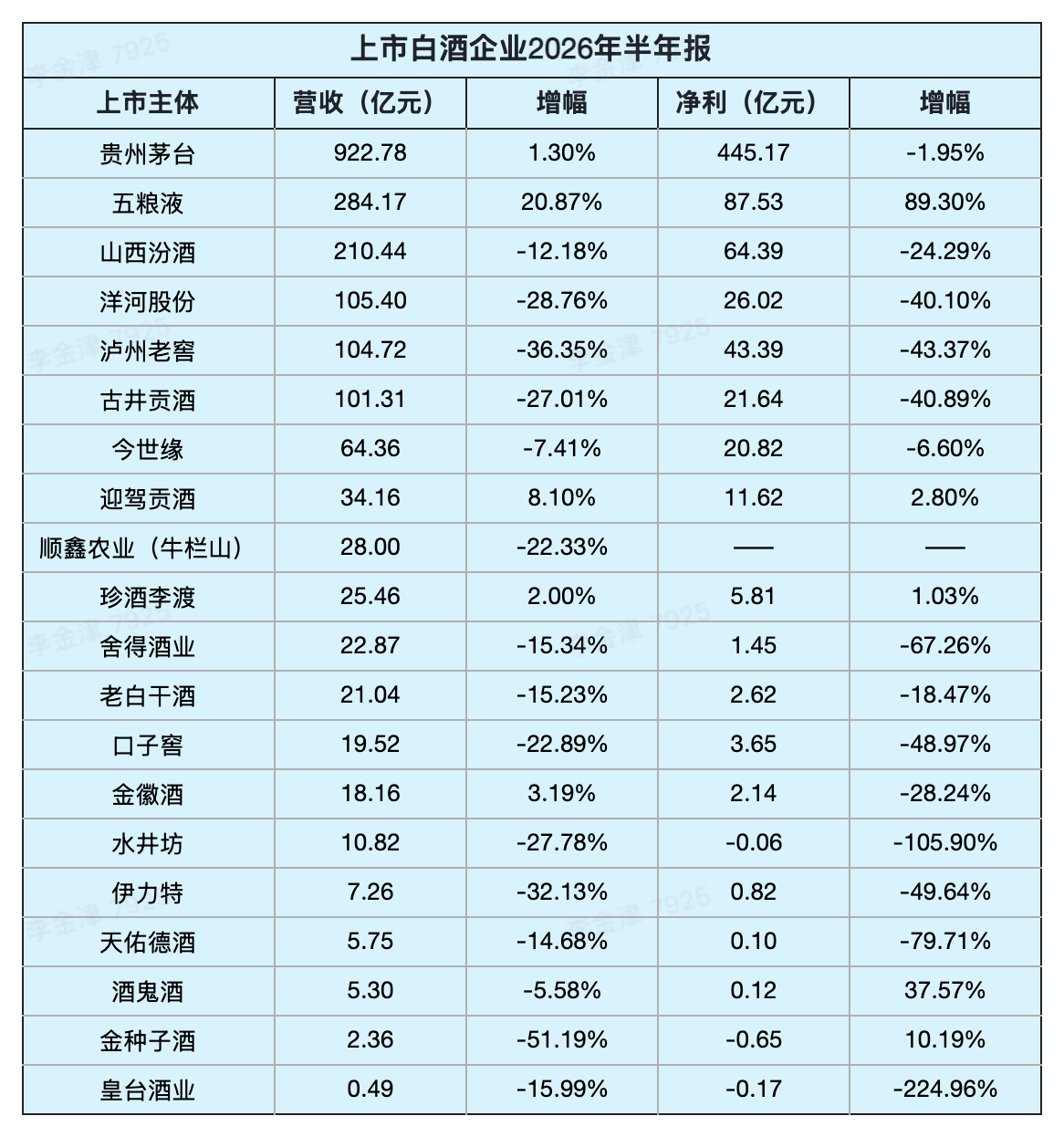
据亿邦动力统计,20家上市白酒企业上半年合计实现营收1994.37亿元,归母净利润736.41亿元。若与此前原始披露口径相比,营收、净利润分别下降17.93%和22.49%;但由于五粮液大幅追溯调整2025年财务数据,按照调整后的同期数据计算,实际降幅约为6.7%和8%。
无论采用哪种口径,一个事实没有改变:白酒还在往下走,而且行业调整尚未见底。

在20家上市酒企中,仅有贵州茅台、五粮液、迎驾贡酒、珍酒李渡、金徽酒5家公司实现营收正增长。而营收净利均增长的只有五粮液、迎驾贡酒和珍酒李渡。

01 营收近2000亿,Top 5拿走九成利润

从整个大盘来看,2026年上半年,仅贵州茅台一家,就贡献了922.78亿元营收和445.17亿元净利润。也就是说,上市酒企每赚100元,就有超过60元进了贵州茅台的口袋。

如果把范围扩大到前五家,这个数字更夸张。贵州茅台、五粮液、山西汾酒、洋河股份和泸州老窖,上半年合计营收1627.51亿元,占20家公司总营收的81.61%。合计净利润666.50亿元,占比达到90.51%。

白酒还是一个2000亿元的上市公司生意,但利润已经高度集中在少数公司手里。

而且,这种集中并不意味着头部企业过得轻松。山西汾酒上半年营收210.44亿元,同比下降12.18%,净利润64.39亿元,同比下降24.29%。

洋河股份、泸州老窖和古井贡酒的情况更明显。三家公司营收分别下降28.76%、36.35%和27.01%,净利润降幅则分别达到40.10%、43.37%和40.89%。

换言之,营收超百亿元的酒企里,除了贵州茅台和五粮液,多数已经进入两位数下滑。

五粮液是20家公司中最亮眼的一个:营收增长20.87%,利润增长89.30%。但五粮液此前对2025年部分财务数据进行了追溯调整,高增速建立在调整后的低基数之上。

腰部公司的日子更难。舍得酒业净利润同比下降67.26%,伊力特下降49.64%,口子窖下降48.97%,天佑德酒下降79.71%。水井坊上半年营收10.82亿元,同比下降27.78%,净利润由盈转亏至-0.06亿元;皇台酒业净亏损0.17亿元。

中国酒业协会的调研也指向类似结果。2026年上半年有74.8%的受访企业营业额下降、86.7%的企业营业利润下降;56.6%的经销商及终端零售商表示价格倒挂程度同比增加。

过去白酒行业的分化,更多是小酒企掉队、头部酒企继续增长。现在变成大部分公司一起往下走,只是谁更扛跌。而行业开始做出的应对,也因此从“怎么继续卖更多”,变成了另一个问题:货到底卖给谁?

02 经销商不再是终点,白酒开始直接找消费者

白酒的问题早已不是秘密。需求疲软、渠道库存、批价倒挂、经销商利润压缩,过去两年已经被市场反复讨论。但从上半年的财报来看,酒企开始改变解决问题的方法。

很长时间里,白酒最熟悉的增长模式,是层层分销。厂家把酒卖给经销商,经销商再卖给二批商、烟酒店、团购商,最终才到消费者手里。

这种模式在价格持续上涨的年代非常有效。只要酒越来越值钱,经销商就愿意打款甚至囤货。厂家完成回款,经销商赚价格上涨和渠道差价,库存本身成为一种资产。

酒价不再上涨,甚至开始倒挂,厂家也从“向渠道要销量”,转向“向消费者要动销”。

贵州茅台是最典型的风向标。2026年上半年,贵州茅台直销渠道实现收入519.62亿元,同比增长29.87%,占酒类收入比重达到57.3%,首次明显超过批发代理渠道。

上半年,i茅台实现酒类收入402.64亿元,同比增长274.18%,单个平台就贡献了贵州茅台营业总收入的43.63%。截至5月底,i茅台累计注册用户已经超过9600万。

其余名酒集体跟进C端转型。五粮液提出抓实传统渠道、做强新兴渠道、做优电商渠道,布局即时零售;汾酒、今世缘、迎驾贡酒纷纷加码会员运营、品鉴、宴席、名酒进名企,绕过中间环节直达消费者。

从长期趋势来看,渠道金字塔逐步扁平化。经销商很难再囤货赚差价,转向服务商,赚运营、服务、会员返点。

酒企也开始把钱从经销商返利,转向终端烟酒店、宴席补贴和消费者品鉴,团购、企业客户、私域和餐饮店则成为新的卖酒渠道。

如果厂家已经可以绕过中间商直接面对消费者,那么它最终必须回答:消费者到底还想不想喝白酒?

03 酒企集体年轻化,但增长还没来

酒企也在寻找新的需求。过去几年,它们几乎集体做了一件事:讨好年轻人。

联名、冰淇淋、咖啡、低度酒、小瓶装、鸡尾酒、明星代言、电商首发、音乐节……能想到的办法,基本都试了一遍。

2025年尤其成为低度白酒的产品大年。五粮液推出29度“一见倾心”,古井贡酒推出26度“轻度古20”,舍得推出29度“舍得自在”,汾酒布局25度产品,洋河则将新酒饮的触角伸向更低度数的果酒等。

今年5月,茅台、五粮液、汾酒、泸州老窖、洋河、古井贡酒等九家头部白酒品牌甚至集体推出50ml“小酌瓶”,把消费场景瞄准年轻人的居家自饮、露营和宵夜。

白酒看起来正变得越来越年轻。但这些年轻化产品,暂时还救不了白酒的财报。

一个典型样本是五粮液29度“一见倾心”。产品上线京东不到4个月销售额便突破亿元,并带来接近40%的女性消费者。这个成绩放在一个白酒新品上已经算优秀,但放到一家年收入数百亿元的酒企身上,仍然太小了。

甚至酒企自己也开始降温。在今年举行的2025年度股东大会上,多家头部酒企对年轻化和超低度酒的态度明显变得更加谨慎。

茅台管理层反思过去的部分跨界联营,认为一些合作虽然实现了年轻化效果,但未必真正给品牌带来加持,未来要追求“长红”而不是“网红”。

年轻人的酒桌正在变成另一套逻辑。他们更在意低负担、性价比、即时满足,以及喝酒本身是不是一件开心的事情。

今年多家头部酒企在讨论年轻化时也承认,年轻消费者并非完全拒绝白酒,而是饮酒需求、消费场景和偏好发生了变化;行业开始从过去简单追逐“低度”,转向重新思考产品、场景和情绪价值。

白酒正在努力转型。只是到目前为止,新故事创造出来的收入,还填不上旧生意留下来的坑。

亿邦持续追踪报道该情报,如想了解更多与本文相关信息,请扫码关注作者微信。

本文首发于 亿邦动力 官方网站

【版权提示】亿邦动力倡导尊重与保护知识产权。未经许可,任何人不得复制、转载、或以其他方式使用本网站的内容。如发现本站文章存在版权问题,烦请提供版权疑问、身份证明、版权证明、联系方式等发邮件至run@ebrun.com,我们将及时沟通与处理。

已点赞

+1

{{ praise_text }}

好文章,值得被更多人看到

FAQ回顾

2026年上半年上市白酒企业整体经营情况怎么样?

2026年上半年20家上市白酒企业合计实现营收1994.37亿元、归母净利润736.41亿元,按调整后口径营收、净利润分别同比下降约6.7%、8%,仅5家企业营收正增长,3家实现营收净利双增长,行业整体仍处于下行调整阶段。

当前白酒行业的渠道模式有什么新变化?

白酒企业正从传统层层分销模式转向C端转型,头部企业纷纷加码直接触达消费者的渠道,比如贵州茅台直销渠道收入占比已超批发代理渠道,其余酒企也在布局即时零售、会员运营、名酒进名企等场景,渠道逐步扁平化,经销商转向服务商角色。

白酒企业年轻化转型效果如何?

近年白酒企业通过推出低度酒、小瓶装、跨界联名等方式布局年轻化转型,部分新品获得不错的销量,但目前年轻化业务贡献的收入规模较小,尚未能扭转行业整体下滑的态势,头部酒企对年轻化布局的态度也逐渐转向谨慎,更关注长期价值。

目前白酒行业的市场集中度水平如何?

2026年上半年,贵州茅台、五粮液、山西汾酒、洋河股份、泸州老窖五家头部上市白酒企业合计营收占20家上市酒企总营收的81.61%,合计净利润占比达90.51%,行业利润高度集中在少数头部企业手中。

广告

下一篇

征集报名《品牌数字化服务商资源手册》

《品牌数字化服务商资源手册》展示数字化服务商风采,亿邦全年零售大会通发,触达更多资源,马上加入!

马上入驻

名创优品2026年上半年:国内营收增速创近三年最快 由中个位数同店增长驱动

2026年上半年,集团总营收115.0亿元,同比增长22.4%;毛利率44.3%,净利润9.6亿元,同比增长5.6%,剔除汇兑损益后的经调整净利润(Non-IFRS)12.2亿元。名创优品品牌营收105.1亿元,同比增长21.6%。